

Abstract
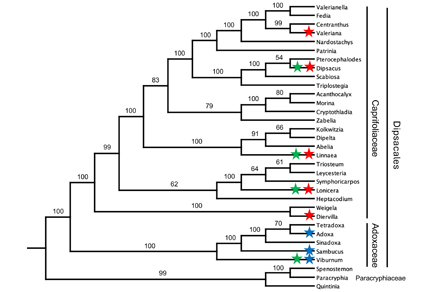
Formal phylogenetic definitions are here provided for the angiosperm clades Dipsacales, Adoxaceae, and Caprifoliaceae. After decades of progress in understanding the phylogeny of Asteridae and Campanulidae, the three clades here associated with those three names are better supported than ever, and the phylogenetic definitions presented here therefore differ little from the pre-PhyloCode phylogenetic definitions provided 25 years ago by Donoghue et al. (2001). It is abundantly clear that Dipsacales is a clade composed of two very well-supported and easily identified sister clades—here Adoxaceae and Caprifoliaceae—that were not recognized in pre-phylogenetic angiosperm classification systems. The impetus for solidifying these names now under the PhyloCode is that decisions made in the past decade by the Nomenclatural Committee for Vascular Plants of the International Code of Nomenclature for algae, fungi, and plants (ICN) have led to the mandatory replacement of the name Adoxaceae by Viburnaceae for a family that includes Viburnum, Sambucus, and Adoxa. This unfortunate decision to replace a widely accepted name, used many thousands of times in the literature, by a name that has rarely been used, can now be circumvented (by those who wish to do so) by correctly observing that Adoxaceae is the accepted name for this clade under the PhyloCode. This paper prepares the way for a comprehensive phylogenetic classification and nomenclature of both Adoxaceae and Caprifoliaceae.
References
- Appelquist, W. L. 2013. Report of the Nomenclature Committee for Vascular Plants: 65. Taxon 62:1315–1326. https://doi.org/10.12705/626.49
- Angiosperm Phylogeny Group. 1998. An ordinal classification for the families of flowering plants. Annals of the Missouri Botanical Garden 85:531–553. https://doi.org/10.2307/2992015
- Angiosperm Phylogeny Group II. 2003. An update of the Angiosperm Phylogeny Group classification for the orders and families of flowering plants: APG II. Botanical Journal of the Linnean Society 141:399–436. https://doi.org/10.1046/j.1095-8339.2003.t01-1-00158.x
- Angiosperm Phylogeny Group III. 2009. An update of the Angiosperm Phylogeny Group classification for the orders and families of flowering plants: APG III. Botanical Journal of the Linnean Society 161:105–121. https://doi.org/10.1111/j.1095-8339.2009.00996.x
- Angiosperm Phylogeny Group IV. Chase, M. W., M. J. Christenhusz, M. F. Fay, J. W. Byng, W. S. Judd, D. E. Soltis, D. J. Mabberley, A. N. Sennikov, P. S. Soltis, and P. F. Stevens. 2016. An update of the Angiosperm Phylogeny Group classification for the orders and families of flowering plants: APG IV. Botanical Journal of the Linnean Society 181:1–20. https://doi.org/10.1111/boj.12385
- Backlund, A., and V. Bittrich. 2016. Adoxaceae. Pp. 19–29 in Flowering Plants. Eudicots. The Families and Genera of Vascular Plants, Volume 14 (J. W. Kadereit and V. Bittrich, eds.). Springer International Publishing Switzerland. https://doi.org/10.1007/978-3-319-28534-4_2
- Backlund, A., and K. Bremer. 1996. To be or not to be: Principles of classification and monotypic plant families. Taxon 47:391–400. https://doi.org/10.2307/1223768
- Backlund, A., and K. Bremer. 1997. Phylogeny of the Asteridae s. str. based on rbcL sequences, with particular reference to the Dipsacales. Plant Systematics and Evolution 207:225–254. https://doi.org/10.1007/BF00984390
- Backlund, A., and M. J. Donoghue. 1996. Morphology and phylogeny of the order Dipsacales. Pp. 1–55 in Phylogeny of the Dipsacales, A. Backlund, Doctoral Dissertation. Uppsala University, Uppsala, Sweden.
- Backlund, A., and N. Pyck. 1998. Diervillaceae and Linnaeaceae, two new families of caprifolioids. Taxon 47: 657–661. https://doi.org/10.2307/1223583
- Beaulieu, J. M., D. C. Tank, and M. J. Donoghue. 2013. A Southern Hemisphere origin for campanulid angiosperms, with traces of the break-up of Gondwana. BMC Evolutionary Biology 13:80. https://doi.org/10.1186/1471-2148-13-80
- Bell, C. B., and M. J. Donoghue. 2003. Phylogeny and biogeography of Morinaceae (Dipsacales) based on nuclear and chloroplast DNA sequences. Organisms, Diversity, and Evolution 3:227–237. https://doi.org/10.1078/1439-6092-00077
- Bell, C. D., and M. J. Donoghue. 2005a. Dating the Dipsacales: Comparing models, genes, and evolutionary implications. American Journal of Botany 92:284–296. https://doi.org/10.3732/ajb.92.2.284
- Bell, C. D., and M. J. Donoghue. 2005b. Phylogeny and biogeography of Valerianaceae (Dipsacales) with special reference to the South American valerians. Organisms, Diversity, and Evolution 5:147–159. https://doi.org/10.1016/j.ode.2004.10.014
- Bell, C. D., E. J. Edwards, S. T. Kim, and M. J. Donoghue. 2001. Dipsacales phylogeny based on chloroplast DNA sequences. Harvard Papers in Botany 6:481–499. https://www.jstor.org/stable/41761758
- Benko-Iseppon, A. M., and W. Morawetz. 2000. Viburnales: Cytological features and a new circumscription. Taxon 49:5–16. https://doi.org/10.2307/1223927
- Berchtold, B. W., and J. S. Presl. 1820. Dipsacales, 255. O Přirozenoſti Roſtlin. K. W. Renders, Prague.
- Bremer, K., A. Backlund, B. Sennblad, U. Swenson, K. Andreasen, M. Hjertson, J. Lundberg, M. Backlund, and B. Bremer. 2001. A phylogenetic analysis of 100+ genera and 50+ families of euasterids based on morphological and molecular data with notes on possible higher level morphological synapomorphies. Plant Systematics and Evolution 229:137–169. https://doi.org/10.1007/s006060170009
- Bremer, B., K. Bremer, N. Heidari, P. Erixon, R. G. Olmstead, A. A. Anderberg, M. Källersjö, and E. Barkhordarian. 2002. Phylogenetics of asterids based on 3 coding and 3 non-coding chloroplast DNA markers and the utility of non-coding DNA at higher taxonomic levels. Molecular Phylogenetics and Evolution 24:274–301. https://doi.org/10.1016/S1055-7903(02)00240-3
- Britton, N.L., and A. Brown. 1913. An Illustrated Flora of the Northern United States, Canada and the British Possessions: Ophioglossaceae to Polygonaceae (Vol. 1). Charles Scribner’s Sons, New York.
- Cantino, P. D., and K. de Queiroz. 2020. International Code of Phylogenetic Nomenclature (PhyloCode): A Phylogenetic Code of Biological Nomenclature. CRC Press, Boca Raton, Florida. https://doi.org/10.1201/9780429446320
- Cantino, P. D., J. A. Doyle, S. W. Graham, W. S. Judd, R. G. Olmstead, P. S. Soltis, D. E. Soltis, and M. J. Donoghue. 2007. Towards a phylogenetic nomenclature of Tracheophyta. Taxon 56:822–846. https://doi.org/10.1002/tax.563001
- Carlson, S. E., V. Mayer, and M. J. Donoghue. 2009. Phylogenetic relationships, taxonomy, and morphological evolution in Dipsacaceae (Dipsacales) inferred by DNA sequence data. Taxon 58:1075–1091. https://doi.org/10.1002/tax.584003
- Chase, M.W., D. E. Soltis, R. G. Olmstead, D. Morgan, D. H. Les, B. D. Mishler, M. R. Duvall, R. A. Price, H. G. Hills, Y. L. Qiu, K. A. Kron, J. H. Rettig, E. Conti, J. D. Palmer, J. R. Manhart, K. J. Sytsma, H. J. Michael, W. J. Kress, K. A. Karol, W. D. Clark, M. Hedrén, B. S. Gaut, R. K. Jansen, K. J. Kim, C. F. Wimpee, J. F. Smith, G. R. Furnier, S. H. Strauss, Q. Y. Xiang, G. M. Plunkett, P. S. Soltis, S. M. Swensen, S. E. Williams, P. A. Gadek, C. J. Quinn, L. E. Eguiarte, E. Golenberg, G. H. Learn, S. W. Graham, S. C. H. Barrett, S. Dayanandan, and V. A. Albert. 1993. Phylogenetics of seed plants: An analysis of nucleotide sequences from the plastid gene rbcL. Annals of the Missouri Botanical Garden 80:528–580. https://doi.org/10.2307/2399846
- Chatelet, D. S., W. Clement, L. Sack, M. J. Donoghue, and E. J. Edwards. 2013. The evolution of photosynthetic anatomy in Viburnum (Adoxaceae). International Journal of Plant Sciences 174:1277–1291. https://doi.org/10.1086/673241
- Chen, S. Y., C. P. Liu, C. C. Baskin, and C. T. Chien. 2021. Deep complex morphophysiological dormancy in seeds of Viburnum plicatum var. formosanum (Adoxaceae) from subtropical mountains. Seed Science Research 31:236–242. https://doi.org/10.1017/S0960258521000180
- Clement, W. L., M. Arakaki, P. W. Sweeney, E. J. Edwards, and M. J. Donoghue. 2014. A chloroplast tree for Viburnum (Adoxaceae) and its implications for phylogenetic classification and character evolution. American Journal of Botany 101:1029–1049. https://doi.org/10.3732/ajb.1400015
- Cronquist, A. 1981. An Integrated System of Classification of Flowering Plants. Columbia University Press, New York.
- Dahlgren, R. M. T. 1980. A revised system of classification of the angiosperms. Botanical Journal of the Linnean Society 80:91–124. https://doi.org/10.1111/j.1095-8339.1980.tb01661.x
- de Queiroz, K., P. D. Cantino, and J. A. Gauthier (eds.). 2020. Phylonyms. A Companion to the PhyloCode. CRC Press, Boca Raton, Florida. https://doi.org/10.1201/9780429446276
- de Queiroz, K., and J. Gauthier. 1990. Phylogeny as a central principle in taxonomy: Phylogenetic definitions of taxon names. Systematic Zoology 39:307–322. https://doi.org/10.2307/2992353
- Donoghue, M.J. 1983. The phylogenetic relationships of Viburnum. Pp.143-166 in Advances in Cladistics, Volume 2 (N. I. Platnick and V.A. Funk, eds.). Columbia University Press, New York.
- Donoghue, M. J., C. D. Bell, and R. C. Winkworth. 2003. The evolution of reproductive characters in Dipsacales. International Journal of Plant Sciences 164:S453–S464. https://doi.org/10.1086/376874
- Donoghue, M. J., T. Eriksson, P. A. Reeves, and R. G. Olmstead. 2001. Phylogeny and phylogenetic taxonomy of Dipsacales, with special reference to Sinadoxa and Tetradoxa (Adoxaceae). Harvard Papers in Botany 6:459–479. https://www.jstor.org/stable/41761757
- Donoghue, M. J., R. G. Olmstead, J. F. Smith, and J. D. Palmer. 1992. Phylogenetic relationships of Dipsacales based on rbcL sequences. Annals of the Missouri Botanical Garden 79:333–345. https://doi.org/10.2307/2399772
- Eichler, A. W. 1875. Bluthendiagramme, I, II. Engelmann, Leipzig.
- Engler, A. 1898. Syllabus der Pflanzenfamilien. 2nd edition. Gebrüder Borntraeger, Berlin.
- Fan, W.-B., Y. Wu, J. Yang, K. Shahzad, and Z.-H. Li. 2018. Comparative chloroplast genomics of Dipsacales species: Insights into sequence variation, adaptive evolution, and phylogenetic relationships. Frontiers in Plant Science 9:689. https://doi.org/10.3389/fpls.2018.00689
- Ferguson, I. K. 1966. The genera of Caprifoliaceae in the southeastern United States. Journal of the Arnold Arboretum 47:33–59. https://doi.org/10.5962/p.33408
- Hara, H. 1981. A new species of the genus Adoxa from Mt. Omei of China. Journal of Japanese Botany 56:271–274.
- Hara, H. 1983. A Revision of the Caprifoliaceae of Japan with Reference to Allied Plants in Other Districts and the Adoxaceae. Academic Scientific, Tokyo.
- Hooker J. D. 1873. Caprifoliaceae. Pp. 1–7 in Genera Plantarum, Vol. 2 (G. Bentham and N. J. Hooker, eds.). L. Reeve and Williams and Norgate, London.
- Hu, Y., Q. Zhang, G. Rao, and Sodmergen. 2008. Occurrence of plastids in the sperm cells of Caprifoliaceae: Biparental plastid inheritance in angiosperms is unilaterally derived from maternal inheritance. Plant and Cell Physiology 49:958–968. https://doi.org/10.1093/pcp/pcn069
- Huang, Y., F. M. Jacques, Y. S. C. Liu, T. Su, Y. Xing, X. Xiao, and Z. Zhou. 2012. New fossil endocarps of Sambucus (Adoxaceae) from the upper Pliocene in SW China. Review of Palaeobotany and Palynology 171:152–163. https://doi.org/10.1016/j.revpalbo.2011.11.008
- Hutchinson, J. 1973. The Families of Flowering Plants. 3rd Edition, Clarendon Press, Oxford.
- Jacobs, B., K. Geuten, N. Pyck, S. Huysmans, S. Jansen, and E. Smets. 2011. Unraveling the phylogeny of Heptacodium and Zabelia (Caprifoliaceae): An interdisciplinary approach. Systematic Botany 36:231–252. https://doi.org/10.1600/036364411X553306
- Jacobs, B., S. Huysmans, and E. Smets. 2010. Evolution and systematic value of fruit and seed characters in Adoxaceae (Dipsacales). Taxon 59:850–866. https://doi.org/10.1002/tax.593014
- Jacobs, B., N. Pyck, and E. Smets. 2010. Phylogeny of the Linnaea clade: Are Abelia and Zabelia closely related? Molecular Phylogenetics and Evolution 57:741–752. https://doi.org/10.1016/j.ympev.2010.08.007
- Judd, W. S., C. S. Campbell, E. A. Kellogg, P. F. Stevens, and M. J. Donoghue. 2002. Plant Systematics: A Phylogenetic Approach. 2nd Edition. Sinauer Associates, Sunderland, Massachusetts.
- Judd, W. S., C. S. Campbell, E. A. Kellogg, P. F. Stevens, and M. J. Donoghue. 2016. Plant Systematics: A Phylogenetic Approach. 4th Edition. Sinauer Associates, Sunderland, Massachusetts. https://doi.org/10.1093/hesc/9781605353890.001.0001
- Judd, W. S., R. W. Sanders, and M. J. Donoghue. 1994. Angiosperm family pairs: Preliminary phylogenetic analyses. Harvard Papers in Botany 5:1–51. https://www.jstor.org/stable/41761490
- Jussieu, A. L. de. 1789. Genera Plantarum. Herissant et Barrois, Paris.
- Laurin, M. 2024. The Advent of PhyloCode. The Continuing Evolution of Biological Nomenclature. CRC Press, Taylor & Francis Group, Boca Raton, Florida. https://doi.org/10.1201/9781003092827
- Lee, A. K., I. S. Gilman, M. Srivastav, A. Lerner, M. J. Donoghue, and W. L. Clement. 2021. Reconstructing Dipsacales phylogeny using Angiosperm 353: Issues and insights. American Journal of Botany 108:1122–1142. https://doi.org/10.1002/ajb2.1695
- Lens, F., R. A. Vos, G. Charrier, T. van Der Niet, V. Merckx, P. Baas, J. Aguirre Gutierrez, B. Jacobs, L. Chacon Dória, E. Smets, and S. Delzon. 2016. Scalariform-to-simple transition in vessel perforation plates triggered by differences in climate during the evolution of Adoxaceae. Annals of Botany 118:1043–1056. https://doi.org/10.1093/aob/mcw151
- Makino, T. 1948. Establishment of the genus Zabelia. Makinoa 9: 175.
- Meyer, E. 1839. Adoxaceae (pp. 198–200). Preussische Pflanzengattungen. Gräfe und Unzer, Königsberg.
- Moore, B. R., and M. J. Donoghue. 2007. Correlates of diversification in the plant clade Dipsacales: Geographic movement and evolutionary innovations. American Naturalist 170:S28–S55.
- Olmstead, R. G., B. Bremer, K. M. Scott, and J. D. Palmer. 1993. A parsimony analysis of the Asteridae sensu lato based on rbcL sequences. Annals of the Missouri Botanical Garden 80:700–722. https://doi.org/10.2307/2399855
- Olmstead, R. G., K. J. Kim, R. K. Jansen, and S. J. Wagstaff. 2000. The phylogeny of the Asteridae sensu lato based on chloroplast ndhF gene sequences. Molecular Phylogenetics and Evolution 16:96–112. https://doi.org/10.1006/mpev.1999.0769
- Olmstead, R. G., H. J. Michaels, K. M. Scott, and J. D. Palmer. 1992. Monophyly of the Asteridae and identification of their major lineages from DNA sequences of rbcL. Annals of the Missouri Botanical Garden 79:249–265. https://doi.org/10.2307/2399768
- Park, B., M. Sinnott-Armstrong, C. Schlutius, J.-C. Penagos Zuluaga, E. L. Spriggs, R. G. Simpson, E. Benavides, M. J. Landis, P. W. Sweeney, D. A. R. Eaton, and M. J. Donoghue. 2019. Sterile marginal flowers increase visitation and fruit set in the hobblebush (Viburnum lantanoides, Adoxaceae) at multiple spatial scales. Annals of Botany 123:381–390. https://doi.org/10.1093/aob/mcy117
- Pyck, N., P. Roels, and E. Smets. 1999. Tribal relationships in Caprifoliaceae: Evidence from a cladistic analysis using ndhF sequences. Systematics and Geography of Plants 69:145–159. https://doi.org/10.2307/3668539
- Pyck, N. and E. Smets. 2000. A search for the phylogenetic position of the seven-son flower (Heptacodium, Dipsacales): Combining molecular and morphological evidence. Plant Systematics and Evolution 225:185–199. https://doi.org/10.1007/BF00985467
- Pyck, N. and E. Smets. 2004. On the systematic position of Triplostegia (Dipsacales): A combined molecular and morphological approach. Belgian Journal of Botany 137:125–139. https://www.jstor.org/stable/20794547
- Ramírez–Barahona, S., H. Sauquet, and S. Magallón. 2020. The delayed and geographically heterogeneous diversification of flowering plant families. Nature Ecology and Evolution 4:1232–1238. https://doi.org/10.1038/s41559-020-1241-3
- Rehder, A. 1911. Synopsis of the genus Abelia. Pp. 122–129 in Plantae Wilsonianae vol. 1 (C. S. Sargent, ed.). Cambridge University Press, Cambridge.
- Reveal, J. L. 2008. (1800–1802) Proposals to conserve the name Viburnaceae (Magnoliophyta), the name Adoxaceae against Viburnaceae, a “superconservation” proposal, and, as an alternative, the name Sambucaceae. Taxon 57:303. https://doi.org/10.2307/25065975
- Reveal, J. L. 2012. An outline of a classification scheme for extant flowering plants. Phytoneuron 2012-37:1–221.
- Savolainen, V., M. W. Chase, S. B. Hoot, C. M. Morton, D. E. Soltis, C. Bayer, M. F. Fay, A. Y. De Bruijn, S. Sullivan, and Y. L. Qiu. 2000a. Phylogenetics of flowering plants based on combined analysis of plastid atpB and rbcL gene sequences. Systematic Biology 49:306–362. https://doi.org/10.1093/sysbio/49.2.306
- Savolainen V., M. F. Fay, D. C. Albach, A. Backlund, M. van der Bank, K. M. Cameron, S. A. Johnson, M. D. Lledó, J.-C. Pintaud, M. Powell, M. C. Sheahan, D. E. Soltis, P. S. Soltis, P. Weston, W. M. Whitten, K. J. Wurdack, and M. W. Chase. 2000b. Phylogeny of the eudicots: A nearly complete familial analysis based on rbcL gene sequences. Kew Bulletin 55:257–309. https://doi.org/10.2307/4115644
- Schmerler, S. B., W. L., Clement, J. M. Beaulieu, D. S. Chatelet, L. Sack, M. J. Donoghue, and E. J. Edwards. 2012. Evolution of leaf form correlates with tropical–temperate transitions in Viburnum (Adoxaceae). Proceedings of the Royal Society B: Biological Sciences 279:3905–3913. https://doi.org/10.1098/rspb.2012.1110
- Simpson, M. G. 2006. Plant Systematics. Elsevier Academic Press, Burlington, Massachusetts.
- Sinnott-Armstrong, M. A., R. Middleton, M. Ogawa, G. Jacucci, E. Moyroud, B. J. Glover, P. J. Rudall, S. Vignolini, and M. J. Donoghue. 2023. Multiple origins of lipid-based structural colors contribute to a gradient of fruit colors in Viburnum (Adoxaceae). New Phytologist 237:643–655. https://doi.org/10.1111/nph.18538
- Soltis, D. E., S. A. Smith, N. Cellinese, K. J. Wurdack, D. C. Tank, S. F. Brockington, N. F. Refulio‐Rodriguez, J. B. Walker, M. J. Moore, B. S. Carlsward, C. D. Bell, M. Latvis, S. Crawley, C. Black, D. Diouf, Z. Xi, C. C. Rushworth, M. A. Gitzendanner, K. J. Sytsma, Y. L. Qiu, K. W. Hilu, C. C. Davis, M. J. Sanderson, R. S. Beaman, R. G. Olmstead, W. S. Judd, M. J. Donoghue, and P. S. Soltis. 2011. Angiosperm phylogeny: 17 genes, 640 taxa. American Journal of Botany 98:704–730. https://doi.org/10.3732/ajb.1000404
- Stevens, P. F. 2001 and onward. Angiosperm Phylogeny Website, version 15, April 2019. <http://www.mobot.org/mobot/research/apweb/> Accessed 31 August 2025.
- Stull, G. W., M. Schori, D. E. Soltis, and P. S. Soltis. 2018. Character evolution and missing (morphological) data across Asteridae. American Journal of Botany 105:470–479. https://doi.org/10.1002/ajb2.1050
- Takhtajan, A. 1980. Outline of the classification of flowering plants (Magnoliophyta). Botanical Review 46:225–359. https://doi.org/10.1007/BF02861558
- Tank, D. C., and M. J. Donoghue. 2010. Phylogeny and phylogenetic nomenclature of the Campanulidae based on an expanded sample of genes and taxa. Systematic Botany 35:425–441. https://doi.org/10.1600/036364410791638306
- Thorne, R. F. 1976. A phylogenetic classification of the Angiospermae. Evolutionary Biology 9:35–106. https://doi.org/10.1007/978-1-4615-6950-3_2
- Thorne, R. F. 1983. Proposed new realignments in the angiosperms. Nordic Journal of Botany 3:85–117. https://doi.org/10.1111/j.1756-1051.1983.tb01447.x
- Wang, H.-X., H. Liu, J. J. Moore, S. Landrein, B. Liu, Z.-X. Zhu, and H.-F. Wang. 2020. Plastid phylogenomic insights into the evolution of the Caprifoliaceae s.l. (Dipsacales). Molecular Phylogenetics and Evolution 142:106641. https://doi.org/10.1016/j.ympev.2019.106641
- Waswa, E. N., E. S. Mutinda, E. M. Mkala, D. M. Katumo, M. A. Oulo, W. O. Odago, S. G. Amenu, S. X. Ding, and G. W. Hu. 2022. Understanding the taxonomic complexes and species delimitation within Sambucus L. (Viburnaceae). Diversity 14:906. https://doi.org/10.3390/d14110906
- Weber, M. G., M. J. Donoghue, W. L. Clement, and A. A. Agarwal. 2012. Phylogenetic and experimental tests of interactions among mutualistic plant defense traits in Viburnum (Adoxaceae). American Naturalist 180:450–463. https://doi.org/10.1086/667584
- Wilson, K. L. 2016a. Report of the General Committee: 14. Taxon 65:878–879. https://doi.org/10.12705/654.15
- Wilson, K. L. 2016b. Report of the General Committee: 15. Taxon 65:1150–1151. https://doi.org/10.12705/655.14
- Winkworth, R. C., C. D. Bell, and M. J. Donoghue. 2008a. Mitochondrial sequence data and Dipsacales phylogeny: Mixed models, partitioned Bayesian analyses, and model selection. Molecular Phylogenetics and Evolution 46:830–843. https://doi.org/10.1016/j.ympev.2007.11.021
- Winkworth, R. C., J. Lundberg, and M. J. Donoghue. 2008b. Toward a resolution of campanulid phylogeny, with special reference to the placement of Dipsacales. Taxon 57:1–13. https://doi.org/10.2307/25065948
- Wu, C. Y. 1981. Another new genus of Adoxaceae, with special references on the infrafamiliar evolution and the systematic position of the family. Acta Botanica Yunnanica 3:383–388.
- Wu, C. Y., Z. L. Wu, and R. F. Huang. 1981. Sinadoxa C. Y. Wu, Z. L. Wu et R. F. Huang, genus novum familiae Adoxacearum. Acta Phytotaxonomica Sinica 19:203–210.
- Xiang, C. L., H. J. Dong, S. Landrein, F. Zhao, W. B. Yu, D. E. Soltis, P. S. Soltis, A. Backlund, H. F. Wang, D. Z. Li, and H. Peng. 2020. Revisiting the phylogeny of Dipsacales: New insights from phylogenomic analyses of complete plastomic sequences. Journal of Systematics and Evolution 58:103–117. https://doi.org/10.1111/jse.12526
- Zhang, W. H., Z. D. Chen, J. H. Li, H. B. Chen, and Y. C. Tang. 2003. Phylogeny of the Dipsacales s.l. based on chloroplast trnL-F and ndhF sequences. Molecular Phylogenetics and Evolution 26:176–189. https://doi.org/10.1016/S1055-7903(02)00303-2
- Zhong, Q. Y., X. G. Fu, T. T. Zhang, T. Zhou, M. Yue, J. N. Liu, and Z. H. Li. 2021. Phylogeny and evolution of chloroplast tRNAs in Adoxaceae. Ecology and Evolution 11:1294–1309. https://doi.org/10.1002/ece3.7133