

Abstract
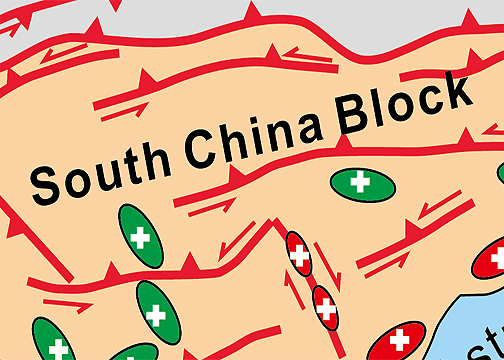
The South China Block has experienced multiple tectonic events. During the Mesozoic, the Indosinian and Yanshanian orogenic events played a significant role in shaping its present-day tectonic framework, producing widespread deformation, metamorphism, and magmatism. These tectonic processes also drove widespread fluid migration through sedimentary successions. Such tectonically induced fluid–rock interactions profoundly modified primary mineral assemblages and promoted the formation and transformation of magnetic minerals, leading to widespread Mesozoic remagnetization in sedimentary strata across the South China Block. These remagnetization records provide a valuable archive for constraining the timing, duration, and spatial extent of tectonic processes and their associated diagenetic responses in sedimentary rocks. This paper presents a systematic review of Mesozoic remagnetization phenomena in sedimentary rocks of the South China Block in relation to the Indosinian and Yanshanian tectonic events. We further synthesize current understanding of the role of tectonic processes in influencing burial diagenesis, hydrocarbon generation, migration, and accumulation, and the destruction of hydrocarbon reservoirs, as well as mineralization. Finally, we highlight the value of remagnetization as a quantitative spatiotemporal tool for reconstructing geological processes involving fluid flow and thermal evolution.
References
- Abdulkarim, M.A., Muxworthy, A.R., Fraser, A., Sims, M., & Cowan, A. (2022) Effect of hydrocarbon presence and properties on the magnetic signature of the reservoir sediments of the Catcher Area Development Region, UK North Sea. Frontiers in Earth Science, 10, 818624. https://doi.org/10.3389/feart.2022.818624
- Appel, E., Crouzet, C., & Schill, E. (2012) Pyrrhotite remagnetizations in the Himalaya: A review. Geological Society, London, Special Publications, 371(1), 163–180. https://doi.org/10.1144/SP371.1
- Bai, L., Zhu, R., Wu, H. & Guo, B. (1998) Remagnetization history of Middle Triassic Leikoupo Formation on Wangcang section in Sichuan Province, China. Science in China Series D: Earth Sciences, 41(Suppl 2), 72–77. https://doi.org/10.1007/BF02984515
- Beard, B.L., & Johnson, C.M. (2004) Fe isotope variations in the modern and ancient Earth and other planetary bodies. Reviews in Mineralogy and Geochemistry, 55 (1), 319–357. https://doi.org/10.2138/gsrmg.55.1.319
- Bian, W., Jiao, X., Wang, S., Liang, J., Ma, J., Ding, J., Zhao, H., Yang, T., Zhang, S., Wu, H., Li, H., & Deng, C. (2024) Remagnetization of the Upper Permian–Lower Triassic limestones in the western Lhasa Terrane and its tectonic implications. Geophysical Journal International, 237 (1), 465–484. https://doi.org/10.1093/gji/ggae052
- Blumstein, A.M., Elmore, R.D., Engel, M.H., Elliot, C. & Basu, A. (2004) Paleomagnetic dating of burial diagenesis in Mississippian carbonates, Utah. Journal of Geophysical Research: Solid Earth, 109 (B4). https://doi.org/10.1029/2003JB002698
- Brothers, L.A., Engel, M.H., & Elmore, R.D. (1996) The late diagenetic conversion of pyrite to magnetite by organically complexed ferric iron. Chemical Geology, 130 (1–2), 1–14. https://doi.org/10.1016/0009-2541(96)00007-1
- Cioppa, M.T., & Symons, D.T.A. (2000) Timing of hydrocarbon generation and migration: Paleomagnetic and rock magnetic analysis of the Devonian Duvernay Formation, Alberta, Canada. Journal of Geochemical Exploration, 69–70, 387–390. https://doi.org/10.1016/S0375-6742(00)00031-5
- Cox, S.F. (2007) Structural and isotopic constraints on fluid flow regimes and fluid pathways during upper crustal deformation: An example from the Taemas area of the Lachlan Orogen, SE Australia. Journal of Geophysical Research: Solid Earth, 112 (B8), B08208. https://doi.org/10.1029/2006JB004734
- Creer, K. (1964) A reconstruction of the continents for the Upper Palaeozoic from palaeomagnetic data. Nature, 203 (4950), 1115-1120. https://doi.org/10.1038/2031115a0
- Creer, K. (1968) Palaeozoic palaeomagnetism. Nature, 219 (5151), 246-250. https://doi.org/10.1038/219246a0
- Ding, L., Yang, D., Cai, F.L., Pullen, A., Kapp, P., Gehrels, G.E., Zhang, L.Y., Zhang, Q.H., Lai, Q.Z., Yue, Y.H., & Shi, R.D. (2013) Provenance analysis of the Mesozoic Hoh-Xil-Songpan-Ganzi turbidites in northern Tibet: Implications for the tectonic evolution of the eastern Paleo-Tethys Ocean. Tectonics, 32 (1), 34–48. https://doi.org/10.1002/tect.20013
- Dobson, J.P., & Heller, F. (1992) Remagnetization in southeast China and the collision and suturing of the Huanan and Yangtze Blocks. Earth and Planetary Science Letters, 111 (1), 11–21. https://doi.org/10.1016/0012-821X(92)90165-R
- Dong, S., Gao, R., Yin, A., Guo, T., Zhang, Y., Hu, J., Li, Q. (2013) What drove continued continent-continent convergence after ocean closure? Insights from high-resolution seismic-reflection profiling across the Daba Shan in central China. Geology, 41 (6), 671–674. https://doi.org/10.1130/G34161.1
- Dunlop, D.J., Özdemir, Ö., & Schmidt, P.W. (1997) Paleomagnetism and paleothermometry of the Sydney Basin 2: Origin of anomalously high unblocking temperatures. Journal of Geophysical Research: Solid Earth, 102 (B12), 27285–27295. https://doi.org/10.1029/97JB02478
- Elmore, R.D., & Dulin, S. (2007) New paleomagnetic age constraints on the Decaturville impact structure and Weaubleau structure along the 38th parallel in Missouri (North America). Geophysical Research Letters, 34 (13), L13306. https://doi.org/10.1029/2007GL030113
- Elmore, R.D., & Leach, M.C. (1990) Remagnetization of the Rush Springs Formation, Cement, Oklahoma: Implications for dating hydrocarbon migration and aeromagnetic exploration. Geology, 18 (2), 124–127. https://doi.org/10.1130/0091-7613(1990)018<0124:ROTRSF>2.3.CO;2
- Elmore, R.D., Dunn, W., & Peck, C. (1985) Absolute dating of dedolomitization by means of paleomagnetic techniques. Geology, 13 (8), 558–564. https://doi.org/10.1130/0091-7613(1985)13<558:ADODBM>2.0.CO;2
- Elmore, R.D., Engel, M.H., Crawford, L., Nick, K., Imbus, S., & Sofer, Z. (1987) Evidence for a relationship between hydrocarbons and authigenic magnetite. Nature, 325 (6103), 428–430. https://doi.org/10.1038/325428a0
- Elmore, R.D., Kelley, J., Evans, M., & Lewchuk, M.T. (2001) Remagnetization and orogenic fluids: Testing the hypothesis in the central Appalachians. Geophysical Journal International, 144 (3), 568–576. https://doi.org/10.1111/j.1365-246X.2001.00349.x
- Elmore, R.D., London, D., Bagley, D., Fruit, D., & Gao, G. (1993) Remagnetization by basinal fluids: Testing the hypothesis in the Viola limestone, southern Oklahoma. Journal of Geophysical Research: Solid Earth, 98 (B4), 6237–6254. https://doi.org/10.1029/92JB02577
- Elmore, R.D., Muxworthy, A.R., & Aldana, M. (2012) Remagnetization and chemical alteration of sedimentary rocks. Geological Society, London, Special Publications, 371 (1), 1–21. https://doi.org/10.1144/sp371.15
- Elmore, R.D., Parnell, J., Engel, M.H., Baron, M., Woods, S., Abraham, M., & Davidson, M. (2002) Palaeomagnetic dating of fluid-flow events in dolomitized rocks along the Highland Boundary Fault, central Scotland. Geofluids, 2 (4), 299–314. https://doi.org/10.1046/j.1468-8123.2002.00045.x
- Enkin, R.J., Osadetz, K.G., Baker, J., & Kisilevsky, D. (2000) Orogenic remagnetizations in the Front Ranges and Inner Foothills of the southern Canadian Cordillera: Chemical harbinger and thermal handmaiden of Cordilleran deformation. Geological Society of America Bulletin, 112 (6), 929–942. https://doi.org/10.1130/0016-7606(2000)112<0929:ORITFR>2.0.CO;2
- Faure, M., Lepvrier, C., Van Nguyen, V., Van Vu, T., Lin, W., & Chen, Z. (2014) The South China Block-Indochina collision: Where, when, and how? Journal of Asian Earth Sciences, 79, 260–274. https://doi.org/10.1016/j.jseaes.2013.09.022
- Faure, M., Lin, W., Chu, Y., & Lepvrier, C. (2016) Triassic tectonics of the southern margin of the South China Block. Comptes Rendus Geoscience, 348 (1), 5–14. https://doi.org/10.1016/j.crte.2015.06.012
- Gao, L., Wang, Q., Deng, J., Chen, F., Zhang, S., & Yang, Z. (2019) Magmatic‐hydrothermal alteration mechanism for Late Mesozoic remagnetization in the South China Block. Journal of Geophysical Research: Solid Earth, 124 (11), 10704–10720. https://doi.org/10.1029/2019jb018018
- Gao, L., Yang, Z.Y., Han, Z.R., Tong, Y.B., Jing, X.Q., & Zhang, S.H. (2018) Remagnetization of the Lower Ordovician Hongshiya Formation of the southwestern Yangtze Block. Tectonophysics, 738, 83–91. https://doi.org/10.1016/j.tecto.2018.05.017
- Gill, J.D., Elmore, R.D., & Engel, M.H. (2002) Chemical remagnetization and clay diagenesis: Testing the hypothesis in the Cretaceous sedimentary rocks of northwestern Montana. Physics and Chemistry of the Earth, 27 (25–31), 1131–1139. https://doi.org/10.1016/S1474-7065(02)00108-0
- Gong, Z., Kodama, K.P., & Li, Y.-X. (2019) Paleomagnetism and rock magnetic cyclostratigraphy of the Ediacaran Doushantuo Formation, South China: Constraints on the remagnetization mechanism and the encoding process of Milankovitch cycles. Palaeogeography, Palaeoclimatology, Palaeoecology, 528, 232–246. https://doi.org/10.1016/j.palaeo.2019.05.002
- Hu, J., Zhang, Y., Jia, D., Muxworthy, A., Selby, D., Li, Y., Brzozowski, M.J., Wei, G., Cao, J., Yin, H., & Li, W. (2023a) Combining Paleomagnetic and Re‐Os Isotope Data to Date Hydrocarbon Generation and Accumulation Processes. Journal of Geophysical Research: Solid Earth, 128 (2), e2022JB025955. https://doi.org/10.1029/2022jb025955
- Hu, R.Z., Chen, W.T., Xu, D.R., & Zhou, M.F. (2017) Reviews and new metallogenic models of mineral deposits in South China: An introduction. Journal of Asian Earth Sciences, 137, 1–8. https://doi.org/10.1016/j.jseaes.2017.02.035
- Hu, X., Gao, L., Wang, Q., Zhang, S., Sun, X., Xue, S., Tang, X., Yang, Z., & Deng, J. (2023b) Interaction Between Mineralization and Rock Magnetization: New Constraints From a Silurian‐Lower Devonian Volcanogenic Massive Sulfide (VMS) Deposit. Journal of Geophysical Research: Solid Earth, 128 (3), 2022jb025020. https://doi.org/10.1029/2022JB025020
- Huang, K.N., & Opdyke, N.D. (1996) Severe remagnetization revealed from Triassic platform carbonates near Guiyang, southwest China. Earth and Planetary Science Letters, 143 (1–4), 49–61. https://doi.org/10.1016/0012-821X(96)00152-5
- Jensen, J.L., Ault, A.K., & Geissman, J.W. (2023) Evaluating the compatibility of hematite (U-Th)/He data and hematite-carried secondary magnetizations: An example from the Colorado Front Range. Geochemistry, Geophysics, Geosystems, 24 (9), e2023GC010993. https://doi.org/10.1029/2023GC010993
- Jiang, Z.X., Liu, Q.S., Dekkers, M.J., Zhao, X., Roberts, A.P., Yang, Z.Y., Jin, C.S., & Liu, J.X. (2017) Remagnetization mechanisms in Triassic red beds from South China. Earth and Planetary Science Letters, 479, 219–230. https://doi.org/10.1016/j.epsl.2017.09.019
- Jiao, W., Li, Y.X., Yang, Z., & Liu, J. (2019) A widespread Early Mesozoic remagnetization in South China. Journal of Geophysical Research: Solid Earth, 124 (1), 88–103. https://doi.org/10.1029/2018jb016707
- Jiao, W.J., Li, Y.X., & Yang, Z.Y. (2018) Paleomagnetism of a well-dated marine succession in South China: A possible Late Cambrian true polar wander (TPW). Physics of the Earth and Planetary Interiors, 277, 38–54. https://doi.org/10.1016/j.pepi.2018.01.009
- Katz, B., Elmore, R.D., Cogoini, M., & Ferry, S. (1998) Widespread chemical remagnetization: Orogenic fluids or burial diagenesis of clays? Geology, 26 (7), 603–606. https://doi.org/10.1130/0091-7613(1998)026<0603:WCROFO>2.3.CO;2
- Katz, B., Elmore, R.D., Cogoini, M., Engel, M.H., & Ferry, S. (2000) Associations between burial diagenesis of smectite, chemical remagnetization, and magnetite authigenesis in the Vocontian trough, SE France. Journal of Geophysical Research: Solid Earth, 105 (B1), 851–868. https://doi.org/10.1029/1999JB900309
- Kent, D.V., Zeng, X., Zhang Wen, Y., & Opdyke, N.D. (1987) Widespread late Mesozoic to Recent remagnetization of Palaeozoic and lower Triassic sedimentary rocks from South China. Tectonophysics, 139 (1–2), 133–143. https://doi.org/10.1016/0040-1951(87)90202-2
- Kilgore, B., & Elmore, R.D. (1989) A study of the relationship between hydrocarbon migration and the precipitation of authigenic magnetic minerals in the Triassic Chugwater Formation, southern Montana. Geological Society of America Bulletin, 101 (10), 1280–1288. https://doi.org/10.1130/0016-7606(1989)101<1280:ASOTRB>2.3.CO;2
- Kyser, T. (2007) Fluids, basin analysis, and mineral deposits. Geofluids, 7 (2), 238–257. https://doi.org/10.1111/j.1468-8123.2007.00178.x
- Lewchuk, M.T., & Symons, D.T.A. (1995) Age and duration of Mississippi Valley-type ore-mineralizing events. Geology, 23 (3), 233–236. https://doi.org/10.1130/0091-7613(1995)023<0233:AADOMV>2.3.CO;2
- Li, H., Gu, Z., Zhang, S., Yan, D., Yang, K., Zhong, T., Yang, T., & Wu, H. (2024) Jurassic remagnetization in the northwestern margin of the Yangtze Block and its tectonic implications. Chinese Journal of Geophysics, 67 (12), 4698–4716. https://doi.org/10.6038/cjg2024R0587
- Li, Z.X., & Li, X.H. (2007) Formation of the 1300-km-wide intracontinental orogen and postorogenic magmatic province in Mesozoic South China: A flat-slab subduction model. Geology, 35 (2), 179–182. https://doi.org/10.1130/G23193A.1
- Lin, J., Fuller, M., & Zhang, W. (1985) Preliminary Phanerozoic polar wander paths for the North and South China Blocks. Nature, 313 (6002), 444–449. https://doi.org/10.1038/313444a0
- Liu, C., Ge, K., Zhang, C., Liu, Q., Deng, C., & Zhu, R. (2011) Nature of remagnetization of Lower Triassic red beds in southwestern China. Geophysical Journal International, 187 (3), 1237–1249. https://doi.org/10.1111/j.1365-246X.2011.05196.x
- Liu, C., Paterson, G.A., Li, S., Pan, Y., & Zhu, R. (2021) Remagnetization of Permian Emeishan basalts: Constraints on the timing of native copper mineralization in northeast Yunnan Province, China. Frontiers in Earth Science, 8. https://doi.org/10.3389/feart.2020.590939
- Liu, C.-Y., Li, S.-H., Deng, C.-L., & Zhu, R.-X. (2013) On the mechanism of remagnetization of Ordovician carbonates from the Yangtze Block, southwestern China. Chinese Journal of Geophysics, 56 (2), 579–591. https://doi.org/10.6038/cjg20130221
- Lixin, B., Rixiang, Z., Hanning, W., & Bin, G. (1998) Remagnetization history of Middle Triassic Leikoupo Formation on Wangcang section in Sichuan Province, China. Science in China Series D: Earth Sciences, 41 (Suppl 2), 72–77. https://doi.org/10.1007/BF02984515
- Machel, H.G. (1995) Magnetic mineral assemblages and magnetic contrasts in diagenetic environments: With implications for studies of palaeomagnetism, hydrocarbon migration and exploration. Geological Society, London, Special Publications, 98, 9–29. https://doi.org/10.1144/GSL.SP.1995.098.01.02
- Manning, E.B., & Elmore, R.D. (2013) Rock magnetism and identification of remanence components in the Marcellus Shale, Pennsylvania. Journal of Geophysical Research: Solid Earth, 120 (2), 705–724. https://doi.org/10.1144/SP371.9
- Manning, E.B., & Elmore, R.D. (2015) An integrated paleomagnetic, rock magnetic, and geochemical study of the Marcellus shale in the Valley and Ridge province in Pennsylvania and West Virginia. Journal of Geophysical Research: Solid Earth, 120 (2), 705–724. https://doi.org/10.1002/2014JB011418
- McCabe, C., & Elmore, R.D. (1989) The occurrence and origin of Late Palaeozoic remagnetization in the sedimentary rocks of North America. Reviews of Geophysics, 27 (4), 471–494. https://doi.org/10.1029/RG027i004p00471
- Meng, J., Gilder, S.A., Li, Y., Chen, Y., Zhang, C., Zhou, Z., Liu, T., Zhao, Y., Wang, Z., & Wang, C. (2022) Remagnetization Age and Mechanism of Cretaceous Sediments in Relation to Dyke Intrusion, Hainan Island: Tectonic Implications for South China and the Red River Fault. Journal of Geophysical Research: Solid Earth, 127 (1), e2021JB023474. https://doi.org/10.1029/2021jb023474
- Oliver, J. (1986) Fluids expelled tectonically from orogenic belts: Their role in hydrocarbon migration and other geologic phenomena. Geology, 14 (2), 99–102. https://doi.org/10.1130/0091-7613(1986)14<99:FETFOb>2.0.CO;2
- Oliva-Urcia, B., Pueyo, E.L. & Larrasoana, J.C. (2008) Magnetic reorientation induced by pressure solution: A potential mechanism for orogenic-scale remagnetizations. Earth and Planetary Science Letters, 265 (3-4), 525–534. https://doi.org/10.1016/j.epsl.2007.10.032
- Qi, L., Muxworthy, A.R., Baker, E.B., Cao, X., Allerton, S., Bryson, J.F.J., & Zhang, Y. (2025) Quantifying Serpentinization‐Driven Remagnetization From Ridge Axis to Subduction Zone Using Quantum Diamond Microscopy. Journal of Geophysical Research: Solid Earth, 130 (10), e2025JB031606. https://doi.org/10.1029/2025jb031606
- Roberts, A.P. (2015) Magnetic mineral diagenesis. Earth-Science Reviews, 151, 1–47. https://doi.org/10.1016/j.earscirev.2015.09.010
- Roberts, A.P., & Weaver, R. (2005) Multiple mechanisms of remagnetization involving sedimentary greigite (Fe3S4). Earth and Planetary Science Letters, 231 (3–4), 263–277.
- Roger, F., Jolivet, M., & Malavieille, J. (2010) The tectonic evolution of the Songpan-Garzê (North Tibet) and adjacent areas from Proterozoic to present: A synthesis. Journal of Asian Earth Sciences, 39 (4), 254–269. https://doi.org/10.1016/j.jseaes.2010.03.008
- Schmidt, P.W., & Embleton, B.J.J. (1981) Magnetic overprinting in southeastern Australia and the thermal history of its rifted margin. Journal of Geophysical Research: Solid Earth, 86 (B5), 3998–4008. https://doi.org/10.1029/JB086iB05p03998
- Shu, L., Yao, J., Wang, B., Faure, M., Charvet, J., & Chen, Y. (2021) Neoproterozoic plate tectonic process and Phanerozoic geodynamic evolution of the South China Block. Earth-Science Reviews, 216, 103596. https://doi.org/10.1016/j.earscirev.2021.103596
- Steiner, M.B. (1973) Late Paleozoic partial remagnetization of Ordovician rocks from southern Oklahoma. Geological Society of America Bulletin, 84 (1), 341–346. https://doi.org/10.1130/0016-7606(1973)84<341:LPPROO>2.0.CO;2
- Symons, D.T.A. (2000) Age of the Sherman-type Zn-Pb-Ag deposits, Mosquito Range, Colorado. Economic Geology, 95 (7), 1489–1504. https://doi.org/10.2113/95.7.1489
- Tannock, L., Herwegh, M., Berger, A., Liu, J., & Regenauer-Lieb, K. (2020) The effects of a tectonic stress regime change on crustal-scale fluid flow at the Heyuan geothermal fault system, South China. Tectonophysics, 781, 228399. https://doi.org/10.1016/j.tecto.2020.228399
- Tohver, E., Weilb, A.B., Solumc, J.G., & Halld, C.M. (2008) Direct dating of carbonate remagnetization by 40Ar/39Ar analysis of the smectite–illite transformation. Earth and Planetary Science Letters, 274 (3-4), 524-530.
- Wang, Y., Fan, W., Zhang, G., & Zhang, Y. (2013) Phanerozoic tectonics of the South China Block: Key observations and controversies. Gondwana Research, 23 (4), 1273–1305. https://doi.org/10.1016/j.gr.2012.02.019
- Wang, Y., Jia, D., Muxworthy, A.R., Zhang, Y., Qi, L., Jia, C.Z., Liu, L., & Jiang, N. (2025) Identifying Framboidal Pyrrhotite: A Proxy for Hydrothermal Alteration of Organic‐Rich Sediments. Geophysical Research Letters, 52 (23), e2025GL119187. https://doi.org/10.1029/2025gl119187
- Wang, Y., Wang, Y., Zhang, Y., Cawood, P.A., Qian, X., Gan, C., Zhang, F., & Zhang, P. (2021) Triassic two-stage intra-continental orogenesis of the South China Block, driven by Paleotethyan closure and interactions with adjoining blocks. Journal of Asian Earth Sciences, 206, 104648. https://doi.org/10.1016/j.jseaes.2020.104648
- Wang, Z.M., & Van der Voo, R. (1993) Pervasive Remagnetization of Paleozoic Rocks Acquired at the Time of Mesozoic Folding in the South China Block. Journal of Geophysical Research-Solid Earth, 98 (B2), 1729-1741. https://doi.org/10.1029/92JB02405
- Weil, A.B., & Van der Voo, R. (2002) Insights into the mechanism for orogen-related carbonate remagnetization from growth of authigenic Fe-oxide: A scanning electron microscopy and rock magnetic study of Devonian carbonates from northern Spain. Journal of Geophysical Research: Solid Earth, 107 (B4), 2069. https://doi.org/10.1029/2001JB000200
- Wilkinson, J., Vowles, K., Muxworthy, A., & MacNiocaill, C. (2017) Regional remagnetization of Irish Carboniferous carbonates dates Variscan orogenesis, not Zn-Pb mineralization. Geology, 45 (8), 747–750. https://doi.org/10.1130/G39032.1
- Woods, S.D., Elmore, R.D., & Engel, M.H. (2000) The occurrence of pervasive chemical remanent magnetizations in sedimentary basins: Implications for dating burial diagenetic events. Journal of Geochemical Exploration, 69–70, 381–385. https://doi.org/10.1016/S0375-6742(00)00080-7
- Xu, X. (2023) Late Triassic to Middle Jurassic tectonic evolution of the South China Block: Geodynamic transition from the Paleo-Tethys to the Paleo-Pacific regimes. Earth-Science Reviews, 241, 104404. https://doi.org/10.1016/j.earscirev.2023.104404
- Yang, S., Yi, Z., Zhao, Q., Liu, Y., & Wang, T. (2025) Paleomagnetism of early Jurassic volcanic rocks from the Changpu Basin: Implications for the late Mesozoic magmatic-hydrothermal remagnetization and Uranium mineralization in South China. Chinese Journal of Geophysics, 68 (4), 1394–1416. https://doi.org/10.6038/cjg2024R0723
- Ye, T., Huang, C., & Deng, Z. (2017) Spatial database of the 1:2,500,000 digital geological map of the People’s Republic of China. Geology in China, 44 (S1), 19–24.
- Zechmeister, M.S., Pueyo, E.L., & Elmore, R.D. (2012) A multidisciplinary investigation of multiple remagnetizations within the Southern Canadian Cordillera, SW Alberta and SE British Columbia. Geological Society, London, Special Publications, 371, 123–143. https://doi.org/10.1144/SP371.11
- Zhang, H., Tan, X., & Han, Y. (2007) Cretaceous synfolding remagnetization components revealing tectonic rotation of the middle Yangtze fold belt. Chinese Science Bulletin, 52 (20), 2837-2846. https://doi.org/10.1007/s11434-007-0437-0
- Zhang, M., Qin, H., Wu, S., Hou, Y., Xiao, Z., Qi, K., Yuan, D.X., Zhang, H., Deng, C., Shen, S.Z., & Pan, Y. (2025) Calcite U‐Pb Geochronology and Paleomagnetism Reveal Mesozoic Multi‐Episodic Remagnetizations From the Penglaitan GSSP Section, South China. Journal of Geophysical Research: Solid Earth, 130 (2), e2024JB030344. https://doi.org/10.1029/2024jb030344
- Zhang, Y., Jia, D., Muxworthy, A.R., Li, Y., Xia, B., Xie, Z., Hu, J., Zi, J., & Liu, W. (2018) The Chemical Remagnetization of Ediacaran Dolomite in the Taishan Paleo‐Reservoir, South China. Journal of Geophysical Research: Solid Earth, 123 (8), 6161–6175. https://doi.org/10.1029/2018jb015547
- Zhang, Y., Jia, D., Muxworthy, A.R., Zhang, Y., Li, Y., Yin, H., Chen, Z., Brzozowski, M.J., Li, W., Wang, M., & Li, Z. (2020) Fluid Migration and Widespread Remagnetization in the Dabashan Fold and Thrust Belt, China. Journal of Geophysical Research: Solid Earth, 125 (11), e2020JB019989. https://doi.org/10.1029/2020jb019989
- Zhang, Y., Jia, D., Shen, L., Yin, H., Chen, Z., Li, H., Li, Z., & Sun, C. (2015) Provenance of detrital zircons in the Late Triassic Sichuan foreland basin: constraints on the evolution of the Qinling Orogen and Longmen Shan thrust-fold belt in central China. International Geology Review, 57 (14), 1806–1824. https://doi.org/10.1080/00206814.2015.1027967
- Zhang, Y., Jia, D., Yin, H., Liu, M., Xie, W., Wei, G., & Li, Y. (2016) Remagnetization of lower Silurian black shale and insights into shale gas in the Sichuan Basin, south China. Journal of Geophysical Research: Solid Earth, 121 (2), 491–505. https://doi.org/10.1002/2015jb012502
- Zhang, Y., Muxworthy, A.R., Jia, D., Wei, G., Xia, B., Wen, B., Wang, M., Liu, W., & Brzozowski, M.J. (2019) Identifying and Dating the Destruction of Hydrocarbon Reservoirs Using Secondary Chemical Remanent Magnetization. Geophysical Research Letters, 46 (20), 11100–11108. https://doi.org/10.1029/2019gl084812
- Zhao, S., Zhao, J., Liu, K., Hu, Q., Wang, Q., Yang, C., & Yu, M. (2024) Characterization of organic matter molecular structure in shale based on nano-infrared spectroscopy. Natural Gas Geoscience, 35 (7), 1249–1260. https://doi.org/10.11764/j.issn.1672-1926.2023.09.018
- Zhao, X., & Coe, R.S. (1987) Palaeomagnetic constraints on the collision and rotation of North and South China. Nature, 327 (6118), 141–144. https://doi.org/10.1038/327141a0
- Zheng, Y.F., Xiao, W.J., & Zhao, G. (2013) Introduction to tectonics of China. Gondwana Research, 23 (4), 1189–1206. https://doi.org/10.1016/j.gr.2012.10.001
- Zhou, X., Sun, T., Shen, W., Shu, L., & Niu, Y. (2006) Petrogenesis of Mesozoic granitoids and volcanic rocks in South China: A response to tectonic evolution. Episodes, 29 (1), 26–33. https://doi.org/10.18814/epiiugs/2006/v29i1/004
- Zhou, X.M., & Li, W.X. (2000) Origin of Late Mesozoic igneous rocks in Southeastern China: Implications for lithosphere subduction and underplating of mafic magmas. Tectonophysics, 326 (3–4), 269–287. https://doi.org/10.1016/S0040-1951(00)00120-7
- Zwing, A., Clauer, N., Liewig, N., & Bachtadse, V. (2009) Identification of remagnetization processes in Paleozoic sedimentary rocks of the northeast Rhenish Massif in Germany by K-Ar dating and REE tracing of authigenic illite and Fe oxides. Journal of Geophysical Research: Solid Earth, 114 (B6), B06104. https://doi.org/10.1029/2008JB006137