

Abstract
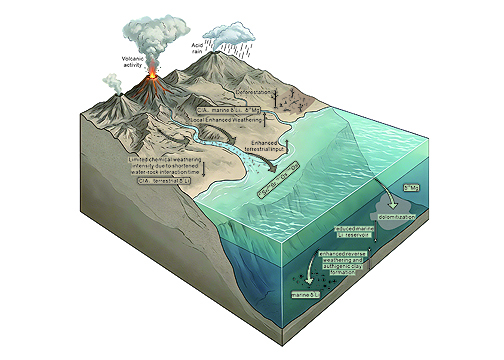
The Permian–Triassic transition (P–Tr, ca. 251.9 Ma) witnessed the most severe mass extinction of the Phanerozoic, triggered by intense volcanic activity and associated environmental catastrophes. Continental silicate weathering is central to understanding both the mechanisms of the extinction and the prolonged Early Triassic warmth, yet changes in its intensity and flux remain controversial. Lithium (Li) isotopes (δ7Li), a promising tracer of silicate weathering, have increasingly been applied to the P–Tr transition. However, δ7Li records from different sedimentary archives (marine carbonates, shales, cherts, and terrestrial clastic rocks) show stark discrepancies: some indicate rapid enhancement of chemical weathering, others invoke marine reverse weathering as the dominant control, and terrestrial evidence points to intensified physical erosion but suppressed chemical weathering. These contradictions arise because the marine δ7Li signal integrates multiple processes—continental weathering input, reverse weathering, and changes in the size of the oceanic Li reservoir—that cannot be disentangled by a single proxy. This review synthesises δ7Li records with the Chemical Index of Alteration (CIA), strontium (Sr) isotopes, osmium (Os) isotopes, and magnesium (Mg) isotopes across the P–Tr transition. We demonstrate a pronounced “intensity‑flux decoupling” in continental weathering, where traditional weathering indices (CIA) and terrestrial δ7Li indicate that chemical weathering intensity (measured as the chemical depletion fraction, W/D) did not increase globally and may have even decreased, while radiogenic Sr and Os isotopes record a sharp rise in the total terrigenous material flux. This paradox is reconciled with a regime of rapid physical erosion with limited chemical leaching, driven by vegetation collapse and a shortened hydrological cycle. Meanwhile, extreme Early Triassic marine δ7Li anomalies are largely controlled by enhanced reverse weathering and a likely reduced marine Li reservoir. A multi-proxy deconvolution framework thus allows a three-dimensional separation of weathering intensity, flux, and internal oceanic processes, offering a unified way to resolve current controversies. Future priorities include quantitative calibration of archive effects, systematic mapping of spatial heterogeneity, and numerical modelling of the marine Li cycle to advance quantitative understanding of Earth system crises in deep time.
References
- Adiatma, Y.D., Saltzman, M.R. & Liu, X.M. (2024) Lithium isotope stratigraphy and Ordovician weathering. Earth and Planetary Science Letters, 647, 119030. https://doi.org/10.1016/j.epsl.2024.119030
- Algeo, T.J. & Twitchett, R.J. (2010) Anomalous Early Triassic sediment fluxes due to elevated weathering rates and their biological consequences. Geology, 38 (11), 1023–1026. https://doi.org/10.1130/G31203.1
- Banner, J.L. & Hanson, G.N. (1990) Calculation of simultaneous isotopic and trace element variations during water-rock interaction with applications to carbonate diagenesis. Geochimica et Cosmochimica Acta, 54 (11), 3123–3137. https://doi.org/10.1016/0016-7037(90)90128-8
- Cao, C., Bataille, C.P., Song, H.J., Saltzman, M.R., Cramer, K.T., Wu, H.C., Korte, C., Zhang, Z.F. & Liu, X.M. (2022) Persistent late Permian to Early Triassic warmth linked to enhanced reverse weathering. Nature Geoscience, 15, 832–838. https://doi.org/10.1038/s41561-022-01078-y
- Cao, C., Liu, X.M., Wang, X.K. & Chen, J. (2023) Effective use of limestones to reconstruct seawater Li isotope compositions—a community standard proposal. Chemical Geology, 626, 121441. https://doi.org/10.1016/j.chemgeo.2023.121441
- Cao, Y., Song, H.Y., Algeo, T.J., Chu, D.L., Du, Y., Tian, L., Wang, Y.H. & Tong, J.N. (2019) Intensified chemical weathering during the Permian-Triassic transition recorded in terrestrial and marine successions. Palaeogeography, Palaeoclimatology, Palaeoecology, 519, 166–177. https://doi.org/10.1016/j.palaeo.2018.06.012
- Capo, R.C., Stewart, B.W. & Chadwick, O.A. (1998) Strontium isotopes as tracers of ecosystem processes: theory and methods. Geoderma, 82 (1-3), 197–225. https://doi.org/10.1016/S0016-7061(97)00102-X
- Chan, L.H., Gieskes, J.M., You, C.F. & Edmond, J.M. (1994) Lithium isotope geochemistry of sediments and hydrothermal fluids of the Guaymas Basin, Gulf of California. Geochimica et Cosmochimica Acta, 58 (20), 4443–4454. https://doi.org/10.1016/0016-7037(94)90346-8
- Chen, X.Y., Teng, F.Z., Huang, K.J. & Algeo, T.J. (2020) Intensified chemical weathering during Early Triassic revealed by magnesium isotopes. Geochimica et Cosmochimica Acta, 287, 263–276. https://doi.org/10.1016/j.gca.2020.02.035
- Chen, B., Chen, J., Qie, W., Huang, P., He, T., Joachimski, M.M. & Algeo, T.J. (2021) Was climatic cooling during the earliest Carboniferous driven by expansion of seed plants? Earth and Planetary Science Letters, 565, 116953. https://doi.org/10.1016/j.epsl.2021.116953
- Chen, J., Guo, Y., Wei, H.B., Liu, H.Y., Ma, R.Y., Xiao, Z. & Feng, Z. (2022) Evaluation of chemical weathering proxies by comparing drilled cores versus outcrops and weathering history during the Permian–Triassic transition. Global and Planetary Change, 214, 103855. https://doi.org/10.1016/j.gloplacha.2022.103855
- Chen, J.B., Lu, B.J., Du, L.Y., Lin, M., Shen, S.Z., Montañez, I.P. & Feng, Z. (2025) Regional postdeforestation weathering feedback drove diachronous C-S cycle perturbations during the end-Permian crisis. Proceedings of the National Academy of Sciences, 122 (44), e2504841122. https://doi.org/10.1073/pnas.2504841122
- Clarkson, M.O., Wood, R.A., Poulton, S.W., Richoz, S., Newton, R.J., Kasemann, S.A., Bowyer, F. & Krystyn, L. (2016) Dynamic anoxic ferruginous conditions during the end-Permian mass extinction and recovery. Nature Communications, 7, 12236. https://doi.org/10.1038/ncomms12236
- Cohen, A.S., Coe, A.L., Harding, S.M. & Schwark, L. (2004) Osmium isotope evidence for the regulation of atmospheric CO2 by continental weathering. Geology, 32 (2), 157–160. https://doi.org/10.1130/G20158.1
- Dal Corso, J., Song, H.J., Callegaro, S., Chu, D.L., Sun, Y.D., Hilton, J., Grasby, S.E., Joachimski, M.M. & Wignall, P.B. (2022) Environmental crises at the Permian–Triassic mass extinction. Nature Reviews Earth & Environment, 3, 197–214. https://doi.org/10.1038/s43017-021-00259-4
- Dellinger, M., Gaillardet, J., Bouchez, J., Calmels, D., Galy, V., Hilton, R.G., Louvat, P. & France-Lanord, C. (2014) Lithium isotopes in large rivers reveal the cannibalistic nature of modern continental weathering and erosion. Earth and Planetary Science Letters, 401, 359–372. https://doi.org/10.1016/j.epsl.2014.05.061
- Dellinger, M., Gaillardet, J., Bouchez, J., Calmels, D., Louvat, P., Dosseto, A., Gorge, C., Alanoca, L. & Maurice, L. (2015) Riverine Li isotope fractionation in the Amazon River basin controlled by the weathering regimes. Geochimica et Cosmochimica Acta, 164, 71–93. https://doi.org/10.1016/j.gca.2015.04.042
- Dellinger, M., Hardisty, D.S., Planavsky, N.J., Gill, B.C., Kalderon‑Asael, B., Asael, D., Croissant, T., Swart, P.K. & West, A.J. (2020) The effects of diagenesis on lithium isotope ratios of shallow marine carbonates. American Journal of Science, 320 (2), 150–184. https://doi.org/10.2475/02.2020.03
- Dellinger, M., West, A.J., Paris, G., Adkins, J.F., Pogge von Strandmann, P.A.E., Ullmann, C.V., Eagle, R.A., Freitas, P., Bagard, M.L., Ries, J.B., Corsetti, F.A., Perez‑Huerta, A. & Kampf, A.R. (2018) The Li isotope composition of marine biogenic carbonates: Patterns and mechanisms. Geochimica et Cosmochimica Acta, 236, 315–335. https://doi.org/10.1016/j.gca.2018.03.014
- Dudás, F., Yuan, D.X., Shen, S.Z. & Bowring, S.A. (2017) A conodont‑based revision of the 87Sr/86Sr seawater curve across the Permian‑Triassic boundary. Palaeogeography, Palaeoclimatology, Palaeoecology, 470, 40–53. https://doi.org/10.1016/j.palaeo.2017.01.007
- Fan, J.X., Shen, S.Z., Erwin, D.H., Sadler, P.M., MacLeod, N., Cheng, Q.M., Hou, X.D., Yang, J., Wang, X.D., Wang, Y., Zhang, H., Chen, X., Li, G.X., Zhang, Y.C., Shi, Y.K., Yuan, D.X., Chen, Q., Zhang, L.N., Li, C. & Zhao, Y.Y. (2020) A high‑resolution summary of Cambrian to Early Triassic marine invertebrate biodiversity. Science, 367 (6475), 273–277. https://doi.org/10.1126/science.aax4953
- Fedo, C.M., Nesbitt, H.W. & Young, G.M. (1995) Unraveling the effects of potassium metasomatism in sedimentary rocks and paleosols, with implications for paleoweathering conditions and provenance. Geology, 23 (10), 921–924. https://doi.org/10.1130/0091-7613(1995)023<0921:UTEOPM>2.3.CO;2
- Feng, Z., Wei, H.B., Guo, Y., He, X.Y., Sui, Q., Zhou, Y., Liu, H.Y., Gou, X.D. & Lv, Y. (2020) From rainforest to herbland: New insights into land plant responses to the end‑Permian mass extinction. Earth‑Science Reviews, 204, 103153. https://doi.org/10.1016/j.earscirev.2020.103153
- Garbelli, C., Cipriani, A., Brand, U., Lugli, F. & Posenato, R. (2022) Strontium isotope stratigraphic insights on the end‑Permian mass extinction and the Permian‑Triassic boundary in the Dolomites (Italy). Chemical Geology, 605, 120946. https://doi.org/10.1016/j.chemgeo.2022.120946
- Georg, R.B., West, A.J., Vance, D., Newman, K. & Halliday, A.N. (2013) Is the marine osmium isotope record a probe for CO2 release from sedimentary rocks? Earth and Planetary Science Letters, 367, 28–38. https://doi.org/10.1016/j.epsl.2013.02.018
- Georgiev, S.V., Stein, H.J., Hannah, J.L., Henderson, C.M. & Algeo, T.J. (2015) Enhanced recycling of organic matter and Os‑isotopic evidence for multiple magmatic or meteoritic inputs to the Late Permian Panthalassic Ocean, Opal Creek, Canada. Geochimica et Cosmochimica Acta, 150, 192–210. https://doi.org/10.1016/j.gca.2014.11.019
- Georgiev, S.V., Stein, H.J., Yang, G., Hannah, J.L., Böttcher, M.E., Grice, K., Holman, A., Turgeon, S., Simonsen, S. & Cloquet, C. (2020) Late Permian‑Early Triassic environmental changes recorded by multi‑isotope (Re‑Os‑N‑Hg) data and trace metal distribution from the Hovea‑3 section, Western Australia. Gondwana Research, 88, 353–372. https://doi.org/10.1016/j.gr.2020.07.007
- Hathorne, E. & James, R. (2006) Temporal record of lithium in seawater: A tracer for silicate weathering? Earth and Planetary Science Letters, 246 (3-4), 393–406. https://doi.org/10.1016/j.epsl.2006.04.020
- Hayashi, K., Fujisawa, H., Holland, H.D. & Ohmoto, H. (1997) Geochemistry of similar to 1.9 Ga sedimentary rocks from northeastern Labrador, Canada. Geochimica et Cosmochimica Acta, 61 (19), 4115–4137. https://doi.org/10.1016/S0016-7037(97)00214-7
- Hindshaw, R.S., Tosca, R., Goût, T.L., Farnan, I., Tosca, N.J. & Tipper, E.T. (2019) Experimental constraints on Li isotope fractionation during clay formation. Geochimica et Cosmochimica Acta, 250, 219–237. https://doi.org/10.1016/j.gca.2019.02.015
- Hu, Z.Y., Li, W.Q., Zhang, H., Krainer, K., Zheng, Q.F., Xia, Z.G., Hu, W.X. & Shen, S.Z. (2021) Mg isotope evidence for restriction events within the Paleotethys ocean around the Permian‑Triassic transition. Earth and Planetary Science Letters, 556, 116704. https://doi.org/10.1016/j.epsl.2020.116704
- Huang, T.Z., Shen, B., Huang, K.J., Ning, M., Li, C., Xue, J.Z., Sun, Y.L. & Huang, B.Q. (2024) Revisiting the Mg isotopic systematics of siliciclastic components of sediments and sedimentary rocks: A new geochemical proxy of continental weathering in Earth’s history. Science China‑Earth Sciences, 67 (2), 620–633. https://doi.org/10.1007/s11430-023-1199-2
- Huh, Y., Chan, L.H. & Edmond, J.M. (2001) Lithium isotopes as a probe of weathering processes: Orinoco River. Earth and Planetary Science Letters, 194 (1-2), 189–199. https://doi.org/10.1016/S0012-821X(01)00523-4
- Jiao, S.L., Zhang, H., Cai, Y.F., Chen, J.B., Feng, Z. & Shen, S.Z. (2023) Collapse of tropical rainforest ecosystems caused by high‑temperature wildfires during the end‑Permian mass extinction. Earth and Planetary Science Letters, 614, 118193. https://doi.org/10.1016/j.epsl.2023.118193
- Joachimski, M.M., Lai, X., Shen, S., Jiang, H., Luo, G., Chen, B., Chen, J. & Sun, Y. (2012) Climate warming in the latest Permian and the Permian‑Triassic mass extinction. Geology, 40 (3), 195–198. https://doi.org/10.1130/G32707.1
- Jurikova, H., Gutjahr, M., Wallmann, K., Flögel, S., Liebetrau, V., Posenato, R., Angiolini, L., Garbelli, C., Brand, U., Wiedenbeck, M. & Eisenhauer, A. (2020) Permian-Triassic mass extinction pulses driven by major marine carbon cycle perturbations. Nature Geoscience, 13, 745–750. https://doi.org/10.1038/s41561-020-00646-4
- Korte, C., Jasper, T., Kozur, H.W. & Veizer, J. (2006) 87Sr/86Sr record of Permian seawater. Palaeogeography, Palaeoclimatology, Palaeoecology, 240 (1-2), 89–107. https://doi.org/10.1016/j.palaeo.2006.03.047
- Korte, C., Kozur, H.W., Bruckschen, P. & Veizer, J. (2003) Strontium isotope evolution of Late Permian and Triassic seawater. Geochimica et Cosmochimica Acta, 67 (1), 47–62. https://doi.org/10.1016/S0016-7037(02)01035-9
- Lau, K.V., Maher, K., Altiner, D., Kelley, B.M., Kump, L.R., Lehrmann, D.J., Silva‑Tamayo, J.C., Weaver, K.L., Yu, M.Y. & Payne, J.L. (2016) Marine anoxia and delayed Earth system recovery after the end‑Permian extinction. Proceedings of the National Academy of Sciences of the United States of America, 113 (9), 2360–2365. https://doi.org/10.1073/pnas.1515080113
- Lemarchand, E., Chabaux, F., Vigier, N., Millot, R. & Pierret, M.C. (2010) Lithium isotope systematics in a forested granitic catchment (Strengbach, Vosges Mountains, France). Geochimica et Cosmochimica Acta, 74 (16), 4612–4628. https://doi.org/10.1016/j.gca.2010.04.057
- Li, G. & West, A.J. (2014) Evolution of Cenozoic seawater lithium isotopes: Coupling of global denudation regime and shifting seawater sinks. Earth and Planetary Science Letters, 401, 284–293. https://doi.org/10.1016/j.epsl.2014.06.011
- Liao, Z.W., Hu, W.X., Cao, J., Wang, X.L., Yao, S.P., Wu, H.G. & Wan, Y. (2016) Heterogeneous volcanism across the Permian‑Triassic Boundary in South China and implications for the Latest Permian Mass Extinction: New evidence from volcanic ash layers in the Lower Yangtze Region. Journal of Asian Earth Sciences, 127, 197–210. https://doi.org/10.1016/j.jseaes.2016.06.003
- Ling, M.X., Sedaghatpour, F., Teng, F.Z., Hays, P.D., Strauss, J. & Sun, W.D. (2011) Homogeneous magnesium isotopic composition of seawater: an excellent geostandard for Mg isotope analysis. Rapid Communications in Mass Spectrometry, 25 (19), 2828–2836. https://doi.org/10.1002/rcm.5172
- Liu, C., Jiang, T.E., Yang, Y. & Ma, J. (2023) Temporal and spatial variations of high‑resolution strontium, carbon, and oxygen isotopic chemostratigraphy at the end‑Permian crisis boundary in South China. Gondwana Research, 113, 89–101. https://doi.org/10.1016/j.gr.2022.10.015
- Liu, X.Y., Krause, A.J., Wilson, D.J., Fraser, W.T., Joachimski, M.M., Brand, U., Stigall, A.L., Qie, W.K., Chen, B., Yang, X.R. & Pogge von Strandmann, P.A.E. (2025) Lithium isotope evidence shows Devonian afforestation may have significantly altered the global silicate weathering regime. Geochimica et Cosmochimica Acta, 396, 107–121. https://doi.org/10.1016/j.gca.2025.02.036
- Liu, Z.Y. & Selby, D. (2021) Deep‑water osmium‑isotope record of the Permian‑Triassic interval from Niushan, China reveals potential delayed volcanic signal post the mass extinction. Global and Planetary Change, 200, 103473. https://doi.org/10.1016/j.gloplacha.2021.103473
- Liu, Z.Y., Selby, D., Zhang, H. & Shen, S.Z. (2020) Evidence for volcanism and weathering during the Permian‑Triassic mass extinction from Meishan (South China) osmium isotope record. Palaeogeography, Palaeoclimatology, Palaeoecology, 553, 109790. https://doi.org/10.1016/j.palaeo.2020.109790
- Mackenzie, F.T. & Kump, L.R. (1995) Reverse Weathering, Clay Mineral Formation, and Oceanic Element Cycles. Science, 270 (5236), 586. https://doi.org/10.1126/science.270.5236.586
- McLennan, S.M. & Taylor, S.R. (1991) Sedimentary Rocks and Crustal Evolution: Tectonic Setting and Secular Trends. Journal of Geology, 99 (1), 1–21. https://doi.org/10.1086/629470
- Misra, S. & Froelich, P.N. (2012) Lithium Isotope History of Cenozoic Seawater: Changes in Silicate Weathering and Reverse Weathering. Science, 335 (6070), 818–823. https://doi.org/10.1126/science.1214697
- Nesbitt, H.W. & Young, G.M. (1982) Early Proterozoic climates and plate motions inferred from major element chemistry of lutites. Nature, 299 (5885), 715–717. https://doi.org/10.1038/299715a0
- Nsingi, J.M., Cui, Y., Cepin, E., Beaty, B., Planavsky, N., Wu, Q., Adloff, M., Wang, J., Selby, D., Liu, Z., Dong, Y., Jiang, S. & Zhu, F. (2025) Changes in continental weathering across the Permian‑Triassic transition: A global review. Global and Planetary Change, 254, 105015. https://doi.org/10.1016/j.gloplacha.2025.105015
- Palmer, M.R. & Edmond, J.M. (1989) The Strontium Isotope Budget of the Modern Ocean. Earth and Planetary Science Letters, 92 (1), 11–26. https://doi.org/10.1016/0012-821X(89)90017-4
- Pearce, C.R., Parkinson, I.J., Gaillardet, J., Charlier, B.L.A., Mokadem, F. & Burton, K.W. (2015) Reassessing the stable (δ⁸⁸/86Sr) and radiogenic (87Sr/86Sr) strontium isotopic composition of marine inputs. Geochimica et Cosmochimica Acta, 157, 125–146. https://doi.org/10.1016/j.gca.2015.02.029
- Peucker-Ehrenbrink, B. & Fiske, G.J. (2019) A continental perspective of the seawater 87Sr/86Sr record: A review. Chemical Geology, 510, 140–165. https://doi.org/10.1016/j.chemgeo.2019.01.017
- Peucker-Ehrenbrink, B. & Ravizza, G. (2000) The marine osmium isotope record. Terra Nova, 12 (5), 205–219. https://doi.org/10.1046/j.1365-3121.2000.00295.x
- Pogge von Strandmann, P.A.E., Burton, K.W., James, R.H., van Calsteren, P., Gislason, S.R. & Sigfússon, B. (2008) The influence of weathering processes on riverine magnesium isotopes in a basaltic terrain. Earth and Planetary Science Letters, 276 (1-2), 187–197. https://doi.org/10.1016/j.epsl.2008.09.020
- Pogge von Strandmann, P.A.E., Jenkyns, H.C. & Woodfine, R.G. (2013) Lithium isotope evidence for enhanced weathering during Oceanic Anoxic Event 2. Nature Geoscience, 6, 668–672. https://doi.org/10.1038/ngeo1875
- Pogge von Strandmann, P.A.E., Schmidt, D.N., Planavsky, N.J., Wei, G., Jones, C.L. & Baumann, K.H. (2019) Assessing bulk carbonates as archives for seawater Li isotope ratios. Chemical Geology, 530, 119338. https://doi.org/10.1016/j.chemgeo.2019.119338
- Pogge von Strandmann, P.A.E., Dellinger, M. & West, A.J. (2021) Lithium isotopes: a tracer of past and present silicate weathering. Geochemical Tracers in Earth System Science. https://doi.org/10.1017/9781108990752
- Pogge von Strandmann, P.A.E., Liu, X.Y., Liu, C.Y., Wilson, D.J., Hammond, S.J., Tarbuck, G., Aristilde, L., Krause, A.J. & Fraser, W.T. (2022) Lithium isotope behaviour during basalt weathering experiments amended with organic acids. Geochimica et Cosmochimica Acta, 328, 37–57. https://doi.org/10.1016/j.gca.2022.04.032
- Pogge von Strandmann, P.A.E., Cosford, L.R., Liu, C.Y., Liu, X.Y., Krause, A.J., Wilson, D.J., He, X.Q., McCoy‑West, A.J., Gislason, S.R. & Burton, K.W. (2023) Assessing hydrological controls on the lithium isotope weathering tracer. Chemical Geology, 642, 121801. https://doi.org/10.1016/j.chemgeo.2023.121801
- Qie, W.K., Zhang, J.P., Luo, G.M., Algeo, T.J., Chen, B., Xiang, L., Liang, K., Liu, X.Y., Pogge von Strandmann, P.A.E., Chen, J.T. & Wang, X.D. (2023) Enhanced Continental Weathering as a Trigger for the End-Devonian Hangenberg Crisis. Geophysical Research Letters, 50 (11), e2022GL102640. https://doi.org/10.1029/2022GL102640
- Rauzi, S., Foster, W.J., Takahashi, S., Hori, R.S., Beaty, B.J., Tarhan, L.G. & Isson, T. (2024) Lithium isotopic evidence for enhanced reverse weathering during the Early Triassic warm period. Proceedings of the National Academy of Sciences of the United States of America, 121 (32), e2318860121. https://doi.org/10.1073/pnas.2318860121
- Rooney, A.D., Selby, D., Lloyd, J.M., Roberts, D.H., Lückge, A., Sageman, B.B. & Prouty, N.G. (2016) Tracking millennial‑scale Holocene glacial advance and retreat using osmium isotopes: Insights from the Greenland ice sheet. Quaternary Science Reviews, 138, 49–61. https://doi.org/10.1016/j.quascirev.2016.02.021
- Schneebeli-Hermann, E., Kurschner, W.M., Hochuli, P.A., Ware, D., Weissert, H., Bernasconi, S.M., Roohi, G., ur‑Rehman, K., Goudemand, N. & Bucher, H. (2013) Evidence for atmospheric carbon injection during the end‑Permian extinction. Geology, 41 (5), 579–582. https://doi.org/10.1130/G34047.1
- Schoepfer, S.D., Henderson, C.M., Garrison, G.H., Foriel, J., Ward, P.D., Selby, D., Hower, J.C., Algeo, T.J. & Shen, Y.N. (2013) Termination of a continent‑margin upwelling system at the Permian‑Triassic boundary (Opal Creek, Alberta, Canada). Global and Planetary Change, 105, 21–35. https://doi.org/10.1016/j.gloplacha.2012.07.005
- Sedlacek, A.R.C., Saltzman, M.R., Algeo, T.J., Horacek, M., Brandner, R., Foland, K. & Denniston, R.F. (2014) 87Sr/86Sr stratigraphy from the Early Triassic of Zal, Iran: Linking temperature to weathering rates and the tempo of ecosystem recovery. Geology, 42 (9), 779–782. https://doi.org/10.1130/G35545.1
- Song, H.J., Wignall, P.B., Tong, J.N., Song, H.Y., Chen, J., Chu, D.L., Tian, L., Luo, M., Zong, K.Q., Chen, Y.L., Lai, X.L., Zhang, K.X. & Wang, H.M. (2015) Integrated Sr isotope variations and global environmental changes through the Late Permian to early Late Triassic. Earth and Planetary Science Letters, 424, 140–147. https://doi.org/10.1016/j.epsl.2015.05.035
- Spalletti, L.A. & Limarino, C.O. (2017) The Choiyoi magmatism in south western Gondwana: implications for the end‑permian mass extinction—a review. Andean Geology, 44 (3), 328–338. https://doi.org/10.5027/andgeoV44n3-a05
- Sun, H., Xiao, Y., Gao, Y., Zhang, G., Casey, J.F. & Shen, Y. (2018) Rapid enhancement of chemical weathering recorded by extremely light seawater lithium isotopes at the Permian‑Triassic boundary. Proceedings of the National Academy of Sciences of the United States of America, 115 (15), 3782–3787. https://doi.org/10.1073/pnas.1711862115
- Sun, Y.D., Joachimski, M.M., Wignall, P.B., Yan, C.B., Chen, Y.L., Jiang, H.S., Wang, L.N. & Lai, X.L. (2012) Lethally Hot Temperatures During the Early Triassic Greenhouse. Science, 338 (6105), 366–370. https://doi.org/10.1126/science.1224126
- Svensen, H., Planke, S., Polozov, A.G., Schmidbauer, N., Corfu, F., Podladchikov, Y.Y. & Jamtveit, B. (2009) Siberian gas venting and the end‑Permian environmental crisis. Earth and Planetary Science Letters, 277 (3-4), 490–500. https://doi.org/10.1016/j.epsl.2008.11.015
- Taylor, K., Rauzi, S., Isson, T., Ibarra, D.E., Hülse, D., Kimmig, S.R., Payne, J.L., Altiner, D., Lehrmann, D.J., Kalderon‑Asael, B., Planavsky, N.J. & Lau, K.V. (2026) Heterogeneous Carbonate Lithium Isotope Records Across the end‑Permian Mass Extinction Indicate a Highly Perturbed Lithium Cycle in the Early Triassic. American Journal of Science, 326, Article 5. https://doi.org/10.2475/001c.156171
- Tipper, E.T., Galy, A. & Bickle, M.J. (2006) Riverine evidence for a fractionated reservoir of Ca and Mg on the continents: Implications for the oceanic Ca cycle. Earth and Planetary Science Letters, 247 (3-4), 267–279. https://doi.org/10.1016/j.epsl.2006.04.033
- Tomascak, P.B. (2004) Developments in the understanding and application of lithium isotopes in the earth and planetary sciences. Reviews in Mineralogy and Geochemistry, 55 (1), 153–195. https://doi.org/10.2138/gsrmg.55.1.153
- Veevers, J.J. & Tewari, R.C. (1995) Permian‑Carboniferous and Permian‑Triassic magmatism in the rift‑zone bordering the Tethyan margin of southern Pangea. Geology, 23 (5), 467–470. https://doi.org/10.1130/0091-7613(1995)023<0467:PCAPTM>2.3.CO;2
- Veizer, J., Ala, D., Azmy, K., Bruckschen, P., Buhl, D., Bruhn, F., Carden, G.A.F., Diener, A., Ebneth, S., Godderis, Y., Jasper, T., Korte, C., Pawellek, F., Podlaha, O.G. & Strauss, H. (1999) 87Sr/86Sr, δ¹³C and δ¹⁸O evolution of Phanerozoic seawater. Chemical Geology, 161 (1-3), 59–88. https://doi.org/10.1016/S0009-2541(99)00081-9
- Vigier, N., Decarreau, A., Millot, R., Carignan, J., Petit, S. & France-Lanord, C. (2008) Quantifying Li isotope fractionation during smectite formation and implications for the Li cycle. Geochimica et Cosmochimica Acta, 72 (3), 780–792. https://doi.org/10.1016/j.gca.2007.11.011
- Viglietti, P.A., Benson, R.B.J., Smith, R.M.H., Botha, J., Kammerer, C.F., Skosan, Z., Butler, E., Crean, A., Eloff, B., Kaal, S., Mohoi, J., Molehe, W., Mtalana, N., Mtungata, S., Ntheri, N., Ntsala, T., Nyaphuli, J., October, P., Skinner, G., Strong, M., Stummer, H., Wolvaardt, F.P. & Angielczyk, K.D. (2021) Evidence from South Africa for a protracted end‑Permian extinction on land. Proceedings of the National Academy of Sciences of the United States of America, 118 (17), e2017045118. https://doi.org/10.1073/pnas.2017045118
- Walker, J.C.G., Hays, P.B. & Kasting, J.F. (1981) A negative feedback mechanism for the long‑term stabilization of Earth’s surface temperature. Journal of Geophysical Research, 86 (C10), 9776–9782. https://doi.org/10.1029/JC086iC10p09776
- Wang, J.Y., Jacobson, A.D., Zhang, H., Ramezani, J., Sageman, B.B., Hurtgen, M.T., Bowring, S.A. & Shen, S.Z. (2019) Coupled δ44/40Ca, δ88/86Sr, and 87Sr/86Sr geochemistry across the end‑Permian mass extinction event. Geochimica et Cosmochimica Acta, 262, 143–165. https://doi.org/10.1016/j.gca.2019.07.035
- Wang, W.Q., Katchinoff, J.A.R., Garbelli, C., Immenhauser, A., Zheng, Q.F., Zhang, Y.C., Yuan, D.X., Shi, Y.K., Wang, J.Y., Planavsky, N. & Shen, S.Z. (2021) Revisiting the Permian seawater 87Sr/86Sr record: New perspectives from brachiopod proxy data and stochastic oceanic box models. Earth‑Science Reviews, 218, 103679. https://doi.org/10.1016/j.earscirev.2021.103679
- Wang, W.Q., Zhang, F.F., Liu, C.Y., Pogge von Strandmann, P.A.E., Xiong, G.L., Zheng, Q.F., Garbelli, C., Zhang, Y.C., Yuan, D.X. & Shen, S.Z. (2024) Constraints on the continental weathering intensity through the Permian using lithium isotopes of well‑preserved brachiopod shells. Earth and Planetary Science Letters, 648, 119101. https://doi.org/10.1016/j.epsl.2024.119101
- Washington, K.E., West, A.J., Kalderon‑Asael, B., Katchinoff, J.A.R., Stevenson, E.I. & Planavsky, N.J. (2020) Lithium isotope composition of modern and fossilized Cenozoic brachiopods. Geology, 48 (11), 1058–1061. https://doi.org/10.1130/G47558.1
- Wei, G.Y., Wei, W., Wang, D., Li, T., Yang, X., Shields, G.A., Zhang, F., Li, G., Chen, T., Yang, T. & Ling, H.F. (2020) Enhanced chemical weathering triggered an expansion of euxinic seawater in the aftermath of the Sturtian glaciation. Earth and Planetary Science Letters, 539, 116244. https://doi.org/10.1016/j.epsl.2020.116244
- Wei, G.Y., Zhao, M.Y., Sperling, E.A., Gaines, R.R., Kalderon‑Asael, B., Shen, J., Li, C., Zhang, F.F., Li, G.J., Zhou, C.M., Cai, C.F., Chen, D.Z., Xiao, K.Q., Jiang, L., Ling, H.F., Planavsky, N.J. & Tarhan, L.G. (2024) Lithium isotopic constraints on the evolution of continental clay mineral factory and marine oxygenation in the earliest Paleozoic Era. Science Advances, 10 (13), eadk2152. https://doi.org/10.1126/sciadv.adk2152
- Wimpenny, J., Colla, C.A., Yin, Q.Z., Rustad, J.R. & Casey, W.H. (2014) Investigating the behaviour of Mg isotopes during the formation of clay minerals. Geochimica et Cosmochimica Acta, 128, 178–194. https://doi.org/10.1016/j.gca.2013.12.012
- Wimpenny, J., Gíslason, S.R., James, R.H., Gannoun, A., Pogge von Strandmann, P.A.E. & Burton, K.W. (2010) The behaviour of Li and Mg isotopes during primary phase dissolution and secondary mineral formation in basalt. Geochimica et Cosmochimica Acta, 74 (18), 5259–5279. https://doi.org/10.1016/j.gca.2010.06.028
- Wu, Q., Ramezani, J., Zhang, H., Wang, J., Zeng, F., Zhang, Y., Liu, F., Chen, J., Cai, Y., Hou, Z., Liu, C., Yang, W., Henderson, C.M. & Shen, S.Z. (2021) High‑precision U‑Pb age constraints on the Permian floral turnovers, paleoclimate change, and tectonics of the North China block. Geology, 49 (6), 677–681. https://doi.org/10.1130/G48051.1
- Xu, G.Z., Shen, J., Algeo, T.J., Yu, J.X., Feng, Q.L., Frank, T.D., Fielding, C.R., Yan, J.X., Deconink, J.F. & Lei, Y. (2023) Limited change in silicate chemical weathering intensity during the Permian‑Triassic transition indicates ineffective climate regulation by weathering feedbacks. Earth and Planetary Science Letters, 616, 118235. https://doi.org/10.1016/j.epsl.2023.118235
- Ye, R.H., Zhang, F.F., Wei, G.Y., Chen, J.B., Feng, Z. & Shen, S.Z. (2024) Lithium isotopes track changes in continental weathering regimes across the end‑Permian mass extinction in Southwest China. Earth and Planetary Science Letters, 647, 119045. https://doi.org/10.1016/j.epsl.2024.119045
- Zhang, H.R., Yang, T.N., Hou, Z.Q., Song, Y.C., Ding, Y. & Cheng, X.F. (2013) Petrogenesis and tectonics of late Permian felsic volcanic rocks, eastern Qiangtang block, north‑central Tibet: Sr and Nd isotopic evidence. International Geology Review, 55 (8), 1017–1028. https://doi.org/10.1080/00206814.2012.759669
- Zhang, H., Zhang, F.F., Chen, J.B., Erwin, D.H., Syverson, D.D., Ni, P., Rampino, M., Chi, Z., Cai, Y.F., Xiang, L., Li, W.Q., Liu, S.A., Wang, R.C., Wang, X.D., Feng, Z., Li, H.M., Zhang, T., Cai, H.M., Zheng, W., Cui, Y., Zhu, X.K., Hou, Z.Q., Wu, F.Y., Xu, Y.G., Planavsky, N. & Shen, S.Z. (2021) Felsic volcanism as a factor driving the end‑Permian mass extinction. Science Advances, 7 (47), eabh1390. https://doi.org/10.1126/sciadv.abh1390
- Zhang, P.X., Yang, M.F, Lu, J., Bond, D.P., Zhou, K., Xu, X.T., Wang, Y., He, Z., Bian, X., Shao, L.Y. & Hilton, J. (2023) End-Permian terrestrial ecosystem collapse in North China: evidence from palynology and geochemistry. Global and Planetary Change, 222, 104070. https://doi.org/10.1016/j.gloplacha.2023.104070
- Zhao, H., Zhang, L., Algeo, T.J., Lyu, Z., Wang, X. & Hao, F. (2025) Volcanism and basalt weathering drove Ordovician climatic cooling. Nature Communications, 16, 11475. https://doi.org/10.1038/s41467-025-66316-4
- Zhou, J.L., Zhang, F.F., Lin, Y.B., Ren, G.Y., Wei, G.Y., Yang, A.H. & Shen, S.Z. (2025) Paired lithium and barium isotopes uncover weathering and productivity controls on the late cambrian SPICE event. Geochimica et Cosmochimica Acta, 410, 188–202. https://doi.org/10.1016/j.gca.2025.10.011