
Abstract
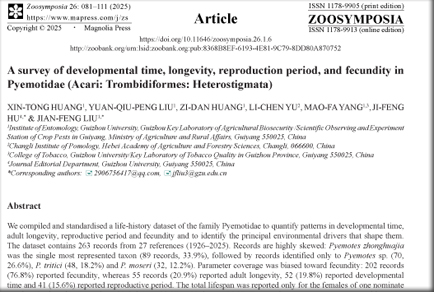
We compiled and standardised a life-history dataset of the family Pyemotidae to quantify patterns in developmental time, adult longevity, reproductive period and fecundity and to identify the principal environmental drivers that shape them. The dataset contains 263 records from 27 references (1926–2025). Records are highly skewed: Pyemotes zhonghuajia was the single most represented taxon (89 records, 33.9%), followed by records identified only to Pyemotes sp. (70, 26.6%), P. tritici (48, 18.2%) and P. moseri (32, 12.2%). Parameter coverage was biased toward fecundity: 202 records (76.8%) reported fecundity, whereas 55 records (20.9%) reported adult longevity, 52 (19.8%) reported developmental time and 41 (15.6%) reported reproductive period. The total lifespan was reported only for the females of one nominate species (P. zhonghuajia)—about 30.5 days at 32 ℃ to 80 days at 16 ℃. Temporal coverage was concentrated in recent years: 165 records (62.7%) were published during 2016–2025, reflecting an increase in experimental (thermal, density and storage) studies that disproportionately focused on P. zhonghuajia.
References
- Bruce, W.A. & Wrensch, D.L. (1990) Reproductive potential, sex ratio, and mating efficiency of the straw itch mite (Acari: Pyemotidae). Journal of Economic Entomology, 83 (2), 384–391.
- Bruce, W.A. (1989) Artificial diet for the parasitic mite Pyemotes tritici (Acari: Pyemotidae). Experimental & Applied Acarology, 6 (1), 11–18.
- Chen, S., Chen, S., Liu, J., Xu, F., Yang, M., Wu, C. & Zhao, R. (2025) Density-dependent transgenerational effects of Pyemotes zhonghuajia parasitism on the Megabruchidius dorsalis. Biological Control, 210, 105890.
- Chen, Y.C., Tian, T.A., Chen, Y.H., Yu, L.C., Hu, J.F., Yu, X.F., Liu, J.F. & Yang, M.F. (2021) The biocontrol agent Pyemotes zhonghuajia has the highest lethal weight ratio compared with its prey and the most dramatic body weight change during pregnancy. Insects, 12 (6), 490.
- Cheng, J., Chen, R., Wang, M., Qiu, Y., Yu, J. & Chi, D. (2025) Study on propagation of Pyemotes moseri at different temperatures and substitute host conditions. Protection Forest Science and Technology, 235, 40–47.
- He, L., Li, L., Yu, L., He, X.Z., Jiao, R., Xu, C., Zhang, L. & Liu, J. (2019) Optimizing cold storage of the ectoparasitic mite Pyemotes zhonghuajia (Acari: Pyemotidae), an efficient biological control agent of stem borers. Experimental and Applied Acarology, 78 (3), 327–342.
- He, L.-M. & Yu, L.-C. (2004) Construction and analysis of experimental population life-tables for Pyemotes sp. Hebei Fruits, (3), 9–10.
- He, L.-M., Yu, L.-C., Jiao, R., Xu, C.-X. & Hao, B.-F. (2011) Mass-rearing of Pyemotes zhonghuajia (Prostigmata: Pyemotidae) with substitute hosts. Chinese Journal of Biological Control, 27 (2), 165–170.
- Herfs, A. (1926) Ökologische Untersuchungen an Pediculoides ventricosus (Newp.) [Ecological studies on Pediculoides ventricosus (Newp.)]. Zoologica: Original-Abhandlungen aus dem Gesamtgebiete der Zoologie, 74, 3–68.
- Hu, S. (2013) Preliminary studies on parasitic mechanism of Pyemotes zhonghuajia to Semanotus bifasciatus. Master’s thesis, Beijing Forestry University, Beijing, China, 50 pp.
- Kim, S.J., Lee, J.H., Yang, C.Y., Kang, T.J., Cho, M.R. & Hong, K.J. (2015) Reproduction and parasitization capacity of an insect parasitic mite, Pyemotes moseri Yu et Liang (Acarina: Pyemotidae) new to Korea. Korean Journal of Applied Entomology, 54 (4), 393–400.
- Li, L.-T., Jiao, R., Xu, C., Xu, H., Zhao, W. & He, L. (2025a) Optimizing temperature and humidity for Pyemotes zhonghuajia reproduction and survival: implications for mass-rearing and field release. Systematic and Applied Acarology, 30 (9), 1571–1581.
- Li, L.-T., Jiao, R., Xu, C.-X., Xu, H.-J., Zhao, W.-S. & He, L.-M. (2025b) Collection, evaluation and domestication of heat-tolerant Pyemotes strains. Hebei Fruits, (2), 10–12.
- Liu, J., Jiang, N., Gao, H., Lai, S., Zhou, Y., Hao, D. & Dai, L. (2025) Laboratory exploration of several potential biocontrol methods against the Ambrosia beetle, Euwallacea interjectus. Insects, 16 (1), 56.
- Liu, J., Zhang, F., Han, D., Jin, Q.-A., Tang, C. & Fu, Y. (2008) Host age preference and biology of Pyemotes sp. (Acari: Pyemotidae). Plant Protection, 34 (5), 86–89.
- Moser, J. & Cross, E.A. (1971) Biology of Pyemotes parviscolyti (acarina: pyemotidae). Entomophaga, 16 (4), 367–379.
- Moser, J.C. & Roton, L.M. (1972) Reproductive compatibility between two widely separated population of Pyemotes scolyti (Acarina: Pyemotidae). The Pan-Pacific Entomologist, 48, 97–99.
- Moser, J.C., Cross, E.A. & Roton, L.M. (1971) Biology of Pyemotes parviscolyti [Acarina: Pyemotidae]. Entomophaga, 16 (4), 367–379.
- Moser, J.C., Kiełczewski, B., Wiśniewski, J. & Bałazy, S. (1978) Evaluating Pyemotes dryas (Vitzthum 1923) (Acari: Pyemotidae) as a parasite of the southern pine beetle. International Journal of Acarology, 4 (2), 67–70.
- Pan, Z.-H. & Zhou, G. (2011) Screening substitute hosts for mass-rearing of Pyemotes zhonghuajia. Hunan Forestry Science and Technology, 38 (4), 39–41.
- Shi, K. (2024) Research on improving the efficiency of breeding Pyemotes moseri by softening the integument of Tenebrio molitor. Master’s thesis, Northwest A&F University, Yangling, China, 80 pp.
- Song, Y.F., Du, H.L., Chen, Y.C., Ye, S., Yang, M.F. & Liu, J.F. (2022) Effect of different densities on the parasitic ability of Pyemotes zhonghuajia on Myzus persicae. Journal of Mountain Agriculture and Biology, 41, 15–20.
- Song, Y.F., Tian, T.A., Chen, Y.C., Zhang, K.S., Yang, M.F. & Liu, J.F. (2024) A mite parasitoid, Pyemotes zhonghuajia, negatively impacts the fitness traits and immune response of the fall armyworm, Spodoptera frugiperda. Journal of Integrative Agriculture, 23 (1), 205–216.
- Song, Y.F., Ye, S., He, X.-Z., Feng, B.-X., Chen, W.-H., Yang, M.-F., Liu, J.-F. & Gao, Y.-L. (2025) Sustainable management of potato tuber moth in storages using entomopathogenic fungi and an ectoparasitic mite. Pest Management Science, 81 (4), 1840–1850.
- Song, Y.-F., Yu, L.-C., Yang, M.-F., Ye, S., Yan, B., Li, L.-T., Wu, C. & Liu, J.-F. (2022) A long-read genome assembly of a native mite in China Pyemotes zhonghuajia Yu, Zhang & He (Prostigmata: Pyemotidae) reveals gene expansion in toxin-related gene families. Toxins, 14, 571.
- Tang, H.-Y. (2022) Vector transmission biocontrol: An effective method to biologically control Anoplophora glabripennis. Master’s thesis, Northwest A&F University, Yangling, China, 87 pp.
- Tian, T.-A., Yu, L.-C., Sun, G.-J., Yu, X.-F., Li, L.-T., Wu, C.-X., Chen, Y.-C., Yang, M.-F. & Liu, J.-F. (2020) Biological control efficiency of an ectoparasitic mite Pyemotes zhonghuajia on oriental armyworm Mythimna separata. Systematic and Applied Acarology, 25, 1683–1692.
- Tomalski, M.D. & Miller, L.K. (1991) Insect paralysis by baculovirus-mediated expression of a mite neurotoxin gene. Nature, 352 (6330), 82–85.
- Tomalski, M.D., Bruce, W.A., Travis, J. & Blum, M.S. (1988) Preliminary characterization of toxins from the straw itch mite, Pyemotes tritici, which induce paralysis in the larvae of a moth. Toxicon, 26 (2), 127–132.
- Tomalski, M.D., Hutchinson, K., Todd, J. & Miller, L.K. (1993) Identification and characterization of tox21A: a mite cDNA encoding a paralytic neurotoxin related to TxP-I. Toxicon, 31 (3), 319–326.
- Tomalski, M.D., Kutney, R., Bruce, W.A., Brown, M.R., Blum, M.S. & Travis, J. (1989) Purification and characterization of insect toxins derived from the mite, Pyemotes tritici. Toxicon, 27 (10), 1151–1167.
- Vaivanijkul, P. & Haramoto, F.H. (1969) The biology of Pyemotes boylei Krczal (Acarina: Pyemotidae). In: Proceedings of the Hawaiian Entomological Society, 20, 2, 443–454.
- Wang, L., Li, X.-L., Fan, D., Chen, Y.-C., Song, Y.-F., Hu, J.-F., Smagghe, G., Liu, J.-F. & Yang, M.F. (2025) Multi-omics analyses provide molecular insights into host immune responses and metabolic disruption in Spodoptera frugiperda parasitized by Pyemotes zhonghuajia. Pest Management Science, 81 (10), 6303–6315.
- Ye, S., Zhang, H.-Y., Song, Y.-F., Yang, M.-F., Li, L.-T., Yu, L.-C. & Liu, J.F. (2022) The complete mitochondrial genome of Pyemotes zhonghuajia (Acari: Pyemotidae). Systematic and Applied Acarology, 27, 1677–1686.
- Yu, L.-C., He, L.-M. & Xu, C.-X. (2000) Biology of Pyemotes sp. and the effects of temperature on its growth, development and reproduction. In: Proceedings of the 2000 Annual Meeting of the Entomological Society of China, Yichang, Hubei, China, pp. 1031–1032.
- Zhang, X. (2013) Studies on artificial propagation and host-selection behavior of Pyemotes tritici (Acari: Pyemotidae). Master’s thesis, Beijing Forestry University, Beijing, China, 66 pp.
- Zhang, X., Zong, S. & Luo, Y. (2013) Research on mass-rearing, storage and transportation of Pyemotes tritici (Acari: Pyemotidae). Acta Agriculturae Boreali-occidentalis Sinica, 22 (8), 108–111.
- Zhu, X.-F., Cui, R., Bi, H.-Y., Xu, B.-Q., Abudukeyumu, K. & Yang, S. (2011) Preliminary analysis of biological characters of Pyemotes sp., a parasitic natural enemy of bark beetle in Xinjiang. Xinjiang Agricultural Sciences, 48 (2), 316–319.