

Abstract
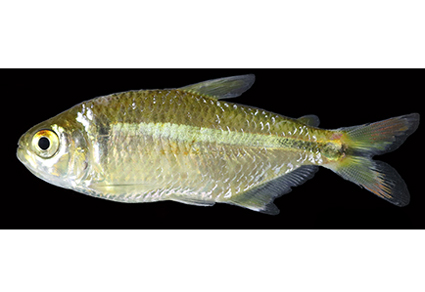
A new species of Psalidodon Eigenmann is described from an ichthyofaunistic poorly known portion of the upper rio Doce basin, in the state of Minas Gerais, southeastern Brazil. The new species is diagnosed and described using an integrative taxonomy approach. Psalidodon canaaensis new species is distinguished from its congeners by an unique combination of character states, which includes: presence of an adipose fin; a complete lateral line with 35–36 perforated scales; six horizontal scale rows between dorsal-fin origin and lateral line, five scales row between lateral line and pelvic-fin origin; 13–14 scales rows around caudal peduncle; presence of a vertically elongated humeral blotch; 18–24 branched anal-fin rays; one or two maxillary teeth bearing 3–5 cusps; males with elongated bony hooks on anal and pelvic fins, one per lepidotrichia segment; and a distinctive coloration pattern of the anal- and caudal- fins, with the anterior portion of the anal-fin olive green, and the caudal-fin greenish from the base to mid-length, followed by light red chromatophores on the distal portion of the fin-rays. A haplotype network, and Maximum Likelihood analysis based on fragments of the Cytochrome c oxidase I (COI) gene for the new species and some of its congeners highly support it as constituting a separate lineage within Psalidodon. Psalidodon canaaensis has a restricted distribution, inhabiting a high-gradient stream with rapid water flow, subject to anthropogenic pressures. Presently, it is the only species of the genus endemic to the rio Doce basin, emphasizing the importance of surveys in understudied areas.
References
- Abilhoa, V. & Duboc, L.F. (2007) A new species of the freshwater fish genus Astyanax (Ostariophysi: Characidae) from the rio Iguaçu basin, southeastern Brazil. Zootaxa, 1587 (1), 43–52. https://doi.org/10.11646/zootaxa.1587.1.3
- Almirón, A.E., Azpelicueta, M.M. & Casciotta, J.R. (2002) Astyanax ita sp. n. - a new species from the Río Iguazú basin, in Argentina (Teleostei, Characiformes, Characidae). Zoologische Abhandlungen, 52, 3–10. https://doi.org/10.1643/0045-8511(2002)002[1052:APANSF]2.0.CO;2
- Alves, C.B.M., Gomes, J.P.C., Pessali, T.C. & Gasparini, J.L. (2021) Peixes ameaçados de extinção na bacia do Rio Doce. In: Drummond, G.M., Subirá, R.J. & Martins, C.S. (Eds.), Livro Vermelho da Biota Aquática do Rio Doce Ameaçada de Extinção pós Rompimento da Barragem de Fundão, Mariana, Minas Gerais: Crustáceos, Efemerópteros, Odonatos e Peixes. Fundação Biodiversitas, Belo Horizonte, pp. 204–266.
- Azpelicueta, M.M., Casciotta, J.R. & Almirón, A.E. (2002) Two new species of the genus Astyanax (Characiformes, Characidae) from the Paraná River basin in Argentina. Revue Suisse de Zoologie, 109 (2), 243–259. https://doi.org/10.5962/bhl.part.79588
- Azpelicueta, M.M. & García, J.O. (2000) A new species of Astyanax (Characiformes, Characidae) from Uruguay River basin in Argentina, with remarks on hook presence in Characidae. Revue Suisse de Zoologie, 107 (2), 245–257. https://doi.org/10.5962/bhl.part.80128
- Bertaco, V.A. & Lucena, C.A.S. (2006) Two new species of Astyanax (Ostariophysi: Characiformes: Characidae) from eastern Brazil, with a synopsis of the Astyanax scabripinnis species complex. Neotropical Ichthyology, 4 (1), 53–60. https://doi.org/10.1590/S1679-62252006000100004
- Bertaco, V.A. & Carvalho, F.R. (2010) New species of Hasemania (Characiformes: Characidae) from Central Brazil, with comments on the endemism of upper rio Tocantins basin, Goiás State. Neotropical Ichthyology, 8 (1), 27–32. https://doi.org/10.1590/S1679-62252010000100004
- Bertaco, V.A., Carvalho, F.R. & Jerep, F.C. (2010) Astyanax goyanensis (Miranda-Ribeiro, 1944), new combination and Astyanax courensis, new species (Ostariophysi: Characiformes): two Characidae from the upper rio Tocantins basin, Central Brazil. Neotropical Ichthyology, 8 (2), 265–275. https://doi.org/10.1590/S1679-62252010000200004
- Bertaco, V.A. & Malabarba, L.R. (2001) Description of two new species of Astyanax (Teleostei: Characidae) from headwater streams of Southern Brazil, with comments on the “A. scabripinnis species complex”. Ichthyological Exploration of Freshwaters, 12 (3), 221–234.
- Bertaco, V.A. & Malabarba, L.R. (2005) A new species of Hyphessobrycon (Teleostei: Characidae) from the upper rio Tocantins drainage, with bony hooks on fins. Neotropical Ichthyology, 3 (1), 83–88. https://doi.org/10.1590/S1679-62252005000100004
- Britski, H.A. (1964) Sobre uma nova espécie de Astyanax do rio Mogi-Guassu (Pisces, Characidae). Papéis Avulsos de Zoologia, 16 (21), 213–215. https://doi.org/10.11606/0031-1049.1964.16p213-215
- Calcagnotto, D., Schaefer, S.A. & DeSalle, R. (2005) Relationships among characiform fishes inferred from analysis of nuclear and mitochondrial gene sequences. Molecular Phylogenetics and Evolution, 36 (1), 135–153. https://doi.org/10.1016/j.ympev.2005.01.004
- Casciotta, J.R. & Almirón, A.E. (2004) Astyanax chico sp. n. - a new species from the río San Francisco basin, northwest of Argentina (Teleostei: Characiformes: Characidae). Zoologische Abhandlungen, 54, 11–17.
- Casciotta, J.R., Almirón, A.E. & Azpelicueta, M.M. (2005) Astyanax pampa (Characiformes, Characidae), a new species from the southernmost boundary of the Brazilian subregion, Argentina. Revue Suisse de Zoologie, 112 (2), 401–408. https://doi.org/10.5962/bhl.part.80305
- Casciotta, J.R., Almirón, A.E., Bechara, J.A., Roux, J.P. & Ruíz Díaz, F.J. (2003) Astyanax pynandi sp. n. (Characiformes, Characidae) from the Esteros del Iberá wetland, Argentina. Revue Suisse de Zoologie, 110 (4), 807–816. https://doi.org/10.5962/bhl.part.80214
- Carmo, F.F., Kamino, L.H.Y., Tobias Junior, R., Campos, I.C., Carmo, F.F., Silvino, G., Castro, K.J.S.X., Mauro, M.L., Rodrigues, N.U.A., Miranda, M.P.S. & Pinto, C.E.F. (2017) Fundão tailings dam failures: the environment tragedy of the largest technological disaster of Brazilian mining in global context. Perspectives in Ecology and Conservation, 15, 145–151. https://doi.org/10.1016/j.pecon.2017.06.002
- Carvalho, D.C., Oliveira, D.A.A., Pompeu, P.S., Leal, C.G., Oliveira, C. & Hanner, R. (2011) Deep barcode divergence in Brazilian freshwater fishes: the case of the São Francisco River basin. Mitochondrial DNA, 22 (suppl 1), 80–86. https://doi.org/10.3109/19401736.2011.588214
- Carvalho, F.R. & Langeani, F. (2013) Hyphessobrycon uaiso: new characid fish from the rio Grande, upper rio Paraná basin, Minas Gerais State (Ostariophysi: Characidae), with a brief comment about some types of Hyphessobrycon. Neotropical Ichthyology, 11 (3), 525–536. https://doi.org/10.1590/S1679-62252013000300006
- Castro, R.M.C. & Vari, R.P. (2004) Astyanax biotae, a new species of stream fish from the Rio Paranapanema basin, upper Rio Paraná system, southeastern Brazil (Ostariophysi: Characiformes: Characidae). Proceedings of the Biological Society of Washington, 117 (3), 330–338.
- Chuctaya, J., Nitschke, P., Andrade, M.C., Wingert, J. & Malabarba, L.R. (2022) A new species of Geophagus (Teleostei: Cichlidae): naming a cichlid species widely known in the aquarium hobby as ‘Geophagus sp. Tapajos red head’. Journal of Fish Biology, 101 (6), 1388–1404. https://doi.org/10.1111/jfb.15207
- Costa, W.J.E.M., Mattos, J.L.O., Barbosa, M.A., Vilardo, P.J. & Katz, A.M. (2023) High endemism in an endangered biodiversity hotspot: phylogeny, taxonomy and distribution patterns of catfishes of the Psammocambeva alpha-clade (Siluriformes: Trichomycteridae) from the Rio Doce basin, Brazil. Fishes, 8, 474. https://doi.org/10.3390/fishes8100474
- Dagosta, F.C.P. & Marinho, M.M.F (2022) New small-sized species of Astyanax (Characiformes: Characidae) from the upper rio Paraguai basin, Brazil, with discussion on its generic allocation. Neotropical Ichthyology, 20 (1), e210127. https://doi.org/10.1590/1982-0224-2021-0127
- Darlim, G. & Marinho, M.M.F. (2018) Moenkhausia lepidura (Kner, 1858) (Characiformes: Characidae): osteology and relationships. Biota Neotropica, 18 (4), e20180546. https://doi.org/10.1590/1676-0611-BN-2018-0546
- Dayrat, B. (2005) Towards integrative taxonomy. Biological Journal of the Linnean Society, 85 (3), 407–417. https://doi.org/10.1111/j.1095-8312.2005.00503.x
- de Pinna, M. de, Reis, V. & Britski, H. (2020) A new species of Trichogenes (Siluriformes, Trichomycteridae), with a discussion on the homologies of the anterior orbital bones in trichomycterids and other loricarioids. American Museum Novitates, 3951, 1–27. https://doi.org/10.1206/3951.1
- de Queiroz, K. (2007) Species concepts and species delimitation. Systematic Biology, 56 (6), 879–886. https://doi.org/10.1080/10635150701701083
- Doyle, J.J. & Doyle, J.L. (1987) A rapid DNA isolation procedure for small quantities of fresh leaf tissue. Phytochemical Bulletin, 19 (1), 11–15.
- Eigenmann, C.H. (1911) New characins in the collection of the Carnegie Museum. Annals of the Carnegie Museum, 8 (1), 164–181. https://doi.org/10.5962/p.14707
- Eigenmann, C.H. (1921) The American Characidae (Part 3). Memoirs of the Museum of Comparative Zoology, 43 (3), 209–310, pls. 30–32 + 40–55 + 61–62 + 64 + 66 + 69 + 85 + 87 + 89 + 92. https://doi.org/10.5962/bhl.title.49183
- Eigenmann, C.H. (1927) The American Characidae (Part 4). Memoirs of the Museum of Comparative Zoology, 43 (4), 311–428, 24 pls. https://doi.org/10.5962/bhl.title.49183
- Fernandes, G.W., Goulart, F.F., Ranieri, B.D., Coelho, M.S., Dales, K., Boesche, N., Bustamante, M., Carvalho, F.A., Carvalho, D.C., Dirzo, R., Fernandes, S., Galetti, P.M., Millan, V.E.G., Mielke, C., Ramirez, J.L., Neves, A., Rogass, C., Ribeiro, S.P., Scariot, A. & Soares-Filho, B. (2016) Deep into the mud: ecological and socioeconomic impacts of the dam breach in Mariana, Brazil. Natureza & Conservação, 14 (2), 35–45. https://doi.org/10.1016/j.ncon.2016.10.003
- Fink, W.L. & Weitzman, S.H. (1974) The so-called cheirodontin fishes of Central America with descriptions of two new species (Pisces: Characidae). Smithsonian Contributions to Zoology, 172, 1–45. https://doi.org/10.5479/si.00810282.172
- Fricke, R., Eschmeyer, W.N. & Van der Laan, R. (2025) Eschmeyer’s catalog of fishes: genera, species, references. Available from: http://researcharchive.calacademy.org/research/ichthyology/catalog/fishcatmain.asp (accessed 1 April 2025)
- Garavello, J.C. & Sampaio, F.A.A. (2010) Five new species of genus Astyanax Baird & Girard, 1854 from rio Iguaçu, Paraná, Brazil (Ostariophysi, Characiformes, Characidae). Brazilian Journal of Biology, 70 (3), 847–865. https://doi.org/10.1590/S1519-69842010000400016
- Garcia, L.C., Ribeiro, D.B., Roque, F.O., Ochoa-Quintero, J.M. & Laurance, W.F. (2017) Brazil’s worst mining disaster: corporations must be compelled to pay the actual environmental costs. Ecological Applications, 27, 5–9. https://doi.org/10.1002/eap.1461
- Garutti, V. & Venere, P.C. (2009) Astyanax xavante, a new species of characid from middle rio Araguaia in the Cerrado region, Central Brazil (Characiformes: Characidae). Neotropical Ichthyology, 7 (3), 377–383. https://doi.org/10.1590/S1679-62252009000300004
- Guindon, S., Dufayard, J.F., Lefort, V., Anisimova, M., Hordijk, W. & Gascuel, O. (2010) New algorithms and methods to estimate maximum-likelihood phylogenies: assessing the performance of PhyML 3.0. Systematic Biology, 59 (3), 307–321. https://doi.org/10.1093/sysbio/syq010
- Hebert, P.D.N., Cywinska, A., Ball, S.L. & deWaard, J.R. (2003) Biological identifications through DNA barcodes. Proceedings of the Royal Society B: Biological Sciences, 270 (1512), 313–321. https://doi.org/10.1098/rspb.2002.2218
- Hoang, D.T., Chernomor, O., von Haeseler, A., Minh, B.Q. & Vinh, L.S. (2018) UFBoot2: improving the ultrafast bootstrap approximation. Molecular Biology and Evolution, 35 (2), 518–522. https://doi.org/10.1093/molbev/msx281
- Instituto Chico Mendes de Conservação da Biodiversidade. (2018) Livro Vermelho da Fauna Brasileira Ameaçada de Extinção: Volume VI - Peixes. ICMBio, Brasília, 1232 pp.
- International Union for Conservation of Nature (IUCN) Standards and petitions subcommittee (2024) Guidelines for using the IUCN Red List categories and criteria. IUCN, Gland; Available from: http://www.iucnredlist.org/documents/RedListGuidelines.pdf (accessed 15 January 2025)
- Ito, P.M.M., Carvalho, T.P., Pavanelli, C.S., Vanegas-Ríos, J.A. & Malabarba, L.R. (2022) Phylogenetic relationships and description of two new species of Diapoma (Characidae: Stevardiinae) from the La Plata River basin. Neotropical Ichthyology, 20 (1), e210115. https://doi.org/10.1590/1982-0224-2021-0115
- Ivanova, N.V., Zemlak, T.S., Hanner, R.H. & Hebert, P.D.N. (2007) Universal primer cocktails for fish DNA barcoding. Molecular Ecology Notes, 7 (4), 544–548. https://doi.org/10.1111/j.1471-8286.2007.01748.x
- Javonillo, R., Malabarba, L.R., Weitzman, S.H. & Burns, J.R. (2010) Relationships among major lineages of characid fishes (Teleostei: Ostariophysi: Characiformes), based on molecular sequence data. Molecular Phylogenetics and Evolution, 54, 498–511. https://doi.org/10.1016/j.ympev.2009.11.014
- Kalyaanamoorthy, S., Minh, B.Q., Wong, T.K.F., von Haeseler, A. & Jermiin, L.S. (2017) ModelFinder: fast model selection for accurate phylogenetic estimates. Nature Methods, 14, 587–589. https://doi.org/10.1038/nmeth.4285
- Katoh, K., Rozewicki, J. & Yamada, K.D. (2019) MAFFT online service: multiple sequence alignment, interactive sequence choice and visualization. Briefings in Bioinformatics, 20 (4), 1160–1166. https://doi.org/10.1093/bib/bbx108
- Lima, F.C.T. (2017) A revision of the cis-andean species of the genus Brycon Müller & Troschel (Characiformes: Characidae). Zootaxa, 4222 (1), 1–189. https://doi.org/10.11646/zootaxa.4222.1.1
- Lima, F.C.T., Malabarba, L.R., Buckup, P.A., Silva, J.F.P., Vari, R.P., Harold, A., Benine, R.C., Oyakawa, O.T., Pavanelli, C.S., Menezes, N.A., Lucena, C.A.S., Malabarba, M.C.S.L., Lucena, Z.M.S., Reis, R.E., Langeani Neto, F., Casatti, L., Bertaco, V.A., Moreira, C. & Lucinda, P.H.F. (2003) Genera incertae sedis in Characidae. In: Reis, R.E., Kullander, S.O. & Ferraris, C.J. Jr. (Eds.), Check list of the freshwater fishes of South and Central America. Edipucrs, Porto Alegre, pp. 106–169.
- Lima, F.C.T. & Moreira, C.R. (2003) Three new species of Hyphessobrycon (Characiformes: Characidae) from the upper rio Araguaia basin in Brazil. Neotropical Ichthyology, 1 (1), 21–33. https://doi.org/10.1590/S1679-62252003000100003
- Lucena, C.A.S., Castro, J.B. & Bertaco, V.A. (2013) Three new species of Astyanax from drainages of southern Brazil (Characiformes: Characidae). Neotropical Ichthyology, 11 (3), 537–552. https://doi.org/10.1590/S1679-62252013000300007
- Malabarba, L.R., Chuctaya, J., Hirschmann, A., Oliveira, E.B. & Thomaz, A.T. (2021) Hidden or unnoticed? Multiple lines of evidence support the recognition of a new species of Pseudocorynopoma (Characidae: Corynopomini). Journal of Fish Biology, 98, 219–236. https://doi.org/10.1111/jfb.14572
- Marques, B., Belei, F. & Sampaio, W.M.S. (2013) Ictiofauna do baixo rio Manhuaçu (Bacia do baixo rio Doce). Evolução e Conservação da Biodiversidade, 4 (1), 32–41. https://doi.org/10.7902/4issecbvol1.2013n63
- Medeiros, L.S., Sarmento-Soares, L.M. & Lima, S.M.Q. (2021) A new psammophilous catfish of the genus Microcambeva from the Rio Doce basin, southeastern Brazil. Ichthyological Exploration of Freshwaters, IEF-1147, 1–13. https://doi.org/10.23788/IEF-1147
- Melo, B.F., Ota, R.P., Benine, R.C., Carvalho, F.R., Lima, F.C.T., Mattox, G.M.T., Souza, C.S., Faria, T.C., Reia, L., Roxo, F.F., Valdez-Moreno, M., Near, T.J. & Oliveira, C. (2024) Phylogenomics of Characidae, a hyper-diverse Neotropical freshwater fish lineage, with a phylogenetic classification including four families (Teleostei: Characiformes). Zoological Journal of the Linnean Society, 202 (1), zlae101. https://doi.org/10.1093/zoolinnean/zlae101
- Melo, F.A.G. & Buckup, P.A. (2006) Astyanax henseli, a new name for Tetragonopterus aeneus Hensel, 1870 from southern Brazil (Teleostei: Characiformes). Neotropical Ichthyology, 4 (1), 45–52. https://doi.org/10.1590/S1679-62252006000100003
- Menezes, N.A. (1990) Três espécies novas de Oligosarcus Günther, 1864 e redefinição taxonômica das demais espécies do gênero (Osteichthyes, Teleostei, Characidae). Boletim de Zoologia, Universidade de São Paulo, 11, 1–39. https://doi.org/10.11606/issn.2526-3358.bolzoo.1987.122368
- Miquelarena, A.M. & López, H.L. (2006) Hyphessobrycon togoi, a new species from the La Plata basin (Teleostei: Characidae) and comments about the distribution of the genus in Argentina. Revue Suisse de Zoologie, 113 (4), 817–828. https://doi.org/10.5962/bhl.part.80378
- Miquelarena, A.M. & Menni, R.C. (2005) Astyanax tumbayaensis, a new species from northwestern Argentina highlands (Characiformes: Characidae) with a key to the Argentinean species of the genus and comments on their distribution. Revue Suisse de Zoologie, 112 (3), 661–676. https://doi.org/10.5962/bhl.part.80319
- Miquelarena, A.M., Protogino, L.C. & López, H.L. (2005) Astyanax hermosus, a new species from the Primero River basin, Córdoba, Argentina (Characiformes, Characidae). Revue Suisse de Zoologie, 112 (1), 13–20. https://doi.org/10.5962/bhl.part.80284
- Mirande, J.M. (2009) Weighted parsimony phylogeny of the family Characidae (Teleostei: Characiformes). Cladistics, 25, 574–613. https://doi.org/10.1111/j.1096-0031.2009.00274.x
- Mirande, J.M. (2010) Phylogeny of the family Characidae (Teleostei: Characiformes): from characters to taxonomy. Neotropical Ichthyology, 8, 385–568. https://doi.org/10.1590/S1679-62252010000200003
- Mirande, J.M. (2019) Morphology, molecules and the phylogeny of Characidae (Teleostei, Characiformes). Cladistics, 35, 282–300. https://doi.org/10.1111/cla.12345
- Mirande, J.M., Aguilera, G. & Azpelicueta, M.M. (2006) Astyanax endy (Characiformes: Characidae), a new fish species from the upper Río Bermejo basin, northwestern Argentina. Zootaxa, 1286 (1), 57–68. https://doi.org/10.11646/zootaxa.1286.1.6
- Mirande, J.M., Aguilera, G. & Azpelicueta, M.M. (2007) A new species of Astyanax (Characiformes: Characidae) from the endorheic Río Salí basin, Tucumán, northwestern Argentina. Zootaxa, 1646 (1), 31–39. https://doi.org/10.11646/zootaxa.1646.1.3
- Neves, M.P., Silva, P.C., Delariva, R.L., Fialho, C.B. & Netto-Ferreira, A.L. (2020) First record of Astyanax bifasciatus Garavello & Sampaio, 2010 (Teleostei, Ostariophysi, Characidae) in the Piquiri river basin, upper Paraná River basin. Check List, 16 (1), 93–101. https://doi.org/10.15560/16.1.93
- Nguyen, L.-T., Schmidt, H.A., von Haeseler, A. & Minh, B.Q. (2015) IQ-TREE: a fast and effective stochastic algorithm for estimating maximum-likelihood phylogenies. Molecular Biology and Evolution, 32 (1), 268–274. https://doi.org/10.1093/molbev/msu300
- Oliveira, C., Avelino, G.S., Abe, K.T., Mariguela, T.C., Benine, R.C., Ortí, G., Vari, R.P. & Castro, R.M. (2011) Phylogenetic relationships within the speciose family Characidae (Teleostei: Ostariophysi: Characiformes) based on multilocus analysis and extensive ingroup sampling. BMC Evolutionary Biology, 11, 275. https://doi.org/10.1186/1471-2148-11-275
- Oliveira, J.C. de & Oyakawa, O.T. (2019) New loricariid fishes from headwaters on Serra da Mantiqueira and Complexo do Espinhaço, Minas Gerais State, Brazil (Teleostei: Siluriformes: Loricariidae). Zootaxa, 4586 (3), 401–424. https://doi.org/10.11646/zootaxa.4586.3.1
- Oliveira-Silva, L., Santos, S.A., Lopes, M.M. & Zanata, A.M. (2022) A new species of Characidium (Characiformes: Crenuchidae) from the rio Doce basin, Brazil. Neotropical Ichthyology, 20 (1), e210125. https://doi.org/10.1590/1982-0224-2021-0125
- Ornelas-García, C.P., Domínguez-Domínguez, O. & Doadrio, I. (2008) Evolutionary history of the fish genus Astyanax Baird & Girard (1854) (Actinopterygii, Characidae) in Mesoamerica reveals multiple morphological homoplasies. BMC Evolutionary Biology, 8, 340. https://doi.org/10.1186/1471-2148-8-340
- Pavanelli, C.S. & Oliveira, C.A.M. (2009) A redescription of Astyanax gymnodontus (Eigenmann, 1911), new combination, a polymorphic characid fish from the rio Iguaçu basin, Brazil. Neotropical Ichthyology, 7 (4), 569–578. https://doi.org/10.1590/S1679-62252009000400003
- Pereira, E.H.L., Lehmann, P.A. & Reis, R.E. (2016) Pareiorhaphis vetula, a new armored catfish from the headwaters of the Rio Doce basin, Brazil (Siluriformes: Loricariidae). Zootaxa, 4144 (3), 443–450. https://doi.org/10.11646/zootaxa.4144.3.10
- Pereira, E.H.L., Pessali, T.C. & Reis, R.E. (2024) A new small-sized Pareiorhaphis (Siluriformes: Loricariidae) from the Manhuaçu River, Doce River basin, Minas Gerais State, eastern Brazil. Ichthyology & Herpetology, 112 (1), 69–75. https://doi.org/10.1643/i2023058
- Pereira, E.H.L. & Reis, R.E. (2017) Morphology-based phylogeny of the suckermouth armored catfishes, with emphasis on the Neoplecostominae (Teleostei: Siluriformes: Loricariidae). Zootaxa, 4264 (1), 1–104. https://doi.org/10.11646/zootaxa.4264.1.1
- Pereira, L.H.G., Hanner, R., Foresti, F. & Oliveira, C. (2013) Can DNA barcoding accurately discriminate megadiverse Neotropical freshwater fish fauna? BMC Genetics, 14 (20), 1–14. https://doi.org/10.1186/1471-2156-14-20
- Pereira, L.H.G., Maia, G.M.G., Hanner, R., Foresti, F. & Oliveira, C. (2011) DNA barcodes discriminate freshwater fishes from the Paraíba do Sul River basin, São Paulo, Brazil. Mitochondrial DNA, 22, 71–79. https://doi.org/10.3109/19401736.2010.532213
- Queiroz, V., Silva, P.C., Malabarba, M.C., Weigt, L., Dergam, J.A. & Malabarba, L.R. (2023) DNA extracted from museum specimens of the 19th century provides a taxonomic resolution on the identity of the characid fish Psalidodon jequitinhonhae (Ostariophysi: Characiformes). Neotropical Ichthyology, 21 (4), e230094. https://doi.org/10.1590/1982-0224-2023-0094
- Reis, V. & de Pinna, M. (2023) Diversity and systematics of Trichomycterus Valenciennes 1832 (Siluriformes: Trichomycteridae) in the Rio Doce basin: iterating DNA, phylogeny and classical taxonomy. Zoological Journal of the Linnean Society, 197 (2), 344–441. https://doi.org/10.1093/zoolinnean/zlac018
- Reis, V.J.C., de Pinna, M.C.C. & Pessali, T.C. (2019) A new species of Trichomycterus Valenciennes 1832 (Trichomycteridae: Siluriformes) from the Rio Doce drainage with remarkable similarities with Bullockia and a CT-scan survey. Journal of Fish Biology, 95, 918–931. https://doi.org/10.1111/jfb.14089
- Ribeiro, A.C., Lima, F.C.T. & Menezes, N.A. (2011) Biogeografia dos peixes de água doce da América do Sul. In: Carvalho, C.J.B. & Almeida, E.A.B. (Eds.), Biogeografia da América do Sul: padrões e processos. Roca, São Paulo, pp. 261–276.
- Rossini, B.C., Oliveira, C.A.M., Melo, F.A.G., Bertaco, V.A., Astarloa, J.M.D., Rosso, J.J., Foresti, F. & Oliveira, C. (2016) Highlighting Astyanax species diversity through DNA barcoding. PLoS ONE, 11 (12), e0167203. https://doi.org/10.1371/journal.pone.0167203
- Rozas, J., Ferrer-Mata, A., Sánchez-DelBarrio, J.C., Guirao-Rico, S., Librado, P., Ramos-Onsins, S.E. & Sánchez-Gracia, A. (2017) DnaSP 6: DNA sequence polymorphism analysis of large data sets. Molecular Biology and Evolution, 34, 3299–3302. https://doi.org/10.1093/molbev/msx248
- Sabaj, M.H. (2020) Codes for natural history collections in ichthyology and herpetology. Copeia, 108 (3), 593–669. https://doi.org/10.1643/ASIHCODONS2020
- Salvador, G.N., Montag, L.F.A., Hughes, R.M., Almeida, S.M., Prudente, B.S., Pessali, T.C., Barroso, T.A., Cianciaruso, M.V., Ligeiro, R., Juen, L. & Carlucci, M.B. (2022) Influences of multiple anthropogenic disturbances coupled with a tailings dam rupture on spatiotemporal variation in fish assemblages of a tropical river. Freshwater Biology, 67, 1708–1724. https://doi.org/10.1111/fwb.13967
- Santos, S.A. & de Britto, M.R. (2021) The ichthyofauna of a poorly known area in the middle-southern Espinhaço mountain range, state of Minas Gerais, Brazil: diagnostics and identification keys. ZooKeys, 1054, 25–66. https://doi.org/10.3897/zookeys.1054.67554
- Sarmento-Soares, L.M., Martins-Pinheiro, R.F. & Rodrigues, L.N. (2017) Peixes do rio Doce segundo as coleções. Boletim Sociedade Brasileira de Ictiologia, 123, 9–25.
- Sarmento-Soares, L.M., Martins-Pinheiro, R.F. & Casagranda, M.D. (2022) Endemicity analysis of the ichthyofauna of the Rio Doce basin, southeastern Brazil. Anais da Academia Brasileira de Ciências, 94 (3), e20210646. https://doi.org/10.1590/0001-3765202220210646
- Schmitter-Soto, J.J. (2016) A phylogeny of Astyanax (Characiformes: Characidae) in Central and North America. Zootaxa, 4109 (1), 101–130. https://doi.org/10.11646/zootaxa.4109.1.5
- Serra, J.P. & Langeani, F. (2015) A new Hasemania Ellis from the upper rio Paraná basin, with the redescription of Hasemania crenuchoides Zarske & Géry (Characiformes: Characidae). Neotropical Ichthyology, 13 (3), 479–486. https://doi.org/10.1590/1982-0224-20140107
- Silva, A.M., Giongo, P., Belei, F. & Sampaio, W.M.S. (2013) Estado de Conservação da ictiofauna do rio Guandu, afluente do baixo rio Doce, ES. Evolução e Conservação da Biodiversidade, 4 (1), 8–13.
- Silva, P.C., Malabarba, M.C. & Malabarba, L.R. (2017) Using ancient DNA to unravel taxonomic puzzles: the identity of Deuterodon pedri (Ostariophysi: Characidae). Neotropical Ichthyology, 15 (1), e160141. https://doi.org/10.1590/1982-0224-20160141
- Silva, P.C., Malabarba, M.C. & Malabarba, L.R. (2019a) Integrative taxonomy: morphology and ancient DNA barcoding reveals the true identity of Astyanax taeniatus, a tetra collected by Charles Darwin during the Beagle’s voyage. Zoologischer Anzeiger, 278, 110–120. https://doi.org/10.1016/j.jcz.2018.12.007
- Silva, P.C., Malabarba, M.C., Vari, R. & Malabarba, L.R. (2019b) Comparison and optimization for DNA extraction of archived fish specimens. MethodsX, 6, 1433–1442. https://doi.org/10.1016/j.mex.2019.06.001
- Silva, P.C., Bertaco, V.A., Bonato, K.O. & Malabarba, L.R. (2025) Integrative diagnosis and review of the conservation status of a Near Threatened species of the “Psalidodon scabripinnis complex”. Neotropical Ichthyology, 22 (4), e240069. https://doi.org/10.1590/1982-0224-2024-0069
- Tamura, K., Stecher, G. & Kumar, S. (2021) MEGA11: Molecular Evolutionary Genetics Analysis Version 11. Molecular Biology and Evolution, 38 (7), 3022–3027. https://doi.org/10.1093/molbev/msab120
- Taylor, W.R. & Van Dyke, G.C. (1985) Revised procedures for staining and clearing small fishes and other vertebrates for bone and cartilage study. Cybium, 9, 107–119.
- Teixeira, T.F., Salvador, G.N., Mirande, J.M. & Lima, F.C.T. (2025) A new species of Psalidodon (Characiformes: Acestrorhamphidae) from the upper Rio São Francisco basin, Brazil, with comments on Hasemania. Ichthyology & Herpetology, 113 (1), 131–142. https://doi.org/10.1643/i2024065
- Terán, G.E., Benitez, M.F. & Mirande, J.M. (2020) Opening the Trojan horse: phylogeny of Astyanax, two new genera and resurrection of Psalidodon (Teleostei: Characidae). Zoological Journal of the Linnean Society, 190 (4), 1217–1234. https://doi.org/10.1093/zoolinnean/zlaa019
- Terán, G.E., Butí, C. & Mirande, J.M. (2017) A new species of Astyanax (Ostariophysi: Characidae) from the headwaters of the arheic Río Sucuma, Catamarca, Northwestern Argentina. Neotropical Ichthyology, 15 (2), 1–10. https://doi.org/10.1590/1982-0224-20160165
- Trifinopoulos, J., Nguyen, L.-T., von Haeseler, A. & Minh, B.Q. (2016) W-IQ-TREE: a fast online phylogenetic tool for maximum likelihood analysis. Nucleic Acids Research, 44 (W1), W232–W235. https://doi.org/10.1093/nar/gkw256
- Vari, R.P. & Castro, R.M.C. (2007) New species of Astyanax (Ostariophysi: Characiformes: Characidae) from the upper Rio Paraná system, Brazil. Copeia, 2007 (1), 150–162. https://doi.org/10.1643/0045-8511(2007)7[150:NSOAOC]2.0.CO;2
- Vieira, F. (2010) Distribuição, impactos ambientais e conservação da fauna de peixes da bacia do rio Doce. MG Biota, 2 (5), 5–22.
- Vieira-Guimarães, F., Martins-Pinheiro, R.F. & Sarmento-Soares, L.M. (2024) Freshwater fishes of the Northeastern Mata Atlântica ecoregion, Brazil: an updated checklist with distributional patterns of a highly endemic ichthyofauna. Zootaxa, 5475 (1), 1–72. https://doi.org/10.11646/zootaxa.5475.1.1
- Weitzman, S.H. (1962) The osteology of Brycon meeki, a generalized characid fish, with an osteological definition of the family. Stanford Ichthyological Bulletin, 8, 1–77.
- Wendt, E.W., Silva, P.C., Malabarba, L.R. & Carvalho, T.P. (2019) Phylogenetic relationships and historical biogeography of Oligosarcus (Teleostei: Characidae): examining riverine landscape evolution in southeastern South America. Molecular Phylogenetics and Evolution, 140, 106604. https://doi.org/10.1016/j.ympev.2019.106604
- Zanata, A.M. & Camelier, P. (2009) Astyanax vermilion and Astyanax burgerai: new characid fishes (Ostariophysi: Characiformes) from Northeastern Bahia, Brazil. Neotropical Ichthyology, 7 (2), 175–184. https://doi.org/10.1590/S1679-62252009000200007