

Abstract
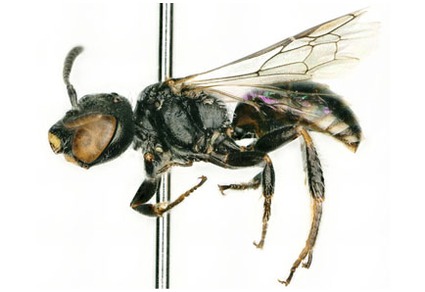
A revised classification is presented for a group of Andean bees from Argentina, Bolivia, and Peru previously assigned to Liphanthus Reed (Andrenidae: Panurginae: Protandrenini) based on a phylogenetic analysis of 108 morphological characters. The results indicate that these species form a well-supported clade with the previously monotypic genus Incasarus Gonzalez, Rasmussen & Engel, rendering Liphanthus, as currently delimited, paraphyletic. These species share several distinctive morphological characters, including dense to crowded punctation on the head and mesoscutum, strongly sculptured tegulae, and unique genitalic features not observed in Liphanthus. Accordingly, we transfer the following species to a redefined Incasarus: I. abotorabi (Mir Sharifi & Packer, 2019) comb. nov.; I. aeneiventris (Friese, 1908) comb. nov. treated here as the senior synonym of L. fritzi Mir Sharifi & Packer, 2019 syn. nov.; I. amblayensis (Mir Sharifi & Packer, 2019) comb. nov.; I. ancashensis (Mir Sharifi & Packer, 2019) comb. nov.; I. cochabambensis (Mir Sharifi & Packer, 2019) comb. nov.; and I. yrigoyeni (Packer, 2019) comb. nov. Additionally, we describe two new species: I. arequipensis Romero & Packer, sp. nov. from Peru, and I. ivari Romero & Packer, sp. nov. from Bolivia, producing a generic richness of nine species. The phylogenetic analysis suggests three distinct lineages within Incasarus. This study enhances our understanding of the diversity of Protandrenini in the Andes and highlights the continued value of museum material and new field sampling for the discovery of diversity within poorly understood lineages.
References
- Arengo, F., Porzecanski, A.L., Blair, M.E., Amato, G., Filardi, C. & Sterling, E.J. (2017) The essential role of museums in biodiversity conservation. In: The Future of Natural History Museums. Routledge, London, pp. 82–100. https://doi.org/10.4324/9781315531892-6
- Arias, J.S. (2025) setk.run: a TNT script to estimate concavity constants under implied weighting. [unpublished script]
- Ascher, J.S. & Pickering, J. (2025) Discover Life bee species guide and world checklist (Hymenoptera: Apoidea: Anthophila). Available from: https://www.discoverlife.org/ (accessed 11 Dec 2025)
- Bossert, S. & Neff, J.L. (2022) Seven replacement names for bees in the genus Protandrena Cockerell, 1896 (Hymenoptera: Andrenidae: Panurginae). Pan-Pacific Entomologist, 98 (3), 226–229. https://doi.org/10.3956/2022-98.3.226
- Bossert, S., Wood, T.J., Patiny, S., Michez, D., Almeida, E.A.B., Minckley, R.L., Packer, L., Neff, J.L., Copeland, R.S., Straka, J., Pauly, A., Griswold, T., Brady, S.G., Danforth, B.N. & Murray, E.A. (2022) Phylogeny, biogeography and diversification of the mining bee family Andrenidae. Systematic Entomology, 47 (2), 283–302. https://doi.org/10.1111/syen.12530
- Brothers, D.J. (1976) Modifications of the metapostnotum and origin of the “propodeal triangle” in Hymenoptera Aculeata. Systematic Entomology, 1 (3), 177–182. https://doi.org/10.1111/j.1365-3113.1976.tb00036.x
- Cockerell, T.D.A. (1896) The bees of the genus Andrena found in New Mexico. Annals and Magazine of Natural History, Series 6, 18, 78–92. https://doi.org/10.1080/00222939608680413
- Ducke, A. (1907) Beitrag zur Kenntnis der Solitärbienen Brasiliens. (Hym.). Zeitschrift für Systematische Hymenopterologie und Dipterologie, 7, 361–368.
- Ducke, A. (1912) Die natürlichen Bienengenera Südamerikas. Zoologische Jahrbücher, Abteilung für Systematik, Geographie und Biologie der Tiere, 34, 51–116.
- Evenhuis, N.L. (2009) The insect and spider collections of the world website. Available from: http://hbs.bishopmuseum.org/codens/ (accessed 7 March 2025)
- Felsenstein, J. (1985) Confidence limits on phylogenies: an approach using the bootstrap. Evolution, 39 (4), 783–791. https://doi.org/10.1111/j.1558-5646.1985.tb00420.x
- Ferrari, R.R. & Packer, L. (2020) Morphological phylogeny and review of the generic classification of Colletinae (Hymenoptera: Colletidae). Zoological Journal of the Linnean Society, 193 (1), 199–216. https://doi.org/10.1093/zoolinnean/zlaa128
- Friese, H. (1908) Die Apidae (Blumenwespen) von Argentina nach den Reisenergebnissen der Herren A.C. Jensen-Haarup und P. Jörgensen in den Jahren 1904–1907. Flora und Fauna, 10, 1–94. https://doi.org/10.5962/bhl.title.14257
- Gerstaecker, A. (1868) Psaenythia, eine neue Bienengattung mit gezähnten Schienensporen. Archiv für Naturgeschichte, 34 (1), 111–137.
- Goloboff, P.A. (1993) Estimating character weights during tree search. Cladistics, 9, 83–91. https://doi.org/10.1111/j.1096-0031.1993.tb00209.x
- Goloboff, P.A. (2022) From observations to optimal phylogenetic trees: phylogenetic analysis of morphological data. Vol. 1. CRC Press, Boca Raton, 298 pp. https://doi.org/10.1201/9781003220084
- Goloboff, P.A. (2022) Refining phylogenetic analyses: phylogenetic analysis of morphological data. Vol. 2. CRC Press, Boca Raton, 312 pp. https://doi.org/10.1201/9780367823412
- Goloboff, P.A. & Morales, M.E. (2023) TNT version 1.6, with a graphical interface for MacOS and Linux, including new routines in parallel. Cladistics, 39 (2), 144–153. https://doi.org/10.1111/cla.12524
- Gonzalez, V.H. & Engel, M.S. (2011) Andinopanurgus, a new Andean subgenus of Protandrena (Hymenoptera: Andrenidae). ZooKeys, 126, 57–76. https://doi.org/10.3897/zookeys.126.1676
- Gonzalez, V.H., Rasmussen, C. & Engel, M.S. (2013) Incasarus garciai, a new genus and species of panurgine bees from the Peruvian Andes (Hymenoptera: Andrenidae). Journal of Melittology, 8, 1–9. https://doi.org/10.17161/jom.v0i8.4506
- Gonzalez, V.H., Rasmussen, C. & Engel, M.S. (2014) A new species of Liphanthus from Peru (Hymenoptera: Andrenidae). Journal of Melittology, 31, 1–9. https://doi.org/10.17161/jom.v0i31.4720
- Harris, R.A. (1979) A glossary of surface sculpturing. Occasional Papers in Entomology, 28, 1–31.
- Lucas-de-Oliveira, B. & Moure, J.S. (1963) Nova posição sistemática para Rhophitulus testaceus Ducke, 1907 (Hymenoptera: Apoidea). Anais da Academia Brasileira de Ciências, 35 (4), 575–584.
- Meira, O.M., Beutel, R.G., Pohl, H., van de Kamp, T., Almeida, E.A. & Boudinot, B.E. (2024) Bee morphology: a skeletomuscular anatomy of Thyreus (Hymenoptera: Apidae). Journal of Morphology, 285 (8), e21751. https://doi.org/10.1002/jmor.21751
- Michener, C.D. (2007) The bees of the world. 2nd Edition. Johns Hopkins University Press, Baltimore, 953 pp.
- Mir Sharifi, N., Graham, L. & Packer, L. (2019) Fifteen new species of Liphanthus Reed (Hymenoptera: Andrenidae) with two submarginal cells. Zootaxa, 4645 (1), 1–80. https://doi.org/10.11646/zootaxa.4645.1.1
- Monckton, S.K. (2016) A revision of Chilicola (Heteroediscelis), a subgenus of xeromelissine bees (Hymenoptera: Colletidae) endemic to Chile. ZooKeys, 591, 1–137. https://doi.org/10.3897/zookeys.591.7731
- Moure, J.S., Urban, D. & Melo, G.A.R. (2022) Protandrenini Robertson, 1904. In: Moure, J.S., Urban, D. & Melo, G.A.R. (Orgs.), Catalogue of Bees (Hymenoptera, Apoidea) in the Neotropical Region. Online Version. Available from: https://www.moure.cria.org.br/catalogue (accessed 18 April 2026)
- Nixon, K.C. (1999) The parsimony ratchet, a new method for rapid parsimony analysis. Cladistics, 15 (4), 407–414. https://doi.org/10.1111/j.1096-0031.1999.tb00277.x
- Nixon, K.C. (2004) ASADO, TNT-MrBayes Slaver version 2. Made available through the author. Available from http://www.cladistics.com (accessed 1 November 2020)
- Packer, L. (2021) Two new species of Andinopanurgus (Hymenoptera: Andrenidae: Panurginae), with a description of the female of A. amyae. Journal of Melittology, 101, 1–19. https://doi.org/10.17161/jom.i101.13338
- Plant, J. & Dubitzky, A. (2008) Relaxing bee specimens: a quick and easy method. Entomologica Austriaca, 15, 41–44.
- Prentice, M.A. (1998) The comparative morphology and phylogeny of apoid wasps (Hymenoptera: Apoidea). Unpublished PhD thesis, University of California, Berkeley, 1439 pp.
- Ramos, K.D.S. (2014) Taxonomic revision of Parasarus (Hymenoptera: Apidae s.l.: Protandrenini), a South American genus of bees. Zoologia (Curitiba), 31, 503–515. https://doi.org/10.1590/S1984-46702014000500011
- Ramos, K.S. & Ruz, L. (2015) A new bee species of the genus Austropanurgus Toro (Andreninae: Protandrenini) from Chile. In: Aguiar, A.J.C., Gonçalves, R.B. & Ramos, K.S. (Orgs.), Ensaios sobre as abelhas da Região Neotropical: homenagem aos 80 anos de Danuncia Urban. Editora UFPR, Curitiba, pp. 195–203.
- Ramos, K.S. & Melo, G.A.R. (2021) Three new genera of Protandrenini bees from South America (Hymenoptera: Apidae: Andreninae). Revista Brasileira de Entomologia, 65, e20210096. https://doi.org/10.1590/1806-9665-rbent-2021-0096
- Ramos, K.S. & Rozen, J.G. (2014) Psaenythisca, a new genus of bees from South America (Apoidea: Andrenidae: Protandrenini), with a description of the nesting biology and immature stages of one species. American Museum Novitates, 3800, 1–32. https://doi.org/10.1206/3800.1
- Roig-Alsina, A. (1993) The evolution of the apoid endophallus, its phylogenetic implications, and functional significance of the genital capsule (Hymenoptera: Apoidea). Bollettino di Zoologia, 60 (1), 169–183. https://doi.org/10.1080/11250009309355807
- Robinson, S.J. (2023) A taxonomic revision of the subgenus Protandrena (Pterosarus) (Hymenoptera: Andrenidae) in Canada and the United States. Unpublished M.Sc. thesis, University of Manitoba, Winnipeg, 303 pp.
- Reed, E.C. (1894) Entomlojía [sic] Chilena. Anales de la Universidad [Santiago, Chile], 85, 599–653.
- Ruz, L. (1980) Pseudosarus, nuevo género de Panurginae chileno (Hymenoptera: Andrenidae). Revista Chilena de Entomología, 10, 25–28.
- Ruz, L. (1986) Classification and phylogenetic relationships of the panurgine bees (Hymenoptera: Andrenidae). Unpublished Ph.D. dissertation, University of Kansas, Lawrence, 303 pp.
- Ruz, L. & Toro, H. (1983) Revision of the bee genus Liphanthus (Hymenoptera: Andrenidae). University of Kansas Science Bulletin, 52, 235–299.
- Santos, B.F., Payne, A., Pickett, K.M. & Carpenter, J.M. (2014) Phylogeny and historical biogeography of the paper wasp genus Polistes (Hymenoptera: Vespidae). Cladistics, 31 (5), 535–549. https://doi.org/10.1111/cla.12103
- Shorthouse, D.P. (2010) SimpleMappr, an online tool to produce publication-quality point maps. Available from: https://www.simplemappr.net/ (accessed 10 June 2025)
- Suarez, A.V. & Tsutsui, N.D. (2004) The value of museum collections for research and society. BioScience, 54 (1), 66–74. https://doi.org/10.1641/0006-3568(2004)054[0066:TVOMCF]2.0.CO;2
- Tapia, D. & Ruz, L. (2003) Cuatro nuevas especies de abejas del género Liphanthus (Hymenoptera: Andrenidae) para Chile y extensión de su distribución geográfica. In: Melo, G.A.R. & Alves-dos-Santos, I. (Eds.), Apoidea Neotropica: homenagem aos 90 anos de Jesús Santiago Moure. UNESC, Criciúma, pp. 51–57.
- Toro, H. (1980) Austropanurgus, nuevo género de Panurginae chileno (Andrenidae, Apoidea). Anales del Museo de Historia Natural de Valparaíso, 13, 209–212.
- Toro, H. (1989) Contribución al conocimiento de los Panurginae chilenos (Apoidea: Andrenidae). Acta Entomológica Chilena, 15, 229–232.
- Vivallo, F. (2008) Liphanthus Reed, 1894 (Hymenoptera: Andrenidae: Protandrenini): two new Argentine species and keys to the species of the subgenera Liphanthus s. str. and Melaliphanthus Ruz & Toro, 1983. Zootaxa, 1854 (1), 55–62. https://doi.org/10.11646/zootaxa.1854.1.5