

Abstract
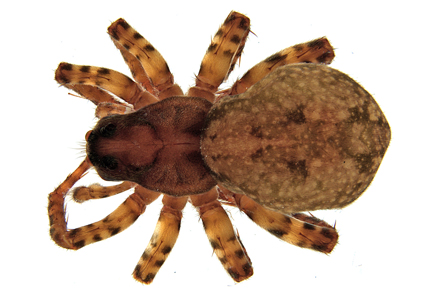
Artoria Thorell, 1877 is revised for the Northern Territory and Queensland. Three species are recorded from the Northern Territory: A. parvula Thorell, 1877 (♂♀, type species), A. superelliptica sp. nov. (♀) and A. vectis sp. nov. (♂♀). Twenty-seven species (including 18 new ones) are recorded from Queensland: A. albopilata (Urquhart, 1893) (♂♀), A. berenice (L. Koch, 1877) (♂♀), A. bicornuta sp. nov. (♂), A. catinata sp. nov. (♂♀), A. coclearia sp. nov. (♂♀), A. cunicularia sp. nov. (♂♀), A. geniculata sp. nov. (♂♀), A. globula sp. nov. (♂♀), A. grahammilledgei Framenau & Baehr, 2018 (♂♀), A. halterata sp. nov. (♀), A. hamifera sp. nov. (♂♀), A. laciniata sp. nov. (♀), A. lineata (L. Koch, 1877) (♂♀), A. lingulata sp. nov. (♂♀), A. mckayi Framenau, 2002 (♂♀), A. nasuta sp. nov. (♂), A. orcina sp. nov. (♂♀), A. proboscidea sp. nov. (♂♀), A. quadrata Framenau, 2002 (♂♀), A. reniformis sp. nov. (♀), A. scapulata sp. nov. (♀), A. semicircularis sp. nov. (♂), A. terania Framenau & Baehr, 2018 (♂♀), A. triangularis Framenau, 2002 (♂♀), A. velata sp. nov. (♂), A. victoriensis Framenau, Gotch & Austin, 2006 (♂♀) and A. werrikimbe sp. nov. (♂♀). This study also added 13 new species of Artoria to New South Wales, seven of these species endemic to the state—A. abscondita sp. nov. (♀), A. ancorata sp. nov. (♀), A. cucurbita sp. nov. (♀), A. limitata sp. nov. (♀), A. longinqua sp. nov. (♀), A. serpentidens sp. nov. (♂♀), and A. tenuis sp. nov. (♀), and one also occurring in the Australian Capital Territory—A. pedroi sp. nov. (♂♀). Summing up, 39 species are taxonomically treated in this paper, including 28 new ones. In addition, we propose the beaury and lingulata species-groups, and redefine the lineata species-group based on male and female genital characters.
References
- Basset, Y., Cizek, L., Cuénoud, P., Didham, R.K., Guilhaumon, F., Missa, O., Novotny, V., Ødegaard, F., Roslin, T., Schmidl, J., Tishechkin, A.K., Winchester, N.N., Roubik, D.W., Aberlenc, H.-P., Bail, J., Barrios, H., Bridle, J.R., Castaño-Meneses, G., Corbara, B., Curletti, G., Duarte Da Rocha, W., De Bakker, D., Delabie, J.H.C., Dejean, A., Fagan, L.L., Floren, A., Kitching, R.L., Medianero, E., Miller, S.E., Gama De Oliveira, E., Orivel, J., Pollet, M., Rapp, M., Ribeiro, S.P., Roisin, Y., Schmidt, J.B., Sørensen, L. & Leponce, M. (2012) Arthropod Diversity in a Tropical Forest. Science, 338 (6113), 1481–1484. https://doi.org/10.1126/science.1226727
- Berland, L. (1938) Araignées des Nouvelles-Hébrides. Annales de la Société entomologique de France, 107 (2), 121–190. https://doi.org/10.1080/21686351.1938.12278981
- Brown, R.W. (1954) Composition of scientific words. A manual of methods and a lexicon of materials for the practice of logotechnics. US National Museum, Washington, 882 pp.
- Bryant, L.M. & Krosch, M.N. (2016) Lines in the land: A review of evidence for eastern Australia’s major biogeographical barriers to closed forest taxa. Biological Journal of the Linnean Society, 119 (2), 238–264. https://doi.org/10.1111/bij.12821
- Crisp, M.D., Laffan, S., Linder, H.P. & Monro, A. (2001) Endemism in the Australian flora. Journal of Biogeography, 28, 183–198. https://doi.org/10.1046/j.1365-2699.2001.00524.x
- Dahl, F. (1908) Die Lycosiden oder Wolfspinnen Deutschlands und ihre Stellung im Haushalte der Natur. Nach statistischen Untersuchungen dargestellt. Nova Acta, Abhandlungen der Kaiserlich Leopoldinisch-Carolinischen Deutschen Akademie der Naturforscher, 88, 175–678.
- Dondale, C.D. & Redner, J.H. (1990) The Wolf Spiders, Nurseryweb Spiders, and Lynx Spiders of Canada and Alaska. Araneae: Lycosidae, Pisauridae, and Oxyopidae. Agriculture Canada, Ottawa, 383 pp.
- Edwards, D.L. & Melville, J. (2010) Phylogeographic analysis detects congruent biogeographic patterns between a woodland agamid and Australian wet tropics taxa despite disparate evolutionary trajectories. Journal of Biogeography, 37 (8), 1543–1556. https://doi.org/10.1111/j.1365-2699.2010.02293.x
- Fauna Portal Australia. (2025) Fauna Portal Australia, genus Artoria. Available from: https://faunaportal.org/projects/fauna-ofaustralia/genus/araneae-spiders/lycosidae-wolf-spiders/artoria/ (accessed 10 June 2025)
- Flores‐Rentería, L., Rymer, P.D., Ramadoss, N. & Riegler, M. (2021) Major biogeographic barriers in eastern Australia have shaped the population structure of widely distributed Eucalyptus moluccana and its putative subspecies. Ecology and Evolution, 11 (21), 14828–14842. https://doi.org/10.1002/ece3.8169
- Framenau, V.W. (2002) Review of the wolf spider genus Artoria Thorell (Araneae: Lycosidae). Invertebrate Systematics, 16 (2), 209–235. https://doi.org/10.1071/IT01028
- Framenau, V.W., Manderbach, R. & Baehr, M. (2002) Riparian gravel banks of upland and lowland rivers in Victoria (south-east Australia): arthropod community structure and life-history patterns along a longitudinal gradient. Australian Journal of Zoology, 50, 103–123. https://doi.org/10.1071/ZO01039
- Framenau, V.W. (2005) The wolf spider genus Artoria Thorell in Australia: New synonymies and generic transfers (Araneae, Lycosidae). Records of the Western Australian Museum, 22 (4), 265–292. https://doi.org/10.18195/issn.0312-3162.22(4).2005.265-292
- Framenau, V.W. (2007) Revision of the new Australian genus Artoriopsis in a new subfamily of wolf spiders, Artoriinae (Araneae: Lycosidae). Zootaxa, 1391 (1), 1–34. https://doi.org/10.11646/zootaxa.1391.1.1
- Framenau, V.W. (2008) A new wolf spider species of the genus Artoria from Western Australia (Araneae: Lycosidae). Records of the Western Australian Museum, 24 (4), 363–368. https://doi.org/10.18195/issn.0312-3162.24(4).2008.363-368
- Framenau, V.W. & Baehr, B.C. (2018) The wolf spider genus Artoria in New South Wales and the Australian Capital Territory, Australia (Araneae, Lycosidae, Artoriinae). Evolutionary Systematics, 2 (2), 169–241. https://doi.org/10.3897/evolsyst.2.30778
- Framenau, V.W., Castanheira, P.d.S. & Yoo, J.-S. (2023) The artoriine wolf spiders of Australia: The new genus Kochosa and a key to genera (Araneae: Lycosidae). Zootaxa, 5239 (3), 301–357. https://doi.org/10.11646/zootaxa.5239.3.1
- Gaston, K.J. (2000) Global patterns in biodiversity. Nature, 405 (6783), 220–227. https://doi.org/10.1038/35012228
- Guy, Y. (1966) Contribution à l’étude des araignées de la famille des Lycosidae et de la sous-famille des Lycosinae avec étude spéciale des espèces du Maroc. Travaux de l’Institut Scientifique Chérifien, Série Zoologie, 33, 1–172.
- Harvey, M.S. (2002) Short-range endemism among the Australian fauna: Some examples from non-marine environments. Invertebrate Systematics, 16 (4), 555–570. https://doi.org/10.1071/IS02009
- Koch, L. (1871) Die Arachniden Australiens nach der Natur beschrieben und abgebildet. Bauer & Raspe, pp. 649–704. https://doi.org/10.5962/bhl.title.121660
- Koch, L. (1877) Die Arachniden Australiens nach der Natur beschrieben und abgebildet. Bauer & Raspe, pp. 889–968. https://doi.org/10.5962/bhl.title.121660
- Koch, L. (1878) Die Arachniden Australiens nach der Natur beschrieben und abgebildet. Verlag von Bauer & Raspe, pp. 969–1044. https://doi.org/10.5962/bhl.title.121660
- Li, Z., Framenau, V.W. & Zhang, Z.S. (2012) First record of the wolf spider subfamily Artoriinae and the genus Artoria from China (Araneae: Lycosidae). Zootaxa, 3235 (1), 35–44. https://doi.org/10.11646/zootaxa.3235.1.3
- Levi, H.W. (1988) The Neotropical orb-weaving spiders of the genus Alpaida (Araneae: Araneidae). Bulletin of the Museum of Comparative Zoology at Harvard College, 151, 365–487.
- Marsh, J.R., Bal, P., Fraser, H., Umbers, K., Latty, T., Greenville, A., Rumpff, L. & Woinarski, J.C.Z. (2022) Accounting for the neglected: Invertebrate species and the 2019–2020 Australian megafires. Global Ecology and Biogeography, 31 (11), 2120–2130. https://doi.org/10.1111/geb.13550
- Marsh, J.R. (2023) Five new species of mouse spiders in the genus Missulena (Mygalomorphae: Actinopodidae) from national parks and conservation reserves in Western Australia. Australian Journal of Taxonomy, 36, 1–23. https://doi.org/10.54102/ajt.40aok
- McKay, R.J. (1973) The wolf spiders of Australia (Araneae: Lycosidae): 1. The bicolor group. Memoirs of the Queensland Museum, 16 (3), 375–398.
- McKay, R.J. (1985) Lycosidae. In: Walton, D.W. (Ed.), Zoological Catalogue of Australia. Vol. 3. Arachnida, Mygalomorphae, Araneomorphae in Part, Pseudoscorpionida, Amblypygida, Palpigradi. Australian Government Publishing Service, Canberra, pp. 73–88. https://doi.org/10.1163/9789004612693_027
- Murphy, N.P., Framenau, V.W., Donnellan, S.C., Harvey, M.S., Park, Y.-C. & Austin, A.D. (2006) Phylogenetic reconstruction of the wolf spiders (Araneae: Lycosidae) using sequences from the 12S rRNA, 28S rRNA and NADH1 genes: Implications for classification, biogeography and the evolution of web building behavior. Molecular Phylogenetics and Evolution, 38 (3), 583–602. https://doi.org/10.1016/j.ympev.2005.09.004
- Piacentini, L.N. & Ramírez, M.J. (2019) Hunting the wolf: A molecular phylogeny of the wolf spiders (Araneae, Lycosidae). Molecular Phylogenetics and Evolution, 136, 227–240. https://doi.org/10.1016/j.ympev.2019.04.004
- Ponder, W.F. & Colgan, D.J. (2002) What makes a narrow-range taxon? Insights from Australian freshwater snails. Invertebrate Systematics, 16 (4), 571. https://doi.org/10.1071/IT01043
- Prado, A.W. do, Baptista, R.L.C. & Framenau, V.W. (2024) Taxonomy of the wolf spider genus Artoria in Western Australia (Araneae, Lycosidae, Artoriinae). Zootaxa, 5547 (1), 1–81. https://doi.org/10.11646/zootaxa.5547.1.1
- Rainbow, W.J. (1911) A census of Australian Araneidae. Records of the Australian Museum, 9 (2), 107–320. https://doi.org/10.3853/j.0067-1975.9.1911.928
- Roewer, C.F. (1951) Neue Namen einiger Araneen-Arten. Abhandlungen des Naturwissenschaftlichen Vereins zu Bremen, 32, 437–456.
- Roewer, C.F. (1955) Katalog der Araneae von 1758 bis 1940, bzw. 1954. 2. Band, Abt. A (Lycosaeformia, Dionycha [excl. Salticiformia]). 2. Band, Abt. B (Salticiformia, Cribellata) (Synonyma-Verzeichnis, Gesamtindex). Institut royal des Sciences naturelles de Belgique, Bruxelles, 1751 pp.
- Roewer, C.F. (1960) Araneae Lycosaeformia II (Lycosidae) (Fortsetzung und Schluss). Exploration Du Parc National de l’Upemba, Mission G. F. de Witte, 55, 519–1040.
- Rosauer, D.F., Catullo, R.A., VanDerWal, J., Moussalli, A. & Moritz, C. (2015) Lineage range estimation method reveals fine-scale endemism linked to Pleistocene stability in Australian rainforest herpetofauna. PLOS ONE, 10 (5), e0126274. https://doi.org/10.1371/journal.pone.0126274
- Russell-Smith, A. (1982) A revision of the genus Trabaea Simon (Araneae: Lycosidae). Zoological Journal of the Linnean Society, 74 (1), 69–91. https://doi.org/10.1111/j.1096-3642.1982.tb01141.x
- Sierwald, P. (1989) Morphology and ontogeny of female copulatory organs in American Pisauridae, with special reference to homologous features (Arachnida: Araneae). Smithsonian Contributions to Zoology, 484, 1–24. https://doi.org/10.5479/si.00810282.484
- Simon, E. (1909) Araneae, 2me partie. In: Michaelsen, W. & Hartmeyer, R. (Eds.), Die Fauna Südwest-Australiens. Ergebnisse der Hamburger südwest-australischen Forschungsreise 1905. Gustav Fischer, Jena, pp. 155–212.
- Sundevall, C.J. (1833) Conspectus Arachnidum. C.F. Berling, Londini Gothorum, 39 pp.
- Thorell, T. (1877) Studi sui Ragni Malesi e Papuani. I. Ragni di Selebes raccolti nel 1874 dal Dott. O. Beccari. Annali Del Museo Civico Di Storia Naturale Di Genova, 10, 341–637.
- Urquhart, A.T. (1893) On new species of Tasmanian Araneae. Papers and Proceedings of the Royal Society of Tasmania, 1892, 94–130. https://doi.org/10.26749/RVKK9927
- Vink, C.J. (2002) Lycosidae (Arachnida: Araneae). Fauna of New Zealand, 44, 1–94. https://doi.org/10.7931/J2/FNZ.44
- Wang, L.-Y., Framenau, V.W. & Zhang, Z.-S. (2021) A further study on the wolf spider subfamily Artoriinae from China (Araneae: Lycosidae). Zootaxa, 4964 (3). https://doi.org/10.11646/zootaxa.4964.3.8
- Wang, L.-Y. & Zhang, Z.-S. (2022) A new species of the genus Artoria Thorell, 1877 from China (Araneae: Lycosidae: Artoriinae). Acta Arachnologica Sinica, 31 (2), 109–113. https://doi.org/10.3969/j.issn.1005-9628.2022.02.008
- Wang, L.-Y., Zhang, Z.-S. & Peng, X.-J. (2019) First record of Artoria Thorell, 1877 (Araneae: Lycosidae) from Malaysia, with the description of a new species. Zootaxa, 4657 (2). https://doi.org/10.11646/zootaxa.4657.2.12
- World Spider Catalog. (2025) World Spider Catalog. Version 26. Natural History Museum Bern, online at http://wsc.nmbe.ch, accessed on 20 June 2025. https://doi.org/10.24436/2
- Yeates, D. & Monteith, G.B. (2008) The Invertebrate Fauna of the Wet Tropics: Diversity, Endemism and Relationships. In: Stork, N.E. & Turton, S.M. (Eds.), Living in a Dynamic Tropical Forest Landscape (1st ed.,). Blackwell Publishing, Malden, MA, USA, pp. 178–191. https://doi.org/10.1002/9781444300321.ch13