Abstract
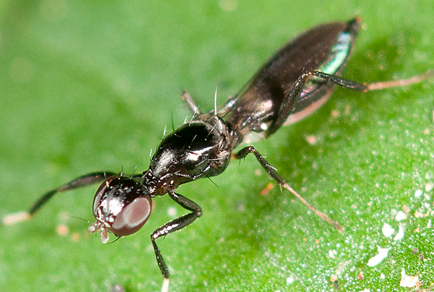
The former family Pseudopomyzidae is revised. Morphological characters and multiple genes are used to assess relationships among the families of Nerioidea, concluding that the family Pseudopomyzidae as currently defined is paraphyletic with respect to Cypselosomatidae Hendel; the family Cypselosomatidae is therefore redefined to include the Pseudopomyzidae. The subgeneric classification of the large genus Pseudopomyza Strobl is updated by synonymizing the subgenera Macalpinella Papp and Rhinopomyzella Hennig with Pseudopomyza s.s., and reinstating the subgenus Heluscolia (Harrison), resulting in four valid subgenera: Apops McAlpine, Dete McAlpine, Heluscolia and Pseudopomyza s.s. The subgenus Apops is composed of two previously included species (P. flavitarsis (Harrison) (New Zealand) and P. arenae McAlpine (Australia, Tasmania)) and three new species (P. chilensis Yau and Marshall (Chile), P. medianentis Yau and Marshall (Australia, Western Australia) and P. nigritarsis Yau and Marshall (New Zealand)). The subgenus Dete includes P. collessi McAlpine (Australia). The subgenus Heluscolia includes P. antipoda (Harrison) and P. brevis (Harrison), both from the New Zealand Subantarctic Islands. The subgenus Pseudopomyza includes P. aristata (Harrison) (New Zealand), P. atrimana (Meigen) (Palaearctic), P. brevicaudata (Harrison) (New Zealand), P. brevifacies (Papp) (Oriental and Palaearctic) and the P. nigrimana species group (formerly treated as the subgenus Rhinopomyzella). The P. nigrimana species group, shown here to be the sister group to P. atrimana, includes P. albimana (Hennig), P. nigrimana (Hennig) and fifteen new species (P. adunca Yau and Marshall, P. ampliata Yau and Marshall, P. angustifrons Yau and Marshall, P. binaevia Yau and Marshall, P. brunneicacumen Yau and Marshall, P. cordata Yau and Marshall, P. cyathiformis Yau and Marshall, P. flavicacumen Yau and Marshall, P. gambiformis Yau and Marshall, P. inflexa Yau and Marshall, P. machaera Yau and Marshall, P. parabinaevia Yau and Marshall, P. proboscis Yau and Marshall, P. prolata Yau and Marshall, P. simulatrix Yau and Marshall).
References
- Aczél, M.L. (1949) Notes on «Tylidae». I. The Palaearctical «Tylidae» (Syn.: Micropezidae, Dipt.) of the Hungarian National Museum (Nat. Hist.). Acta Zoologica Lilloana, 8, 161–196.
- Aczél, M.L. (1951) Morfologia externa y division sistematica de las «Tanypezidiformes» con sinopsis de las especies argentinas de «Tylidae» («Micropezidae») y «Neriidae» (Diptera). Acta Zoologica Lilloana, 11, 482–589.
- Aczél, M.L. (1954) Results of the Archbold Expeditions: Neriidae von Neuguinea (Diptera). Treubia, 22 (3), 505–532.
- Aczél, M.L. (1955) Nothybidae, a new family of Diptera. Treubia, 23, 1–18.
- Aczél, M.L. (1961) A revision of the American Neriidae (Diptera, Acalyptratae). Studia Entomologica, 4 (1–4), 257–345.
- Andersson, H. (1976) Revision of the genus Formicosepsis de Meijere (Diptera: Cypselosomatidae). Entomologica Scandinavica, 7, 175–185. https://doi.org/10.1163/187631276X00298
- Bayless, K.M., Trautwein, M.D., Meusemann, K., Shin, S., Petersen, M., Donath, A., Podsiadlowski, L., Mayer, C., Niehuis, O., Peters, R.S., Meier, R., Kutty, S.N., Liu, S., Zhou, X., Misof, B., Yeates, D.K., Wiegmann, B.M. (2021). Beyond Drosophila: resolving the rapid radiation of schizophoran flies with phylotranscriptomics. BMC Biology 19, 23. https://doi.org/10.1186/s12915-020-00944-8
- Becker, T. (1902b) Die Meigen’schen Typen der sogen. Muscidae acalypterae (Muscaria holometopa) in Paris und Wien [part]. Zeitschrift für Systematische Hymenopterologie und Dipterologie, 2, 289–320.
- Becker, T. (1905) Cyclorrhapha Schizophora: Holometopa. Pages 1–273 In: Becker, T., Bezzi, M., Kertész, K. & Stein, P. (eds.): Katalog der Paläarktischen Dipteren. Vol. 4, [i] + 328 pp., Budapest.
- Belgers, D. (2010) Een nieuwe vindplaats van Pseudopomyza atrimana (Meigen, 1830) van Nederland. [A new locality of Pseudopomyza atrimana (Meigen, 1830) in the Netherlands]. De Vliegenmepper 2010(2), 26–27 (in Dutch).
- Beuk, P.L.T. (2013) Family Pseudopomyzidae. In: Beuk, P.L.T. (ed.) Checklist of the Diptera of the Netherlands, https://diptera-info.nl/news.php?fam=Pseudopomyzidae (Date accessed: 10-Feb-2022).
- Bickel, D., Pape, T., Meier, R. (Eds.). (2009) Diptera Diversity: Status, Challenges and Tools. Leiden, The Netherlands: Brill. https://doi.org/10.1163/ej.9789004148970.I-459
- Blanchard, é. (1840) Histoire naturelle des insectes. Orthoptères, névroptères, hémiptères, hyménoptères, lépidoptères et diptères. Vol. 3. In: Laporte, F.L. de (Ed.), Histoire naturelle des animaux articulés. P. Duménil, Paris, pp. 1–672. https://doi.org/10.5962/bhl.title.59226
- Borowiec, M.L. (2016) AMAS: a fast tool for alignment manipulation and computing of summary statistics. PeerJ 4, e1660. https://doi.org/10.7717/peerj.1660
- Brues, C.T., Melander, A.L., Carpenter, F.M. (1954) Classification of insects: Keys to the living and extinct families of insects, and to the living families of other terrestrial arthropods. (Revised ed.). Bulletin of the Museum of Comparative Zoology, Harvard University, 108, 1–917.
- Buck, M. & McAlpine, D.K. (2010) 57: Pseudopomyzidae (pseudopomyzid flies). In: Brown, B.V., Borkent, A., Cumming, J.M., Woodley, N.E. & Zumbado, M.A. (Eds.), Manual of Central American Diptera. Vol. 2. NRC Research Press, Ottawa, pp. 821–825.
- Carvalho-Filho, F.S. & Esposito, M.C. (2011) Redescription of Pseudopomyzella flava Hennig (Diptera: Cypselosomatidae) and the first record from Brazil. Biota Neotropica, 11 (1), 195–198. https://doi.org/10.1590/S1676-06032011000100020
- Chandler, P. (1983) Pseudopomyza atrimana (Meigen) (Diptera: Pseudopomyzidae), a fly of acalypterate family new to the British list. Proceedings and Transactions of the British Entomological and Natural History Society, 16, 87–91.
- Chandler, P. (2021) An Update of the 1998 Checklist of Diptera of the British Isles. 440 pp. Dipterists Forum. Online PDF file, available at: https://dipterists.org.uk/sites/default/files/pdf/BRITISH%20ISLES%20CHECKLIST%202021_07.pdf [last accessed: 30-Jan-2022].
- Chvála, M. (2008) The types of Diptera (Insecta) described by Pater Gabriel Strobl. Studia Dipterologica, Suppl. 17, 281 pp. Ampyx-Verlag, Halle.
- Colless, D.H. & McAlpine, D.K. (1970) 34. Diptera. In: The Insects of Australia. Melbourne University Press, Carlton, pp. 656–740. https://doi.org/10.5479/si.00963801.37-1719.499
- Colless, D.H. & McAlpine, D.K. (1991) Chapter 39. Diptera (flies). In: The Insects of Australia. 2nd Edition. Melbourne University Press, Carlton, pp. 91–96.
- Collin, J. (1945) British Micropezidae (Diptera). Entomologist’s Record and Journal of Variation 57, 115–119.
- Crampton, G.C. (1944a) A comparative morphological study of the terminalia of male calypterate cyclorrhaphous Diptera and their acalypterate relatives. Bulletin of the Brooklyn Entomological Society, 39, 1–31.
- Crampton, G.C. (1944b) Suggestions for grouping the families of acalypterate cyclorrhaphous Diptera on the basis of the male terminalia. Proceedings of the Entomological Society of Washington, 46, 152–154.
- Cresson, E.T. (1912) Descriptions of Several New Neotropical Acalyptrate Diptera. Entomological News and Proceedings of the Entomological Society of the Academy of Natural Sciences of Philadelphia 23, 389–396.
- Cumming, J.M., Sinclair B.J. & Wood, D.M. (1995) Homology and phylogenetic implications of male genitalia in Diptera – Eremoneura, Insect Systematics & Evolution, 26(2), 120–151. https://doi.org/10.1163/187631295X00143
- Cumming, J.M. & Wood, D.M. (2017) Adult morphology and terminology. In: Kirk-Spriggs, A.H. & Sinclair, B.J. (Ed.), Manual of Afrotropical Diptera. Vol. 1. Introductory chapters and keys to Diptera families. Suricata 4. South African National Biodiversity Institute, Pretoria, pp. 89–133.
- Dikow, T. (2017) Apioceridae Ch.46. In: Kirk-Spriggs, A.H. & Sinclair, B.J. (Eds.), Manual of Afrotropical Diptera. Vol. 1I. Nematocerous Diptera and lower Brachycera. Suricata 5. South African National Biodiversity Institute, Pretoria, pp. 1057–1061.
- Edgar, R.C. (2004) MUSCLE: multiple sequence alignment with high accuracy and high throughput. Nucleic Acids Research, 32(5), 1792–1797. https://doi.org/10.1093/nar/gkh340
- Enderlein, G. (1922) Klassifikation der Micropeziden. Archiv für Naturgeschichte (A), 88, 140–229.
- Evenhuis, N.L. (1994) Catalogue of the fossil flies of the world (Insecta: Diptera). Backhuys Publishers Leiden. viii + 600 pp.
- Ferro, G.B. (2019) Systematics of the tribe Taeniapterini (Diptera: Micropezidae, Taeniapterinae) with a review of the genus Paragrallomyia Hendel (PhD thesis). University of Guelph. Available from: https://atrium.lib.uoguelph.ca/xmlui/handle/10214/17455
- Folmer, O., Black, M., Hoeh, W., Lutz, R., Vrijenhoek, R. (1994) DNA primers for amplification of mitochondrial cytochrome c oxidase subunit I from diverse metazoan invertebrates. Molecular Marine Biology and Biotechnology, 3, 294–299.
- Foottit, R.G., Maw, H.E.L., Havill, N.P., Ahern, R.G., Montgomery, M.E. (2009) DNA barcodes to identify species and explore diversity in the Adelgidae (Insecta: Hemiptera: Aphidoidea). Molecular Ecology Resources, 9, 188–195. https://doi.org/10.1111/j.1755-0998.2009.02644.x
- Frey, R. (1921) Studien über den bau des Mundes der niederen Diptera Schizophora nebst Bemerkungen über die Systematik dieser Dipterengruppe. Acta Societatis pro Fauna et Flora Fennica, 48 (3), 1–245.
- Frey, R. (1941) Brachycera (excl. Muscidae, Tachinidae). In: Enumeratio Insectorum Fenniae. VI Diptera. Bytesforening, Helsingfors, pp. 1–31.
- Frey, R. (1952) Über Chiropteromyza n. gen. und Pseudopomyza Strobl (Diptera, Haplostomata). Notulae Entomologicae, 32, 5–8.
- Gibson, J.F., Skevington, J.H., Kelso, S. (2010) Placement of Conopidae (Diptera) within Schizophora based on mtDNA and nrDNA gene regions. Molecular Phylogenetics and Evolution, 56, 91–103. https://doi.org/10.1016/j.ympev.2010.03.026
- Gibson, J.F., Kelso, S., Jackson, M.D., Kits, J.H., Miranda, G.F.G., Skevington J.F. (2011) Diptera-specific polymerase chain reaction amplification primers of use in molecular phylogenetic research. Annals of the Entomological Society of America, 104(5), 976–997. https://doi.org/10.1603/AN10153
- Gill, D.G. (1968) Family Heleomyzidae. In: Papavero, N. (ed.), A catalogue of the Diptera of the Americas south of the United States 85. Departamento de Zoologia, Secretaria de Agricultura, São Paulo, pp. 1–13.
- Goloboff P.A. & Catalano S.A. (2016) TNT version 1.5, including a full implementation of phylogenetic morphometrics. Cladistics, 32(3), 221–238. https://doi.org/10.1111/cla.12160
- Griffiths, G.C.D. (1972) The phylogenetic classification of Diptera Cyclorrhapha with reference to the structure of the male postabdomen. W. Junk N.V., Publishers, The Hague, 340 pp. https://doi.org/10.1007/978-94-017-5914-4_3
- Han, H., Ro, K., Choi, D., Kim, S. (2002) Molecular systematics of the Tephritoidea (Insecta: Diptera): Phylogenetic signal in 16S and 28S rDNAs for inferring relationships among families. Korean Journal of Biological Sciences 6: 145–151. https://doi.org/10.1080/12265071.2001.9647644
- Hackman, W. (1980) A check list of the Finnish Diptera. Notulae entomologicae, 60 (17–48), 117–162.
- Hackman, W. & Väisänen, R. (1985) The evolution and phylogenetic significance of the costal chaetotaxy in the Diptera. In: Annales zoologici fennici. Finnish Academy of Sciences, Societas Scientiarum Fennica, Societas pro Fauna et Flora Fennica and Societas Biologica Fennica Vanamo, Helsinki, pp. 169–203.
- Hajibabaei, M., Janzen, D.H., Burns, J.M., Hallwachs, W., Hebert, P.D.N. (2006) DNA barcodes distinguish species of tropical Lepidoptera. Proceedings of the National Academy of Sciences of the United States of America, 103, 968–971. https://doi.org/10.1073/pnas.0510466103
- Harrison, R.A. (1955) Part 1. Report on Diptera of Auckland and Campbell Islands. Pages 205– 231 In: Harrison, R.A., Alexander, C.P., Richards, O.W. & Oldroyd, H. The Diptera of Auckland and Campbell Islands. Records of the Dominion Museum, 2, 205–246.
- Harrison, R.A. (1959) Acalypterate Diptera of New Zealand. New Zealand. Department of Scientific and Industrial Research Bulletin, 128, vii + 382 pp.
- Harrison, R. A. (1976) The Arthropoda of the southern islands of New Zealand (9) Diptera. Journal of the Royal Society of New Zealand 6, 107–152. https://doi.org/10.1080/03036758.1976.10421469
- Hebert, P.D.N., Penton, E.H., Burns, J.M., Janzen, D.H., Hallwachs, W. (2004) Ten species in one: DNA barcoding reveals cryptic species in the Neotropical skipper butterfly Astraptes fulgerator. Proceedings of the National Academy of Sciences of the United States of America, 101, 14812–14817. https://doi.org/10.1073/pnas.0406166101
- Hebert, P.D., Dewaard, J.R., Zakharov, E.V., Prosser, S.W., Sones, J.E., McKeown, J.T., Mantle, B., La Salle, J.A. (2013) A DNA ‘barcode blitz’: Rapid digitization and sequencing of a natural history collection. PLoS ONE 8: e68535. https://doi.org/10.1371/journal.pone.0068535
- Hendel, F. (1902) Ueber die systematische Stellung der Dipterengattungen Pseudopomyza Strobl u. Rhicnoessa Lw. Wiener Entomologische Zeitung, 21, 261–264.
- Hendel, F. (1916) Beiträge zur Systematik der Acalyptraten Musciden (Dipt.). Entomologische Mitteilungen, 5 (9/12), 294–299.
- Hendel, F. (1922) Die paläarktischen Muscidae acalyptratae Girsch. Haplostomata Frey nach ihren Familien und Gattungen. I. Die Familien. Konowia, 1 (4–5), 146–160.
- Hennig, W. (1937) Uebersicht über die Arten der Neriiden und über die Zoogeographie dieser Acalyptraten-Gruppe. Stettiner Entomologische Zeitung, 98, 240–280.
- Hennig, W. (1952) Die Larviformen der Dipteren. Eine übersicht über die bisher bekannten Jugendstadien der zweiflügeligen Insecten. 3 Vols. Akademie-Verlag, Berlin, vii + 628 pp.
- Hennig, W. (1958) Die Familien der Diptera Schizophora und ihre phylogenetischen Verwandtschaftsbeziehungen. Beiträge zur Entomologie, 8, 505–688. https://doi.org/10.21248/contrib.entomol.8.5-6.505-688
- Hennig, W. (1965) Die Acalyptratae des Baltischen Bernsteins und ihre Bedeutung fur die Erforschung der phylogenetischen Entwicklung dieser Dipteren-Gruppe. Stuttgarter Beiträge zur Naturkunde, 145, 1–215.
- Hennig, W. (1969) Neue Gattungen und Arten der Acalyptratae. The Canadian Entomologist, 101, 589–633. https://doi.org/10.4039/Ent101589-6
- Hennig, W. (1971a) Die familien Pseudopomyzidae und Milichiidae im Baltischen Berstein (Diptera: Cyclorrhapha). Stuttgarter Beiträge zur Naturkunde 233:1–16.
- Hennig, W. (1971b) Neue Untersuchungen uber die Familien der Diptera Schizophora (Diptera: Cyclorrhapha). Stuttgarter Beiträge zur Naturkunde, 226, 1–76.
- Hennig, W. (1973) Ordnung Diptera (Zweiflugler). Handbuch der Zoologie, 4 (2) 2/31 (Lfg. 20), 1–227.
- Hennig, W. (1976) Das Hypopygium von Lonchoptera lutea Panzer und die phylogenetischen Verwandschaftsbezeihungen der Cyclorrhapha (Diptera). Stuttgarter Beiträge zur Naturkdunde, 283, 1–63.
- Hoang, D.T., Chernomor, O., von Haeseler, A., Minh, B.Q., Vinh, L.S. (2018) UFBoot2: Improving the ultrafast bootstrap approximation. Molecular Biology and Evolution, 35, 518–522. https://doi.org/10.1093/molbev/msx281.
- Hoffeins, W. & Woźnica, A.J. (2013) Description of new species Eopseudopomyza szadziewskii sp. n. and redescription of E. kuehnei Hennig, 1971 from Eocene Baltic amber (Diptera: Pseudopomyzidae). Polish Journal of Entomology, 82, 317–325. https://doi.org/10.2478/v10200-012-0045-4
- Ivanova, N.V., deWaard, J.R., Hebert, P.D.N. (2006) An inexpensive, automation-friendly protocol for recovering high-quality DNA. Molecular Ecology Notes, 6, 998–1002. https://doi.org/10.1111/j.1471-8286.2006.01428.x
- Jackson, M.D. (2019) Placement of Micropezinae (Micropezidae) on the Diptera Tree of Life: a molecular phylogenetic approach (PhD thesis). University of Guelph. Available from: http://hdl.handle.net/10214/15240
- Kahanpää, J. & Stuke, J-H. (2014) Checklist of the superfamilies Conopoidea, Diopsoidea and Nerioidea of Finland (Insecta, Diptera). ZooKeys, 441, 251–257. https://doi.org/10.3897/zookeys.441.7227
- Kalyaanamoorthy, S., Minh, B.Q., Wong, T.K.F., von Haeseler, A. Jermiin, L.S. (2017) ModelFinder: Fast model selection for accurate phylogenetic estimates. Nature Methods, 14, 587–589. https://doi.org/10.1038/nmeth.4285
- Koch, N.M., Soto, I.M., Ramírez, M.J. (2015) First phylogenetic analysis of the family Neriidae (Diptera), with a study on the issue of scaling continuous characters. Cladistics, 31 (2), 142–165. https://doi.org/10.1111/cla.12084
- Krivosheina, N.P. (1979) A new representative of the family Pseudopomyzidae from the Palaearctic Fauna and the taxonomic position of this family in the system of Diptera. Revue de I’Entomologie de I’URSS, 58, 179–189.
- Krivosheina, N.P. (1984) Family Pseudopomyzidae. In: Soós, A. & Papp, L. (Eds.), Catalogue of Palaearctic Diptera. Vol. 10, Clusiidae-Chloropidae. Akadémiai Kiadó, Budapest, p. 49.
- Krivosheina, N.P. (1999) 64. family – Pseudopomyzidae. Pages 500–503 In: Ler, P.A. (ed.) [Key to the insects of Russian Far East. Vol. VI. Diptera and Siphonaptera. Pt. 1.] In Russian. Dalnauka, Vladivostok, 665 pp.
- Larsson, A. (2014) AliView: a fast and lightweight alignment viewer and editor for large data sets. Bioinformatics, 30(22), 3276–3278. http://dx.doi.org/10.1093/bioinformatics/btu531.
- Lindsay, K.G. (2021) A revision of the genus Scipopus (Diptera, Micropezidae, Taeniapterinae) (MSc thesis). University of Guelph. Available from: https://atrium.lib.uoguelph.ca/xmlui/handle/10214/25787
- Lonsdale, O. (2020) Family groups of Diopsoidea and Nerioidea (Diptera: Schizophora)—Definition, history and relationships. Zootaxa, 4735 (1), 1–177. https://doi.org/10.11646/zootaxa.4735.1.1
- Lonsdale, O. (2021) Manual of North American Agromyzidae (Diptera, Schizophora), with revision of the fauna of the “Delmarva” states. ZooKeys, 1051,1–481. https://doi.org/10.3897/zookeys.1051.64603
- Maddison, W.P. & Maddison, D.R. (2015) Mesquite: a modular system for evolutionary analysis. Version 3.04. [http://mesquiteproject.org]
- Macquart, P.J.M. (1835) Histoire Naturelle des insectes. Diptères. Tome Deuxième. Roret, Paris, 703 or 710 pp., 12 pls. https://doi.org/10.5962/bhl.title.14274
- Macquart, P.J.M. (1843) Diptères exotiques nouveaux ou peu connus. Mémoires de la Societé Royale des Sciences, de l’Agriculture et des Arts de Lille, 2 (2), 162–460. [1842]
- Malloch, J.R. (1924) Notes on Australian Diptera. No.iii. Proceedings of the Linnean Society of New South Wales, 49, 329–338.
- Malloch, J.R. (1925) Notes on Australian Diptera. No.vi. Proceedings of the Linnean Society of New South Wales, 50, 80–97.
- Malloch, J.R. (1926) Notes on Oriental Diptera, with Descriptions of new species. The Philippine Journal of Science, 31 (4), 491–512.
- Malloch, J.R. (1932) Notes on Australian Diptera. No.xxxii. Proceedings of the Linnean Society of New South Wales, 57, 213–217.
- Malloch, J.R. (1933) An aberrant New Zealand borborid (Diptera, Borboridae). Stylops, 2, 260–262.
- Marques, D.W. & Rafael, J.A. (2016) Latheticomyia Wheeler (Diptera: Pseudopomyzidae) from Peru: new species, description of the male of L. longiterebra Hennig and a key to species. Zootaxa, 4093 (3), 424–434. https://doi.org/10.11646/zootaxa.4093.3.8
- Marshall, S.A. (2012) Flies: The Natural History and Diversity of Diptera. Firefly Books Ltd., Richmond Hill, Ontario, 616 pp.
- Mathis, W.N. (1989) Family Pseudopomyzidae. Page 470. In: Evenhuis, N.L. (ed.) (1989) Catalog of the Diptera of the Australasian and Oceanian regions. E.J. Brill, Leiden. 1155 pp.
- McAlpine, D.K. (1966) Description and biology of an Australian species of Cypselosomatidae (Diptera), with a discussion of family relationships. Australian Journal of Zoology, 14, 673–685. https://doi.org/10.1071/ZO9660673
- McAlpine, D.K. (1994) A new Australian species of pseudopomyzid fly (Diptera: Nerioidea) and the subgenera of Pseudopomyza. Proceedings of the Linnean Society of New South Wales, 114 (4), 181–187.
- McAlpine, D.K. (1996) Relationships and classification of the Pseudopomyzidae (Diptera: Nerioidea). Proceedings of the Linnean Society of New South Wales, 116, 223–232.
- McAlpine, D.K. (1997a) Gobryidae, a New Family of Acalyptrate Flies (Diptera: Diopsoidea), and a Discussion of Relationships of the Diopsoid Families. Records of the Australian Museum 49, 167–194. https://doi.org/10.3853/j.0067-1975.49.1997.1264
- McAlpine, D.K. (1997b) Relationships of the Megamerinidae. Beitrage zur Entomologie 47, 465–475. https://doi.org/10.21248/contrib.entomol.47.2.465-475
- McAlpine, D.K. (2019) The genus Pseudopomyza (Diptera: Nerioidea) in Tasmania, with description of a new species. Records of the Australian Museum, 71 (3), 87–94. https://doi.org/10.3853/j.2201-4349.71.2019.1674
- McAlpine, D.K. & Shatalkin A.I. (1998) Family Pseudopomyzidae. In: Papp, L. & Darvas, B. (Eds.), Contributions to a Manual of Palaearctic Diptera. Vol. 3. Higher Brachycera. Science Herald, Budapest, pp. 155–163.
- McAlpine, J.F. (1987) Chapter 55. Cypselosomatidae. In: McAlpine, J.F., Peterson, B.V., Shewell, G.E., Teskey, H.J., Vockeroth, J.R. & Wood, D.M. (Coords.), Manual of Nearctic Diptera. Vol 2. Agriculture Canada Monograph. No. 28. Biosystematics Research Institute, Ottawa, pp. 757–760.
- McAlpine, J.F. (1989) Phylogeny and classification of the Muscomorpha. In: McAlpine, J.F. & Wood, D.M. (Ed.), Manual of the Nearctic Diptera. Vol. 3. Research Branch, Agriculture Canada. Monograph No. 32. Biosystematics Research Institute, Ottawa, pp. 1397–1518.
- Md Yusof, N. A. (2020) A review of the stilt-legged fly subfamily Eurybatinae (Diptera: Micropezidae) (PhD thesis). University of Guelph. Available from: https://atrium.lib.uoguelph.ca/xmlui/handle/10214/18040
- Meigen, J.W. (1830) Systematische Beschreibung der bekannten europäischen zweiflügeligen Insekten. Sechster Theil. Schulz, Hamm. xi + 401 +[3] pp. https://doi.org/10.5962/bhl.title.12464
- Melander, A.L. (1913) A synopsis of the dipterous groups Agromyzinae, Milichiinae, Ochthiphilinae and Geomyzinae. Journal of the New York Entomological Society, 21, 219–272.
- Merz, B. (1998) Die Megamerinidae, Strongylophthalmyiidae, Pseudopomyzidae, Chyromyidae und Camillidae der Schweiz (Diptera, Acalyptrata). Mitteilungen der Entomologischen Gesellschaft Basel, 47 (4) (1997), 130–138.
- Miller, M.A., Pfeiffer, W., Schwartz, T. (2010) Creating the CIPRES Science Gateway for inference of large phylogenetic trees. In. Proceedings of the Gateway Computing Environments Workshop (GCE), 14 Nov. 2010, New Orleans, LA, pp. 1–8. https://doi.org/10.1109/GCE.2010.5676129
- Mortimer, N., Campbell, H.J., Tulloch, A.J., King, P.R., Stagpoole, V.M., Wood, R.A., Rattenbury, M.S., Sutherland, R., Adams,C.J., Collot, J., Seton, M. (2017) Zealandia: Earth’s Hidden Continent. GSA Today, v. 27, https://doi.org/10.1130/GSATG321A.1
- Nartshuk, E.P. (1977) On the evolution of phytophagy in Diptera. In: Gorodkov, K.B. (Ed.), Sistematika i evolyutsiya dvukrylykh nasekomykh [Systematics and evolution of Diptera (Insecta)]. Zoologicheskiy Institut Akademii Nauk SSSR, Leningrad, pp. 70–77. [in Russian]
- Nguyen, L.T., Schmidt, H.A., von Haeseler, A., Minh, B.Q. (2015) IQ-TREE: A Fast and Effective Stochastic Algorithm for Estimating Maximum-Likelihood Phylogenies. Molecular Biology and Evolution, 32(1), 268–274, https://doi.org/10.1093/molbev/msu300
- Nixon, K.C. (2002) Winclada version 1.00.08. Published by the author, Ithaca, New York. Available from http://www.cladistics.com/ (accessed 2 December 2016)
- Osten-Sacken, C.R., Semper, C. (1882) Diptera from the Philippine Islands / brought home by Dr. Carl Semper, and described by C. R. Osten Sacken. Berlin Entomologische Zeitschrift, Berlin, 1–112 pp. https://doi.org/10.5962/bhl.title.8561
- Pape, T., Blagoderov, V., Mostovski, M.B. (2011) Order Diptera Linnaeus, 1758. In: Zhang, Z.-Q. (Ed.), Animal biodiversity: An outline of higher-level classification and survey of taxonomic richness. Zootaxa, 3148 (1), pp. 222–229. https://doi.org/10.11646/zootaxa.3148.1.42
- Papp, L. (1998) Two dipterous families new to Hungary (Diptera: Pseudopomyzidae and Chiropteromyzidae). Folia Entomologica Hungarica, 59, 121–123.
- Papp, L. (2001) Pseudopomyzidae, Micropezidae. Pages 268–269 in Papp, L. (ed.) Checklist of the Diptera of Hungary. Hungarian Natural History Museum, Budapest. 550 pp.
- Papp, L. (2005) Some acalyptrate flies (Diptera) from Taiwan. Acta Zoologica Academiae Scientiarum Hungaricae, 51 (3), 187–213.
- Park, D.S., Suh, S.J., Oh, H.W., Hebert, P. (2010) Recovery of the mitochondrial COI barcode region in diverse Hexapoda through tRNA-based primers. BMC Genomics, 11, 423.
- Prado, A.P. (1984) Family Cypselosomatidae. In: Papavero, N., (Ed.), A Catalogue of the Diptera of the Americas South of the United States. Fasc. 49A. Departamento de Zoologia, Secretária da Agricultura, São Paulo, pp. 2.
- Prosser, S.W., deWaard J.R., Miller S.E., Herbert P.D.N (2016) DNA barcodes from century-old type specimens using next-generation sequencing. Molecular Ecology Resources, 16: 487–497. https://doi.org/10.1111/1755-0998.12474
- Rambaut, A. (2007) Figtree. Available from: http://tree.bio.ed.ac.uk/software/Figtree/ [accessed 25 Nov. 2020].
- Rogers, J.J.W. & Santosh, M. (2004) Continents and Supercontinents. Oxford: Oxford University.
- Roháček, J. (1981) První nález čeledi Pseudopomyzidae (Diptera) v Československu. First record of the family Pseudopomyzidae in Czechoslovakia. Časopis Slezského Muzea Opava (A) 30, 189–190 (in Czech, with English summary).
- Roháček, J. (2009) Pseudopomyzidae McAlpine, 1966. In: Jedlička, L., Kúdela, M. & Stloukalová, V. (eds): Checklist of Diptera of the Czech Republic and Slovakia. Electronic version 2. http://www.edvis.sk/diptera2009/ (Accessed 28 February 2022)
- Roháček, J. (2012a) A new record of mass occurrence of Pseudopomyza atrimana (Meigen), with notes on probable breeding habitat of the species (Diptera: Pseudopomyzidae). Casopis slezskeho zemskeho muzea (A), 61 (1), 3–10. https://doi.org/10.2478/v10210-012-0002-6
- Roháček, J. (2012b) The fauna of Pseudopomyzidae, Micropezidae, Megamerinidae and Psilidae (Diptera) in the Gemer area (Central Slovakia). Casopis slezskeho zemskeho muzea (A), 61 (2), 131–142.
- Rohdendorf, B.B. (1964) [Historical development of dipterous insects.] Trudy Paleontologischeskogo Instituta, 100, 1–311. [in Russian]
- Rohdendorf, B.B. (1974) The Historical Development of Diptera. University of Alberta Press, Edmonton, 360 pp. [English translation of Rohdendorf (1964)]
- Rohdendorf, B.B. (1977) The classification and phylogeny of Diptera. In: Gorodkov, K.B. (Ed.), Systematics and evolution of Diptera (Insecta). Academy of Sciences of USSR, Zoological Institute, Leningrad. pp. 81–88. [in Russian]
- Ronquist, F. & Huelsenbeck, J.P. (2003) MRBAYES 3: Bayesian phylogenetic inference under mixed models. Bioinformatics, 19: 1572–1574. https://doi.org/10.1093/bioinformatics/btg180
- Sabrosky, C.W. (1999) Family-Group Names in Diptera: An annotated catalog. MYIA, 10, 1–576.
- Schacht, W. (1997) Zweiflügler aus Bayern X (Diptera: Pseudopomyzidae, Micropezidae, Tanypezidae, Megamerinidae, Psilidae). Entomofauna, 17(14), 273–280.
- Shatalkin, A.I. (1994) Palaearctic species of Pseudopomyzidae (Diptera). Russian Entomological Journal, 3 (3–4), 129–145.
- Shtakelberg, A.A. (1969) Pseudopomyzidae. Pages 324–325 In: Bey-Bienko, G. Ja. (ed.) Определитель насекомых европейской части СССР. Двухкрылие, блохи. Vol 5. Part II. Nauka, Leningrad. 946 pp.
- Sinclair, B.J., Cumming, J.M., & Brooks, S.E. (2013). Male terminalia of Diptera (Insecta): a review of evolutionary trends, homology and phylogenetic implications. Insect Systematics & Evolution, 44(3–4), 373–415. https://doi.org/10.1163/1876312X-04401001
- Skibińska, E. & Chudzicka, E. (2007) Micropezidae, Pseudopomyzidae. Page 198. In: Bogdanowicz, W., Chudzicka, E., Pilipiuk, I. & Skibińska, E. (eds.) Fauna Polski – Charakterystyka i wykaz gatunków. Tom II [Fauna of Poland – Characteristics and checklist of species, Vol. II], Muzeum i Instytut Zoologii PAN, Warszawa, 505 pp.
- Spahr, U. (1985) Ergänzungen und Berichtigungen zu R. Keilbachs Bibliographie und Liste der Bernsteinfossilien—Ordnung Diptera. Stuttgarter Beiträge zur Naturkunde, Ser. B., 111, 1–146.
- Steyskal, G.C. (1970) The family position and additional description data concerning Tenuia nigripes Malloch (Diptera: Pseudopomyzidae). Pacific Insects, 12 (4), 871–873.
- Stuke, J.-H. (2009) Die artenarmen Familien der acalyptraten Zweiflügler in Niedersachsen und Bremen (Diptera: Acalyptratae). Drosera, 2008, 77–106.
- Strobl, P.G. (1893) Neue österreichische Muscidae Acalypterae. III. Theil. Wiener Entomologische Zeitung, 12, 280–285.
- Vockeroth, J.R. (1977) Family Pseudopomyzidae. Page 7. In: Delfinado, M.D. & Hardy, D.E. (eds) A Catalog of the Diptera of the Oriental Region, Volume III. Suborder Cyclorrhapha (excluding Division Aschiza). University Press of Hawaii, Honolulu, 854 pp.
- Westwood, J.O. (1840) Order XIII. Diptera Aristotle. (Antliata Fabricius. Halteriptera Clairv.) In his: An introduction to the modern classification of insects; founded on the natural habits and corresponding organisation of the different families. Synopsis of the genera of British insects. Longman, Orme, Brown, Green & Longmans, London, pp.125–154. https://doi.org/10.5962/bhl.title.12455
- Wheeler, W.M. (1956) Latheticomyia, a new genus of acalyptrate flies of uncertain family relationship. Proceedings of the United States National Museum, 106 (= No. 3368), 305–314. http://dx.doi.org/10.5479/si.00963801.106-3368.305
- Wiegmann, B.M., Trautwein, M.D., Winkler, I.S., Barr, N.B., Kim, J.W., Lambkin, C., Bertone, M.A., Cassel, B.K., Bayless, K.M., Heimberg, A.M., Wheeler, B.M., Peterson, K.J., Pape, T., Sinclair, B.J., Skevington, J.H., Blagoderov, V., Caravas, J., Kutty, S.N., Schmidt-Ott, U., Kampmeier, G.E., Thompson, F.C., Grimaldi, D.A., Beckenbach, A.T., Courtney, G.W., Friedrich, M., Meier, R., Yeates, D.K. (2011) Episodic radiations in the fly tree of life. Proceedings of the National Academy of Sciences, 108 (14), 5690–5695. https://doi.org/10.1073/pnas.1012675108
- Winkler, I.S., Rung, A. & Scheffer, S.J. (2010) Hennig’s orphans revisited: Testing morphological hypotheses in the “Opomyzoidea” (Diptera: Schizophora). Molecular Phylogenetics & Evolution, 54, 746–762. https://doi.org/10.1016/j.ympev.2009.12.016
- Yatoo, S.F., Maqbool, A., Wachkoo, A.A. (2022) Pseudopomyzidae—A family of Diptera new to the Indian fauna. Zootaxa, 5124 (1), 95–100. https://doi.org/10.11646/ZOOTAXA.5124.1.8
- Yau, T. & Marshall S.A. (2015) Enzymatic clearing agents as an alternative approach to macerating Diptera specimens. Fly Times, (55), 11–12