
Abstract
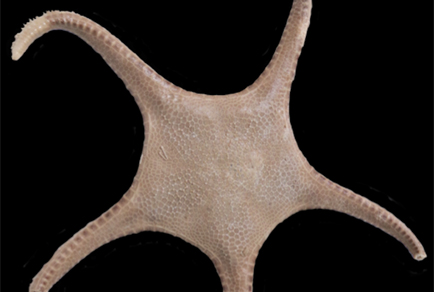
Bivalve pedicellariae are a prominent yet poorly understood morphological feature observed within specific groups within the Valvatida (Asteroidea) and have been used primarily as a taxonomic character. Seven new species, including the new genus Astrophylax which features prominent bivalve pedicellariae are described herein. In situ observations of shallow and deep-sea taxa provide possible insight into bivalve pedicellariae function. An overview of taxa which contain bivalve pedicellariae, primarily in the Goniasteridae but also the Oreasteridae and the Asteropseidae is also included. A survey of these taxa and their pedicellariae, including trends in abundance, biogeography, and depth provide further context for the understanding of these unusual characters, especially within the Goniasteridae and the Oreasteridae.
References
Agassiz, A. (1873) The homologies of pedicellariae. The American Naturalist, 7 (7), 398–406. https://doi.org/10.1086/271167
Alton, M. (1966) Bathymetric distribution of sea stars (Asteroidea) off the Northern Oregon coast. Journal of the Fisheries Research Board of Canada, 23 (11), 1673–1714. https://doi.org/10.1139/f66-158
Arai, M. & Fujita, T. (2021) Sea Stars of families Ophidiasteridae and Goniasteridae (Echinodermata: Asteroidea) from the Mesophotic Zone of the Ogasawara Islands, including two new species. Species Diversity, 26, 7–21. https://doi.org/10.12782/specdiv.26.7
Atkinson, L.J. & Sink, K.J. (2018) Field Guide to the Offshore Marine Invertebrates of South Africa. Malachite Marketing and Media, Pretoria, 498 pp. https://doi.org/10.15493/SAEON.PUB.10000001
Bell, F.J. (1908) Echinoderma. National Antarctic Expedition. Natural History, 4, 1–15, pls. 1–5.
Benham, W.B. (1909) Echinoderma (Science reports N.Z. Government Trawling Expedition). Records of the Canterbury Museum, 1 (2), 83–116.
Benham, W.B. (1911) Stellerids and echinoids from the Kermadec Islands. Transactions of the New Zealand Institute, 43, 140–163.
Bernasconi, I. (1956) Dos nuevos Equinodermos de la costa del Brasil. Neotropica, 2/8, 33–36.
Bernasconi, I. (1963) Asteroideos argentinos. 4. Familia Goniasteridae. Revista Museo Argentino de Ciencias Naturales Bernardino Rivadavia. Zoologia, 9 (1), 1–25, pls. 1–5.
Blake, D.B. (1980) On the affinities of three small sea star families. Journal of Natural History, 14, 163–182. https://doi.org/10.1080/00222938000770171
Blake, D.B. (1987) Classification and phylogeny of post-Paleozoic sea stars (Asteroidea: Echinodermata). Journal of Natural History, 21, 481–528. https://doi.org/10.1080/00222938700771141
Blake, D.B. (2009) Re-evaluation of the Devonian family Helianthasteridae Gregory, 1899 (Asteroidea: Echinodermata). Paläontologische Zeitschrift, 83, 293–308. https://doi.org/10.1007/s12542-009-0020-x
Blake, D.B. (2010) Comptoniaster adamsi nov. sp. (Echinodermata, Asteroidea) from the middle Cretaceous of Texas and its phylogenetic position. Geobios, 43 (2), 179–190. https://doi.org/10.1016/j.geobios.2009.09.005
Breton, G. (1992) Les goniasteridae (Asteroidea, Echinodermata) Jurassiques et Cretaces de France: taphonomie, systematique, biostratigraphie, paleobiogeographie, evolution. Thèse de Doctorat d’ Etat Sciences, Université de Caen, Editions du Museum du Havre, Cité du Havre, 588 pp.
Breton, G. (1996) Les pédicellaires alvéolaires sont-ils arrivés chez les Goniasteridae (Echinodermata: Asteroidea) au Crétacé par voie épidémique? Bulletin de la Société zoologique de France, 121 (1), 87–92.
Briggs, J.C. & Bowen, B.W. (2013) Marine shelf habitat: biogeography and evolution. Journal of Biogeography, 40 (6), 1023–1035. https://doi.org/10.1111/jbi.12082
Bruzelius, N. (1805) Dissertatio sistens species cognitas asteriarum, quamr. sub praesidio A.J. Retzii. exhibet N. Bruzelius. Lundae, 37 pp.
Cairns, S.D. (1991) The Marine Fauna of New Zealand: Stylasteridae (Cnidaria: Hydroida). New Zealand Oceanographic Institute Memoir, 98, 1–179, pls. 1–77.
Campbell, A.C. (1983) Form and Function of Pedicellariae. Echinoderm Studies, 1, 139–167. https://doi.org/10.1201/9781003079071-6
Campbell, A.C. & Rainbow, P.S. (1976) The role of pedicellariae in preventing barnacle settlement on the sea–urchin test. Marine Behaviour and Physiology, 4, 253–260. https://doi.org/10.1080/10236247709386957
Carey, A.G. (1972) Food sources of sublittoral, bathyal and abyssal asteroids in the Northeast Pacific Ocean. Ophelia, 10, 35–47. https://doi.org/10.1080/00785326.1972.10430100
Castell y Tickell, S., Low, N.H.N., Lamb, R.W., Brandt, M. & Witman, J.D. (2022) Distribution and feeding ecology of sea stars in the Galápagos rocky subtidal zone. Experimental Marine Biology and Ecology, 553. https://doi.org/10.1016/j.jembe.2022.151754
Chen, T.Y. (1932) Notes on the Echinodermata of Amoy. Reports of the Marine Biological Association of China, 1, 65–74.
Chia, F.-S. & Amerongen, H. (1975) On the prey-catching pedicellariae of a starfish, Stylasterias forreri (deLoriol). Canadian Journal of Zoology, 53 (6), 748–755. https://doi.org/10.1139/z75-089
Clark, A.M. (1951) Some Echinoderms from South Africa. Transactions of the Royal Society of South Africa, 33 (2), 193–221. https://doi.org/10.1080/00359195109519884
Clark, A.M. (1962) Asteroidea. B.A.N.Z. Antarctic Research Expedition 1929–1931, B9, 68–70.
Clark, A.M. (1967) Notes on asteroids in the British Museum (Natural History) V. Nardoa and some other ophidiasterids. Bulletin of the British Museum (Natural History) Zoology, 15 (4), 169–198. https://doi.org/10.5962/bhl.part.27517
Clark, A.M. (1984) Notes on Atlantic and other Asteroidea. 4. Families Poraniidae and Asteropseidae. Bulletin of the British Museum of Natural History (Zoology), 47 (1), 19–51. https://doi.org/10.5962/p.271706
Clark, A.M. (1993) An index of names of recent Asteroidea. Part 2: Valvatida. Echinoderm Studies, 4, 187–366. https://doi.org/10.1201/9781003072553-4
Clark, A.M. & Downey, M.E. (1992) Starfishes of the Atlantic. Chapman and Hall, London, 794 pp.
Clark, A.M. & Rowe, F.W.E. (1971) Monograph of Shallow-water Indo-West Pacific Echinoderms. British Museum (Natural History) Publications, 690, ix, 1–238, 31 pls.
Clark, H.E.S. (1970) Sea-stars (Echinodermata: Asteroidea) from Eltanin Cruise 26, with a review of the New Zealand asteroid fauna. Zoology Publications from Victoria University of Wellington, 52, 1–34, pls. 1–3.
Clark, H.E.S. (1971) Pentopliidae, a new family of Asteroidea from the South Atlantic Ocean. Bulletin of Marine Science, 21 (2), 545–551.
Clark, H.E.S. (1982) A new genus and two new species of sea-stars from North of New Zealand, with notes on Rosaster species (Echinodermata: Asteroidea). National Museum of New Zealand Records, 2 (5), 35–42.
Clark, H.E.S. & McKnight, D.G. (2001) The marine fauna of New Zealand: Echinodermata: Asteroidea (Sea-stars), Order Valvatida. NIWA Biodiversity Memoir, 117, 1–270.
Clark, H.L. (1913) Echinoderms from Lower California, with descriptions of new species. Bulletin of the American Museum of Natural History, 32 (8), 185–236, 3 plates. https://doi.org/10.5962/bhl.title.1734
Clark, H.L. (1916) Report on the sea-lilies, starfishes, brittle-stars and sea-urchins obtained by the F.I.S. Endeavour on the coasts of Queensland, New South Wales, Tasmania, Victoria, South Australia, and Western Australia. Biological Results of the Fishing experiments carried on by the F.I.S. Endeavour, 1909–1914, 4 (1), 1–123. https://doi.org/10.5962/bhl.title.13854
Clark, H.L. (1923) The Echinoderm fauna of South Africa. Annals of the South African Museum, 13 (7), 221–435, 23 pls.
Clark, H.L. (1938) Echinoderms from Australia, an account of collections made in 1929 and 1932. Memoirs of the Museum of Comparative Zoölogy at Harvard College, 55, 1–597, 28 pls.
Clark, H.L. (1946) The Echinoderm fauna of Australia. Its composition and its origin. Publications of the Carnegie Institution of Washington, 566, 1–567.
Clark, R.N. & Jewett, S.C. (2011) A new sea star of the genus Hippasteria (Asteroidea; Goniasteridae) from the Aleutian Islands. Zootaxa, 2963, 48–54. https://doi.org/10.11646/zootaxa.2963.1.2
Collin, R., Venera-Ponton, D.E., Paulay, G. & Boyle, M.J. (2020) World Travelers: DNA Barcoding unmasks the Origin of Cloning Asteroid Larvae from the Caribbean. Biological Bulletin, 239, 73–79. https://doi.org/10.1086/710796
Coppard, S.E., Kroh, A. & Smith, A.B. (2010) The evolution of pedicellariae in echinoids: an arms race against pests and parasites. Acta Zoologica (Stockholm), 00, 1–24. https://doi.org/10.1111/j.1463-6395.2010.00487.x
Dayton, P.K., Robillard, G.A., Paine, R.T. & Dayton, L.B. (1974) Biological Accommodation in the Benthic Community at McMurdo Sound, Antarctica. Ecological Monographs, 44 (1), 105–128. https://doi.org/10.2307/1942321
Dearborn, J.H., Edwards, K.C. & Fratt, D.B. (1991) Diet, feeding behavior, and surface morphology of the multi-armed Antarctic sea star Labidiaster annulatus (Echinodermata: Asteroidea). Marine Ecology Progress Series, 77, 65–84. https://doi.org/10.3354/meps077065
Döderlein, L. (1896) Bericht uber die von Herrn Professor Semon bei Amboina und Thursday Island gesammelten Asteroidea. Denkschriften der Medicinisch Naturwissenschaftlichen Gesellschaft zu Jena, 5, 301–326, pls. 18–22.
Döderlein, L. (1915) Die Arten der Asteroiden Gattung Anthenea Gray. Jahrbuchern des Nassauischen Vereins fur Naturkunde in Wiesbaden, 68, 21–55.
Döderlein, L. (1916) Uber die Gattung Oreaster und verwandte. Zoologische Jahrbücher, 40, 409–440.
Döderlein, L. (1935) Die Asteriden der Siboga–Exped. iii. Oreasteridae. Siboga–Expedition, 46 (3), 71–110, pls. 15–20.
Domantay, J.S. & Roxas, H.A. (1938) The Littoral Asteroidea of Port Galera Bay and adjacent waters. Philippine Journal of Science, 65 (3), 203–237, 17 pls.
Downey, M.E. (1973) Starfishes from the Caribbean and the Gulf of Mexico. Smithsonian Contributions to Zoology, 126, 1–158. https://doi.org/10.5479/si.00810282.126
Emson, R.H. & Young, C.M. (1994) Feeding mechanism of the brisingid starfish Novodinia antillensis. Marine Biology, 118, 433–442. https://doi.org/10.1007/BF00350300
Farquhar, H. (1897) A contribution to the history of New Zealand Echinoderms. Zoological Journal of the Linnean Society, 26, 186–198. https://doi.org/10.1111/j.1096-3642.1897.tb00402.x
Fau, M. & Villier, L. (2018) Post-metamorphic ontogeny of Zoroaster fulgens Thomson, 1873 (Asteroidea, Forcipulatacea). Journal of Anatomy, 233 (5), 644–665. https://doi.org/10.1111/joa.12881
Fau, M. & Villier, L. (2020) Comparative anatomy and phylogeny of the Forcipulatacea (Echinodermata: Asteroidea): insights from ossicle morphology. Zoological Journal of the Linnean Society, 189, 921–952. https://doi.org/10.1093/zoolinnean/zlz127
Fisher, W.K. (1905) New starfishes from deep water off California and Alaska. Bulletin of the Bureau of Fisheries, 24, 291–320.
Fisher, W.K. (1906) The starfishes of the Hawaiian islands. Bulletin of the United States Fish Commission, 23, 987–1130.
Fisher, W.K. (1908) Necessary changes in the nomenclature of starfishes. Smithsonian Miscellaneous Collections (Quarterly), 52, 87–93.
Fisher, W.K. (1913) New starfishes from the Philippine Islands, Celebes, and the Moluccas. Proceedings of the United States National Museum, 46, 201–224. https://doi.org/10.5479/si.00963801.46-2022.201
Fisher, W.K. (1919) Starfishes of the Philippine seas and adjacent waters. Bulletin of the United States National Museum, 3 (100), 1–547, 156 pls.
Fisher, W.K. (1940) Asteroidea. Discovery Reports, 20, 69–306.
Foltz, D., Fatland, S., Eléaume, M., Markello, K., Howell, K., Neil, K. & Mah, C. (2013) Global population divergence of the sea star Hippasteria phrygiana corresponds to onset of the last glacial period of the Pleistocene. Marine Biology, 160 (5), 1285–1296. https://doi.org/10.1007/s00227-013-2180-1
Fujita, T. & Marsh, L.M. (2004) Results of the Rumphius Biohistorical Expedition to Ambon (1990). Part 12. The Asteroidea (Echinodermata) collected from Ambon, Indonesia. Zoologische Mededelingen, 78 (8), 161–179.
Gale, A.S. (2011) The phylogeny of post-Palaeozoic Asteroidea (Neoasteroidea, Echinodermata). Special Papers in Paleontology, 85, 1–112.
Ghyoot, M., Dubois, P. & Jangoux, M. (1994) The venom apparatus of the floriferous pedicellariae of the touopneustid Sphaerechinus granularis (Echinodermata; Echinoidea): Fine structure and mechanism of venom discharge. Zoomorphology, 114, 73–82. https://doi.org/10.1007/BF00396641
Gosliner, T.M., Behrens, D.W. & Williams, G.C. (1996) Coral Reef Animals of the Indo-Pacific. Sea Challengers Press, Monterey, California, 314 pp.
Goto, S. (1914) A descriptive monograph of Japanese Asteroidea. 1. Journal of the College of Science, Imperial University of Tokyo, 29, 1–808, pls. 1–19. https://doi.org/10.5962/bhl.title.119074
Gray, J.E. (1840) XXXII. A synopsis of the genera and species of the class Hypostoma (Asterias, Linnaeus). Annals of the Magazine of Natural History, 6, 275–290. https://doi.org/10.1080/03745484009443296
Gray, J.E. (1847) Descriptions of some new genera and species of Asteriadae. Proceedings of the Zoological Society of London, 72–83.
Guenther, J., Heimann, K. & deNys, R. (2007) Pedicellariae of the crown-of-thorns sea star Acanthaster planci are not an effective defence against fouling. Marine Ecology Progress Series, 340, 101–108. https://doi.org/10.3354/meps340101
Halpern, J.A. (1970) Goniasteridae (Echinodermata: Asteroidea) of the Straits of Florida. Bulletin of Marine Science, 20 (1), 193–286.
Hotchkiss, F.H.C. & Clark, A.M. (1976) Restriction of the family Poraniidae, sensu Spencer & Wright, 1966 (Echinodermata, Asteroidea). Bulletin of the British Museum of Natural History, 30 (6), 263–268. https://doi.org/10.5962/bhl.part.2385
Imaoka, T., Irimura, S., Okutani, T., Oguro, C. & Kanazawa, K. (1991) Echinoderms from the Continental Shelf and Slope around Japan. Vol. II. The Intensive Research of Unexploited Fishery Resources on Continental Slopes. Japan Fisheries Resource Conservation Association, Tokyo, 1–204.
Jagt, J.W.M. (2000) Late Cretaceous-Early Paleocene echinoderms and the K/T boundary in the southeast Netherlands and northeast Belgium. Part 5: Asteroids. Scripta Geologica, 121, 377–503, 9 figs, 27 pls.
Jangoux, M. (1978) Les étoiles de mer (Echinodermata: Asteroidea) récoltées par le M/V Calamar au large des Guyanes et du Venezuela. Bulletin of the Zoological Museum of Amsterdam, 6 (13), 93–101, 3 pls.
Jangoux, M. & Lambert, A. (1987) Comparative anatomy and classification of asteroid pedicellariae. In: Burke et al. (Eds.), Echinoderm Biology. Balkema, Rotterdam, pp. 719–723.
Jangoux, M. & Lambert, A. (1987) Etude comparative des pédicellaires des astéries (Echinodermes). Bulletin de la Société des sciences naturelles de l’Ouest de la France, 47–58.
John, D.D. & Clark, A.M. (1954) The Rosaura Expedition. 3. The Echinodermata. Bulletin of the British Museum (Zoology), 2, 139–162, 1 pl., 12 figs. https://doi.org/10.5962/p.314149
Keable, S.J. & Reid, A.L. (2015) Marine Invertebrates collected during the Kermadec Biodiscovery Expedition. Bulletin of the Auckland Museum, 20, 115–137.
Koehler, R. (1910) Astéries et Ophiures des iles Aru et Kei. Abhandlungen der Senckenbergischen Naturforschenden Gesellschaft, 33, 265–295. https://doi.org/10.5962/bhl.title.12579
Koehler, R. (1920) Echinodermata: Asteroidea. Scientific Reports of the Australasian Antarctic Expedition, C8, 1–308. https://doi.org/10.5962/bhl.title.85380
Koehler, R. (1923) Astéries et Ophiures recueillies par l’Expédition Antarctique Suédoise (1901–1903). Further Zoological Results of the Swedish Antarctic Expedition 1901–1903 under the direction of Dr. Otto Nordenskjold, 1 (1), 1–145.
Lambert, A., De Vos, L. & Jangoux, M. (1984) Functional morphology of the pedicellariae of the asteroid Marthasterias glacialis (Echinodermata). Zoomorphology, 104, 122–130. https://doi.org/10.1007/BF00312026
Lamarck, J.-B. de. (1816) Ordre Second. Radiaires Échinodermes. Histoire naturelle des animaux sans vertèbres, 2, 522–568.
Liao, Y. & Clark, A.M. (1995) The Echinoderms of Southern China. Science Press, Beijing, 614 pp., 23 pls.
Linchangco, G.V., Foltz, D.W., Reid, R., Williams, J., Nodzak, C., Kerr, A.M., Miller, A.K., Hunter, R., Wilson, N.G., Nielsen, W.J., Mah, C.L., Rouse, G.W., Wray, G.A. & Janies, D.A. (2017) The phylogeny of extant starfish (Asteroidea: Echinodermata) including Xyloplax based on comparative transcriptomics. Molecular Phylogenetics and Evolution, 115, 161–170. https://doi.org/10.1016/j.ympev.2017.07.022
Linnaeus, C. (1758) Systema Naturae per regna tria naturae, secundum classes, ordines, genera, species, cum characteribus, differentiis, synonymis, locis. Impensis Direct. Laurentii Salvii, Holmiae [Stockholm], 824 p. https://doi.org/10.5962/bhl.title.542
Livingstone, A.A. (1933) A new Mediaster from Queensland. Records of the Australian Museum, 19 (1), 21–22, 1 pl. https://doi.org/10.3853/j.0067-1975.19.1933.687
Livingstone, A.A. (1934) Two new asteroids from Australia. Records of the Australian Museum, 19 (3), 177–180. https://doi.org/10.3853/j.0067-1975.19.1934.697
Ludwig, H. (1899) Echinodermen des Sansibargebietes. Abhandlungen der Senckenbergischen Naturforschenden Gesellschaft, 21 (1), 537–563.
Macan, T.T. (1938) Asteroidea. Scientific Reports, John Murray Expedition, 4 (9), 323–435, pls. 1–6.
Mah, C.L. (2006) Phylogeny and biogeography of the deep-sea goniasterid, Circeaster (Echinodermata: Asteroidea) including descriptions of six new species. Zoosystema, 28 (4), 917–954.
Mah, C.L. (2007) Systematics, Phylogeny, and Historical Biogeography of the Pentagonaster clade (Asteroidea, Valvatida, Goniasteridae). Invertebrate Systematics, 21, 311–339. https://doi.org/10.1071/IS06049
Mah, C. (2011) Revision and Key to High-Latitude (Antarctic and subAntarctic) Goniasteridae. Zootaxa, 2759, 1–48. https://doi.org/10.11646/zootaxa.2759.1.1
Mah, C.L. (2018) New genera, species and occurrence records of Goniasteridae (Asteroidea; Echinodermata) from the Indian Ocean. Zootaxa, 4539 (1), 1–116. https://doi.org/10.11646/zootaxa.4539.1.1
Mah, C.L. (2021) The East Pacific/South Pacific Boundary: New Taxa and Occurrences from Rapa Nui (Easter Island), New Caledonia and adjacent regions. Zootaxa, 4980 (3), 401–450. https://doi.org/10.11646/zootaxa.4980.3.1
Mah, C.L. (2022) New Genera, Species and Occurrence of Deep-Sea Asteroidea (Valvatacea, Forcipulatacea, Echinodermata) collected from the Tropical Pacific Ocean by the CAPSTONE Expedition. Zootaxa, 5164 (1), 1–75. https://doi.org/10.11646/zootaxa.5164.1.1
Mah, C.L. (2023) A new species of Astrosarkus (Oreasteridae) from Australia with an overview and further records of Mesophotic Oreasteridae. Memoirs of the Museum Victoria, 82, 143–165. https://doi.org/10.24199/j.mmv.2023.82.08
Mah, C.L. (2024a) Two New Taxa of Goniasteridae (Asteroidea, Echinodermata) and Noteworthy Observations of Deep-Sea Asteroidea by the NOAA Ship Okeanos Explorer in the North and Tropical Atlantic. Zootaxa, 5432 (4), 461–508. https://doi.org/10.11646/zootaxa.5432.4.2
Mah, C.L. (2024b) New Goniasteridae and In situ Observations Significant to Deep-Sea Coral Predation. Memoirs of the Museum Victoria, 83, 1–35. https://doi.org/10.24199/j.mmv.2024.83.01
Mah, C.L. & Foltz, D.W. (2011) Molecular Phylogeny of the Valvatacea (Asteroidea, Echinodermata). Zoological Journal of the Linnean Society, 161, 769–788. https://doi.org/10.1111/j.1096-3642.2010.00659.x
Mah, C.L., Neill, K., Eleaume, M. & Foltz, D. (2014) New Species and global revision of Hippasteria (Hippasterinae: Goniasteridae; Asteroidea; Echinodermata). Zoological Journal of the Linnean Society, 171, 422–456.
Mah, C.L., Kogure, Y., Fujita, T. & Higashiji, T. (2024) New Taxa and Occurrences of Mesophotic and Deep-sea Goniasteridae (Valvatida, Asteroidea) from Okinawa and adjacent regions. Zootaxa, 5403 (1), 1–41. https://doi.org/10.11646/zootaxa.5403.1.1
Maluf, Y. (1988) Composition and distribution of the central eastern Pacific echinoderms. Natural History Museum of Los Angeles County, Technical Reports, 2, 242 pp.
Marsh, L.M. (1974) Shallow-Water Asterozoans of Southeastern Polynesia I. Asteroidea. Micronesica, 10 (1), 65–104.
Marsh, L.M. & Fromont, J. (2020) Field Guide to Shallow-Water Seastars of Australia. Western Australian Museum, Welshpool.
Mauzey, K.P., Birkeland, C. & Dayton, P.K. (1968) Feeding behavior of asteroids and escape responses of their prey in the Puget Sound region. Ecology, 49, 603–619. https://doi.org/10.2307/1935526
McKnight, D.G. (1973) Additions to the asteroid fauna of New Zealand; family Goniasteridae. NZOI Records, 1 (13), 171–195.
Meissner, M. (1892) Asteriden gesammelt von Herrn Stabarzt Dr. Sander auf der Reise S.M.S. Prinz Adalbert. Archiv für Naturgeschichte, 1892 (1), 183–190.
Mortensen, T. (1933) Papers from Dr. Th. Mortensen’s Pacific Expedition 1914–26. 65. Echinoderms of South Africa (Asteroidea and Ophiuroidea). Videnskabelige Meddelelser fra Dansk naturhistorisk Forening I Kjøbenhavn, 93, 215–399.
Müller, J. & Troschel, F.H. (1842) System der Asteriden. 1. Asteriae. 2. Ophiuridae. Vieweg, Braunschweig, xxx+134 pp., 12 pls. https://doi.org/10.5962/bhl.title.11715
Neumann, C. & Girod, P. (2018) Weitschataster intermedius gen. et sp. nov., a goniasterid starfish (Echinodermata: Asteroidea) from the Upper Cretaceous of Germany. Paläontologische Zeitschrift, 92 (3), 425–433. https://doi.org/10.1007/s12542-018-0404-x
Parelius, J. (1768) Beskrivelse over Nogle Korstrold. Kongelige Norske Videnskabers Selskab Skrifter, 4, 423–428, pl. 14.
Perrier, E. (1869) Recherches sur les pedicellaires et les ambulacres des astéries et des oursins. Thèses présentées à la Faculté des Sciences de Paris pour obtenir le Grade de Docteur ès Sciences Naturelles, Victor Masson et fils, Paris, 188 pp., 2 pls.
Perrier, E. (1875) Révision de la collection de stellérides du Museum d’Histoire naturelle de Paris. Reinwald, Paris, 384 p.
Perrier, E. (1881) Report on the Results of dredging in the Gulf of Mexico and in the Caribbean Sea, 1877–79, by the United States Coastal Survey Steamer Blake. 14. Description sommaire des espèces nouvelles d’Astéries. Bulletin of the Museum of Comparative Zoology, 9, 1–31.
Perrier, E. (1884) Mémoire sur les étoiles de mer recueillies dans la mer des Antilles et le golfe du Mexique : durant les expéditions de dragage faites sous la direction de M. Alexandre Agassiz. Archives (Muséum national d’histoire naturelle), 2 (6), 127–276. https://doi.org/10.5962/bhl.title.82184
Perrier, E. (1894) Stellérides. Expéditions Scientifique Travailleur et du Talisman, 3, 1–431, 26 pls.
Rowe, F.W.E. (1989) Nine new deep-water species of Echinodermata from Norfolk Island and Wanganella Bank, northeastern Tasman Sea, with a checklist of the echinoderm fauna. Proceedings of the Linnean Society of New South Wales, 111, 257–291.
Rowe, F.W.E. & Gates, J. (1995) Echinodermata in Wells, A. (Ed.), Zoological Catalogue of Australia 33. CSIRO, Melbourne, Australia, 1–510.
Saba, M., Ichimura, S. & Soyama, I. (2002) Sea stars and Brittle stars in Japanese Waters. Hankyu Communications, Tokyo, 136 pp. [In Chinese with English summary]
Scheibling, R.E. (1982) Feeding Habits of Oreaster reticulatus (Echinodermata: Asteroidea). Bulletin of Marine Science, 32 (2), 504–410.
Scheibling, R.E. & Metaxas, A. (2008) Abundance, Spatial Distribution, and Size Structure of the Sea Star Protoreaster nodosus in Palau, with Notes on Feeding and Reproduction. Bulletin of Marine Science, 82, 221–235.
Sladen, W.P. (1889) Asteroidea. Report of the Scientific Results of H.M.S. Challenger, 30, 1–893. https://doi.org/10.1111/j.1096-3642.1882.tb02281.x
Smith, G.A. (1927) A collection of Echinoderms from China. Annals and Magazine of Natural History, 9 (20), 272–279. https://doi.org/10.1080/00222932708655598
Stimpson, W. (1857) On the Crustacea and Echinodermata of the Pacific shores of North America. Boston Journal of Natural History, 6, 444–532, pls. 18–23 [preprint issued April 1857, journal edition 1858]. https://doi.org/10.5962/bhl.title.59693
Storm, V. (1881) Bidrag til Kundskab om Throndhjemsfjordens Fauna, III. Det Kongelige Norske Videnskabers Selskabs Skrifter, 1881, 73–96.
Sutton, M.D., Briggs, D.E.G., Siveter, D.J., Siveter, D.J. & Gladwell, D.J. (2005) A starfish with three-dimensionally preserved soft parts from the Silurian of England. Proceedings of the Royal Society B, Biological Sciences, 272 (1567), 1001–1006. https://doi.org/10.1098/rspb.2004.2951
Tinn, O. & Ainsaar, L. (2014) Asterozoan pedicellariae and ossicles revealed from the Middle Ordovician of Baltica. Acta Paleontologica Polonica, 59 (2), 353–358. https://doi.org/10.4202/app.2012.0034
Tortonese, E. (1949) Echinodermi della Somalia Italiana. Annali del Museo civico di storia naturale Giacomo Doria, 59 (15), 202–245.
Tortonese, E. (1976) Researches on the coast of Somalia. Seastars of the genus Monachaster (Echinodermata, Asteroidea). Monitore Zoologico Italiano, New Series, Supplemento VII (6), 271–276. https://doi.org/10.1080/03749444.1976.10736828
Tortonese, E. & Clark, A.M. (1956) On the generic position of the asteroid Goniodiscus placenta Müller & Troschel. Annals and Magazine of Natural History, Series 12, 9, 347–352. https://doi.org/10.1080/00222935608655821
Turner, R.L., Boucher, J.M., O’Neill, B.O. & Becker, N.W. (2021) Brittle stars with a bite: a new kind of pedicellaria in echinoderms. Zoomorphology, 140, 505–525. https://doi.org/10.1007/s00435-021–00542-4
Turner, R.L. & O’Neill, B.O. (2023) A sister-group comparison of branching and pedicellariae in brittle stars (Echinodermata: Ophiuroidea). Integrative Organismal Biology, 5 (1), obad013. https://doi.org/10.1093/iob/obad013
VandenSpiegel, D., Lane, D.J.W. & Stampanato, S. (1998) The Asteroid Fauna (Echinodermata) of Singapore with a Distribution Table and an Illustrated Identification to the Species. Raffles Bulletin of Zoology, 46 (2), 431–470.
Verrill, A.E. (1882) Notice of the remarkable marine fauna occupying the outer banks off the southern coast of New England, No. 3. American Journal of Science, (3) 23, 136–142.
Verrill, A.E. (1894) Descriptions of new species of starfishes and ophiurans, with a revision of certain species formerly described; mostly from the collections made by the United States Commission of Fish and Fisheries. Proceedings of the United States National Museum, 17 (1000), 245–297. https://doi.org/10.5479/si.00963801.1000.245
Verrill, A.E. (1899) Revision of certain genera and species of starfishes, with descriptions of new forms. Transactions of the Connecticut Academy of Arts and Sciences, 10 (1), 145–234. https://doi.org/10.5962/bhl.part.7031
Verrill, A.E. (1914) Monograph of the shallow-water starfishes of the North Pacific coast from the Arctic Ocean to California. Harriman Alaska series: U.S. National Museum, 14, 1–408. https://doi.org/10.5962/bhl.title.25926
Verrill, A.E. (1915) Report on the starfishes of the West Indies, Florida, and Brazil. Bulletin from the Laboratories of Natural History, State University of Iowa, 7, 1–232. https://doi.org/10.5962/bhl.title.12035
Viguier, C. (1879) Anatomie comparée du squelette des Stellérides. Archives de Zoologie Expérimentale et générale, 7, 33–250.
Villier, L., K.M. Kutscher & Mah, C.L. (2004) Systematics and paleontology of middle Toarcian Asteroidea (Echinodermata) from the ‘Seuil du Poitou’, Western France. Geobios, 37 (6), 807–825. https://doi.org/10.1016/j.geobios.2003.05.010
Walenkamp, J.H.C. (1976) The asteroids of the coastal waters of Surinam. Zoologische Verhandelingen, 147, 1–91, 18 plates.
Walenkamp, J.H.C. (1979) Asteroidea (Echinodermata) from the Guyana Shelf. Zoologische Verhandelingen, 170, 1–97, 20 pls.
Wulff, L. (1995) Sponge-feeding by the Caribbean starfish Oreaster reticulatus. Marine Biology, 123, 313–325. https://doi.org/10.1007/BF00353623