
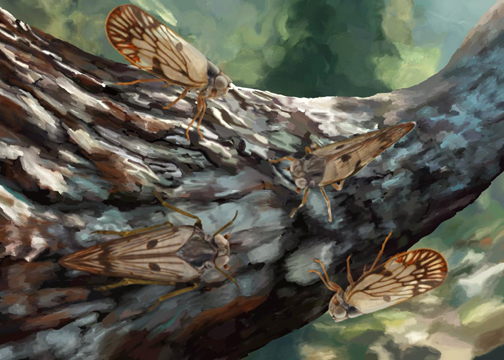

Abstract
We report Cretolala kachinensis gen. et sp. nov., the first formally described representative of the family Lalacidae from mid-Cretaceous (~99 Ma) Kachin amber. The morphology and taphonomy of the specimen were studied using optical microscopy, micro-computed tomography (micro-CT), confocal laser scanning microscopy (CLSM), and scanning electron microscopy coupled with energy-dispersive X-ray spectroscopy (SEM‒EDS). Cretolala kachinensis gen. et sp. nov. exhibits a unique combination of forewing characters, including a strengthened, broad, and wrinkled costal margin; ScP+R fork proximal to both the Pcu+A1 fusion and the CuA fork; MP with five terminals; and CuA1 and CuA2 each with two terminals. Crossvein patterns differ between the left and right forewings, indicating that crossvein expression alone is not diagnostic. The forewing bears distinct maculation, with a face-like pattern dorsally and an extensive lateral pattern that may indicate aposematism, mimicry, or plant-like camouflage in an arboreal herbivore. Taphonomic analyses based on optical micrographs and material-dependent X-ray attenuation in micro-CT show that minerals are distributed throughout the fossil, coating anatomical surfaces and infilling pre-existing cavities and voids. These phases help stabilize morphology and influence the micro-CT reconstruction of soft-bodied structures. SEM–EDS analyses indicate that the body-coating and void-filling minerals are dominated by quartz and pyrite, with feldspars and aluminosilicate mixtures also present, locally enriched in K, Na, Mg, or Ca. This assemblage and its textures point to a polyphase paragenetic sequence, with early detrital infill and later authigenic mineralization. Our results suggest that minerals and some chemicals derived from the host sediments can be transported into and, in some cases, precipitated within amber inclusions, infilling voids and providing structural support that influences fossil preservation. Collectively, these phases occlude porosity, stabilize morphology, and enhance X-ray contrast, although they locally obscured primary tissue boundaries. Our results highlight multistage diagenesis in Kachin amber and underscore variability among inclusions in both mineral assemblages and the timing of mineralization/diagenetic events.
References
- Boderau, M., Nel, A. & Fu, Y.Z. (2025a) A new Lapicixius planthopper species (Fulgoromorpha: Lalacidae) from the Lower Cretaceous Yixian Formation of northeastern China. Journal of Insect Biodiversity, 77 (1), 85–90. https://doi.org//10.12976/jib/2025.77.1.12
- Boderau, M., Fu, Y.Z., Jiang, H., Guan, S., Peng, A., Nel, A. & Jouault, C. (2025b) Bayesian modelling of the fossil record enlightens the evolutionary history of Hemiptera. Proceedings of the Royal Society B, 292, 20251133. https://doi.org//10.1098/rspb.2025.1133
- Boderau, M., Nel, A. & Jouault, C. (2025c) Diversification and extinction of Hemiptera in deep time. Communications Biology, 8 (1), 352. https://doi.org//10.1038/s42003-025-07773-x
- Bourgoin, T. (1993) Female genitalia in Hemiptera Fulgoromorpha, morphological and phylogenetic data. Annales de la Société entomologique de France, (N.S.), 29 (3), 225–244. https://doi.org//10.1080/21686351.1993.12277686
- Bourgoin, T. (2025) FLOW (Fulgoromorpha Lists on The Web): a world knowledge base dedicated to Fulgoromorpha. Available from: https://flow.hemiptera-databases.org/flow/?&lang=en (accessed 30 Oct 2025).
- Bourgoin, T. & Szwedo, J. (2022) Toward a new classification of planthoppers Hemiptera Fulgoromorpha: 1. What do Fulgoridiidae really cover? Annales Zoologici, 72 (4), 951–962. https://doi.org//10.3161/00034541ANZ2022.72.4.011
- Bourgoin, T. & Szwedo, J. (2023) Toward a new classification of planthoppers Hemiptera Fulgoromorpha: 2. Higher taxa, their names and their composition. Zootaxa, 5297 (4), 562–568. https://doi.org//10.11646/zootaxa.5297.4.5
- Bourgoin, T., Wang, R.R., Asche, M., Hoch, H., Soulier-Perkins, A., Stroiński, A., Yap, S. & Szwedo, J. (2015) From micropterism to hyperpterism: recognition strategy and standardized homology-driven terminology of the forewing venation patterns in planthoppers (Hemiptera: Fulgoromorpha). Zoomorphology, 134, 63–77. https://doi.org//10.1007/s00435-014-0243-6
- Brożek, J., Stroiński, A., Romaniak, A. & Bourgoin, T. (2024) Disparity of metatibial and metatarsal cuticular and sensory structures in Cixiidae (Hemiptera: Fulgoromorpha) with a metatibiotarsal diagnosis for the tribes. Zoological Letters, 10 (1), 16. https://doi.org//10.1186/s40851-024-00239-8
- Bucher, M. (2024) Les grandes extinctions de masse ont-elles impacté l’évolution des insectes? Exemple de l’histoire macroévolutive des Hémiptères Fulgoromorpha. Systématique, phylogénie et taxonomie. Thèse de doctorat, Museum national d’histoire naturelle (MNHN), Paris, 409 pp.
- Bucher, M., Gignoux, G., Szwedo, J. & Bourgoin, T. (2024) Time-traveling through fossil planthopper tegmina in the Paleozoic and Mesozoic eras (Insecta: Hemiptera: Fulgoromorpha). Palaeoentomology, 7 (1), 1–67. https://doi.org//10.11646/palaeoentomology.7.1.1
- Cruickshank, R.D. & Ko, K.O. (2003) Geology of an amber locality in the Hukawng Valley, Northern Myanmar. Journal of Asian Earth Sciences, 21 (5), 441–455. https://doi.org//10.1016/S1367-9120(02)00044-5
- Hamilton, K.G.A. (1990) Insecta from the Santana Formation, Lower Cretaceous, of Brazil. Chapter 6. Homoptera. Bulletin of the American Museum of Natural History, 195, 82–122.
- Haug, J.T., Azar, D., Ross, A.J., Szwedo, J., Wang, B., Arillo, A., Baranov, V., Bechteler, J., Beutel, R.G., Blagoderov, V., Delclòs, X., Feldberg, K., Feldmann, R., Foth, C., Fraaije, R.H.B., Gehler, A., Harms, D., Hedenäs, L., Hyžný, M., Jagt, J.W.M., Jagt-Yazykova, E.A., Jarzembowski, E.A., Kerp, H., Khine, P.K., Kirejtshuk, A.G., Klug, C., Kopylov, D.S., Kotthoff, U., Kriwet, J., McKellar, R.C., Nel, A., Nützel, A., Peñalver, E., Perrichot, V., Pint, A., Ragazzi, E., Regalado, L., Reich, M., Rikkinen, J., Schmidt, A.R., Schneider, H., Schram, F.R., Schweigert, G., Selden, P.A., Solórzano-Kraemer, M.M., Stilwell, J.D., van-Bakel, B.W.M., Vega, F.J., Wang, Y., Xing, L.D. & Haug, C. (2020) Comment on the letter of the Society of Vertebrate Paleontology (SVP) dated April 21, 2020, regarding “Fossils from conflict zones and reproducibility of fossil-based scientific data”: Myanmar amber. Paläontologische Zeitschrift, 94, 431–437. https://doi.org//10.1007/s12542-020-00522-x
- International Commission on Zoological Nomenclature (ICZN) (1999) International code of zoological nomenclature. Fourth Edition. International Trust for Zoological Nomenclature, London, xxix + 336 pp.
- Jiang, H., Tomaschek, F., Muscente, A. D., Niu, C., Nyunt, T. T., Fang, Y., Schmidt, U., Chen, J., Lönartz, M., Mähler, B., Wappler, T., Jarzembowski, E.A., Szwedo, J., Zhang, H., Rust, J. & Wang, B. (2022) Widespread mineralization of soft-bodied insects in Cretaceous amber. Geobiology, 20, 363–376. https://doi.org//10.1111/gbi.12488
- Jiang, H., Szwedo, J., Labandeira, C.C., Chen, J., Moulds, M.S., Mähler, B., Muscente, A.D., Zhuo, D., Nyunt, T.T., Zhang, H.C., Wei, C., Rust, J. & Wang, B. (2024) Mesozoic evolution of cicadas and their origins of vocalization and root feeding. Nature Communications, 15, 376. https://doi.org//10.1038/s41467-023-44446-x
- Lozano, R.P., López Del Valle, R., Baeza, E., Delvene, G., Barrón, E., Peñalver, E., Rodrigo, A. & Pérez-de la Fuente, R. (2025) Preventive conservation of amber: some preliminary investigations. Pyrite decay in amber: deterioration of collections and conservation guidelines. Geoheritage, 17 (4), 168. https://doi.org//10.1007/s12371-025-01219-w
- Nel, A., Prokop, J., Nel, P., Grandcolas, P., Huang, D.Y., Roques, P., Guilbert, E., Dostál, O. & Szwedo, J. (2012) Traits and evolution of wing venation pattern in paraneopteran insects. Journal of Morphology, 273 (5), 480–506. https://doi.org//10.1002/jmor.11036
- Parchem, R.J., Perry, M.W. & Patel, N.H. (2007) Patterns on the insect wing. Current Opinion in Genetics and Development, 17 (4), 300–308. https://doi.org//10.1016/j.gde.2007.05.006
- Ren, D., Lu, L.W., Guo, Z.G. & Ji, S.A. (1995) Faunae and stratigraphy of Jurassic-Cretaceous in Beijing and the adjacent areas. Seismic Publishing House, Beijing, viii+222 pp.
- Ren, D., Yin, J. & Dou, W. (1998) New planthoppers and froghoppers from the Late Jurassic of northeast China (Homoptera: Auchenorrhyncha). Acta Zootaxonomica Sinica, 23 (3), 281–288.
- Schubnel, T., Desutter-Grandcolas, L., Legendre, F., Prokop, J., Mazurier, A., Garrouste, R., Grandcolas, P. & Nel, A. (2019) To be or not to be: postcubital vein in insects revealed by microtomography. Systematic Entomology, 45 (2), 327–336. https://doi.org//10.1111/syen.12399
- Scotese, C.R., Vérard, C., Burgener, L., Elling, R.P. & Kocsis, A.T. (2025) The Cretaceous world: plate tectonics, palaeogeography and palaeoclimate. Geological Society, London, Special Publications, 544, 31–202. https://doi.org//10.1144/SP544-2024-28
- Shi, G.H., Grimaldi, D.A., Harlow, G.E., Wang, J., Wang, J., Yang, M.C., Lei, W.Y., Li, Q.L. & Li, X.H. (2012) Age constraint on Burmese amber based on U-Pb dating of zircons. Cretaceous Research, 37, 155–163. https://doi.org//10.1016/j.cretres.2012.03.014
- Stagg, N.A., Jiang, H., Tomaschek, F., Staniczek, A.H., Mähler, B., Bruthansová, J., Nyunt, T.T. & Godunko, R.J. (2026). Hidden taxonomic and taphonomic diversity revealed by mayflies (Ephemeroptera: Hexagenitidae) from mid-Cretaceous Kachin amber. Scientific Reports (in press). https://doi.org//10.1038/s41598-026-46621-8
- Szwedo, J. (2007) Fulgoromorpha: planthoppers. In: Martill D.M., Bechly, G. & Loveridge, R.F. (Eds), The Crato fossil beds of Brazil: window into an ancient world. Cambridge University Press, Cambridge, pp. 297–313. https://doi.org//10.1017/CBO9780511535512.012
- Szwedo, J., Bourgoin, T. & Lefebvre, F. (2004) Fossil planthoppers (Hemiptera: Fulgoromorpha) of the world. An annotated catalogue with notes on Hemiptera classification. Studio 1, Warsaw, 199 pp.
- Szwedo, J., Wang, B., Soszyńska-Maj, A., Azar, D. & Ross, A.J. (2020) International Palaeoentomological Society statement. Palaeoentomology, 3 (3), 221–222. https://doi.org//10.11646/palaeoentomology.3.3.1
- Thu, K. & Zaw, K. (2017) Gem deposits of Myanmar. Geological Society, London Memoirs, 48, 497–529. https://doi.org//10.1144/m48.23
- Wang, L.N., Szwedo, J., Zhuo, D., Xiao, C.T. & Luo, C.H. (2025) Adding to the diversity of Katlasidae (Hemiptera: Fulgoromorpha: Fulgoridoidea)—a new genus and species from mid-Cretaceous Kachin amber of northern Myanmar. Palaeontologia Electronica, 28 (3), 1–15. https://doi.org//10.26879/1575
- Wittkopp, P.J., Carroll, S.B. & Kopp, A. (2003) Evolution in black and white: genetic control of pigment patterns in Drosophila. Trends in Genetics, 19 (9), 495–504. https://doi.org//10.1016/S0168-9525(03)00194-X
- Wittkopp, P.J. & Beldade, P. (2009) Development and evolution of insect pigmentation: genetic mechanisms and the potential consequences of pleiotropy. Seminars in Cell & Developmental Biology, 20 (1), 65–71. https://doi.org//10.1016/j.semcdb.2008.10.002
- Zhang, Z. (2002) New early Cretaceous lalacid from Jingxi Basin of Beijing, China (Homoptera: Fulgoroidea). Acta Zootaxonomica Sinica, 27 (1), 20–23.