

Abstract
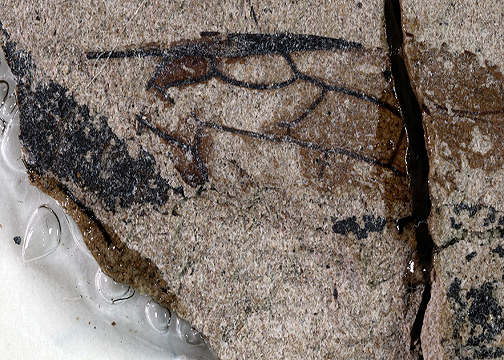
A new horntail sawfly, Cenosirex speirsorum gen. et sp. nov. (Siricidae), is described from a single fossil specimen collected at the Munce’s Hill locality of the Paskapoo Formation in Alberta, Canada. The new genus is assigned to Siricinae sensu Rasnitsyn (1968) (= Siricinae + Tremicinae) based on the following combination of forewing characters: strongly corrugated wing membrane, moderately narrow ribbon-like costal space, presence of Sc, long 1-Rs with a reclival base, absence of 2rs-m, and basally positioned anal loop. The new taxon exhibits a mosaic of characters shared with several extinct and extant genera, but differs from them primarily in the absence of veins 1rs-m and 2rs-m in the forewing, and in having vein 1cu-a situated slightly distal to the midpoint of cell 1M. This discovery expands the known palaeoentomological diversity of the Paskapoo Formation, representing the first ‘Symphyta’ described from this Palaeocene unit. It also broadens the Palaeocene record of the Siricidae, previously documented only from Europe (France), to include North America, and highlights the need for further palaeontological investigation of the formation. We also provide new illustrations of the type material of Xeris muratensis Boderau et al., 2024, as the original figures were insufficient to clearly depict the diagnostic characters.
References
- Alvarez, L.W., Alvarez, W., Asaro, F. & Michel, H.V. (1980) Extraterrestrial cause for the Cretaceous-Tertiary extinction. Science, 208 (4448), 1095–1108. https://doi.org/10.1126/science.208.4448.1095
- Archibald, S.B., Aase, A. & Nel, A. (2021) The second North American fossil horntail wood-wasp (Hymenoptera: Siricidae), from the early Eocene Green River Formation. Zootaxa, 4999 (4), 325–334. https://doi.org/10.11646/zootaxa.4999.4.2
- Archibald, S.B. & Rasnitsyn, A.P. (2015) New early Eocene Siricomorpha (Hymenoptera: Symphyta: Pamphiliidae, Siricidae, Cephidae) from the Okanagan Highlands, western North America. The Canadian Entomologist, 148, 209–228. https://doi.org/10.4039/tce.2015.55
- Archibald, S.B. & Rasnitsyn, A.P. (2022) The early Eocene Eourocerus anguliterreus gen. et sp. nov. (Hymenoptera, Siricidae) from Republic, Washington. Zootaxa, 5105 (2), 289–295. https://doi.org/10.11646/zootaxa.5105.2.8
- Archibald, S.B., Rasnitsyn, A.P., Brothers, D.J. & Mathewes, R.W. (2018) Modernisation of the Hymenoptera: ants, bees, wasps, and sawflies of the early Eocene Okanagan Highlands of western North America. The Canadian Entomologist, 150, 250–257. https://doi.org/10.4039/tce.2017.59
- Béthoux, O. & Anderson, J.M. (2021) The Polycytellidae viewed as Gondwanan Glosselytrodea. Palaeoentomology, 4 (6), 550–558. https://doi.org/10.11646/palaeoentomology.4.6.5
- Béthoux, O., Llamosi, A. & Toussaint, S. (2016) Reinvestigation of Protelytron permianum (Insecta; Early Permian; USA) as an example for applying reflectance transformation imaging to insect imprint fossils. Fossil Record, 20, 1–7. https://doi.org/10.5194/fr-20-1-2016
- Boderau, M., Engel, M.S., Jouault, C. & Nel, A. (2024) A horntail wasp from the Upper Miocene of France closely related to an extant Eastern Palaearctic species (Hymenoptera: Siricidae). Zootaxa, 5538 (2), 194–200. https://doi.org/10.11646/zootaxa.5538.2.6
- Carpenter, F.M. (1992) Part R, Arthropoda 4: Superclass Hexapoda. Treatise on Invertebrate Paleontology, R (4), 1–655.
- Demchuk, T.D. (1990) Palynostratigraphic zonation of Paleocene strata in the central and south-central Alberta Plains. Canadian Journal of Earth Sciences, 27, 1263–1269. https://doi.org/10.1139/e90-136
- Fox, R.C. (1990) The succession of Paleocene mammals in western Canada. In: Bown, T.M. & Rose, T.K. (Eds), Dawn of the age of mammals in the northern part of the Rocky Mountain interior, North America. Geological Society of America, Special Paper, 243, pp. 51–70. https://doi.org/10.1130/SPE243-p51
- GBIF (2026) Siricidae in GBIF Secretariat (2023) GBIF Backbone Taxonomy. Checklist dataset. Available from: https://doi.org/10.15468/39omei (Accessed 27 February 2026)
- Glass, D. (1997) Lexicon of Canadian stratigraphy, Western Canada including Eastern British Columbia, Alberta, Saskatchewan and southern Manitoba. Canadian Society of Petroleum Geologists, Calgary, Alberta, 4, 772 pp.
- Goulet, H. & Huber, J.T. (1993) Hymenoptera of the world: an identification guide to families. Research Branch, Agriculture Canada Publication, Ottawa, vii + 668 pp.
- Hoffman, G.L. & Stockey, R.A. (2000) Geological setting and paleobotany of the Joffre Bridge Roadcut fossil locality (late Paleocene), Red Deer Valley, Alberta. Canadian Journal of Earth Sciences, 36, 2073–2084. https://doi.org/10.1139/e99-095
- Hong, Y.C. (1975) Eine neue fossile—Sinosiricidae (Hymenoptera: Siricoidea) in west-Weichangder Provinz Hebei. Acta Entomologica Sinica, 18, 235–241.
- Jouault, C., Coutret, B., Konhauser, K.O. & Nel, A. (2023a) A new hangingfly species (Mecoptera: Bittacidae) from the Paleocene Paskapoo Formation (Canada). Palaeoentomology, 6 (5), 507–518. https://doi.org/10.11646/palaeoentomology.6.5.9
- Jouault, C., Coutret, B., Konhauser, K.O. & Nel, A. (2023b) New odonatans (Odonata: Gomphaeschnidae; Synlestidae) from the Paleocene Paskapoo Formation: systematic and biogeographical implications. Journal of Systematic Palaeontology, 21, 2261457. https://doi.org/10.1080/14772019.2023.2261457
- Jouault, C., Oyama, N., Álvarez-Parra, S., Huang, D.Y., Perrichot, V., Condamine, F.L. & Legendre, F. (2025) The radiation of Hymenoptera illuminated by Bayesian inferences from the fossil record. Current Biology, 35, 2164–2174.e4. https://doi.org/10.1016/j.cub.2025.03.002
- Jouault, C., Pouillon, J.-M. & Nel, A. (2020) The first fossil horntail wasp (Hymenoptera: Siricidae) from Lower Cretaceous Crato Formation in Brazil. Palaeoentomology, 3 (4), 382–389. https://doi.org/10.11646/palaeoentomology.3.4.10
- Kopylov, D.S. & Rasnitsyn, A.P. (2025) Anaxyelidae of Karatau: 100 years after. Insects, 16, 943. https://doi.org/10.3390/insects16090943
- Kopylov, D.S., Rasnitsyn, A.P., Zhang, H.C. & Zhang, Q. (2020) Anaxyelidae of Daohugou: oldest occurrences of the relict family in the fossil record. Part 1: Daosyntexis and Brachysyntexis. Alcheringa, 44, 104–114. https://doi.org/10.1080/03115518.2019.1697753
- Li, X., Niu, G.Y. & Wei, M.C. (2025) A new species of Orthosyntexis (Hymenoptera: Anaxyelidae) from mid-Cretaceous Burmese amber. Insects, 16, 1039. https://doi.org/10.3390/insects16101039
- Nel, A. (1988) Redescription de Eosirex ligniticus Piton, 1940 (Hymenoptera Symphyta Siricidae). L’Entomologiste, 44, 287–292.
- Piton, L. (1940) Paléontologie du gisement éocéne de Menat (puy-de-Dôme) (flore et faune). P. Vallier, Clermont-Ferrand, 303 pp.
- Rasnitsyn, A.P. (1968) Noviye mezozoyskiye pilil’shchiki (Hymenoptera, Symphata) [New Mesozoic sawflies (Hymenoptera, Symphyta)]. In: Rohdendorf, B.B. (Ed.), yurskoy nasekomiye Karatau [Jurassic insects of Karatau]. Nauka, Moscow, pp. 190–236. [In Russian]
- Rasnitsyn, A.P. (1969) Proiskhozhdenie i evolyutsiya nizshikh pereponchatokrylykh [Origin and evolution of the Lower Hymenoptera]. Akademiya Nauk SSSR, Trudy Paleontologicheskogo Instituta, 123, 1–196. [In Russia]
- Rasnitsyn, A.P. (1980) Proiskhozhdenie i evolyutsiya pereponchatokrylykh nasekomykh [Origin and evolution of Hymenoptera]. Akademii Nauk SSSR, Trudy Paleontologicheskogo Instituta, 174, 1–191. [In Russian]
- Rasnitsyn, A.P. (1988) An outline of evolution of the hymenopterous insects (Order Vespida). Oriental Insects, 22, 115–145. https://doi.org/10.1080/00305316.1988.11835485
- Rasnitsyn, A.P. (1993) Melovye entomofauny basseyna r. Ul’i (zapadnoe Priokhot’e). In: Mezozoyskie nasekomye i ostrakody Azii. Akademiya Nauk SSSR, Trudy Paleontologicheskogo Instituta, 252, 5–60. [In Russia]
- Rasnitsyn, A.P. & Zhang, H.C. (2004) Composition and age of the Daohugou hymenopteran (Insecta, Hymenoptera = Vespida) assemblage from Inner Mongolia, China. Palaeontology, 47, 1507–1517. https://doi.org/10.1111/j.0031-0239.2004.00416.x
- Rohwer, S.A. (1915) A remarkable new genus of Cephidae. Proceedings of the Entomological Society of Washington, 17, 114–117.
- Rosse-Guillevic, S., Kopylov, D.S., Rasnitsyn, A.P., Nam, G.-S., Kwon, S.-H. & Jouault, C. (2023) Blurring the limits of anaxyelid subfamilies: a new genus and species (Hymenoptera: Anaxyelidae) from the Albian of the Republic of Korea. Palaeoentomology, 6 (4), 424–434. https://doi.org/10.11646/palaeoentomology.6.4.13
- Schiff, N.M., Goulet, H., Smith, D.R., Boudreault, C., Wilson, A.D. & Scheffler, B.E. (2012) Siricidae (Hymenoptera: Symphyta: Siricoidea) of the western hemisphere. Canadian Journal of Arthropod Identification, 21, 1–305. https://doi.org/10.3752/cjai.2012.21
- Schulte, P., Alegret, L., Arenillas, I., Arz, J.A., Barton, P.J., Bown, P.R., Bralower, T.J., Christeson, G.L., Claeys, P., Cockell, C.S., Collins, G.S., Deutsch, A., Goldin, T.J., Goto, K., Grajales-Nishimura, J.M., Grieve, R.A.F., Gulick, S.P.S., Johnson, K.R., Kiessling, W., Koeberl, C., Kring, D.A., MacLeod, K.G., Matsui, T., Melosh, J., Montanari, A., Morgan, J.V., Neal, C.R., Nichols, D.J., Norris, R.D., Pierazzo, E., Ravizza, G., Rebolledo-Vieyra, M., Reimold, W.U., Robin, E., Salge, T., Speijer, R.P., Sweet, A.R., Urrutia-Fucugauchi, J., Vajda, V., Whalen, M.T. & Willumsen, P.S. (2010) The Chicxulub asteroid impact and mass extinction at the Cretaceous-Paleogene boundary. Science, 327 (5970), 1214–1218. https://doi.org/10.1126/science.1177265
- Stockey, R.A., Hoffman, G.L. & Vavrek, M.J. (2014) Chapter 13: Paleobotany and Palynology of the Munce’s Hill fossil locality near Red Deer, Alberta, Canada. In: Stevens, W.D., Montiel, O.M. & Raven, P.H. (Eds), Paleobotany and Biogeography: a festschrift for Alan Graham in his 80th year. Missouri Botanical Garden, St. Louis, pp. 367–388.
- Taeger, A., Blank, S.M. & Liston, A.D. (2010) World catalog of Symphyta (Hymenoptera). Zootaxa, 2580 (1), 1–1064. https://doi.org/10.11646/zootaxa.2580.1.1
- Vilhelmsen, L. (2001) Phylogeny and classification of the extant basal lineages of the Hymenoptera (Insecta). Zoological Journal of the Linnean Society, 131, 393–442. https://doi.org/10.1111/j.1096-3642.2001.tb01320.x
- Wang, M., Rasnitsyn, A.P., Han, G. & Ren, D. (2018) A new genus and species of basal horntail (Hymenoptera, Siricidae) from the Lower Cretaceous of China. Cretaceous Research, 91, 195–201. https://doi.org/10.1016/j.cretres.2018.06.006
- Wedmann, S., Pouillon, J.-M. & Nel, A. (2014) New Palaeogene horntail wasps (Hymenoptera, Siricidae) and a discussion of their fossil record. Zootaxa, 3869 (1), 33–43. https://doi.org/10.11646/zootaxa.3869.1.3
- Wickman, B.E. (1967) Life history of the incense-cedar wood wasp, Syntexis libocedrii (Hymenoptera: Syntexidae). Annals of the Entomological Society of America, 60 (6), 1291–1295. https://doi.org/10.1093/aesa/60.6.1291
- Wutke, S., Blank, S.M., Boevé, J.-L., Faircloth, B.C., Koch, F., Linnen, C.R., Malm, T., Niu, G.Y., Prous, M., Schiff, N.M., Schmidt, S., Taeger, A., Vilhelmsen, L., Wahlberg, N., Wei, M.C. & Nyman, T. (2024) Phylogenomics and biogeography of sawflies and woodwasps (Hymenoptera, Symphyta). Molecular Phylogenetics and Evolution, 199, 108144. https://doi.org/10.1016/j.ympev.2024.108144
- Zachos, J., Dickens, G. & Zeebe, R. (2008) An early Cenozoic perspective on greenhouse warming and carbon-cycle dynamics. Nature, 451 (7176), 279–283. https://doi.org/10.1038/nature06588
- Zachos, J., Pagani, M., Sloan, L., Thomas, E. & Billups, K. (2001) Trends, rhythms, and aberrations in global climate 65 Ma to present. Science, 292 (5517), 686–693. https://doi.org/10.1126/science.1059412