

Abstract
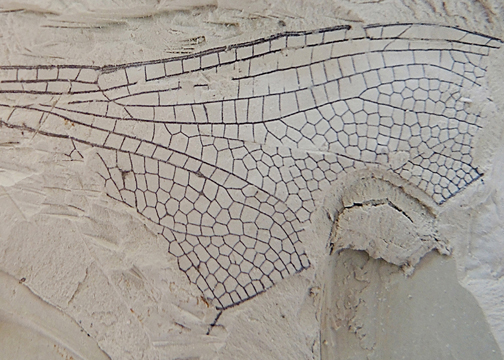
The hawker dragonflies or Aeshnidae sensu stricto (excluding the Gomphaeschnidae) are diverse in the fossil record but still known only in the Cenozoic. They are rather frequent as compression fossils during the Eocene, Oligocene, and Miocene (e.g., Nel et al., 1994, 1996, 1997; Prokop & Nel, 2000; Nel & Petrulevičius, 2010; Nel et al., 2024). Among these the genus Aeshna Fabricius, 1775 is represented by Late Eocene, Oligocene, and Miocene species from North America, Europe, and China, with an increasing diversity through time, with one Eocene, three Oligocene, and 11 Miocene species. The diversity of the other aeshnid genera apparently decreased during the same period in Eurasia and North America (e.g., the Eocene to Miocene genus Oligaeschna Piton & Théobald, 1939) (Huang et al., 2023). Fossil Cenozoic Aeshnidae are quite poorly known in the other parts of the world. Here we describe a new species of Aeshna from the Middle Miocene of Germany, confirming this general tendency.
References
- Bechly, G. (1996) Morphologische Untersuchungen am Flügelgeäder der rezenten Libellen und deren Stammgruppenvertreter (Insecta; Pterygota; Odonata), unter besonderer Berücksichtigung der phylogenetischen Systematik und des Grundplanes der Odonata. Petalura, Special Volume 2, 1–402.
- Carvalho, A.L. (1992) Revalidation of the genus Remartinia Navás 1911, with the description of a new species and a key to the genera of Neotropical Aeshnidae (Anisoptera). Odonatologica, 21 (3), 289–298.
- De Marmels, J. (1994) A new genus of Aeshnini (Odonata: Aeshnidae) from the Andes with description of a new species. Entomologica Scandinavica, 25 (4), 427–438. https://doi.org/10.1163/187631294X00199
- Ellenrieder, N. von (2002) A phylogenetic analysis of the extant Aeshnidae (Odonata: Anisoptera). Systematic Entomology, 27 (4), 437–467. https://doi.org/10.1046/j.1365-3113.2002.00190.x
- Fiest, W. (2025) Der riesische Brockhorizont. In: Gregor, H.-J., Fiest, W., Girbau, J.S. & Heissig, K. (Eds), Neue Befunde zur Fundstelle Kalksandsteinwerk Derching, ihre paläofloristischen (Palmen, Characeen) und -faunistischen Besonderheiten (Kleinsäuger, Großsäuger) und sedimentologisch–stratigraphischen Probleme (Brockhorizont). Geo-Paläontologisches Forum, 2. pp. 15–21. https://geo-palaeontologisches-forum.de/publikationen
- Galliani, C., Scherini, R. & Piglia, A. (2006) Dragonflies and damselflies of Europe. A scientific approach to the identification of European Odonata without capture. WBA Handbook, 7, 1–347.
- Garrison, R.W., von Ellenrieder, N. & Louton, J.A. (2006) Dragonfly genera of the new world: An illustrated and annotated key to the Anisoptera. The Johns Hopkins University Press, Baltimore, 1–368.
- Gentilini, G. & Peters, G. (1993) The upper Miocene aeshnids of Monte Castellaro, Central Italy, and their relationships to extant species (Odonata: Aeshnidae). Odonatologica, 22, 147–178.
- Hofmann, C.-C. & Sachse, M. (2023) SEM pollen analysis of Miocene deposits of Entrischenbrunn (Bavaria, Germany) reveal considerable amounts of pollen of subhumid and sclerophyllous together with azonal water plants reflecting the vegetation mosaic of a braided river system. Review of Palaeobotany and Palynology, 308, 104787. https://doi.org/10.1016/j.revpalbo.2022.104787
- Huang, D.Y., Lian, X.N. & Nel, A. (2023) The first Chinese representative of the Cenozoic hawker dragonfly Oligaeschna (Odonata: Aeshnidae) from the Eocene of North Tibet. Historical Biology, 35 (6), 997–1001. https://doi.org/10.1080/08912963.2022.2071713
- Huang, J.N., Cao, Z.D., Zhang, Y.Z., Li, Z.Y., Zhang, S.H., Yan, D.F. & Xie, S.P. (2026) A Miocene hawker dragonfly (Odonata: Aeshnidae) from the eastern Qaidam Basin, northeast Tibetan Plateau. Historical Biology, 1–8. https://doi.org/10.1080/08912963.2026.2621918
- Jacquelin, L., Desutter-Grandcolas, L., Chintauan-Marquier, I., Boistel, R., Zheng, D., Prokop, J. & Nel, A. (2018) New insights on basivenal sclerites using 3D tools and homology of wing veins in Odonatoptera (Insecta). Scientific Reports, 8 (238), 1–7. https://doi.org/10.1038/s41598-017-18615-0
- Li, Y.J., Nel, A., Ren, D., Zhang, B.L. & Pang, H. (2011) New discoveries of Neogene hawker dragonflies (Insecta, Odonata, Aeshnidae) from Shandong province in China. Zoosystema, 33 (4), 577–590. https://doi.org/10.5252/z2011n4a8
- Martínez-Delclòs, X. & Nel, A. (1991) Découverte de trois insectes fossiles dans l’Oligocène du bassin de l’Ebre (Espagne) (Odonata, Lestidae, Aeshnidae). Bulletin du Muséum National d’Histoire Naturelle, (4), 13 (3-4), 157–165.
- Nel, A. (1986) Sur la présence du genre Aeschna Fabricius, 1775 dans les calcaires stampiens de Céreste (Odonata, Aeshnidae). L’Entomologiste, 42, 195–198.
- Nel, A., Arillo, A. & Martinez-Delclòs, X. (1996) New fossil Odonata (Insecta) from the Upper Miocene of France and Spain. (Anisoptera and Zygoptera). Neues Jahrbuch für Geologie und Paläontologie, Abhandlungen, 199, 167–219.
- Nel, A., Arillo, A. & Ortuño, V. (1997) New Western Palaearctic Cenozoic Odonata (Insecta: Odonata: Zygoptera and Anisoptera). Bulletin de la Société Entomologique de France, 102 (3), 265–270. https://doi.org/10.3406/bsef.1997.17342
- Nel, A., Garrouste, R., Kaya, M., Licht, A., Legal, S. & Coster, P. (2024) The second oldest representative of the genus Aeshna (Odonata: Aeshnidae) found in the lowermost Oligocene of Luberon (France) and revealed by UV light. Historical Biology, 36 (2), 261–265. https://doi.org/10.1080/08912963.2022.2157274
- Nel, A., Martínez-Delclòs, X., Escuillié, F. & Brisac, P. (1994) Les Aeshnidae fossiles: état actuel des connaissances (Odonata, Anisoptera). Neues Jahrbuch für Geologie und Paläontologie, Abhandlungen, 194 (2-3), 143–186. https://doi.org/10.1127/njgpa/194/1994/143
- Nel, A. & Petrulevičius, J.F. (2010) Afrotropical and Nearctic genera of Odonata in the French Oligocene: Biogeographic and paleoclimatic implications (Insecta: Calopterygidae and Aeshnidae). Annales de la Société Entomologique de France (N.S.), 46 (1-2), 228–236. https://doi.org/10.1080/00379271.2010.10697662
- Nel, A., Petrulevičius, J.F. & Jarzembowski, E.A. (2005) New fossil Odonata from the European Cenozoic (Insecta: Odonata: Thaumatoneuridae, Aeshnidae, ?Idionychidae, Libellulidae). Neues Jahrbuch für Geologie und Paläontologie, Abhandlungen, 235 (3), 343–380. https://doi.org/10.1127/njgpa/235/2005/343
- Papp, A. & Mandl, K. (1951) Insekten aus den Congerienschichten des Wiener Beckens. Sitzungsberichte der Oesterreichische Akademie der Wissenschaften, Mathematisch-Naturwissenschaftliche Klasse, (1), 160, 295–302.
- Prokop, J. & Nel, A. (2000) Merlax bohemicus gen. n., sp. n., a new fossil dragonfly from the Lower Miocene of northern Bohemia (Odonata: Aeshnidae). European Journal of Entomology, 97, 427–431. https://doi.org/10.14411/eje.2000.065
- Prokop, J., Pecharová, M. & Nel, A. (2016) New Cenozoic dragonflies from the Most Basin and Středohoří complex volcanic area (Czech Republic, Germany). Journal of Natural History, 50 (37-38), 2311–2326. https://doi.org/10.1080/00222933.2016.1193648
- Riou, B. & Nel, A. (1995) Nouveaux odonates fossiles du Miocène supérieur de l’Ardèche Odonata: Sieblosiidae: Lestidae (Libellulidae, Corduliidae, Aeshnidae. Travaux de l’Ecole Pratique des Hautes Études, Biologie et Evolution des Insectes, 7 (8), 125–144.
- Schmitt, H. & Butzmann, R. (1997) Entrischenbrunn–statistische Untersuchungen an einer neuen Florenfundstelle aus der Oberen Süßwassermolasse im Landkreis Pfaffenhofen a.d. Ilm. Documenta Naturae, 110, 55–87.
- Scudder, S.H. (1890) The Tertiary insects of North America. Report of the United States Geological Survey of the Territories, 13, 1–734. https://doi.org/10.5962/bhl.title.44698
- Zhang, J.F. (1989) Fossil insects from Shanwang, Shandong, China. Shandong Science and Technology Publishing House, Jinan, 459 pp. [In Chinese with English abstract]