

Abstract
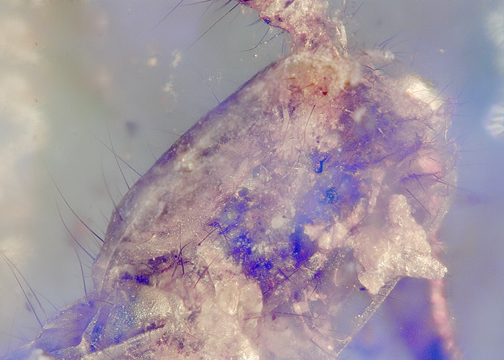
A new species of Diplura, belonging to the little-known and poorly diverse hexapod family Japygidae, is described as Metajapyx zhangi Sendra, Sánchez-García, Peñalver & Luan sp. nov. The specimen, a complete and well-preserved male, was discovered in mid-Cretaceous (Cenomanian) Kachin amber from northern Myanmar. Diplurans are rare in the fossil record due to their soil and subterranean habits. The new species is assigned to the genus Metajapyx Silvestri, 1933, and represents its first fossil species. Metajapyx zhangi sp. nov. is compared with the extant species of the genus and with the only other japygid species described from Kachin amber. The diagnosis is based on a combination of characters, including the number of antennomeres, body chaetotaxy, and the characteristics of the abdominal sclerites and cerci. These results improve understanding of anatomical variation among Metajapyx species and point to remarkable morphological stasis across deep geological time. This discovery also provides new evidence on the early morphological diversification of Japygoidea and the faunal composition of Cretaceous soil-dwelling predators.
References
- Börner, C. (1904) Zur Systematik der Hexapoden. Zoologischer Anzeiger, 27, 511–533.
- Cognato, A.I. & Grimaldi, D.A. (2008) 100 million years of morphological conservatism in a bark beetle (Coleoptera: Curculionidae; Scolytinae). Systematic Entomology, 34, 1−8. https://doi.org/10.1111/j.1365-3113.2008.00441.x
- Condé, B. (1956) Matériaux pour une Monographie des Diploures Campodéidés. Mémoires du Muséum National d’Histoire naturelle, Série A, Zoologie, 12, 1–202.
- Du, S.Y., Tihelka, E., Yu, D.Y., Chen, W.J., Bu, Y., Cai, C.Y., Engel, M.S., Luan, Y.X. & Zhang, F. (2024) Revisiting the four Hexapoda classes: Protura as the sister group to all other hexapods. Proceedings of the National Academy of Sciences, USA, 121 (39), e2408775121. https://doi.org/10.1073/pnas.2408775121
- Engel, M.S. & Grimaldi, D.A. (2002) The first Mesozoic Zoraptera (Insecta). American Museum Novitates, 3362, 1–20. https://doi.org/10.1206/0003-0082(2002)362<0001:TFMZI>2.0.CO;2
- Engel, M.S., Breitkreuz, L.C.V., Cai, C.Y., Alvarado, M., Azar, D. & Huang, D.Y. (2016) The first Mesozoic microwhip scorpion (Palpigradi): a new genus and species in mid-Cretaceous amber from Myanmar. The Science of Nature, 103, 19. https://doi.org/10.1007/s00114-016-1345-4
- Ewing, H.E. (1942) The origin and classification of the Apterygota. Proceedings of the Entomological Society of Washington, 44, 76–99. https://doi.org/10.5281/zenodo.16308124
- Grimaldi, D.A. (2010) 400 million years on six legs: on the origin and early evolution of Hexapoda. Arthropod structure & Development, 39 (2-3), 191–203. https://doi.org/10.1016/j.asd.2009.10.008
- Haliday, A.H. (1864) XVI. Iapyx, a new genus of insects belonging to the stirps Thysanura, in the order Neuroptera. Journal of the Linnean Society London, 24 (3), 441–447. https://doi.org/10.1111/j.1096-3642.1863.tb00166.x
- Haug, J.C., Azar, D., Ross, A., Szwedo, J., Wang, B., Arillo, A., Baranov, V., Bechteler, J., Beutel, R., Blagoderov, V., Delclòs, X., Dunlop, J., Feldberg, K., Feldmann, R., Foth, Ch., Fraaije, R.H.B., Gehler, A., Harms, D., Hedenäs, L., Hyžný, M., Jagt, J.W.M., Jagt-Yazykova, E.A., Jarzembowski, E., Kerp, H., Kay Khine, P., Kirejtshuk, A.G., Klug, Ch., Kopylov, D.S., Kotthoff, U., Kriwet, J., McKellar, R.C., Nel, A., Neumann, Ch., Nützel, A., Peñalver, E., Perrichot, V., Pint, A., Ragazzi, E., Regalado, L., Reich, M., Rikkinen, J., Sadowski, E.-M., Schmidt, A.R., Schneider, H., Schram, F.R., Schweigert, G., Selden, P., Seyfullah, L.J., Solórzano-Kraemer, M.M., Stilwell, J.D., van Bakel, B.W.M., Vega, F.J., Wang, Y., Xing, L. & Haug, C. (2020) Comment on the letter of the Society of Vertebrate Paleontology (SVP) dated April 21, 2020 regarding “Fossils from conflict zones and reproducibility of fossil-based scientific data”: Myanmar amber. PalZ, 94, 431–437. https://doi.org/10.1007/s12542-020-00524-9
- Kukalová-Peck, J. (1987) New Carboniferous Diplura, Monura, and Thysanura, the hexapod ground plan and the role of thoracic side lobes in the origin of wings (Insecta). Canadian Journal Zoology, 65, 2327–2345.
- Luan, Y.X., Mallatt, J.M., Xie, R.D, Yang, Y.M. & Yin, W.Y. (2005) The phylogenetic positions of the three basal-hexapod group (Protura, Diplura and Collembola) based on ribosomal DNA gene sequences. Molecular Biology and Evolution, 22 (7), 1579–1592. https://doi.org/10.1093/molbev/msi148
- Muegge, M.A. & Bernard, E.C. (1990) Two new species of Metajapyx (Diplura: Japygidae) from Tennessee. Proceedings of the Entomological Society of Washington, 92 (4), 793–801.
- Paclt, J. (1957) Diplura. In: Genera insectorum. 212, 1–123.
- Pagés, J. (1953) Japyginae (Japygidae, Insecta, Diplura) de la Yougoslavie et des Régions limitrophes. Bulletin du Muséum d’Histoire naturelle du Pays Serbe, série B, 5-6, 235–264.
- Pagés, J. (1959) Remarques sur la classification des diploures. Travaux du Laboratoire de Zoologie et de la Station Aquicole Grimaldi de la Faculte des Sciences de Dijon, 26, 1–25.
- Pagés, J. (1984) Dicellurata Genavensia XIII. Japygidés du Sud-Est asiatique. No 4. Revue suisse de Zoologie, 91 (1-2), 329−368. https://doi.org/10.5962/bhl.part.81883
- Pagés, J. (1989) Sclérites et appendices de l’abdomen des Diploures (Insecta, Apterygota). Archives des Sciences Genève, 42 (3), 509–551.
- Pagés. J. (1995) Japygidés (Diplura) du Sud-Est asiatique nº 7: Malaysia (Sarawak), Indonésie (Java, Sumatra) et Sri Lanka -Dicellurata Genavensia XX-. Revue suisse Zoologie, 102 (2), 277–305. https://doi.org/10.5962/bhl.part.80466
- Peretti, A. (2020) Ethical guidelines for Burmese amber acquisitions. Journal of Applied Ethical Mining of Natural Resources and Paleontology, 1, 4–78.
- Pierce, W.D. (1950) Fossil arthropods from onyx-marble. Bulletin of the Southern California Academy of Sciences, 49, 101–107.
- Pierce, W.D. (1951) Fossil arthropods from onyx-marble. Bulletin of the Southern California Academy of Sciences, 50, 34–49.
- Potapov, A.M., Beaulieu, F., Birkhofer, K., Bluhm, S.L., Degtyarev, M.I., Devetter, M., Goncharov, A.A., Gongalsky, K.B., Klarner, B., Korobushkin, D.I., Liebke, D.F., Maraun, M., Mc Donnell, R.J., Pollierer, M.M., Schaefer, I., Shrubovych, J., Semenyuk, I.I., Sendra, A., Tuma, J., Tůmová, M., Vassilieva, A.B., Chen, T.W., Geisen, S., Schmidt, O., Tiunov, A.V. & Scheu, S. (2022) Feeding habits and multifunctional classification of soil-associated consumers from protists to vertebrates. Biological Reviews, 97, 1057–1117. https://doi.org/10.1111/brv.12832
- Sánchez-García, A. & Engel, M.S. (2017) Long-term stasis in a diverse fauna of Early Cretaceous springtails (Collembola: Symphypleona). Journal of Systematic Palaeontology, 15 (7), 513–537. https://doi.org/10.1080/14772019.2016.1194575
- Sánchez-García, A., Sendra, A., Davis, S. & Grimaldi, D.A. (2023) Fossil diversity in ‘dawn’ hexapods (Diplura: Projapygoidea), with direct evidence for being chemically predaceous in the Cretaceous. Zoological Journal of the Linnean Society, 198 (3), 847–870. https://doi.org/10.1093/zoolinnean/zlac101
- Sánchez-García, A., Sendra, A., Davis S.R. & Grimaldi, D.A. (2024) ‘Dawn’ hexapods in Cenozoic ambers (Diplura: Campodeoidea). Zoological Journal of the Linnean Society, 201 (1), 136–158. https://doi.org/10.1093/zoolinnean/zlad118
- Sendra, A., Jiménez-Valverde, A., Selfa, J. & Reboleira, A.S.P.S. (2021) Diversity, ecology, distribution and biogeography of Diplura. Insect Conservation and Diversity, 14, 415–425. https://doi.org/10.1111/icad.12480
- Sendra, A., Sánchez-García, A., Hoch, H., Jiménez-Valverde, A., Selfa, J., Moutaouakil, S., du Preez, G., Millar, R. & Ferreira, R.L. (2023) Life in darkness: an overview of cave-adapted japygids (Hexapoda, Diplura). European Journal of Taxonomy, 894, 1–54. https://doi.org/10.5852/ejt.2023.894.2287
- Silvestri, F. (1912) Die Thysanuren des baltischen Bernsteins. Sonder-Abdruck aus den Schriften der Physikalisch-Ökonomischen Gesellschaft zu Königsberg in Pr., 53, 42–66.
- Silvestri, F. (1929) Contribución al conocimiento de los Japygidae (Thysan.) de España. Eos, V, 81–95.
- Silvestri, F. (1930) Contribuzione alla conoscenza degli Japygidae (Thysanura) della regione australiana. Bollettino del Laboratorio di Zoologia generale e agraria in Portici, 23, 210–226.
- Silvestri, F. (1933) Nuovi contributi alla conoscenza della fauna delle isole Italiane dell’Egeo. Bollettino del Laboratorio di Zoologia generale e agraria in Portici, 27, 61–111.
- Silvestri, F. (1948a) Contributo alla conoscenza degli Japygidae (Insecta Diplura). Società Italana delle Scienze detta Accademia dei XL, Serie 3, 27, 3–115.
- Silvestri, F. (1948b) Japyginae (Japygidae: Insecta Diplura) della fauna italiana finora note. Bollettino del Laboratorio di Entomologia Agraria di Portici, 8, 238–296.
- Smith, L.M. (1962) Japygidae of South America, 3. Japygidae of Chile. Proceedings of the Biological Society of Washington, 75, 273–292.
- Smith, L.M. & Bolton, C.L. (1964) Japygidae of North America 9. The genus Metajapyx. Journal of Kansas Entomological Society, 37 (2), 126–138.
- Staniczek, A.H., Sroka, P. & Bechly, G. (2014) Neither silverfish nor fowl: the enigmatic Carboniferous Carbotriplura kukalovae Kluge, 1996 (Insecta: Carbotriplurida) is the putative fossil sister group of winged insects (Insecta: Pterygota). Systematic Entomology, 39 (4), 619–632. https://doi.org/10.1111/syen.12076
- Szwedo, J., Wang, B., Soszynska, A., Azar, D. & Ross, A. (2020) International Palaeoentomological Society Statement. Palaeoentomology, 3 (3), 221–222. https://doi.org/10.11646/palaeoentomology.3.3.1
- Verhoeff, K.W. (1923) Zur Kenntnis der Japygiden (3. Aufsatz.). Deutsche Entomologische Zeitschrift, 1923, 33–52.
- Wang, Y.H., Huang, D.Y. & Cai, C.Y. (2023) A new genus of japygids (Diplura: Japygidae) in mid-Cretaceous amber from northern Myanmar. Zootaxa, 5396 (1), 64–73. https://doi.org/10.11646/zootaxa.5396.1.12
- Wilson, H.M. & Martill, D.M. (2001) A new japygid dipluran from the lower Cretaceous of Brasil. Palaeontology, 44 (5), 1025–1031. https://doi.org/10.1111/1475-4983.00213
- Xia, F.Y., Yang, G.D., Zhang, Q.Q., Shi, G.L. & Wang, B. (2015) Amber—Lives through time and space. Science Press, Beijing, 197 pp.
- Yu, T.T., Thomson, U., Mu, L., Ross, A., Kennedy, J., Broly, P., Xia, F.Y., Zhang, H.C., Wang, B. & Dilcher, D. (2019) An ammonite trapped in Burmese amber. Proceedings of the National Academy of Sciences, USA, 116 (23), 11345–11350. https://doi.org/10.1073/pnas.1821292116
- Zhang, W. (2017) Frozen dimensions. The fossil insects and other invertebrates in amber. Chongqing University Press, Chongqing, 697 pp.