

Abstract
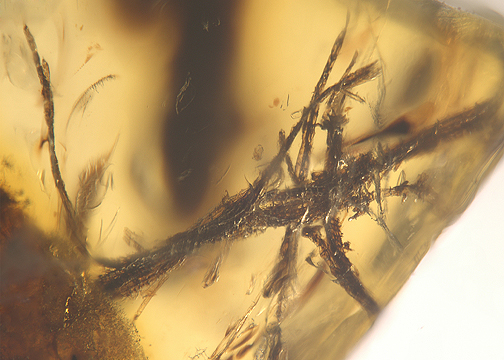
The Eocene represents a critical period for amber formation, yet relatively few Eocene amber deposits have been documented in China. To date, only the fossiliferous Fushun amber (Liaoning Province) and the relatively less explored Maoming amber (Guangdong Province) have been described. In this study, we report Eocene amber from Longkou, Shandong Province, eastern China, and provide mineralogical Fourier Transform Infrared (FT-IR) spectroscopic characterization. This represents the first record of amber from Shandong Province. Longkou amber occurs abundantly within Eocene coal seams, offering considerable potential for future discoveries of biological inclusions.
References
- Agnihotri, P., Singh, V.P., Singh, H., Grimaldi, D., Thakkar, M.G., Priya, T., Subramanian, K.A., Dutta, S. & Mishra, S. (2025) Eocene amber fossils reveal how complex trophic interactions shaped tropical rainforest biodiversity. iScience, 28 (9), 113430. https://doi.org/10.1016/j.isci.2025.113430
- Azar, D., Gèze, R. & Acra, F. (2010) Chapter 14: Lebanese amber. In: Penney, D. (Ed.), Biodiversity of fossils in amber from the major world deposits. Siri Scientific Press, Manchester, pp. 271–298.
- Bureau of Geology and Mineral Resources of Shandong Province. (1996) Lithostratigraphy of Shandong Province. China University of Geosciences Press, Wuhan, 323 pp. [In Chinese]
- Chen, H.H. & Sun, S. (1988) Lithofacies and depositional environments of the Tertiary coal-bearing series in the Huangxian Basin, Shandong Province. Acta Petrologica Sinica, 4 (2), 50–58. [In Chinese]
- Coward, A.J., Mays, C., Patti, A.F., Stilwell, J.D., O’Dell, L.A. & Viegas, P. (2018) Taphonomy and chemotaxonomy of Eocene amber from southeastern Australia. Organic Geochemistry, 118, 103–115. https://doi.org/10.1016/j.orggeochem.2017.12.004
- Fu, J.F., Wang, J.W. & Tong, Y.S. (2002) The new discovery of the plesiadapiformes from the early Eocene of Wutu Basin, Shandong Province. Vertebrata Palasiatica, 40 (3), 219–227. [In Chinese] https://doi.org/10.19615/j.cnki.1000-3118.2002.03.007
- Hong, Y.C. (2002a) Amber insects of China. Beijing Science and Technology Press, Beijing, 653 pp. [In Chinese]
- Hong, Y.C. (2002b) Atlas of amber insects of China. Henan Scientific and Technological Publishing House, Zhengzhou, 394 pp. [In Chinese]
- Inglis, G.N., Bragg, F., Burls, N.J., Cramwinckel, M.J., Evans, D., Foster, G.L., Huber, M., Lunt, D.J., Siler, N., Steinig, S., Tierney, J.E., Wilkinson, R., Anagnostou, E., de Boer, A.M., Dunkley Jones, T., Edgar, K.M., Hollis, C.J., Hutchinson, D.K. & Pancost, R.D. (2020) Global mean surface temperature and climate sensitivity of the early Eocene climatic optimum (EECO), Paleocene–Eocene thermal maximum (PETM), and latest Paleocene. Climate of the Past, 16 (5), 1953–1968. https://doi.org/10.5194/cp-16-1953-2020
- Jia, K.R. (2010) Coal-bearing Strata characteristics and coal looking direction analysis in Eastern Shandong Paleogene coalfields. Coal Geology of China, 22 (S1), 1–3, 28. [In Chinese]
- Katz, M.E., Miller, K.G., Wright, J.D., Wade, B.S., Browning, J.V., Cramer, B.S. (2008) Stepwise transition from the Eocene greenhouse to the Oligocene icehouse. Nature Geoscience, 1, 329–334. https://doi.org/10.1038/ngeo179
- Kong, F.F., Jia, Q., Li, Z.X., Lü, D.W., Liu, H.Y., Wang, D.D. & Han, Q.Y. (2019) Sedimentary facies characteristics and evolution of coal-bearing rock series of the Paleogene Lijiaya Formation in Huangxian Basin, Shandong Province. Journal of Palaeogeography, 21 (3), 469–478. [In Chinese] https://doi.org/10.19800/j.cnki.aps.1992.04.007
- Li, Y.T. (1985) Non-marine gastropod fossils from the Wutu Formation, Changle County, Shandong Province. Proceedings of Stratigraphy and Paleontology, 12, 237–251. [In Chinese]
- Li, Z.X., Wei, J.C., Li, S.C., Han, M.L. & Lan, H.X. (1998) The basin-filling features and sequence division in the Paleogene Huangxian fault basin, Shandong. Sedimentary Facies and Palaeogeography, 18 (4), 1–8. [In Chinese]
- Meng, F.H. (2006) Research and practices on coal mining technology under seabed in Longkou Mining Area. Coal Science and Technology, 34 (2), 19–22. [In Chinese] https://doi.org/10.13199/j.cst.2006.02.37.mengfh.006
- Ni, Z.J., Song, X.B., Azar, D., Wang, Z.X., Cai, C.Y., Xuan, Q., Maksoud, S., Lian, X.N. & Huang, D.Y. (2023) Discovery of Late Cretaceous amber from Guangzhou, south China. Palaeoentomology, 6 (4), 329–332. https://doi.org/10.11646/palaeoentomology.6.4.3
- Nohra, Y.A., Perrichot, V., Jeanneau, L., Le Pollès, L. & Azar, D. (2015) Chemical characterization and botanical origin of French ambers. Journal of Natural Products, 78 (6), 1284–1293. https://doi.org/10.1021/acs.jnatprod.5b00093
- Pankowski, M.V. (2024) A new Malthinus (Coleoptera: Cantharidae: Malthininae) adds to the unrivaled diversity of arthropods found in Eocene Baltic amber. Zootaxa, 5481 (4), 483–489. https://doi.org/10.11646/zootaxa.5481.4.7
- Sadowski, E.M., Schmidt, A.R., Seyfullah, L. & Kunzmann, L. (2017) Conifers of the ‘Baltic amber forest’ and their palaeoecological significance. Stapfia, 106, 1–73.
- Song, X.B., Lian, X.N., Yu, X.F., Wu, X.K., Wang, Y.H., Cai, C.Y., Xuan, Q., Gao, J., Azar, D., Ni, Z.J., Xu, M.M. & Huang, D.Y. (2025) Discovery of late Eocene amber from the Maoming Basin, Guangdong Province. Palaeoentomology, 8 (2), 129–137. https://doi.org/10.11646/palaeoentomology.8.2.3
- Song, Z.C., Cao, L. & Li, M.Y. (1964) Tertiary sporo-pollen complexes of Shantung. China Academica Sinica Philology Institute of Geology and Paleontology, Memoir, 3, 179–290. [In Chinese]
- Sonibare, O.O., Hoffmann, T. & Foley, S.F. (2012) Molecular composition and chemotaxonomic aspects of Eocene amber from the Ameki Formation, Nigeria. Organic Geochemistry, 51, 55–62. https://doi.org/10.1016/j.orggeochem.2012.08.003
- Thomas, E. & Zachos, J.C. (2000) Was the late Paleocene thermal maximum a unique event? GFF, 122 (1), 169–170. https://doi.org/10.1080/11035890001221169
- Tong, Y.S. & Wang, J.W. (1993) A new soricomorph (Mammalia, Insectivora) from the Early Eocene of Wutu Basin, Shandong China. Vertebrata Palasiatica, 31 (1), 19–32. [In Chinese] https://doi.org/10.19615/j.cnki.1000-3118.1993.01.003
- Tong, Y.S. & Wang, J.W. (1994) A new neoplagiaulacid Multituberculate (Mammalia) from the Lower Eocene of Wutu Basin, Shandong. Vertebrata Palasiatica, 32 (4), 275–282, 315–316. [In Chinese] https://doi.org/10.19615/j.cnki.1000-3118.1994.04.011
- Tong, Y.S. & Wang, J.W. (1997) A palaeanodont (Mammalia) from the Early Eocene Wutu Formation, Changle County, Shandong Province. Vertebrata Palasiatica, 35 (2), 110–120. [In Chinese] https://doi.org/10.19615/j.cnki.1000-3118.1997.02.004
- Tong, Y.S., Wang, J.W. & Meng, J. (2004) Olbitherium millenariusum, a new perissodactyl-like archaic ungulate (Mammalia) from the Early Eocene Wutu Formation, Shandong. Vertebrata Palasiatica, 42 (1), 27–38. [In Chinese] https://doi.org/10.19615/j.cnki.1000-3118.2004.01.003
- Wang, B., Rust, J., Engel, M.S., Szwedo, J., Dutta, S., Nel, A., Fan, Y., Meng, F., Shi, G., Jarzembowski, E.A., Wappler, T., Stebner, F., Fang, Y., Mao, L., Zheng, D. & Zhang, H. (2014) A diverse paleobiota in early Eocene Fushun amber from China. Current Biology, 24 (14), 1606–1610. https://doi.org/10.1016/j.cub.2014.05.048
- Wang, B.S., Li, Y.H. & Wang, X.E. (2000) Palaeogene transgressive lacustrine environment and coal accumulation in Huangxian Basin. Coal Geology & Exploration, 28 (3), 8–11. [In Chinese]
- Wang, J.W. & Tong, Y.S. (1996) A new lophialetid perissodactyl (Mammalia) from the Early Eocene of Wutu Basin, Shandong Province. Vertebrata Palasiatica, 34 (4), 312–321. [In Chinese] https://doi.org/10.19615/j.cnki.1000-3118.1996.04.010
- Wang, J.W. & Tong, Y.S. (1997) A new phenacodontid condylarth (Mammalia) from the early Eocene of the Wutu Basin, Shandong. Vertebrata Palasiatica, 35 (4), 283–289. [In Chinese] https://doi.org/10.19615/j.cnki.1000-3118.1997.04.004
- Wang, M.S. (2015) Study on the comprehensive development and utilization of Longkou oil shale. Multipurpose Utilization of Mineral Resources, 36 (6), 7–10. [In Chinese]
- Wang, P.L., Li, Z.X., Lü, D.W., Wang, Z.F., Liu, H.Y., Wang, D.D. & Feng, T.T. (2013) Analysis on palaeoclimate and metallogenic materials of typical basins under co-occurring circumstances of coal and oil shale. Coal Geology of China, 25 (12), 8–11. [In Chinese]
- Wang, X.M., Wang, M.Z. & Zhang, X.Q. (2005) Eocene Palynostratigraphy of Wutu, Shandong and its stratigraphical significance. Journal of Stratigraphy, 29 (1), 22–27. [In Chinese]
- Wang, Z.F., Lin, M.Y. & Wang, B.S. (2007) Maceral and geochemical characteristics of coal seam and oil shale in Huangxian Basin. Coal Geology & Exploration, 35 (4), 12–14. [In Chinese]
- Wolfe, A.P., McKellar, R.C., Tappert, R., Sodhi, R.N.S. & Muehlenbachs, K. (2016) Bitterfeld amber is not Baltic amber: three geochemical tests and further constraints on the botanical affinities of succinite. Review of Palaeobotany and Palynology, 225, 21–32. https://doi.org/10.1016/j.revpalbo.2015.11.002
- Xi, J., Hu, S.R., Guo, B., Wang, H.S. & Wang, E.M. (2012) Study on Hydrocarbon Generation Features of Kochenite in Paleogene Coal of Huangxian Basin. Coal Science and Technology, 40 (7), 108–111. [In Chinese] https://doi.org/10.13199/j.cst.2012.07.111.xij.004
- Xiong, B., Li, X.Q., Zhong, N.N. & Wang, T.G. (1996) The resinite types and their hydrocarbon-forming significance in Tertiary organic source rocks in Huangxian Coalfield. Coal Geology of China, 8 (4), 15–19. [In Chinese]
- Xue, Z.Z. & Zhang, W. (2000) Coal mining practice under water-bearing strata near the sea in Longkou Mine Area. Coal Mining Technology, 10 (2), 13–14, 21. [In Chinese] https://doi.org/10.13532/j.cnki.cn11-3677/td.2000.02.004
- Yang, Z.J. (1961) On two new fossil lizards of China. Vertebrata Palasiatica, 3 (2), 115–121. [In Chinese] https://doi.org/10.19615/j.cnki.1000-3118.1961.02.003
- Zhang, M.M. & Zhou, J.J. (2002) First discovery of fossil pike (Esox, Pisces Teleostei) from China. Vertebrata Palasiatica, 40 (2), 81–96. [In Chinese] https://doi.org/10.19615/j.cnki.1000-3118.2002.02.001
- Zhang, S.X. (1987) The sedimentary characteristic and sedimentary environment of the Huangxian Formation in Huangxian Coalfield. Journal of Shandong Mining Institute, 9 (2), 128–136. [In Chinese] https://doi.org/10.16452/j.cnki.sdkjzk.1987.02.015