

Abstract
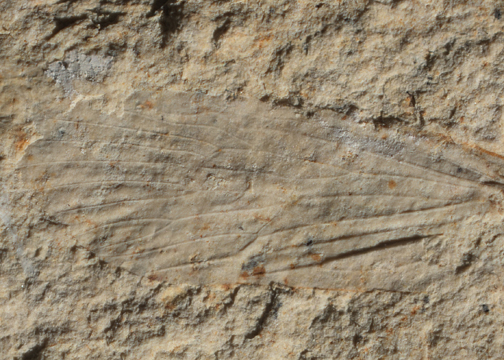
The fossil record of insects in Greece is particularly scarce, with the only known locations comprising Evia (Bachmayer et al., 1971, 1981) and Crete (Wappler et al., 2009), each with a very small number of specimens. However, the fidelity of certain insect orders prevents their preservation in certain settings that other orders may be represented. The order Trichoptera is scarcely represented in the fossil record compared to Diptera, Coleoptera and Hymenoptera which are more abundant in Cenozoic (Labandeira & Sepkoski, 1993). Additionally, larval cases of Trichoptera are more commonly preserved than body fossils. In this paper, I describe a new specimen belonging to Phryganeidae from the Vitala area of Kymi, a rare family for compressional fossil findings, based on a fossilized wing. Furthermore, this is the first record of a fossil trichopteran from the Early Miocene Anatolian landmass, an understudied palaeogeographic area for palaeoentomology.
References
- Arillo, A.A. & Bremond, C.S. (1992) Nota sobre la presencia de un Tricóptero y un Odonato en el Mioceno Superior de la depresión ceretana. Boletín Geológico y Minero, 103 (6), 16–20.
- Bachmayer, F., Symeonidis, N. & Theodoropoulos, D. (1971) Einige Insektenreste aus den Jungtertiaren Süsswasserablagerungen von Kumi (Insel Euboea, Griechenland). Annales Géologiques des Pays Helleniques, 23, 165–174.
- Bachmayer, F., Symeonidis, N. & Theodorou, G. (1981) Neue Insektenreste aus den jungtertiaren Süsswasser-Ablagerungen von Kumi (Insel Euboa, Griechenland). Annales Géologiques des Pays Helleniques, 30, 763–766.
- Carpenter, F.M. (1931) Insects from the Miocene (Latah) of Washington, DC: Part 6. Trichoptera. Annals of the Entomological Society of America, 24 (2), 319–322. https://doi.org/10.1093/aesa/24.2.319
- Cockerell, T.D.A. (1913) The genus Phryganea (Trichoptera) in the Florissant shales. Psyche, 20, 95–96. https://doi.org/10.1155/1913/90926
- Cockerell, T.D.A. (1914) New and little-known insects from the Miocene of Florissant, Colorado. Journal of Geology, 22 (7), 714–724. https://doi.org/10.1086/622186
- Cockerell, T.D.A. (1925) Tertiary insects from Kudia River, Maritime Province, Siberia. Proceedings of the United States National Museum, 68 (2606), 1–16. https://doi.org/10.5479/si.00963801.68-2606.1
- Fytikas, M., Giulliani, O., Innocenti, F., Manetti, P., Mazzuolli, R., Peccerillo, A. & Villari, L. (1976) Geochronological data on recent magmatism of the Aegean Sea, Tectonophysics, 31, 129–134.
- Harzhauser, M. & Piller, W. (2007) Benchmark data of a changing sea—Palaeogeography, Palaeobiogeography and events in the Central Paratethys during the Miocene. Palaeogeography, Palaeoclimatology, Palaeoecology, 253, 8–31. https://doi.org/10.1016/j.palaeo.2007.03.031
- Heer, O. (1883) Ueber die fossilen insekten Grönlands, flora fossilis Grönlandica. Die Fossile Flora Grönlands. II. Wurster, Zürich, pp. 143–148. https://doi.org/10.7146/mog.v5.143941
- Holzenthal, R.W., Morse, J.C. & Kjer, K.M. (2011) Order Trichoptera Kirby, 1813. In: Zhang, Z.Q. (Ed.), Animal biodiversity: An outline of higher-level classification and survey of taxonomic richness. Zootaxa, 3148 (1), 209–211. https://doi.org/10.11646/zootaxa.3148.1.40
- Ivanov, V.D., Melnitsky, S.I. & Perkovsky, E.E. (2016) Caddisflies from Cenozoic resins of Europe. Paleontological Journal, 50 (5), 485–493. https://doi.org/10.1134/S0031030116050063
- Labandeira, C.C. & Sepkoski, J.J. (1993) Insect diversity in the fossil record. Science, 261, 310–315. https://doi.org/10.1126/science.11536548
- Melnitsky, S.I., Ivanov, V.D., Perkovsky, E.E., Vasilenko, D.V. & Legalov, A.A. (2024) The new species of Holocentropus, Plectrocnemia and Phryganea (Insecta: Trichoptera) from Eocene Rovno amber. Ecologica Montenegrina, 80, 1–12. https://doi.org/10.37828/em.2024.80.1
- Meunier, F., (1919) Neue Beiträge über die fossilen Insekten aus der Braunkohle von Rott (Aquitanien) im Siebengebirge (Rheinpreußen), Jahrbuch der Preussischen Geologischen Landesanstalt u. Bergankademie zu Berlin, 39 (1), 141–153.
- Meunier, F. (1918) Eine neue Phryganiden-Art aus den Gipsplatten von Aix (Provence). Entomologische Mitteilungen, 7, 198–200. https://doi.org/10.5962/bhl.part.27262
- Piton, L.F.A. (1940) Paléontologie du gisement Éocène de Menat (Puy-de-Dôme). Flore et faune (Thèse de sciences naturel les). Mémoires de la société d’histoire naturelle d’Auvergne, Société d’Histoire Naturelle d’Auvergne, 1, 1–303.
- Roegl, F. (1999) Mediterranean and Paratethys. Facts and hypotheses of an Oligocene to Miocene paleogeography (short overview). Geologica Carpathica, 50, 330–349.
- Scudder, S.H. (1890) The Tertiary insects of North America. Bulletin of U.S. Geological Survey, 13, 1–734. https://doi.org/10.5962/bhl.title.44698
- Sommer, R.S. & Zachos, F.E. (2009) Fossil evidence and phylogeography of temperate species: ‘glacial refugia’ and post-glacial recolonization. Journal of Biogeography, 36, 2013–2020. https://doi.org/10.1111/j.1365-2699.2009.02187.x
- Statz, G. (1936) Über neue Funde von Neuropteren, Panorpaten und Trichopteren aus den tertiären Schiefern von Rott am Siebengebirge. Decheniana, 93, 208–255.
- Sukatsheva, I.D. (2016) The family Phryganeidae (Insecta, Trichoptera) from the Mesozoic and Cenozoic of Asia (with a brief worldwide overview of the fossil caddisfly fauna). Paleontological Journal, 50 (4), 396–405. https://doi.org/10.1134/S0031030116040134
- Velitzelos, D. (2002) Field guide to the Neogene of the Island of Evia—early Miocene flora of Kymi. In: Field guide, 6th European palaeobotany‐paly‐nology conference. University of Athens, 1–62.
- Velitzelos, D., Bouchal, J.M. & Denk, T. (2014) Review of the Cenozoic floras and vegetation of Greece. Review of Palaeobotany and Palynology, 204, 56–117. https://doi.org/10.1016/j.revpalbo.2014.02.006
- Wappler, T., Dlussky, G.M. & Reuter, M. (2009) The first fossil record of Polyrhachis (Hymenoptera: Formicidae: Formicinae) from the Upper Miocene of Crete (Greece). Paläontologische Zeitschrift, 83, 431–438. https://doi.org/10.1007/s12542-009-0035-3
- Wichard, W. (2013) Overview and descriptions of Trichoptera in Baltic amber: Spicipalpia and Integripalpia. Naturkunde Museum Berlin–Verlag Dr. Kessel, Remagen, 230 pp.