

Abstract
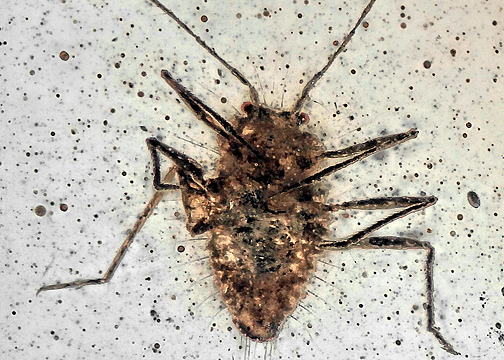
We here report an amber piece from Kachin amber, Myanmar, Cretaceous, about 100 million years old. It includes a group of 17 immatures of coccomorphans (scale insects) displaying wax, most likely for defensive purposes. In the same piece we found two possible predators of the coccomorphans: an adult rove beetle and an aphidlion-like larva with a fully assembled camouflaging cloak. Both possible predators are positioned very close to some of the coccomorphans, and no separate flows of amber seem to separate them. It therefore seems likely that this is a case of predators preserved together with their prey. Such cases of predator-prey interaction are still rare in amber, while other interactions, such as mating or parasitism, have been increasingly reported. A comparable case of aphids preserved together with an aphidlion has so far only been known from significantly younger Baltic amber. The here reported case seems to be the first one in which an aphidlion-like larva is preserved together with potential prey in Kachin amber, although quite a large number of such larvae have already been reported.
References
- Abd-Rabou, S., Ahmed, N. & Moustafa, M. (2012) Predators of scale insects (Hemiptera: Coccoidea) and their role in control in Egypt. Egyptian Academic Journal of Biological Sciences (A: Entomology), 5 (3), 203–209. https://doi.org/10.21608/eajbsa.2012.14286
- Allsup, K. (2020) Aphid lions. Home & Yard, Garden Pest Newsletter, University of Illinois Extension, 8. Hosted by College of Agriculture, Consumer, and Environmental Sciences University of Illinois, Urbana-Champaign Illinois Natural History Survey. Available from: https://hyg.ipm.illinois.edu/article.php?id=1167 (last accessed on January 23, 2026).
- Arce, S.I., Braig, F., Linhart, S.J., Le Cadre, J., Salvamoser, O., Müller, P., Haug, C. & Haug, J.T. (2025) Morphological variation of long-legged velvet mite larvae in deep time. Rivista Italiana di Paleontologia e Stratigrafia, 131, 331–351. https://doi.org/10.54103/2039-4942/23134
- Arce, S.I., Haug, C., Haug, J.T. & Amaral, A.P. (2024a) Driven apart: fossil parasitic long-legged velvet mite larvae on gall midges represent a long lost parasitic association between mites and dipterans. Palaeoentomology, 7 (2), 254–264. https://doi.org/10.11646/palaeoentomology.7.2.9
- Arce, S.I., Haug, C., Müller, P., Haug, J.T. & Fu, Y.Z. (2024b) Oldest record of a larva of long-legged velvet mite (Erythraeoidea) parasitising an immature planthopper. Palaeoentomology, 7 (4), 461–464. https://doi.org/10.11646/palaeoentomology.7.4.3
- Balog, A., Mehrparvar, M. & Weisser, W.W. (2013) Polyphagous predatory rove beetles (Coleoptera: Staphylinidae) induce winged morphs in the pea aphid Acyrthosiphon pisum (Hemiptera: Aphididae). European Journal of Entomology, 110 (1), 153–157. https://doi.org/10.14411/eje.2013.021
- Barden, P., Perrichot, V. & Wang, B. (2020) Specialized predation drives aberrant morphological integration and diversity in the earliest ants. Current Biology, 30 (19), 3818–3824. https://doi.org/10.1016/j.cub.2020.06.106
- Birken, E.M. & Cloyd, R.A. (2007) Food preference of the rove beetle, Atheta coriaria Kraatz (Coleoptera: Staphylinidae) under laboratory conditions. Insect Science, 14 (1), 53–56. https://doi.org/10.1111/j.1744-7917.2007.00125.x
- Chen, X.H., Newton, A.F., Huang, D.Y., Lü, L. & Cai, C.Y. (2025) The first Mesozoic record of Ochthephilus (Coleoptera: Staphylinidae: Oxytelinae) from mid-Cretaceous Burmese amber. Insect Systematics & Evolution, 56 (3), 223–234. https://doi.org/10.1163/1876312x-bja10071
- Dunne, E.M., Raja, N.B., Stewens, P.P. & Zaw, K. (2022) Ethics, law, and politics in palaeontological research: The case of Myanmar amber. Communications Biology, 5 (1), 1023. https://doi.org/10.1038/s42003-022-03847-2
- Fischer, T.C. & Hörnig, M.K. (2019) Mating moths (Tineidae, Ditrysia, Lepidoptera) preserved as frozen behavior inclusion in Baltic amber (Eocene). Palaeontologia Electronica, 22.1.7A, 1–11. https://doi.org/10.26879/829
- Foldi, I. (1991) The wax glands in scale insects: comparative ultrastructure, secretion, function and evolution (Homoptera: Coccoidea). Annales de la Societe entomologique de France (NS), 27 (2), 163–188. https://doi.org/10.1080/21686351.1991.12277633
- Fu, Y.Z., Cai, C.Y., Chen, P.P., Xuan, Q., Myint, T.A. & Huang, D.Y. (2024) Group mating in Cretaceous water striders. Proceedings of the Royal Society B, 291, 20232546. https://doi.org/10.1098/rspb.2023.2546
- Habibullah-Rana, M., Khan, F. & Naqvi, S.N.H. (2010) Comparative feeding behaviour of rove beetles (Paederus littoralis.) with reference to natural and artificial diets. Pakistan Journal of Entomology, 25 (1), 33–35.
- Haug, C., Haug, J.T., Haug, G.T., Müller, P., Zippel, A., Kiesmüller, C., Gauweiler, J. & Hörnig, M.K. (2024a) Fossils in Myanmar amber demonstrate the diversity of anti-predator strategies of Cretaceous holometabolan insect larvae. iScience, 27, 108621. https://doi.org/10.1016/j.isci.2023.108621
- Haug, J.T., Azar, D., Ross, A., Szwedo, J., Wang, Bo, Arillo, A., Baranov, V., Bechteler, J., Beutel, R., Blagoderov, V., Delclòs, X., Dunlop, J., Feldberg, K., Feldmann, R., Foth, C., Fraaije, R.H.B., Gehler, A., Harms, D., Hedenäs, L., Hyžny, M., Jagt, J.W.M., Jagt-Yazykova, E.A., Jarzembowski, E., Kerp, H., Khine, P.K., Kirejtshuk, A.G., Klug, C., Kopylov, D.S., Kotthoff, U., Kriwet, J., McKellar, R.C., Nel, A., Neumann, C., Nützel, A., Peñalver, E., Perrichot, V., Pint, A., Ragazzi, E., Regalado, L., Reich, M., Rikkinen, J., Sadowski, E.-M., Schmidt, A.R., Schneider, H., Schram, F.R., Schweigert, G., Selden, P., Seyfullah, L.J., Solórzano-Kraemer, M.M., Stilwell, J.D., van Bakel, B.W.M., Vega, F.J., Wang, Y.D., Xing, L.D. & Haug, C. (2020a) Comment on the letter of the Society of Vertebrate Paleontology (SVP) dated April 21, 2020 regarding “Fossils from conflict zones and reproducibility of fossil-based scientific data”: Myanmar amber. Paläontologische Zeitschrift, 94, 431–437. https://doi.org/10.1007/s12542-020-00524-9
- Haug, J.T., Baranov, V., Schädel, M., Müller, P., Gröhn, C. & Haug, C. (2020b) Challenges for understanding lacewings: how to deal with the incomplete data from extant and fossil larvae of Nevrorthidae? (Neuroptera). Fragmenta entomologica, 52, 137–167. https://doi.org/10.4081/fe.2020.472
- Haug, J.T., Kay Lwin Tun, Haug, G.T., Kyaw Naing Than, Haug, C. & Hörnig, M.K. (2023a) A hatching aphidlion-like lacewing larva in 100 million years old Kachin amber. Insect Science, 30, 880–886. https://doi.org/10.1111/1744-7917.13137
- Haug, J.T., Kiesmüller, C., Haug, G.T., Haug, C. & Hörnig, M.K. (2023b) A fossil aphidlion preserved together with its prey in 40 million-year-old Baltic amber. Palaeobiodiversity and Palaeoenvironments, 103, 155–163. https://doi.org/10.1007/s12549-021-00521-z
- Haug, J.T., Linhart, S., Baranov, V. & Haug, C. (2024b) Eocene and modern entomofauna differ—a Cretaceous-like larva in Rovno amber. Insect Science, 32 (2), 712–718. https://doi.org/10.1111/1744-7917.13410
- Haug, J.T., Linhart, S., Haug, G.T., Gröhn, C., Hoffeins, C., Hoffeins, H.-W., Müller, P., Weiterschan, T., Wunderlich, J. & Haug, C. (2022) The diversity of aphidlion-like larvae over the last 130 million years. Insects, 13 (4), 336. https://doi.org/10.3390/insects13040336
- Haug, J.T., Zippel, A., Haug, G.T. & Haug, C. (2025) Possible fossil larvae of Staphylinidae from Kachin amber and a quantitative morphological comparison indicate that rove beetle larvae partly replaced lacewing larvae. Insects, 16, 910. https://doi.org/10.3390/insects16090910
- Hörnig, M.K., Kiesmüller, C., Müller, P., Haug, C. & Haug, J.T. (2020) A new glimpse on trophic interactions of 100-million-year old lacewing larvae. Acta Palaeontologica Polonica, 65, 777–786. https://doi.org/10.4202/app.00677.2019
- Hu, F.S., Hsiao, Y. & Solodovnikov, A. (2025) A global citizen science effort via iNaturalist reveals food webs of large predatory rove beetles. Food Webs, 43, e00399. https://doi.org/10.1016/j.fooweb.2025.e00399
- Jałoszyński, P. & Peris, D. (2016) Cretaceous amber inclusions of Spain and Myanmar demonstrate early diversification and wide dispersal of Cephenniitae (Coleoptera: Staphylinidae: Scydmaeninae). Cretaceous Research, 57, 190–198. https://doi.org/10.1016/j.cretres.2015.09.002
- Kiesmüller, C., Haug, G.T., Haug, C., Müller, P., Hörnig, M.K. & Haug, J.T. (2024) New indications for the life habits of long-legged aphidlion-like larvae in about 100-million-year-old amber. Paläontologische Zeitschrift, 98, 429–441. https://doi.org/10.1007/s12542-024-00693-x.
- Kiesmüller, C., Haug, J.T., Müller, P. & Hörnig, M.K. (2022) A case of frozen behaviour: A flat wasp female with a beetle larva in its grasp in 100-million-year-old amber. Fossil Record, 25, 287–305. https://doi.org/10.3897/fr.25.82469
- Kozár, F. (2004) Ortheziidae of the world. Plant Protection Institute, Hungarian Academy of Science, Budapest, 525 pp.
- Krooss, S. & Schaefer, M. (1998) How predacious are predators? A study on Ocypus similis, a rove beetle of cereal fields. Annals of Applied Biology, 133 (1), 1–16. https://doi.org/10.1111/j.1744-7348.1998.tb05797.x
- Li, Y.D., Newton, A.F., Li, X.Y., Huang, D.Y. & Cai, C.Y. (2023) Earliest fossil record of Phloeocharinae in mid-Cretaceous amber from northern Myanmar (Coleoptera: Staphylinidae). Cretaceous Research, 142, 105371. https://doi.org/10.1016/j.cretres.2022.105371
- MacLeod, E.G. (1964) A comparative morphological study of the head capsule and cervix of larval Neuroptera (Insecta). Doctoral dissertation, Harvard University, Massachusetts, USA, 528 pp.
- Mainda, T. (2023) Festenus annodutt nov.sp. from Burmese amber (Coleoptera, Staphylinidae, Steninae). Linzer biologische Beiträge, 54/2, 573–576.
- Mainda, T. (2024) The diminutive fear of the Cretaceous edaphon: Festenus microraptor nov.sp. from 110 Ma old Hkamti-Burmese amber (Coleoptera, Staphylinidae, Steninae). Linzer biologische Beiträge, 56/1, 129–133.
- Mantoanelli, E., Albuquerque, G.S., Tauber, C.A. & Tauber, M.J. (2006) Leucochrysa (Leucochrysa) varia (Neuroptera: Chrysopidae): larval descriptions, developmental rates, and adult color variation. Annals of the Entomological Society of America, 99 (1), 7–18. https://doi.org/10.1603/0013-8746(2006)099[0007:LLVNCL]2.0.CO;2
- Maritz, R.A. & Maritz, B. (2020) Sharing for science: high-resolution trophic interactions revealed rapidly by social media. PeerJ, 8, e9485. https://doi.org/10.7717/peerj.9485
- Oswald, J.D., Contreras-Ramos, A. & Penny, N.D. (2002) Neuroptera (Neuropterida). In: Bousquets, J. & Morone, J.J. (Eds), Biodiversidad, Taxonomía y Biogeografía de Artrópodos de México: Hacia una Síntesis de su Conocimiento, Volume 3. Universidad Nacional Autónoma de México, Distrito Federal, Mexico, pp. 559–581.
- Pérez-de la Fuente, R., Delclòs, X., Peñalver, E. & Engel, M.S. (2016) A defensive behavior and plant-insect interaction in Early Cretaceous amber–the case of the immature lacewing Hallucinochrysa diogenesi. Arthropod Structure & Development, 45 (2), 133–139. https://doi.org/10.1016/j.asd.2015.08.002
- Pérez-de la Fuente, R., Delclòs, X., Peñalver, E., Speranza, M., Wierzchos, J., Ascaso, C. & Engel, M.S. (2012) Early evolution and ecology of camouflage in insects. Proceedings of the National Academy of Sciences, 109 (52), 21414–21419. https://doi.org/10.1073/pnas.1213775110
- Pérez-de la Fuente, R., Engel, M.S., Azar, D. & Peñalver, E. (2019) The hatching mechanism of 130-million-year-old insects: an association of neonates, egg shells and egg bursters in Lebanese amber. Palaeontology, 62 (4), 547–559. https://doi.org/10.1111/pala.12414
- Pérez-de la Fuente, R., Peñalver, E., Azar, D. & Engel, M.S. (2018) A soil-carrying lacewing larva in Early Cretaceous Lebanese amber. Scientific Reports, 8 (1), 16663. https://doi.org/10.1038/s41598-018-34870-1
- Poinar, G., Jr. & Vega, F.E. (2023) A new coccid family, Adocimycolidae fam. nov. (Hemiptera: Coccomorpha), with extended hamulohalteres in Burmese (Myanmar) amber. Palaeodiversity, 16 (1), 125–134. https://doi.org/10.18476/pale.v16.a5
- Poinar, G., Jr., Vega, F.E. & Schneider, S.A. (2020) A mid-Cretaceous female scale insect (Hemiptera: Sternorrhyncha: Coccomorpha) in Burmese amber. Zootaxa, 4810 (3), 511–522. https://doi.org/10.11646/zootaxa.4810.3.7
- Pundt, L. (2019) Fact sheet: Biological control of mealybugs. Integrated Pest Management Program, Department of Plant Science and Landscape Architecture, Uconn Extension, pp. 1–5. Available from: https://ipm-cahnr.media.uconn.edu/wp-content/uploads/sites/3216/2024/08/biologicacontrolofmealybugs.pdf (last accessed on January 23, 2026).
- Rojas, D.M.M., Márquez, J., Navarrete-Heredia, J.L., Martínez Falcón, A.P., Lobato-García, J.M. & Benítez Malvido, J. (2024) Rove beetle species diversity and the patterns of interactions with their host plants in primary and secondary tropical forests. Journal of Insect Conservation, 28 (6), 1349–1362. https://doi.org/10.1007/s10841-024-00633-9
- Shcherbakov, D.E. (2022) Crawlers of the scale insect Mesophthirus (Homoptera: Xylococcidae) on feathers in Burmese amber—wind transport or phoresy on dinosaurs? Paleontological Journal, 56 (3), 338–348. https://doi.org/10.1134/S0031030122030121
- Shi, G.H., Grimaldi, D.A., Harlow, G.E., Wang, J., Wang, J., Yang, M.C., Lei, W.Y., Li, Q.L. & Li, X.H. (2012) Age constraint on Burmese amber based on U-Pb dating of zircons. Cretaceous Research, 37, 155–163. https://doi.org/10.1016/j.cretres.2012.03.014
- Solórzano-Kraemer, M.M., Peñalver, E., Herbert, M C., Delclòs, X., Brown, B.V., Aung, N.N. & Peretti, A.M. (2023) Necrophagy by insects in Oculudentavis and other lizard body fossils preserved in Cretaceous amber. Scientific Reports, 13 (1), 2907. https://doi.org/10.1038/s41598-023-29612-x
- Stocker, B., Barthold, S. & Betz, O. (2022) Mouthpart ecomorphology and predatory behaviour in selected rove beetles of the “Staphylinine group” (Coleoptera: Staphylinidae: Staphylininae, Paederinae). Insects, 13 (8), 667. https://doi.org/10.3390/insects13080667
- Tauber, C.A., Mantoanelli, E., Albuquerque, G.S., Reguilon, C., Olazo, E G. & Tauber, M.J. (2011) A taxonomically significant polymorphism in Leucochrysa (Neuroptera: Chrysopidae): nomenclature, larval and adult descriptions, and biological notes. Zootaxa, 3130 (1), 1–29. https://doi.org/10.11646/zootaxa.3130.1.1
- Tauber, C.A., Sosa, F., Albuquerque, G.S. & Tauber, M.J. (2013) Adults and larvae of two Leucochrysa (Leucochrysa) species (Neuroptera: Chrysopidae): descriptions, biological notes, and relationships. Zootaxa, 3750 (2), 101–129. https://doi.org/10.11646/zootaxa.3750.2.1
- Townsend, L.H. (1939) Lacewings and their allies. The Scientific Monthly, 48 (4), 350–357.
- Vea, I.M. & Grimaldi, D.A. (2012) Phylogeny of ensign scale insects (Hemiptera: Coccoidea: Ortheziidae) based on the morphology of recent and fossil females. Systematic Entomology, 37 (4), 758–783. https://doi.org/10.1111/j.1365-3113.2012.00638.x
- Vea, I.M. & Grimaldi, D.A. (2015) Diverse new scale insects (Hemiptera: Coccoidea) in amber from the Cretaceous and Eocene with a phylogenetic framework for fossil Coccoidea. American Museum Novitates, 2015 (3823), 1–80. https://doi.org/10.18476/pale.v16.a5
- Wang, B., Xia, F.Y., Engel, M.S., Perrichot, V., Shi, G.L., Zhang, H.C., Chen, J., Jarzembowski, E.A., Wappler, T. & Rust, J. (2016) Debris-carrying camouflage among diverse lineages of Cretaceous insects. Science Advances, 2, e1501918. https://doi.org/10.1126/sciadv.1501918
- Wang, B., Xia, F.Y., Wappler, T., Simon, E., Zhang, H.C., Jarzembowski, E.A. & Szwedo, J. (2015) Brood care in a 100-million-year-old scale insect. eLife, 4, e05447. https://doi.org/10.7554/eLife.05447
- Weihrauch, F. (2012) The significance of brown and green lacewings as aphid predators in the special crop hops (Neuroptera: Hemerobiidae, Chrysopidae). Mitteilungen der Deutschen Gesellschaft für Allgemeine und Angewandte Entomologie, 18, 587–590.
- Weitschat, W. (2009) Jäger, Gejagte, Parasiten und Blinde Passagiere—Momentaufnahmen aus dem Bernsteinwald. Denisia, 26 /Kataloge der Oberösterreichischen Landesmuseen Neue Serie, 86, 243–256.
- Whitehead, P.F. (2017) Amischa bifoveolata (Mannerheim, 1830) (Coleoptera: Staphylinidae) and other beetles as predators of the root mealybug Rhizoecus cacticans (Hambleton, 1946) (Hemiptera: Pseudococcidae) in Worcestershire. Entomologist’s Gazette, 68 (1), 54–56.
- Yamamoto, S. (2024) Earliest fossil record of Tachyporini rove beetles in mid-Cretaceous Kachin amber from northern Myanmar (Coleoptera: Staphylinidae: Tachyporinae). Journal of Asia-Pacific Entomology, 27 (2), 102227. https://doi.org/10.1016/j.aspen.2024.102227
- Yamamoto, S. & Newton, A.F. (2021) First fossil trichophyine rove beetle from mid-Cretaceous amber of northern Myanmar (Coleoptera: Staphylinidae: Trichophyinae). Cretaceous Research, 127, 104951. https://doi.org/10.1016/j.cretres.2021.104951
- Yin, Z.W., Parker, J., Cai, C.Y., Huang, D.Y. & Li, L.Z. (2018) A new stem bythinine in Cretaceous Burmese amber and early evolution of specialized predatory behaviour in pselaphine rove beetles (Coleoptera: Staphylinidae). Journal of Systematic Palaeontology, 16 (7), 531–541. https://doi.org/10.1080/14772019.2017.1313790
- Yu, T.T., Thomson, U., Mu, L., Ross, A., Kennedy, J., Broly, P., Xia, F.Y., Zhang, H.C., Wang, B. & Dilcher, D. (2019) An ammonite trapped in Burmese amber. Proceedings of the National Academy of Sciences, 116 (23), 11345–11350. https://doi.org/10.1073/pnas.1821292116
- Zimmermann, D., Randolf, S. & Aspöck, U. (2019) Chapter 11: From chewing to sucking via phylogeny—from sucking to chewing via ontogeny: mouthparts of Neuroptera. In: Krenn, H. (Ed.), Insect mouthparts: Form, function, development and performance. Springer, Berlin, 361–385. https://doi.org/10.1007/978-3-030-29654-4_11
- Żyła, D., Yamamoto, S., Wolf-Schwenninger, K. & Solodovnikov, A. (2017) Cretaceous origin of the unique prey-capture apparatus in mega-diverse genus: stem lineage of Steninae rove beetles discovered in Burmese amber. Scientific Reports, 7 (1), 45904. https://doi.org/10.1038/srep45904