
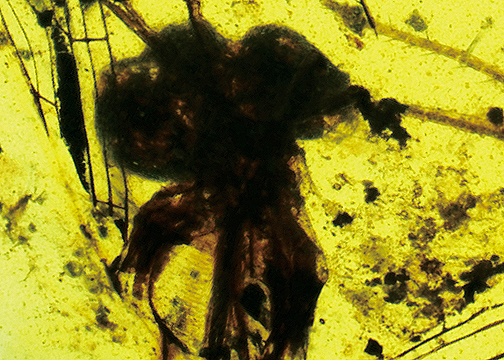

Abstract
The zygopteran family Burmacoenagrionidae Zheng, Nel & Wang, 2019 is endemic to the west Burma Block and occurring during the mid-Cretaceous (Zheng et al., 2019). It was considered to be a member of the Coenagrionoidea Kirby, 1890, which is the dominant group of the extant damselflies (Dijkstra et al., 2014). Four burmacoenagrionid genera have been previously described, including Burmacoenagrion Zheng, Nel & Wang, 2019, Burmagrion Möstel, Schorr & Bechly, 2017, Burmachistigma Zheng, Nel & Wang, 2019, and Electrocoenagrion Zheng, Nel & Wang, 2019 (Möstel et al., 2017; Zheng et al., 2019). This indicates that Burmacoenagrionidae is the most diversified zygopteran family currently recorded in the Kachin amber (Zheng, 2020).
References
Bechly, G. (1996) Morphologische Untersuchungen am Flügelgeäder der rezenten Libellen und deren Stammgruppenvertreter (Insecta; Pterygota; Odonata), unter besonderer Berücksichtigung der Phylogenetischen Systematik und des Grundplanes der Odonata. Petalura, 2, 1–402.
Cruickshank, R. D. & Ko, K. (2003) Geology of an amber locality in the Hukawng Valley, northern Myanmar. Journal of Asian Earth Sciences, 21, 441–455. https://doi.org/10.1016/S1367-9120(02)00044-5
Dijkstra, K.-D. B., Kalkman, V. J., Dow, R. A., Stokvis, F. R. & van Tol, J. (2014) Redefining the damselfly families: a comprehensive molecular phylogeny of Zygoptera (Odonata). Systematic Entomology, 39, 68–96. https://doi.org/10.1111/syen.12035
Fabricius, J. C. (1793) Entomologia systematica emendata et aucta, secundum classes, ordines, genera, species, adjectis synonymis, locis, observationibus, descriptionibus. C.G. Proft, Hafniae, 3, 1–488.
Liu, Y. X., Li, R., Oestman, M., Shi, C. F., Ren, D., & Yang, Q. (2025) New damselflies (Odonata: Zygoptera: Burmacoenagrionidae) from mid-Cretaceous Myanmar amber. Palaeoentomology, 8(2), 157-165. DOI:10.11646/palaeoentomology.8.2.6
Möstel, C., Schorr, M. & Bechly, G. (2017) A new stem-coenagrionoid genus of damselflies (Odonata: Zygoptera) from mid-Cretaceous Burmese amber. Zootaxa, 4243, 177–186. DOI:10.11646/zootaxa.4243.1.9
Nel, A., Martinez-Delclòs, X., Paicheler, J. C. & Henrotay, M. (1993) Les ‘Anisozygoptera’ fossiles. Phylogénie et classification (Odonata). Martinia Hors Série, 3, 1–311.
Kirby, W. F. (1890) A synonymic catalogue of Neuroptera Odonata, or dragonflies. With an appendix of fossil species. London: Gurney & Jackson, 202 pp.
Riek, E. F. (1976) A new collection of insects from the Upper Triassic of South Africa. Annals of the Natal Museum, 22, 791–820. https://hdl.handle.net/10520/AJA03040798_608
Riek, E. F. & Kukalová-Peck, J. (1984) A new interpretation of dragonfly wing venation based upon Early Carboniferous fossils from Argentina (Insecta: Odonatoidea) and basic character states in pterygote wings. Canadian Journal of Zoology, 62, 1150–1166. https://doi.org/10.1139/z84-166
Shi, G., Grimaldi, D. A., Harlow, G. E., Wang, J., Wang, J., Wang, M., Lei, W., Li, Q. & Li, X. (2012) Age constraint on Burmese amber based on U-Pb dating of zircons. Cretaceous Research, 37, 155–163. https://doi.org/10.1016/j.cretres.2012.03.014
Zheng, D.R., Nel, A., Zhang, H.C., Chang, S.C., Jarzembowski, E.A., Zhuo, D. & Wang, B. (2019) A highly diverse coenagrionoid damselfly group (Odonata: Zygoptera: Burmacoenagrionidae fam. nov.) from mid-Cretaceous Burmese amber. Journal of Systematic Palaeontology, 17 (3), 239–253. https://doi.org/10.1080/14772019.2017.1406010
Zheng, D.R. (2020) Odonatans in lowermost Cenomanian Kachin amber: updated review and a new hemiphlebiid damselfly. Cretaceous Research, 118 (104640), 1–7. https://doi.org/10.1016/j.cretres.2020.104640
Selys Longchamps, E. de (1854) Monographie des Calopterygines. Mémoires de la Société royale des Sciences de Liége, 9, xi + 291 pp.