

Abstract
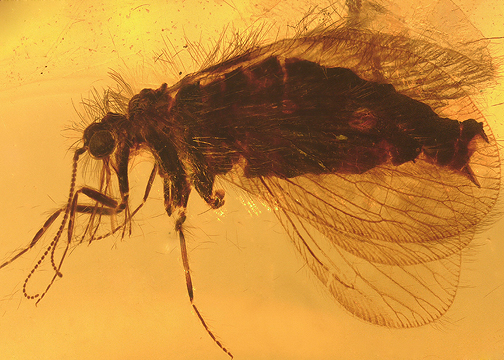
The first siphonate Neuroptera are discovered from the Hkamti (Sagaing) mines of mid-Cretaceous amber in northern Myanmar. Two adults of Sisyridae (spongilla-flies or spongilla lacewings) were located in a single piece and belong to a new paradoxosisyrine genus near to Sidorchukatia Khramov. The new genus differs from the latter in wing venation, antennal structure, and other details of setation. Cherasisyra elegans gen. et sp. nov. is described and figured and general comments are made regarding the potential biology of Paradoxosisyrinae.
References
- Banks, N. (1905) A revision of the Nearctic Hemerobiidae. Transactions of the American Entomological Society, 32, 21–51 + pls. iii–v.
- Engel, M.S., Winterton, S.L. & Breitkreuz, L.C.V. (2018) Phylogeny and evolution of Neuropterida: Where have wings of lace taken us? Annual Review of Entomology, 63, 531–551. https://doi.org/10.1146/annurev-ento-020117-043127
- Grimaldi, D. & Engel, M.S. (2005) Evolution of the insects. Cambridge University Press, Cambridge, xv+755 pp.
- Khramov, A.V., Yan, E. & Kopylov, D.S. (2019) Nature’s failed experiment: long-proboscid Neuroptera (Sisyridae: Paradoxosisyrinae) from Upper Cretaceous amber of northern Myanmar. Cretaceous Research, 104, 104180. https://doi.org/10.1016/j.cretres.2019.07.010
- Lu, X.M. & Liu, X.Y. (2021) The Neuropterida from the mid-Cretaceous of Myanmar: A spectacular palaeodiversity bridging the Mesozoic and present faunas. Cretaceous Research, 121, 104727. https://doi.org/10.1016/j.cretres.2020.104727
- Makarkin, V.N. (2016) Enormously long, siphonate mouthparts of a new, oldest known spongillafly (Neuroptera, Sisyridae) from Burmese amber imply nectarivory or hematophagy. Cretaceous Research, 65, 126–137. https://doi.org/10.1016/j.cretres.2016.04.007
- Musa, M., Kaye, T.G., Bieri, W. & Peretti, A. (2021) Burmese amber compared using micro-attenuated total reflection infrared spectroscopy and ultraviolet imaging. Applied Spectroscopy, 75 (7), 839–845. https://doi.org/10.1177/0003702820986880
- New, T.R. (1986) A review of the biology of Neuroptera Planipennia. Neuroptera International, Supplemental Series, 1, 1–56.
- New, T.R. (1989) Planipennia: lacewings. Handbuch der Zoologie, Band 4, Arthropoda: Insecta. W. de Gruyter, Berlin, New York, 30, 1–132.
- Parfin, S.I. & Gurney, A.B. (1956) The spongilla-flies with special reference to those of the Western Hemisphere (Sisyridae, Neuroptera). Proceedings of the United States National Museum, 105 (3360), 421–529. https://doi.org/10.5479/si.00963801.105-3360.421
- Peña-Kairath, C., Delclòs, X., Álvarez-Parra, S., Peñalver, E., Engel, M.S., Ollerton, J. & Peris, D. (2023) Insect pollination in deep time. Trends in Ecology and Evolution, 38 (8), 749–759. https://doi.org/10.1016/j.tree.2023.03.008
- Peretti, A. (2020) Ethical guidelines for Burmese amber acquisitions. Journal of Applied Ethical Mining of Natural Resources and Paleontology (PMF Journal), 1, 1–78.
- Peretti, A. & Bieri, W. (2021) PMF data depository of analysis FTIR-ATR, PL analysis, CT scan and UV imaging of amber containing holotype Yaksha perettii, Oculudentavis naga and comparative amber samples, and associated invertebrate inclusions. Journal of Applied Ethical Mining of Natural Resources and Paleontology (PMF Journal), 2, 1–35.