
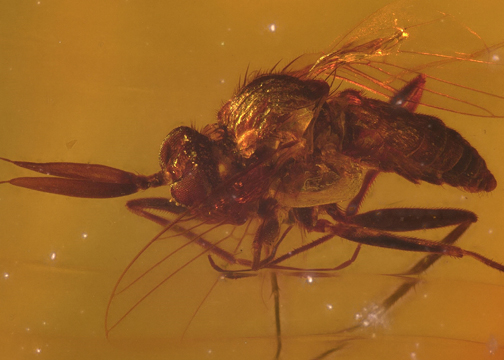

Abstract
Lazarus taxa are those clades for which fossil species were the only taxa known until surviving members were discovered much later, usually in relict habitats. The most famous of Lazarus taxa are the fishes of the Actinistia, commonly known as coelacanths (a name referring to the first described species, the Permian Coelacanthus granulatus Agassiz, 1839). At first known from a diversity of fossil species spanning the Devonian to Cretaceous, the lineage was believed extinct until the first living species, Latimeria chalumnae Smith, 1939, was trawled and discovered in 1938 off the coast of South Africa (Smith, 1939). A second living species was discovered around Sulawesi in 1997 (Pouyaud et al., 1999).
References
- Amorim, D.S., Riccardi, P.R. & Rafael, J.A. (2020) First known extant species of Alavesia (Diptera: Atelestidae) in the Neotropical region: Alavesia leukoprosopa, sp. nov., from the southern Atlantic Forest, Brazil. American Museum Novitates, 3962, 1–12. https://doi.org//10.1206/3962.1
- Grimaldi, D. & Engel, M.S. (2005) Evolution of the insects. Cambridge University Press, Cambridge, xv+755 pp.
- Jouault, C., Ngo-Muller, V., Zhang, Q.Q. & Nel, A. (2020) New empidoid flies (Diptera: Atelestidae; Dolichopodidae) from mid-Cretaceous Burmese amber. Palaeoentomology, 3 (2), 204–211. https://doi.org//10.11646/palaeoentomology.3.2.10
- Peñalver, E. & Arillo, A. (2007) A new species of the family Hybotidae in the Lower Cretaceous amber of El Caleyu (Asturias, Spain); Alavesia prietoi n. sp. Alavesia, 1, 63–68.
- Peng, A.C., Engel, M.S., Boderau, M., Legendre, F., Liu, Y., Nyunt, T.T., Wang, B. & Nel, A. (2025) Descending from trees: A Cretaceous winged ice-crawler illuminates the ecological shift and origin of Grylloblattidae. Proceedings of the Royal Society, Series B, Biological Sciences, 292 (2049), 20250557, 1–12. https://doi.org//10.1098/rspb.2025.0557
- Poinar, G.O. & Vega, F.E. (2020) A new genus of Empididae (Diptera) with enlarged postpedicels in mid-Cretaceous Burmese amber. Historical Biology, 33 (9), 1830–1835. https://doi.org//10.1080/08912963.2020.1743700
- Pouyaud, L., Wirjoatmodjo, S., Rachmatika, I., Tjakrawidjaja, A., Hadiaty, R. & Hadie, W. (1999) Une nouvelle espèce de coelacanthe: Preuves génétiques et morphologiques. Comptes Rendus de l’Académie des Sciences, Série III, 322 (4), 261–267. https://doi.org//10.1016/s0764-4469(99)80061-4
- Sinclair, B.J. & Grimaldi, D.A. (2020) Cretaceous diversity of the relict genus Alavesia Waters and Arillo (Diptera: Empidoidea: Atelestidae). American Museum Novitates, 3961, 1–40. https://doi.org//10.1206/3961.1
- Sinclair, B.J. & Kirk-Spriggs, A.H. (2010) Alavesia Waters and Arillo—a Cretaceous-era genus discovered extant on the Brandberg Massif, Namibia (Diptera: Atelestidae). Systematic Entomology, 35 (2), 268–276. https://doi.org//10.1111/j.1365-3113.2009.00506.x
- Smith, J.L.B. (1939) A living fish of Mesozoic type. Nature, 143 (3620), 455–456. https://doi.org//10.1038/143455a0
- Stark, A., Hoffeins, C., Hoffeins, H.W. & Arillo, A. (2020) Signal from the Cretaceous—a new species of Alavesia from Burmese amber (Diptera: Empidoidea: Atelestidae). Palaeoentomology, 3 (5), 513–524. https://doi.org//10.11646/palaeoentomology.3.5.9
- Waters, S.B. & Arillo, A. (1999) A new genus of Hybotidae (Diptera, Empidoidea) from Lower Cretaceous amber of Alava (Spain). Studia Dipterologica, 6 (1), 59–66.
- Zhang, S.H., Xie, S.P., Zhang, Y., Wang, B., Zhang, P., Zeng, X. & Yu, Y. (2020) A new species of dance fly (Diptera, Empidoidea, Atelestidae) from mid-Cretaceous Burmese amber. Cretaceous Research, 118, 104660. https://doi.org//10.1016/j.cretres.2020.104660