

Abstract
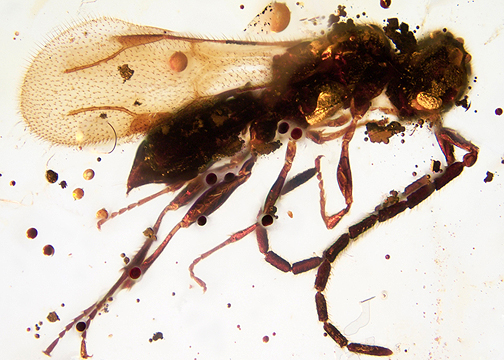
The oldest representative of the ceraphronoid family Megaspilidae is described and illustrated based on a well-preserved female from Early Cretaceous Lebanese amber. Alphaspilus heliades gen. et sp. nov. shows the characteristic anatomical features of the family and, despite superficial similarity, clearly differs from the genera Megaspilus Westwood and Conostigmus Dahlbom. This discovery proves that both stem and crown ceraphronoid groups coexisted in Early Cretaceous forest ecosystems. An updated checklist of all known fossil Megaspilidae species is provided.
References
- Alekseev, V.N. (1995) Conostigmus antiquus sp. n., a fossil ceraphronoid species from Baltic amber (Hymenoptera, Ceraphronoidea). Amber and Fossils, 1 (1), 23–25.
- Alekseev, V.N. & Rasnitsyn, A.P. (1981) Late Cretaceous Megaspilidae (Hymenoptera) from amber of the Taymyr. Paleontologicheskii Zhurnal, 4, 127–130. [In Russian; English translation in Paleontological Journal, 4, 124–128]
- Álvarez-Parra, S. & Azar, D. (2024) The wasps (Hymenoptera) from Lower Cretaceous Lebanese and Spanish ambers. Fossil Studies, 2 (2), 110–122. https://doi.org//10.3390/fossils2020005
- Ashmead, W.H. (1893) Monograph of the North American Proctotrypidae. Bulletin of the United States National Museum, 45, 1–472, + pls. i–xviii. https://doi.org//10.5479/si.03629236.45.1
- Azar, D. & Nel, A. (2013) A new beaded lacewing from a new Lower Cretaceous amber outcrop in Lebanon (Neuroptera: Berothidae). In: Azar, D., Engel, M.S., Jarzembowski, E., Krogmann, L. & Santiago-Blay, J. (Eds), Insect evolution in an amberiferous and stone alphabet. Brill, Leiden, pp. 111–130. https://doi.org//10.1163/9789004210714_009
- Blaimer, B.B., Santos, B.F., Cruaud, A., Gates, M.W., Kula, R.R., Mikó, I., Rasplus, J.-Y., Smith, D.R., Talamas, E.J., Brady, S.G. & Buffington, M.L. (2023) Key innovations and the diversification of Hymenoptera. Nature Communications, 14, 1212. https://doi.org//10.1038/s41467-023-36868-4
- Brues, C.T. (1940) Calliceratidae in Baltic amber. Proceedings of the American Academy of Arts & Sciences, 73, 265–269.
- Cooper, K.W. & Dessart, P. (1975) Adult, larva and biology of Conostigmus quadratogenalis Dessart & Cooper, sp.n., (Hym., Ceraphronoidea), parasite of Boreus (Mecoptera) in California. Bulletin et Annales de la Société Royale Belge d’Entomologie, 111, 37–53.
- Delclòs, X., Peñalver, E., Arillo, A., Engel, M.S., Nel, A., Azar, D. & Ross, A. (2016) New mantises (Insecta: Mantodea) in Cretaceous ambers from Lebanon, Spain, and Myanmar. Cretaceous Research, 60, 91–108. https://doi.org//10.1016/j.cretres.2015.11.001
- Dessart, P. (1977) Contribution à l’étude des Lagynodinae (Hym. Ceraphronoidea Megaspilidae). Bulletin et Annales de la Société Royale Belge d’Entomologie, 113, 277–319.
- Dessart, P. (1978) Revision de trois Conostigmus de l’ambre de la Baltique (Hym. Ceraphronoidea Megaspilidae). Bulletin et Annales de la Société Royale Belge d’Entomologie, 114 (1-3), 50–58.
- Dessart, P. (1987a) Redescription de Lagynodes pseudocarinatus Szabó & Oehlke, 1986, de l’ambre de la Baltique (Hym. Ceraphronoidea Megaspilidae Lagynodinae). Bulletin et Annales de la Société Royale Belge d’Entomologie, 123, 237–241.
- Dessart, P. (1987b) Revision des Lagynodinae (Hymenoptera Ceraphronoidea Megaspilidae). Bulletin de l’Institut Royal des Sciences Naturelles de Belgique Entomologie, 57, 5–30.
- Dessart, P. (2006) Familia Megaspilidae. Memoirs of the American Entomological Institute, 77, 232–236.
- Dessart, P. & Cancemi, P. (1986) Tableau dichotomique des genres de Ceraphronoidea (Hymenoptera) avec commentaires et nouvelles espèces. Frustula Entomologica, 7-8, 307–372.
- Engel, M.S. (2025) New ceraphronoid wasps in Cretaceous and Cenozoic ambers from Lebanon, New Jersey, and India (Hymenoptera: Ceraphronoidea). Palaeoworld, 34 (6), 200993. https://doi.org//10.1016/j.palwor.2025.200993
- Fergusson, N.D.M. (1980) A revision of the British species of Dendrocerus Ratzeburg (Hymenoptera: Ceraphronoidea) with a review of their biology as aphid hyperparasites. Bulletin of the British Museum of Natural History (Entomology), 41, 255–314. https://doi.org//10.5962/bhl.part.28549
- Haliday, A.H. (1833) An essay on the classification of the parasitic Hymenoptera of Britain, which correspond with the Ichneumones minuti of Linnaeus. Entomological Magazine, 1, 259–276.
- Huber, J.T. & Sharkey, M.J. (1993) Structure. In: Goulet, H. & Huber, J.T. (Eds), Hymenoptera of the world: An identification guide to families. Agriculture Canada, Ottawa, pp. 13–59.
- Jouault, C., Oyama, N., Álvarez-Parra, S., Huang, D., Perrichot, V., Condamine, F.L. & Legendre, F. (2025) The radiation of Hymenoptera illuminated by Bayesian inferences from the fossil record. Current Biology, 35 (9), 2164–2174. https://doi.org//10.1016/j.cub.2025.03.002
- Maksoud, S. & Tabakian, H. (2025) Lebanese amber: A time capsule from the dawn of modern ecosystems. Palaeoworld, 34 (6), 201015. https://doi.org//10.1016/j.palwor.2025.201015
- Maksoud, S., Azar, D., Granier, B. & Gèze, R. (2017) New data on the age of the Lower Cretaceous amber outcrops of Lebanon. Palaeoworld, 26 (2), 331–338. https://doi.org//10.1016/j.palwor.2016.03.003
- McKellar, R.C. & Engel, M.S. (2011) New Stigmaphronidae and Megaspilidae (Hymenoptera: Ceraphronoidea) from Canadian Cretaceous amber. Cretaceous Research, 32 (6), 794–805. https://doi.org//10.1016/j.cretres.2011.05.008
- Mikó, I., Trietsch, C., van de Kamp, T., Masner, L., Ulmer, J.M., Yoder, M.J., Zuber, M., Sandall, E.L., Baumbach, T. & Deans, A.R. (2018a) Revision of Trassedia (Hymenoptera: Ceraphronidae), an evolutionary relict with an unusual distribution. Insect Systematics and Diversity, 2 (6), 4. https://doi.org//10.1093/isd/ixy015
- Mikó, I., van de Kamp, T., Trietsch, C., Ulmer, J.M., Zuber, M., Baumbach, T. & Deans, A.R. (2018b) A new megaspilid wasp from Eocene Baltic amber (Hymenoptera: Ceraphronoidea), with notes on two non-ceraphronoid families: Radiophronidae and Stigmaphronidae. PeerJ, 6, e5174. https://doi.org//10.7717/peerj.5174
- Moser, M., Salden, T., Mikó, I. & Krogmann, L. (2024) Synthesis of the host associations of Ceraphronoidea (Hymenoptera): a key to illuminating a dark taxon. Insect Systematics and Diversity, 8 (6), 6. https://doi.org//10.1093/isd/ixae039
- Peñalver, E. & Engel, M.S. (2006) Two wasp families rare in the fossil record (Hymenoptera): Perilampidae and Megaspilidae from the Miocene of Spain. American Museum Novitates, 3540, 1–12. https://doi.org//10.1206/0003-0082(2006)3540[1:TWFRIT]2.0.CO;2
- Perrichot, V. & Néraudeau, D. (2014) Introduction to thematic volume “Fossil arthropods in Late Cretaceous Vendean amber (northwestern France)”. Paleontological Contributions, 10A, 1–4. https://doi.org//10.17161/PC.1808.15981
- Sánchez‐García, A., Peñalver, E., Delclòs, X. & Engel, M.S. (2019) Jumping bristletails (Insecta, Archaeognatha) from the Lower Cretaceous amber of Lebanon. Papers in Palaeontology, 5 (4), 679–697. https://doi.org//10.1002/spp2.1261
- Sendi, H., Vršanský, P. & Azar, D. (2023) Jordanian—Lebanese—Syrian cockroaches s.s. from Lower Cretaceous amber—Monograph. Biologia, 78 (6), 1447–1541. https://doi.org//10.1007/s11756-023-01357-y
- Szabó, J. & Oehlke, J. (1986) Neue Proctotrupoidea aus dem baltischen Bernstein. Beiträge zur Entomologie, 36 (1), 99–106. https://doi.org//10.21248/contrib.entomol.36.1.99-106
- Szwedo, J., Azar, D. & Nohra, Y. (2013) First record of Perforissidae from the Early Cretaceous Lebanese amber (Hemiptera: Fulgoromorpha: Fulgoroidea). In: Azar, D., Engel, M.S., Jarzembowski, E., Krogmann, L. & Santiago-Blay, J. (Eds), Insect evolution in an amberiferous and stone alphabet. Brill, Leiden, pp. 145–163. https://doi.org//10.1163/9789004210714_011
- Wang, B., Shi, G.L., Xu, C., Spicer, R.A., Perrichot, V., Schmidt, A.R., Feldberg, K., Heinrichs, J., Chény, C., Pang, H., Liu, X.Y., Gao, T.P., Wang, Z.X., Ślipiński, A., Solórzano-Kraemer, M.M., Heads, S.W., Thomas, M.J., Sadowski, E.-M., Szwedo, J., Azar, D., Nel, A., Liu, Y., Chen, J., Zhang, Q., Zhang, Q.Q., Luo, C.H., Yu, T.T., Zheng, D.R., Zhang, H.C. & Engel, M.S. (2021) The mid-Miocene Zhangpu biota reveals an outstandingly rich rainforest biome in East Asia. Science Advances, 7 (18), eabg0625. https://doi.org//10.1126/sciadv.abg0625