
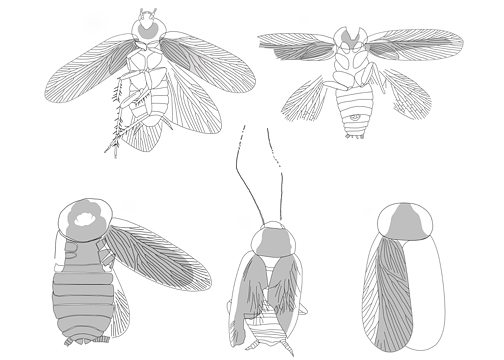

Abstract
The cosmopolitan cockroach genus Perlucipecta Wei & Ren, 2013 is one of the most common taxa within the extinct cockroach family Mesoblattinidae, with a high abundance of remains recorded from several localities around the world. Species within this genus exhibit distinctive coloration patterns on the pronotum and forewings, raising questions about the role of such coloration in predator deterrence. Although the genus is known worldwide, only two species have been discovered so far from the abundant Myanmar amber, including the new species described herein. Perlucipecta jedlickai sp. nov., a female specimen is described with characteristic forewing and pronotum coloration, alongside a remarkably well-preserved ovipositor, offering a view into the transitional cockroach reproduction strategy. The paleogeographical distribution of the genus is also discussed in light of its apparent ecological prominence in the fossil record.
References
- Anisyutkin, L.D., Grachev, V.G., Ponomarenko, A.G., Rasnitsyn, A.P. & Vršansky, P. (2008) Fossil insects in the Cretaceous mangrove facies of southern Negev, Israel. In: Krassilov, V. & Rasnitsyn, A.P. (Eds), Plant-arthropod interactions in the early angiosperm history: Evidence from the Cretaceous of Israel. Pensoft, Sofia, pp. 190–223.
- Bruce, V., Green, P.R. & Georgeson, M.A. (2003) Visual perception. 4th edn. Psychology Press, Hove, 483 pp.
- Comstock, J.H. & Needham, J.G. (1898) The wings of insects. The American Naturalist, 33, 117–126. https://doi.org/10.1086/277142
- Cott, H.B. (1940) Adaptive coloration in animals. Methuen & Co., London, 600 pp.
- De Valois, R.L. & De Valois, K.K. (1980) Spatial vision. Annual Review of Psychology, 31, 309–341. https://doi.org/10.1146/annurev.ps.31.020180.001521
- Ding, Q.H., Zhang, L.D., Guo, S.Z., Zhang, C.J., Peng, Y.D., Jia, B., Chen, S.W. & Xian, D.H. (2003) Paleoclimatic and palaeoenvironmental proxies of the Yixian Formation in the Beipiao area, western Liaoning. Geological Bulletin of China, 22 (3), 186–191.
- Dittmann, I.L., Hörnig, M.K., Haug, J.T. & Haug, C. (2015) Raptoblatta waddingtonae n. gen. et n. sp.—an Early Cretaceous roach-like insect with a mantodean-type raptorial foreleg. Palaeodiversity, 8, 103–111.
- Fujiyama, I. (1974) A Liassic cockroach from Toyora, Japan. Bulletin of the National Science Museum, Tokyo, 17, 311–314.
- Geinitz, F.E. (1880) Der Jura von Dobbertin in Mecklenburg und seine Versteinerungen. Zeitschrift der Deutschen Geologischen Gesellschaft, 32, 510–535.
- Giebel, C.G. (1856) Die Insecten und Spinnen der Vorwelt mit steter Berücksichtigung der lebenden Insekten und Spinnen. Die Fauna der Vorwelt, 2, 1–511.
- Grabau, A.W. (1923) Cretaceous fossils from Shantung. Bulletin of the Geological Survey of China, 5, 143–181.
- Graham, N.V.S. (1989) Visual pattern analysers. Oxford Psychology Series, Oxford University Press, Oxford, 670 pp.
- Handlirsch, A. (1906−1908) Die Fossilen Insekten und die Phylogenie der Rezenten Formen, Ein Handbuch für Paläontologen und Zoologen. Wilhelm Engelmann, Leipzig, 1430 pp. https://doi.org/10.5962/bhl.title.34145
- Hinkelman, J. (2019) Spinaeblattina myanmarensis gen. et sp. nov. and Blattoothecichnus argenteus ichnogen. et ichnosp. nov. (both Mesoblattinidae) from mid-Cretaceous Myanmar amber. Cretaceous Research, 99, 229–239. https://doi.org/10.1016/j.cretres.2019.02.026
- Hinkelman, J. (2021a) Mongolblatta sendii sp. n. (Mesoblattinidae) from North Myanmar amber links record to Laurasian sediments. Palaeontographica Abteilung A: Palaeozoology—Stratigraphy, 321, 81–96. https://doi.org/10.1127/pala/2021/0105
- Hinkelman, J. (2021b) Cuniculoblatta brevialata gen. et sp. n., the second case of brachyptery from Cretaceous North Myanmar amber. Palaeontographica Abteilung A: Palaeozoology—Stratigraphy, 321, 97–107. https://doi.org/10.1127/pala/2021/0104
- Hinkelman, J. (2022a) A monospecific assemblage of cockroaches (Dictyoptera: Subioblattidae) from the Triassic of Kyrgyzstan. Paläontologische Zeitschrift, 96, 781–793. https://doi.org/10.1007/s12542-022-00617-7
- Hinkelman, J. (2022b) Origins and diversity of spot-like aposematic and disruptive colorations among cockroaches. Biologia, 78, 1659–1677. https://doi.org/10.1007/s11756-022-01163-y
- Hinkelman, J. & Vršanská, L. (2020) A Myanmar amber cockroach with protruding feces contains pollen and a rich microcenosis. The Science of Nature, 107, 13. https://doi.org/10.1007/s00114-020-1669-y
- Hong, Y.C. (1980) New genus and species of Mesoblattinidae (Blattodea, Insecta) in China. Bulletin Chinese Academic Geological Science, Series VI, 1, 49–60.
- Hörnig, M.K. (2018) Evolution of reproductive strategies in dictyopteran insects—clues from ovipositor morphology of extinct roachoids. Acta Palaeontologica Polonica, 63, 1–24. https://doi.org/10.4202/app.00324.2016
- Hubel, D.H. & Wiesel, T.N. (1962) Receptive fields, binocular interaction and functional architecture in the cat’s visual cortex. Journal of Physiology, 166, 106–154. https://doi.org/10.1113/jphysiol.1962.sp006837
- Jon, S.H., Won, C.G., So, K.S. & Nam, T.Y. (2019) New Mesozoic insect fossils from the Democratic People's Republic of Korea. Cretaceous Research, 99, 240–245. https://doi.org/10.1016/j.cretres.2019.02.019
- Kania, I., Wang, B. & Szwedo, J. (2015) Dicranoptycha Osten Sacken, 1860 (Diptera, Limoniidae) from the earliest Cenomanian Burmese amber. Cretaceous Research, 52, 522–530. https://doi.org/10.1016/j.cretres.2014.03.002
- Klass, K.D. & Meier, R.A. (2006) A phylogenetic analysis of Dictyoptera (Insecta) based on morphological characters. Entomologische Abhandlungen, 63, 3–50.
- Kuhn, O. (1938) Drei neue Insekten aus dem Mesozoikum von Bayern. Paläontologische Zeitschrift, 20, 318–320. https://doi.org/10.1007/BF03041823
- Latreille, P.A. (1810) Considérations générales sur l'ordre naturel des animaux composant les classes des crustacès, des arachnides, et des insectes, avec un tableau méthodique de leurs genres, disposés en familles. Chez. F. Schoell, Paris, 444 pp. https://doi.org/10.5962/bhl.title.34917
- Lee, S.W. (2016) Taxonomic diversity of cockroach assemblages (Blattaria, Insecta) of the Aptian Crato Formation (Cretaceous, NE Brazil). Geologica Carpathica, 67, 433–450. https://doi.org/10.1515/geoca-2016-0027
- Li, X.R., Zheng, Y.H., Wang, C.C. & Wang, Z.Q. (2018) Old method not old-fashioned: parallelism between wing venation and wing-pad tracheation of cockroaches and a revision of terminology. Zoomorphology, 137, 519–533. https://doi.org/10.1007/s00435-018-0419-6
- Lin, Q.B. (1982) Insecta. In: Xi’an Institute of Geology and Mineral Resources (Eds), Palaentological atlas of Northwest China: Shaanxi, Gansu, Ningxia, Vol. 3. Geological Publishing House, Beijing, pp. 70–83.
- Lin, Q.B. (1986) Early Mesozoic fossil insects from South China. Palaeontologica Sinica, B, 170, 1–112.
- Martins-Neto, R.G., Mancuso, A. & Gallego, O.F. (2005) The Triassic Insect Fauna from Argentina. Blattoptera from the Los Rastros Formation (Bermejo Basin), La Rioja Province. Ameghiniana, 42 (4), 1–21.
- Martínez-Delclòs, X. (1993) Blátidos (Insecta, Blattodea) del Cretácico Inferior de España. Familias Mesoblattinidae, Blattulidae y Poliphagidae. Boletín Geológico y Minero, 104, 516–538.
- Mendes, M. (2000) Novas baratas (Insecta, Blattodea) da Formação Santana, Cretáceo Inferior do nordeste do Brasil [New cockroaches (Insecta, Blattodea, Blattidae) from the Santana Formation, Lower Cretaceous, Northeastern Brazil.]. Revista da Universidade de Guarulhos, Série Geociências, 5, 25–35.
- Poinar, G.Jr. (2019) Burmese amber: evidence of Gondwanan origin and Cretaceous dispersion. Historical Biology, 31, 1304–1309. https://doi.org/10.1080/08912963.2018.1446531
- Scudder, S.H. (1886) A review of Mesozoic cockroaches. Memoirs of the Boston Society of Natural History, 3, 439–484.
- Sendi, H., Vršanský, P. & Azar, D. (2023) Jordanian—Lebanese—Syrian cockroaches s.s. from Lower Cretaceous amber—Monograph. Biologia, 78, 1447–1541. https://doi.org/10.1007/s11756-023-01357-y
- Shapley, R. & Lennie, P. (1985) Spatial frequency analysis in the visual system. Annual Review of Neuroscience, 8, 547–581. https://doi.org/10.1146/annurev.ne.08.030185.002555
- Shi, G.H., Grimaldi, D.A., Harlow, G.E., Wang, J., Wang, J., Yang, M.C., Lei, W.Y., Li, Q.L. & Li, X.H. (2012) Age constraint on Burmese amber based on U-Pb dating of zircons. Cretaceous Research, 37, 155–163. https://doi.org/10.1016/j.cretres.2012.03.014
- Stevens, M., Cuthill, I.C., Párraga, C.A. & Troscianko, T. (2006a) The effectiveness of disruptive coloration as a concealment strategy. In: Alonso, J.M., Macknik, S., Martinez, L., Tse, P. & Martinez-Conde, S. (Eds), Progress in brain research, vol. 155. Elsevier, Berlin, pp. 49–65. https://doi.org/10.1016/S0079-6123(06)55004-6
- Stevens, M., Cuthill, I.C., Windsor, A.M.M. & Walker, H.J. (2006b) Disruptive contrast in animal camouflage. Proceedings of the Royal Society B, 273, 2433–2438. https://doi.org/10.1098/rspb.2006.3614
- Stevens, M. (2007) Predator perception and the interrelation between different forms of protective coloration. Proceedings of the Royal Society B, 274, 1457–1464. https://doi.org/10.1098/rspb.2007.0220
- Šmídová, L., Bruthansová, J. & Hain, M. (2024) The ootheca-bearing cockroach Praeblattella indicates primitive external egg retention in the Cretaceous. Palaeontographica Abteilung A, 327, 179–190. https://doi.org/10.1127/pala/2024/0146
- Thayer, G.H. (1909) Concealing-coloration in the animal kingdom; an exposition of the laws of disguise through color and pattern: being a summary of Abbott H. Thayer’s discoveries. Macmillan, New York, 260 pp. https://doi.org/10.5962/bhl.title.87588
- Tillyard, R.J. (1919) Mesozoic insects of Queensland. No. 6 Blattoidea. Proceedings of the Linnean Society of New South Wales, 44, 358–382.
- Vršanský, P. (2000) Decreasing variability—from the Carboniferous to the present! (Validated on independent lineages of Blattaria). Paleontological Journal, 34 (3), 374–379.
- Vršanský, P. (2002) Origin and the early evolution of mantises. AMBA Projekty, 6 (1), 1–16.
- Vršanský, P. (2003) Unique assemblage of Dictyoptera (Insecta—Blattaria, Mantodea, Isoptera) from the Lower Cretaceous of Bon Tsagaan Nuur in Mongolia. Entomological Problems, 33, 119–151.
- Vršanský, P. (2004a) Transitional Jurassic/Cretaceous Cockroach assemblage (Insecta, Blattaria) from the Shar-Teg in Mongolia. Geologica Carpathica, 55, 457–468.
- Vršanský, P. (2004b) Cretaceous Gondwanian Cockroaches (Insecta: Blattaria). Entomological Problems, 34, 49–54.
- Vršanský, P. (2005) Mass mutations of insects at the Jurassic/ Cretaceous boundary? Geologica Carpathica, 56, 473–781.
- Vršanský, P. (2009) Albian cockroaches (Insecta, Blattida) from French amber of Archingeay. Geodiversitas, 31, 73–98. https://doi.org/10.5252/g2009n1a7
- Vršanský, P. (2019) Santonian cockroaches from Yantardakh amber (Russia: Taimyr) differ in dominance. Palaeoentomology, 2 (3), 297–307. https://doi.org/10.11646/palaeoentomology.2.3.15
- Vršanský, P. (2020) Cockroaches from Jurassic sediments of the Bakhar Formation in Mongolia. Springer Nature, Cham, 91 pp. https://doi.org/10.1007/978-3-030-59407-7
- Vršanský, P. (2024) Late Mesozoic cockroaches s.l. from the Karabastau Formation in Kazakhstan. Amba Projekty, 14, 1–700.
- Vršanský, P. & Koubová, I. (2025) Kedysi akokolvek gen. et sp. n. (Mantides: Mesoblattinidae; burmite) further complicates transition pattern towards Ectobiidae evidences. Palaeontographica Abteilung A, 331 (4-6), 97–109. https://doi.org/10.1127/pala/0171
- Vršanský, P. & Makhoul, E. (2013) Mieroblattina pacis gen. et sp. n.—Upper Cretaceous cockroach (Blattida: Mesoblattinidae) from Nammoura limestone of Lebanon. In: Azar, D., Engel, M.S., Jarzembowski, E., Krogmann, L., Nel, A. & Santiago-Blay, J. (Eds), Insect evolution in an ambiferous and stone alphabet. Brill, Leiden, pp. 165–172. https://doi.org/10.1163/9789004210714_012
- Vršanský, P. & Sendi, H. (2022) Pathological dino-aged cockroach with biramous cercus. Amba Projekty, 12, 1–8.
- Vršanský, P., Kováčová, Z., Vasilenko, D.V., Pálková, H., Nagy, Š., Kosnáč, D., Vidlička, L. & Martin, S.K. (2024) Systematics of Mesozoic ‘Arctic’ polar cockroaches. Biologia, 80, 51–77. https://doi.org/10.1007/s11756-024-01814-2
- Vršanský, P., Lee, S.B., Sohn, J., Vršanská, L., Jang, J. & Nam, G.S. (2025) Jinju cockroaches. Amba Projekty, 15, 1–174.
- Vršanský, P., Oružinský, R., Aristov, D., Wei, D.D., Vidlička, L. & Ren, D. (2017) Temporary deleterious mass mutations relate to originations of cockroach families. Biologia, 27, 886–912. https://doi.org/10.1515/biolog-2017-0096
- Vršanský, P., Vršanská, L., Vasilenko, D.V., Puškelová, Ľ. & Biroň, A. (2021) An isolated Cretaceous analogue of Madagascar on the Adria-Turkey microcontinent indicated by fossils in Brezina, Algeria. Palaeontographica Abteilung A: Palaeozoology—Stratigraphy, 321, 19–35. https://doi.org/10.1127/pala/2021/0107
- Westwood, J.O. (1854) Contributions to fossil entomology. Quarterly Journal of the Geological Society, 10, 378–396. https://doi.org/10.1144/GSL.JGS.1854.010.01-02.43
- Wei, D.D. & Ren, D. (2013) Completely preserved cockroaches of the family Mesoblattinidae from the Upper Jurassic-Lower Cretaceous Yixian Formation (Liaoning Province, NE China). Geologica Carpathica, 64, 291–304. https://doi.org/10.2478/geoca-2013-0021
- Zhang, H.C. (1997) Early Cretaceous insects from the Dalazi Formation of the Zhixin basin, Jilin Province, China. Palaeoworld, 7, 75–103.