

Abstract
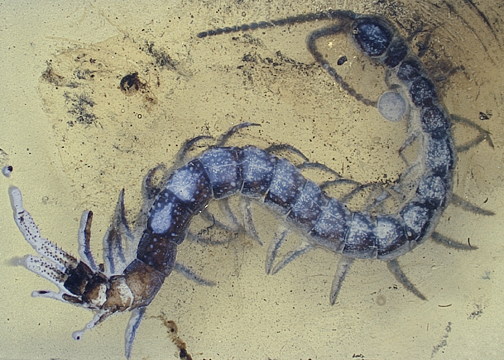
Two specimens of scolopendromorph centipedes from Eocene Baltic amber provide a confidently documented fossil record of the blind family Cryptopidae. The fossil material, illustrated via light microscopy and microcomputed tomography, is assigned to the extant genus Cryptops Leach, 1814, based on diagnostic morphological characters such as the absence of eyes, 21 leg-bearing segments with strongly delimited pre- and metatergites, oblique sutures and lateral crescentic sulci on the tergites, and robust, spiniform setae on the ultimate legs. A distinctive pattern of sutures on the first trunk tergite supports conspecificity of the fossil material and a unique combination of characters allows distinction from extant species. Phylogenetic analysis of a dataset for blind Scolopendromorpha incorporates 61 morphological characters for 41 species (37 extant, four extinct) with sequence data for two nuclear ribosomal and two mitochondrial loci for the extant species. The total-evidence maximum likelihood tree places the fossils within total-group Cryptops in a framework of strongly supported extant clades. The fossils constrain a minimum divergence date for the genus to the late Eocene (Priabonian) according to the age of Baltic amber, although geographic structure within extant clades of Cryptops and previous molecular estimates suggest this is a conservative minimum. The discovery supplements the sparse Cenozoic fossil record for Scolopendromorpha and illustrates an application of amber inclusions as temporal calibration points in centipede phylogeny.
References
- Bachofen-Echt, A. (1942) Über Myriapoden des Bernsteins. Palaeobiologica, 7 (3), 394–403.
- Barber, A.D. (2002) Atlas of the centipedes of Britain and Ireland. Field Studies Council, Telford, 390 pp.
- Benavides, L.R., Edgecombe, G.D. & Giribet, G. (2023) Re-evaluating and dating myriapod diversification with phylotranscriptomics under a regime of dense taxon sampling. Molecular Phylogenetics and Evolution, 178, 107621. https://doi.org/10.1016/j.ympev.2022.107621
- Cadenas-Amaya, S., Riquelme, F., Hernández-Patricio, M. & Cupul-Magaña, F. (2025) A checklist of centipedes in Mexican amber. Paleontología Mexicana, 14 (2), 107–120. https://doi.org/10.22201/igl.05437652e.2025.14.2.405
- Castresana, J. (2000) Selection of conserved blocks from multiple alignments for their use in phylogenetic analysis. Molecular Biology and Evolution, 17, 540–552. https://doi.org/10.1093/oxfordjournals.molbev.a026334
- Edgecombe, G.D., Akkari, N., Netherlands, E.C. & Du Preez, G. (2020) A troglobitic species of the centipede Cryptops (Chilopoda, Scolopendromorpha) from northwestern Botswana. ZooKeys, 977, 25–40. https://doi.org/10.3897/zookeys.977.57088
- Edgecombe, G.D., Strange, S.E., Popovici, G., West, T. & Vahtera, V. (2023) An Eocene fossil plutoniumid centipede: A new species of Theatops from Baltic amber (Chilopoda: Scolopendromorpha). Journal of Systematic Palaeontology, 21 (1), 2228796, 1–17. https://doi.org/10.1080/14772019.2023.2228796
- Edgecombe, G.D., Vahtera, V., Stock, S.R., Kallonen, A., Xiao, X., Rack, A. & Giribet, G. (2012) A scolopocryptopid centipede (Chilopoda: Scolopendromorpha) from Mexican amber: synchrotron microtomography and phylogenetic placement using a combined morphological and molecular dataset. Zoological Journal of the Linnean Society, 166, 768–786. https://doi.org/10.1111/j.1096-3642.2012.00860.x
- Haug, J.T., Haug, C., Schweigert, G. & Sombke, A. (2014) The evolution of centipede venom claws—Open questions and possible answers. Arthropod Structure & Development, 43 (1), 5–16. https://doi.org/10.1016/j.asd.2013.10.006
- Hoang, D.T., Chernomor, O., von Haeseler, A., Minh, B.Q. & Vinh, L.S. (2018) UFBoot2: Improving the ultrafast bootstrap approximation. Molecular Biology and Evolution, 35, 518–522. https://doi.org/10.1093/molbev/msx281
- Kalyaanamoorthy, S., Minh, B.Q., Wong, T.K.F., von Haeseler, A. & Jermiin, L.S. (2017) ModelFinder: fast model selection for accurate phylogenetic estimates. Nature Methods, 14, 587–589. https://doi.org/10.1038/nmeth.4285
- Katoh, K., Rozewicki, J. & Yamada, K.D. (2019) MAFFT online service: multiple sequence alignment, interactive sequence choice and visualization. Briefings in Bioinformatics, 20, 1160–1166. https://doi.org/10.1093/bib/bbx108
- Katoh, K. & Standley, D.M. (2013) MAFFT multiple sequence alignment software version 7: Improvements in performance and usability. Molecular Biology and Evolution, 30, 772–780. https://doi.org/10.1093/Molbev/Mst010
- Kuraku, S., Zmasek, C.M., Nishimura, O. & Katoh, K. (2013) aLeaves facilitates on-demand exploration of metazoan gene family trees on MAFFT sequence alignment server with enhanced interactivity. Nucleic Acids Research, 41, W22–W28. https://doi.org/10.1093/nar/gkt389
- Lemoine, F., Correia, D., Lefort, V., Doppelt-Azeroual, O., Mareuil, F., Cohen-Boulakia, S. & Gascuel, O. (2019) NGPhylogeny.fr: new generation phylogenetic services for non-specialists. Nucleic Acids Research, 47, W260–W265. https://doi.org/10.1093/nar/gkz303
- Lewis, J.G.E. (1989) The scolopendromorph centipedes of St John, U.S. Virgin Islands collected by Dr W. B. Muchmore. Journal of Natural History, 23, 1003–1016. https://doi.org/10.1080/00222938900770921
- Lewis, J.G.E. (2009) A review of some characters used in the taxonomy of Cryptops (subgenus Cryptops) (Chilopoda: Scolopendromorpha: Cryptopidae). Soil Organisms, 81 (3), 505–518.
- Lewis, J.G.E. (2013) A review of the species in the genus Cryptops Leach, 1815 from the Old World and the Australasian region related to Cryptops (Cryptops) doriae Pocock, 1891 (Chilopoda: Scolopendromorpha: Cryptopidae). Zootaxa, 3683 (1), 1–34. https://doi.org/10.11646/zootaxa.3683.1.1
- Maddison, W.P. & Maddison, D.R. (2025) Mesquite: a modular system for evolutionary analysis. Version 3.81. (Available from: http://www.mesquiteproject.org).
- Mundel, P. (1979) The centipedes (Chilopoda) of the Mazon Creek. In: Nitecki, M.H. (Ed.), Mazon Creek fossils. Academic Press, New York, pp. 361–378. https://doi.org/10.1016/B978-0-12-519650-5.50021-7
- Murienne, J., Edgecombe, G.D. & Giribet, G. (2010) Including secondary structure, fossils and molecular dating in the centipede tree of life. Molecular Phylogenetics and Evolution, 57, 301–313. https://doi.org/10.1016/j.ympev.2010.06.022
- Phillips, J.W., Chung, A.Y.C., Edgecombe, G.D. & Ellwood, M.D.F. (2020) Bird’s nest ferns promote resource sharing by centipedes. Biotropica, 52, 335–344. https://doi.org/10.1111/btp.12713
- Pocock, R.I. (1891) XXIV.—Notes on the synonymy of some species of Scolopendridæ, with descriptions of new genera and species of the group. Annals and Magazine of Natural History, 7 (38), 221–231. https://doi.org/10.1080/00222939109460598
- Poinar, G.O. (1992) Life in amber. Stanford University Press, Palo Alto, 350 pp. https://doi.org/10.1515/9781503623545
- Ribaut, H. (1915) Biospeologica, XXXVI. Notostigmophora, Scolopendromorpha, Geophilomorpha (Myriapodes) (Première Série). Archives de Zoologie Expérimentale et Générale, 55, 323–346.
- Ross, A.J., Bojarski, B. & Szwedo, J. (2026) A critical review of the age of Baltic amber from the Samland Peninsula, Russia. Earth and Environmental Science Transactions of the Royal Society of Edinburgh, First View, 1–14. https://doi.org/10.1017/S1755691025100960
- Schileyko, A., Vahtera, V. & Edgecombe, G.D. (2020) An overview of the extant genera and subgenera of the order Scolopendromorpha (Chilopoda): a new identification key and updated diagnoses. Zootaxa, 4825 (1), 1–64. https://doi.org/10.11646/zootaxa.4825.1.1
- Talavera, G. & Castresana, J. (2007) Improvement of phylogenies after removing divergent and ambiguously aligned blocks from protein sequence alignments. Systematic Biology, 56, 564–577. https://doi.org/10.1080/10635150701472164
- Vahtera, V., Edgecombe, G.D. & Giribet, G. (2012) Evolution of blindness in scolopendromorph centipedes (Chilopoda: Scolopendromorpha): Insight from an expanded sampling of molecular data. Cladistics, 28, 4–20. https://doi.org/10.1111/j.1096-0031.2011.00361.x
- Vahtera, V., Edgecombe, G.D. & Giribet, G. (2013) Phylogenetics of scolopendromorph centipedes: can denser taxon sampling improve an artificial classification? Invertebrate Systematics, 27, 578–602. https://doi.org/10.1071/IS13035
- Vaidya, G., Lohman, D.J. & Meier, R. (2011) SequenceMatrix: concatenation software for the fast assembly of multi-gene datasets with character set and codon information. Cladistics, 27, 171–180. https://doi.org/10.1111/j.1096-0031.2010.00329.x
- Whiting, M.F., Carpenter, J.M., Wheeler, Q.D. & Wheeler, W.C. (1997) The Strepsiptera problem: phylogeny of the holometabolous insect orders inferred from 18S and 28S ribosomal DNA sequences and morphology. Systematic Biology, 46, 1–68. https://doi.org/10.1093/sysbio/46.1.1
- Wolfe, A.P., Tappert, R., Muehlenbachs, K., Boudreau, M., McKellar, R.C., Basinger, J.F. & Garrett, A. (2009) A new proposal concerning the botanical origin of Baltic amber. Proceedings of the Royal Society B: Biological Sciences, 276 (1672), 3403–3412. https://doi.org/10.1098/rspb.2009.0806
- Wong, T.K.F., Ly-Trong, N., Ren, H., Baños, H., Roger, A.J., Susko, E., Bielow, C., Maio, N.D., Goldman, N., Hahn, M.W., Huttley, G., Lanfear, R. & Minh, B.Q. (2025) IQ-TREE 3: Phylogenomic inference software using complex evolutionary models. EcoEvoRxiv. https://doi.org/10.32942/X2P62N
- Zalesskaya, N.T. & Schileyko, A.A. (1991) [The scolopendromorph centipedes (Chilopoda, Scolopendromorpha).] Nauka Publishing, Moscow, 110 pp. [In Russian]