

Abstract
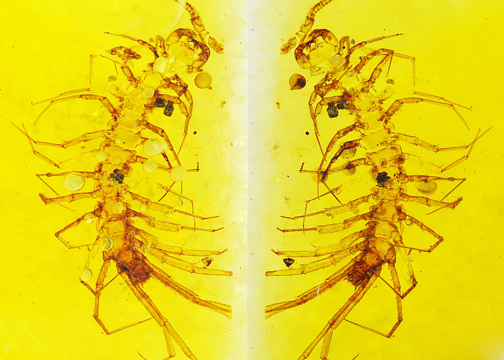
Fossil evidence indicates that the basal group of Lithobiomorpha had already appeared by the Middle Devonian at the latest. However, no Mesozoic species of Lithobiomorpha have been formally established to date. Here, a new genus and species, Cretohenicops calcaratus sp. nov. (Lithobiomorpha: Henicopidae) is described based on a well-preserved inclusion from mid-Cretaceous Myanmar amber. The new species exhibits a combination of characters that differs from extant relatives: 7+6 coxosternal teeth; uniarticulate tarsi on legs 1–13 and biarticulate tarsus on leg 14; and the female gonopods are equipped with 2+2 small coniform spurs. We also found that Cretohenicops gen. nov. combines the characteristics of distal spinose projections on most tibiae (diagnostic of Henicopidae) and large robust spurs in fixed positions on femora and tibiae (as in Lithobiidae). The discovery of this new genus and species enriches the fossil record of Henicopidae (Lithobiomorpha) from the Mesozoic and provides new fossil evidence for studies on the evolution of Lithobiomorpha.
References
- Akkari, N., Komerički, A., Stoev, P., Karaman, I. & Edgecombe, G.D. (2017) A new cave centipede from Croatia, Eupolybothrus liburnicus sp. n., with notes on the subgenus Schizopolybothrus Verhoeff, 1934 (Chilopoda, Lithobiomorpha, Lithobiidae). ZooKeys, 687, 11–43. https://doi.org/10.3897/zookeys.687.13844
- Attems, C. (1928) The Myriapoda of South Africa. Annals of the South African Museum, 26, 1–431.
- Benavides, L.R., Edgecombe, G.D. & Giribet, G. (2023) Reevaluating and dating myriapod diversification with phylotranscriptomics under a regime of dense taxon sampling. Molecular Phylogenetics and Evolution, 178, 107621. https://doi.org/10.1016/j.ympev.2022.107621
- Bonato, L. & Zapparoli, M. (2011) 16 Chilopoda–Geographical distribution. In: Minelli, A. (Ed.), Treatise on zoology. Anatomy, taxonomy, biology. The Myriapoda, Vol. 1. Brill, Leiden, pp. 327–337. https://doi.org/10.1163/9789004188266_017
- Bonato, L., Edgecombe, G.D. & Minelli, A. (2014) Geophilomorph centipedes from the Cretaceous amber of Burma. Palaeontology, 57, 97–110. https://doi.org/10.1111/pala.12051
- Bonato, L., Edgecombe, G.D., Lewis, J.G.E., Minelli, A., Pereira, L.A., Shelley, R.M. & Zapparoli, M. (2010) A common terminology for the external anatomy of centipedes (Chilopoda). ZooKeys, 69, 17–51. https://doi.org/10.3897/zookeys.69.737
- Cong, P.Y., Gai, Y.H. & Yan, G.Q. (2007) Phylogenetics and phylochronological analysis of myriapod major groups based on combined evidence of morphology, fossil and molecules. Acta Micropalaeontologica Sinica, 24, 407–421.
- Cupul-Magaña, F. & Flores-Guerrero, U. (2016) Guide for the identification of centipedes families (Myriapoda: Chilopoda) from Mexico: An update. Revista Bio Ciencias, 4, 40–51. https://doi.org/110.15741/revbio.03.01.07
- Dányi, L., Balázs, G. & Tuf, I.H. (2019) Taxonomic status and behavioural documentation of the troglobiont Lithobius matulici (Myriapoda, Chilopoda) from the Dinaric Alps: Are there semiaquatic centipedes in caves? ZooKeys, 848, 1–20. https://doi.org/10.3897/zookeys.848.33084
- Eason, E.H. (1992) On the taxonomy and geographical distribution of the Lithobiomorpha. Berichte des Naturwissenschaftlich-Medizinischen Vereins in Innsbruck Supplement, 10, 1–9.
- Edgecombe, G.D. (2001) Revision of Paralamyctes (Chilopoda: Lithobiomorpha: Henicopidae), with six new species from eastern Australia. Records of the Australian Museum, 53, 201–241. https://doi.org/10.3853/j.0067-1975.53.2001.1328
- Edgecombe, G.D. (2003) A new genus of henicopid centipede (Chilopoda: Lithobiomorpha) from New Caledonia. Memoirs of the Queensland Museum, 49, 269–284.
- Edgecombe, G.D. (2004) The henicopid centipede Haasiella (Chilopoda: Lithobiomorpha): New species from Australia, with a morphology-based phylogeny of Henicopidae. Journal of Natural History, 38, 37–76. https://doi.org/10.1080/0022293021000007552
- Edgecombe, G.D. (2007) Centipede systematics: progress and problems. Zootaxa, 1668 (1), 327–341. https://doi.org/10.11646/zootaxa.1668.1.17
- Edgecombe, G.D. (2011a) Phylogenetic relationships of Myriapoda. In: Minelli, A. (Ed.), Treatise on Zoology-Anatomy, Taxonomy, Biology. The Myriapoda. Vol. 1. Brill, Leiden, pp. 1–20. https://doi.org/10.1163/9789004188266_002
- Edgecombe, G.D. (2011b) Chilopoda—Fossil history. In: Minelli, A. (Ed.), Treatise on Zoology-Anatomy, Taxonomy, Biology. The Myriapoda. Vol. 1. Brill, Leiden, pp. 355–361. https://doi.org/10.1163/9789004188266_019
- Edgecombe, G.D. & Giribet, G. (2007) Evolutionary biology of centipedes (Myriapoda: Chilopoda). Annual Review of Entomology, 52, 151–170. https://doi.org/10.1146/annurev.ento.52.110405.091326
- Edgecombe, G.D. & Giribet, G. (2003) Relationships of Henicopidae (Chilopoda: Lithobiomorpha): New molecular data, classification and biogeography. African Invertebrates, 44, 13–38.
- Edgecombe, G.D. & Giribet, G. (2004) Adding mitochondrial sequence data (16S rRNA and cytochrome c oxidase subunit I) to the phylogeny of centipedes (Myriapoda: Chilopoda): an analysis of morphology and four molecular loci. Journal of Zoological Systematics and Evolutionary Research, 42 (2), 89–101. https://doi.org/10.1111/j.1439-0469.2004.00245.x
- Edgecombe, G.D. & Hollington, L.M. (2002) The henicopid centipede Haasiella (Chilopoda: Lithobiomorpha): New species from Australia, with a morphology-based phylogeny of Henicopidae. Invertebrate Systematics, 16 (4), 785–812.
- Edgecombe, G.D., Giribet, G. & Wheeler, W.C. (2002) Phylogeny of Henicopidae (Chilopoda: Lithobiomorpha): a combined analysis of morphology and five molecular loci. Systematic Entomology, 27, 31–64. https://doi.org/10.1046/j.0307-6970.2001.00163.x
- Edgecombe, G.D., Strange, S.E., Popovici, G., West, T. & Vahtera, V. (2023) An Eocene fossil plutoniumid centipede: a new species of Theatops from Baltic amber (Chilopoda: Scolopendromorpha). Journal of Systematic Palaeontology, 21, 2228796. https://doi.org/10.1080/14772019.2023.2228796
- Farzalieva, G.S., Zalesskaja, N.T. & Edgecombe, G.D. (2004) A new genus and species of lithobiomorph centipede (Chilopoda: Lithobiomorpha: Anopsobiidae) from eastern Kazakhstan. Arthropoda Selecta, 13, 219–224.
- Fernández, R., Edgecombe, G.D. & Giribet, G. (2016) Exploring phylogenetic relationships within Myriapoda and the effects of matrix composition and occupancy on phylogenomic reconstruction. Systematic Biology, 65 (5), 871–889. https://doi.org/10.1093/sysbio/syw041
- Fernández, R., Edgecombe, G.D. & Giribet, G. (2018) Phylogenomics illuminates the backbone of the Myriapoda Tree of Life and reconciles morphological and molecular phylogenies. Scientific Reports, 8 (1), 83, 1–7. https://doi.org/10.1038/s41598-017-18562-w
- Fernández, R., Laumer, C.E., Vahtera, V., Libro, S., Kaluziak, S., Sharma, P.P., Pérez-Porro, A.R., Edgecombe, G.D. & Giribet, G. (2014) Evaluating topological conflict in centipede phylogeny using transcriptomic data sets. Molecular Biology and Evolution, 31 (6), 1500–1513. https://doi.org/10.1093/molbev/msu108
- Ganske, A.S., Trotta Padilla, L., Spelda, J. & Pedersen, K.B. (2020) Phylogeny of Lithobiidae Newport, 1844, with emphasis on the megadiverse genus Lithobius Leach, 1814 (Myriapoda, Chilopoda). Cladistics, 36 (6), 665–687. https://doi.org/10.1111/cla.12431
- Haug, G.T., Haug, J.T. & Haug, C. (2024) Convergent evolution of defensive appendages—a lithobiomorph-like centipede with a scolopendromorph-type ultimate leg from about 100 million-year-old amber. Palaeobiodiversity and Palaeoenvironments, 104, 131–140. https://doi.org/10.1007/s12549-023-00581-3
- Le Cadre, J., Melzer, R.R., Müller, P., Haug, C. & Haug, J.T. (2024) Three new lithobiomorphan centipede specimens from mid-Cretaceous Myanmar amber, a clue on the geological record of Lithobiomorpha. Mesozoic, 1 (4), 493–505. https://doi.org/10.11646/mesozoic.1.4.7
- Ma, H.Q., Song, D.X. & Zhu, M.S. (2007) Review of Cermatobius Haase, 1885 (Chilopoda: Henicopidae) of China and neotype designation for Cermatobius longicornis (Takakuwa, 1939). Zootaxa, 1608 (1), 21–30. https://doi.org/10.11646/zootaxa.1608.1.3
- Negrea, Ş. & Minelli, A. (1994) The myriapod fauna of some Romanian caves. Atti della Società Italiana di Scienze Naturali e del Museo Civico di Storia Naturale di Milano, 133, 167–174.
- Rosenberg, J. (1982) Coxal organs in Geophilomorpha (Chilopoda). Zoomorphology, 100, 107–120. https://doi.org/10.1007/BF00310357
- Shear, W.A. (2018) The centipede family Anopsobiidae new to North America, with the description of a new genus and species and notes on the Henicopidae of North America and the Anopsobiidae of the Northern Hemisphere (Chilopoda, Lithobiomorpha). Zootaxa, 4422 (2), 259–283. https://doi.org/10.11646/zootaxa.4422.2.6
- Shear, W.A. & Bonamo, P.M. (1988) Devonobiomorpha, A new order of centipedes (Chilopoda) from the middle Devonian of Gilboa, New York State, USA, and the phylogeny of centipede orders. American Museum Novitates, 2927, 1–30.
- Shear, W.A. & Bonamo, P.M. (1990) Fossil centipedes from the Devonian of New York State, USA. In: Minelli, A. (Ed.), Proceedings of the 7th International Congress of Myriapodology. Brill, Leiden, pp. 89–96. https://doi.org/10.1163/9789004630383_014
- Shear, W.A. & Edgecombe, G.D. (2010) The geological record and phylogeny of the Myriapoda. Arthropod Structure and Development, 39, 174–190. https://doi.org/10.1016/j.asd.2009.11.002
- Shear, W.A., Jeram, A.J. & Selden, P. (1998) Centipede legs (Arthropoda, Chilopoda, Scutigeromorpha) from the Silurian and Devonian of Britain and the Devonian of North America. American Museum Novitates, 3231, 1–16.
- Shi, G.H., Grimaldi, D.A., Harlow, G.E., Wang, J., Wang, J., Yang, M.C., Lei, W.Y., Li, Q.L. & Li, X.H. (2012) Age constraint on Myanmar amber based on U-Pb dating of zircons. Cretaceous Research, 37, 155–163. https://doi.org/10.1016/j.cretres.2012.03.014
- Sorribes, A.S. (2024) Lithobius hemihydrobius (Chilopoda, Lithobiomorpha) una nova espècie cavernícola amb comportament semiaquátic / Lithobius hemihydrobius (Chilopoda, Lithobiomorpha) a new cave-dwelling species with semiaquatic behavior. Publicacions del Centre de Recursos de Biodiversitat Animal, 20, 1–24.
- Stoev, P., Komerički, A., Akkari, N., Liu, S., Zhou, X., Weigand, A. M., Hostens, J., Hunter, C. I., Edmunds, S. C., Porco, D., Zapparoli, M., Georgiev, T., Mietchen, D., Roberts, D., Faulwetter, S., Smith, V. & Penev, L. (2013) Eupolybothrus cavernicolus Komerički & Stoev sp. n. (Chilopoda: Lithobiomorpha: Lithobiidae): the first eukaryotic species description combining transcriptomic, DNA barcoding and micro-CT imaging data. Biodiversity Data Journal, 1, e1013. https://doi.org/10.3897/BDJ.1.e1013
- Szwedo, J., Wang, B., Soszyńska-Maj, A., Azar, D. & Ross, A. (2020) International Palaeoentomological Society statement. Palaeoentomology, 3 (3), 221–222. https://doi.org/10.11646/palaeoentomology.3.3.1
- Wolfe, J.M., Daley, A.C., Legg, D.A. & Edgecombe, G.D. (2016) Fossil calibrations for the arthropod Tree of Life. Earth-Science Reviews, 160, 43–110. https://doi.org/10.1016/j.earscirev.2016.06.008
- Zapparoli, M. & Edgecombe, G.D. (2011) Chilopoda—Taxonomic overview. Lithobiomorpha. In: Minelli, A. (Ed.), Treatise on zoology–Anatomy, taxonomy, biology—The Myriapoda. Vol. 1. Brill, Leiden, pp. 371–389. https://doi.org/10.1163/9789004188266_020
- Zhang, W.W. (2017) Frozen dimensions of the fossil insects and other invertebrates in amber. Chongqing University Press, Chongqing, 692 pp.