

Abstract
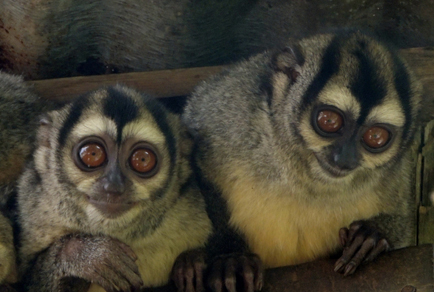
The binomen Aotus jorgehernandezi Defler & Bueno, 2007 was erected for a species of night monkey diagnosed on the basis of karyomorphic differences. The type locality of A. jorgehernandezi is unknown, as the original description was based on a single specimen found in captivity in the Andean region of Colombia but presumed to be native to Los Nevados National Natural Park, located on the border between the departments of Quindío and Risaralda, in the Central Cordillera of Colombia. Since the description of this species, the binomen has been controversial as the holotype is lost, and as no additional specimens referred to this species are yet known. Here, we evaluate the nomenclatural validity of A. jorgehernandezi and the taxonomic traits used for its description, comparing it to other Aotus species from Colombia. Although the binomen A. jorgehernandezi is nomenclaturally available, taxonomic traits including the karyotype information strongly suggest that it is a junior synonym of A. brumbacki Hershkovitz, 1983, which has a cis-Andean distribution in Colombia.
References
- Anonymous [International Commission on Zoological Nomenclature] (1999) International code of zoological nomenclature. ‘Fourth edition’. London (International Trust for zoological Nomenclature): i–xxix + 1–306.
- Alfaro, M. E. & Holder, M. T. (2006) The posterior and the prior in Bayesian phylogenetics. Annual Review of Ecology, Evolution, and Systematics, 37 (1): 19–42. <https://doi.org/10.1146/annurev.ecolsys.37.091305.110021>.
- Arango-Lozano, J., Toro-Cardona, F. A., Montilla, J. S. O. & Ramírez-Chaves, H. E. (2025) Ecological forecasting for night monkeys in the Aotus lemurinus complex: climate-driven threats to habitat suitability. International Journal of Primatology, 46 (2): 556‒572. <https://doi.org/10.1007/s10764-024-00481-z>.
- Arenas, S., Giraldo, M. J., Bueno, M. L., Rivera Páez, F. A. & López Gartner, G. A. (2012) Caracterización cariológica de tres monos Aotus griseimembra (Primates: Aotidae) mantenidos en cautiverio. Boletín científico, Centro de Museos, Museo de Historia natural, 16 (2): 120‒132.
- Arias-Rodriguez, L., Páramo-Delgadillo, S. & Durán-González, A. D. L. (2006) Caracterización citogenética del pez tropical de agua dulce Parachromis managuensis (Pisces: Cichlidae). Revista de Biología tropical, 54 (1): 35‒42. <https://doi.org/10.15517/rbt.v54i1.13986>.
- Boubli, J. P., Rylands, A. B., Farias, I. P., Alfaro, M. E. & Lynch, J. W. (2012) Cebus phylogenetic relationships: a preliminary reassessment of the diversity of the untufted capuchin monkeys. American Journal of Primatology, 74 (4): 381‒393. <https://doi.org/10.1002/ajp.21998>.
- Bradley, B. J. & Mundy, N. I. (2008) The primate palette: the evolution of primate coloration. Evolutionary Anthropology, 17 (2): 97‒111. <https://doi.org/10.1002/evan.20164>.
- Brumback, R. A. (1973) Two distinctive types of owl monkeys (Aotus). Journal of medical Primatology, 2 (5): 284‒289. <https://doi.org/10.1159/000460336>.
- Brumback, R. A. (1974) A third species of the owl monkey (Aotus). Journal of Heredity, 65 (5): 321‒323. <https://doi.org/10.1093/oxfordjournals.jhered.a108540>.
- Brumback, R. A., Staton, R. D., Benjamin, S. A. & Lang, C. M. (1971) The chromosomes of Aotus trivirgatus Humboldt 1812. Folia primatologica, 15 (3‒4): 264‒273. <https://doi.org/10.1159/000155384>.
- Chan, A. H. E., Saralamba, N., Saralamba, S., Ruangsittichai, J. & Thaenkham, U. (2022) The potential use of mitochondrial ribosomal genes (12S and 16S) in DNA barcoding and phylogenetic analysis of trematodes. BMC Genomics, 23 (1): 104. <https://doi.org/10.1186/s12864-022-08302-4>.
- Defler, T. R. (2010) Historia natural de los primates colombianos. Bogotá D.C. (Universidad Nacional de Colombia): 1‒612.
- Defler, T. R. & Bueno, M. L. (2007) Aotus diversity and the species problem. Primate Conservation, 22 (1): 55‒70. <https://doi.org/10.1896/052.022.0104>.
- Defler, T. R., Bueno, M. L. & Hernández-Camacho, J. I. (2001) Taxonomic status of Aotus hershkovitzi: its relationship to Aotus lemurinus lemurinus. Neotropical Primates, 9 (2): 37‒52. <https://doi.org/10.62015/np.2001.v9.480>.
- Del Portillo, H., Cufiño, F. & Ramírez, J. M. (1980) Aotus trivirgatus Catatumbo—Colombia. Revista de la Universidad de La Salle, 2 (6): 49‒55.
- Descailleaux, J., Aquino, R., Fujita, R. & Encarnación, F. (1986) Un nuevo complemento cromosómico para el género Aotus. • In: M. T. de Mello (ed.). A Primatologia No Brasil. 2. Belo Horizonte (Imprensa Universitária, Universidade Federal de Minas Gerais): 387.
- Dobigny, G., Britton‐Davidian, J. & Robinson, T. J. (2015) Chromosomal polymorphism in mammals: an evolutionary perspective. Biological Reviews, 92 (1): 1‒21. <https://doi.org/10.1111/brv.12213>.
- Dollman, G. (1909) Six new species of Aotus. Annals and Magazine of natural History, (8), 4 (21): 199–204. <https://doi.org/10.1080/00222930908692662>.
- Drummond, A. J., Suchard, M. A., Xie, D. & Rambaut, A. (2012) Bayesian phylogenetics with BEAUti and the BEAST 1.7. Molecular Biology & Evolution, 29 (8): 1969‒1973. <https://doi.org/10.1093/molbev/mss075>.
- Elliot, D. G. (1912) A review of the primates. New York (American Museum of Natural History): [i] + cxix + 1‒317 + i‒xxxviii, pl. 1‒10 + I‒XXXII.
- Eroğlu, H. E. (2015) Which chromosomes are subtelocentric or acrocentric? A new karyotype symmetry/asymmetry index. Caryologia, 68 (3): 239‒245. <https://doi.org/10.1080/00087114.2015.1032614>.
- Fernandez-Duque, E., Juárez, C. P. & Defler, T. R. (2023) Morphology, systematics, and taxonomy of owl monkeys. • In: E. Fernandez-Duque (ed.). Owl monkeys: biology, adaptive radiation, and behavioral ecology of the only nocturnal primate in the Americas. Cham (Springer International Publishing): 3‒23. <https://doi.org/10.1007/978-3-031-13555-2_1>.
- Ford, S. M. (1994) Taxonomy and distribution of the owl monkey. • In: J. F. Baer, R. E. Seller & I. Kakoma (ed.). Aotus: the owl monkey. New York (Academic Press): 1–57. <https://doi.org/10.1016/B978-0-12-072405-5.50006-8>.
- Geoffroy Saint-Hilaire, I. (1843) Note sur un nouveau genre de singes. Comptes rendus hebdomadaires des Séances de l’Académie des Sciences, 16: 1151.
- Geoffroy Saint-Hilaire, I. & de Blainville, H. M. D. (1834) Magasin de Zoologie, d’Anatomie comparée et de Paléontologie. Classe des mammifères. Paris (Chez Méquignon-Marvis Père et Fils, Imprimeurs-Libraire): 1‒4.
- Giraldo, A., Bueno, M. L., Silva, E., Ramírez, J., Umaña, J. & Espinal, C. (1986) Estudio citogenético de 288 Aotus colombianos. Biomedica, 6 (1‒2): 5‒13. <https://doi.org/10.7705/biomedica.v6i1-2.1912>.
- Goldman, E. A. (1914) Descriptions of five new mammals from Panama. Smithsonian miscellaneous Collections, 63 (1): 1–7.
- Goldfuss, G. A. (1809) Ueber die Gattungen der Affen. • In: G. A. Goldfuss (ed.). Naturhistorischer Atlas. Nürnberg (J. L. Schrag): 1‒12.
- Gray, J. E. (1866) Catalogue of monkeys, lemurs, and fruit-eating bats (Chiroptera), in the collection of the British Museum. London (Trustees of the British Museum): i‒viii + 1‒137.
- Groves, C. (2001) Primate taxonomy. Washington, DC (Smithsonian Institution Press): 1‒350.
- Hernández-Camacho, J. & Cooper, R. W. (1976) The nonhuman primates of Colombia. • In: R. W. Thorington Jr. & P. G. Heltne (ed.). Neotropical primates: field studies and conservation. Washington, DC (National Academy of Sciences): 35–69.
- Hershkovitz, P. (1949) Mammals of northern Colombia, preliminary report no. 4: monkeys (Primates), with taxonomic revisions of some forms. Proceedings of the United States national Museum, 98 (3232): 323–427. <https://doi.org/10.5479/si.00963801.98-3232.323>.
- Hershkovitz, P. (1983) Two new species of night monkeys, genus Aotus (Cebidae, Platyrrhini): a preliminary report on Aotus taxonomy. American Journal of Primatology, 4 (3): 209‒243. <https://doi.org/10.1002/ajp.1350040302>.
- Huelsenbeck, J. P. & Ronquist, F. (2001) MRBAYES: Bayesian inference of phylogenetic trees. Bioinformatics, 17 (8): 754–755. <https://doi.org/10.1093/bioinformatics/17.8.754>.
- Humboldt, A. de (1809) Sur les singes qui habitent les rives de l’Orénoque, du Cassiquiare et du Rio Negro. • In: A. de Humboldt & A. Bonpland, Recueil d’observations de zoologie et d’anatomie comparée, faites dans l’océan atlantique, dans l’intérieur du nouveau continent et dans la mer du Sud, pendant les années 1799, 1800, 1801, 1802 et 1803. Volume 1 (5‒6). Paris (Levrault): 407–412. [Publication date according to Sherborn 1899].
- Humboldt, A. de (1812) Tableau synoptique des singes de l’Amérique. • In: A. de Humboldt & A. Bonpland, (1812), Recueil d’observations de zoologie et d’anatomie comparée, faites dans l’océan atlantique, dans l’intérieur du nouveau continent et dans la mer du Sud pendant les années 1799, 1800, 1801, 1802 et 1803. Volume 1 (7). Paris (Schoell & Dufour), ‘1811’: 353–363. [Publication date according to Sherborn 1899]. <https://doi.org/10.5962/bhl.title.43770>.
- Illiger, C. (1811) Prodromus systematis mammalium et avium additis terminis zoographicis utriusque classis. Berlin (C. Salfeld): i‒xviii + 1‒301 + [i]. <https://doi.org/10.5962/bhl.title.106965>.
- Kuhl, H. (1820) Tabula synoptica Simiarum. In: H. Kuhl, Beiträge zur Zoologie und vergleichenden Anatomie, Frankfurt am Main (Hermannsche Buchhandlung), 1: 1‒74.
- Linnaeus, C. (1758) Systema Naturae per regna tria naturae, secundum classes, ordines, genera, species, cum characteribus, differentiis, synonymis, locis. Editio decima, reformata. Tomus 1. Holmiae (Laurentii Salvii): [i–iv] + 1–824. <https://doi.org/10.5962/bhl.title.542>.
- Linnaeus, C. (1766) Systema Naturae per per regna tria naturae, secundum classes, ordines, genera, species, cum characteribus, differentiis, synonymis, locis. regna tria Editio duodecima, reformata. Tomus 1, Pars I. Holmiae (Laurentii Salvii): 1–532. <https://doi.org/10.5962/bhl.title.68927>.
- Ma, N. S. F. (1981) Chromosome evolution in the owl monkey, Aotus. American Journal of physical Anthropology, 54 (3): 293‒303. <https://doi.org/10.1002/ajpa.1330540302>.
- Ma, N. S. F., Aquino, R. & Collins, W. E. (1985) Two new karyotypes in the Peruvian owl monkey (Aotus trivirgatus). American Journal of Primatology, 9 (4): 333‒341. <https://doi.org/10.1002/ajp.1350090409>.
- Ma, N. S. F., Jones, T. C., Bedard, M. T., Miller, A., Morgan, L. & Adams, E. (1977) The chromosome complement of an Aotus hybrid. Journal of Heredity, 68 (6): 409‒412.
- Ma, N. S. F., Jones, T. C., Miller, A. C., Morgan, L. M. & Adams, E. A. (1976) Chromosome polymorphism and banding patterns in the owl monkey (Aotus). Laboratory Animal Science, 26 (6) [2]: 1022‒1036.
- Ma, N. S. F., Renquist, D. M., Hall, R., Sehgal, P. K., Simeone, T. & Jones, T. C. (1980) XX/“XO” sex determination system in a population of Peruvian owl monkey, Aotus. Journal of Heredity, 71 (5): 336‒342. <https://doi.org/10.1093/oxfordjournals.jhered.a109382>.
- Ma, N. S. F., Rossan, R. N., Kelley, S. T., Harper, J. S., Bedard, M. T. & Jones, T. C. (1978) Banding patterns of the chromosomes of two new karyotypes of the owl monkey, Aotus, captured in Panama. Journal of medical Primatology, 7 (3): 146‒155. <https://doi.org/10.1159/000459804>.
- Maldonado, A. M., Nijman, V. & Bearder, S. K. (2009) Trade in night monkeys Aotus spp. in the Brazil-Colombia-Peru tri-border area: international wildlife trade regulations are ineffectively enforced. Endangered Species Research, 9 (2): 143‒149. <https://doi.org/10.3354/esr00209>.
- Martins-Junior, A. M., Sampaio, I., Silva, A., Boubli, J., Hrbek, T., Farias, I. & Schneider, H. (2022) Out of the shadows: multilocus systematics and biogeography of night monkeys suggest a central Amazonian origin and a very recent widespread southeastward expansion in South America. Molecular Phylogenetics & Evolution, 170 [107426]: 1‒13. <https://doi.org/10.1016/j.ympev.2022.107426>.
- Menezes, A. N., Bonvicino, C. R. & Seuánez, H. N. (2010) Identification, classification and evolution of owl monkeys (Aotus, Illiger 1811). BMC evolutionary Biology, 10: 1‒15. <https://doi.org/10.1186/1471-2148-10-248>.
- Monsalve, M. V. & Defler, T. R. (2010) An Aotus karyotype from extreme eastern Colombia. Primate Conservation, 25: 21‒26. <https://doi.org/10.1896/052.025.0106>.
- Montilla, S. O. & Link, A. (2022) Albinism in a wild Caribbean night monkey (Aotus griseimembra) in a fragmented landscape in Colombia. Therya Notes, 3: 14‒17. <https://doi.org/10.12933/therya_notes-22-62>.
- Mundy, N. I., Ancrenaz, M., Wickings, E. J. & Lunn, P. G. (1998) Protein deficiency in a colony of western lowland gorillas (Gorilla g. gorilla). Journal of Zoo and Wildlife Medicine, 29 (2): 261‒268.
- Rambaut, A., Drummond, A. J., Xie, D., Baele, G. & Suchard, M. A. (2018) Posterior summarization in Bayesian phylogenetics using Tracer 1.7. Systematic Biology, 67 (5): 901‒904. <https://doi.org/10.1093/sysbio/syy032>.
- Ramírez-Cerquera., J. (1983) Reporte de una nueva especie de primate del género Aotus de Colombia. Resúmenes de las Comunicaciones científicas del IX Congreso latinoamericano de Zoología, Arequipa, Perú, 9–15 de Octubre, 1983: 146.
- Ramírez-Chaves, H. E. (2011) Especímenes tipo de mamíferos (Mammalia) depositados en la colección del Instituto de Ciencias Naturales, Universidad Nacional de Colombia. Acta biológica colombiana, 16 (2): 281‒292.
- Reumer, J. W., & de Boer, L. E. (1980) Standardization of Aotus chromosome nomenclature, with descriptions of the 2 n = 49–50 karyotype and that of a new hybrid. Journal of human Evolution, 9 (6): 461‒482. <https://doi.org/10.1016/0047-2484(80)90003-2>.
- Ruiz-García, M., Vallejo, A., Camargo, E., Alvarez, D., Leguizamón, N. & Gálvez, H. (2016) Can mitochondrial DNA, nuclear microsatellite DNA and cranial morphometrics accurately discriminate different Aotus species (Cebidae)? Some insights on population genetics parameters and the phylogeny of the night monkeys. • In: M. Ruiz- García & J. Shostell (ed.). Molecular population genetics, evolutionary biology and biological conservation of the neotropical primates. New York (Nova Science Publishers Inc.): 287–344.
- Ruiz-García, M., Vásquez, C., Camargo, E., Castellanos-Mora, L. F., Gálvez, H., Leguizamón, N. & Shostell, J. M. (2013) Molecular genetics analysis of mtDNA COII gene sequences shows illegal traffic of night monkeys (Aotus, Platyrrhini, Primates) in Colombia. Journal of Primatology, 2 (1): 2‒9. <https://doi.org/10.4172/2167-6801.1000107>.
- Ruiz‐Herrera, A., García, F., Aguilera, M., Garcia, M. & Ponsà Fontanals, M. (2005) Comparative chromosome painting in Aotus reveals a highly derived evolution. American Journal of Primatology, 65 (1): 73‒85. <https://doi.org/10.1002/ajp.20098>.
- Rylands, A. B., Schneider, H., Langguth, A., Mittermeier, R. A., Groves, C. P. & Rodríguez-Luna, E. (2000) An assessment of the diversity of New World primates. Neotropical Primates, 8 (2): 61‒93. <https://doi.org/10.62015/np.2000.v8.453>.
- Santos-Mello, R. & de Mello, M. T. (1986) Cariótipo de Aotus trivirgatus (macaco-da-noite) das proximidades de Manaus, Amazonas. Nota preliminar. • In: M. T. de Mello (ed.). A primatologia no Brasil. 2. Belo Horizonte (Imprensa Universitária, Universidade Federal de Minas Gerais): 139‒146.
- Savage, T. S. & Wyman, J. (1847) Notice of the external characters and habits of Troglodytes gorilla, a new species of orang from the Gaboon River; osteology of the same. Boston Journal of natural History, 5 (4): 417–442.
- Shanee, S., Tirira, D. G., Aquino, R., Carretero-Pinzón, X., Link, A., Maldonado, A. M. & Fernandez-Duque, E. (2023) Geographic distribution of owl monkeys. • In: E. Fernandez-Duque (ed.). Owl monkeys: biology, adaptive radiation, and behavioral ecology of the only nocturnal primate in the Americas. Cham (Springer International Publishing): 25‒62. <https://doi.org/10.1007/978-3-031-13555-2_2>.
- Sherborn, C. D. (1899) A note on the date of the parts of ‘Humboldt and Bonpland’s Voyage: Observations de Zoologie’. Annals and Magazine of natural History, (7), 3: 428. <https://doi.org/10.1080/00222939908678146>.
- Spix, J. B. von. (1823) Simiarum et vespertilionum brasiliensium species novae. Munich (Typis Francisci Seraphici Hübschmanni): 12‒14.
- Svensson, M. S., Shanee, S., Shanee, N., Bannister, F. B., Cervera, L., Donati, G. & Nijman, V. (2017) Disappearing in the night: an overview on trade and legislation of night monkeys in South and Central America. Folia primatologica, 87 (5): 332‒348. <https://doi.org/10.1159/000454803>.
- Tamura, K., Stecher, G., Peterson, D., Filipski, A. & Kumar, S. (2013) MEGA6: Molecular Evolutionary Genetics Analysis version 6.0. Molecular Biology and Evolution, 30 (12): 2725–2729. <https://doi.org/10.1093/molbev/mst197>.
- Thomas, O. (1927) The Godman-Thomas expedition to Peru. V. On mammals collected by Mr. R. W. Hendee in the Province of San Martin, N. Peru, mostly at Yurac Yacu. Annals and Magazine of natural History, (9), 19 (111): 361–375. <https://doi.org/10.1080/00222932708655503>.
- Thorington, R. W., Jr. & Vorek, R. E. (1976) Observations on the geographic variation and skeletal development of Aotus. Laboratory Animal Science, 26 (6) [2]: 1006‒1021.
- Torres, O. M., Enciso, S., Ruiz, F., Silva, E. & Yunis, I. (1998) Chromosome diversity of the genus Aotus from Colombia. American Journal of Primatology, 44 (4): 255‒275. <https://doi.org/10.1002/(SICI)1098-2345(1998)44:4<255::AID-AJP2>3.0.CO;2-V>.
- Uribe-Alcocer, M. & Arreguin-Espinoza, J. (1989) Los cromosomas de los peces Oreochromis urolepis hornorum y Oreochromis mossambicus (Pisces: Cichlidae). Anales del Instituto de Ciencias del Mar y Limnología, 16: 189‒198.
- Yunis, E., Caballero, O. M. T. de. & Ramírez, C. (1977) Genus Aotus Q-and G-band karyotypes and natural hybrids. Folia primatologica, 27 (3): 165‒177. <https://doi.org/10.1159/000155785>.