

Abstract
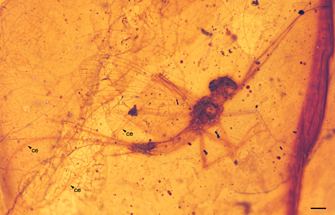
The family Pseudironidae, formerly regarded as a subfamily of Heptageniidae, is today represented by the single Nearctic genus Pseudiron McDunnough, 1931. Fossil representatives of this lineage are exceedingly rare. In this study, a new fossil species, Burmella jiangchaoi sp. nov., is described from mid-Cretaceous Kachin amber of northern Myanmar. Detailed morphological examination of the new material and previously described taxa supports the synonymy Burmella Godunko, Martynov & Staniczek, 2021 = Longiheptagenia Yang, Zhao & Ren, 2023 syn. nov.. The genus Burmella was previously placed in Vietnamellidae, but re-evaluation indicates that its rounded hind wings result from secondary reduction, whereas the combination of its tarsal configuration and fore wing venation correspond to the diagnostic features of Pseudironidae. Consequently, Burmella is here transferred to Pseudironidae. The discovery of Burmella jiangchaoi sp. nov. provides the first fossil record of Pseudironidae from the Cretaceous, extending the known temporal and geographical range of the family from the modern Nearctic region to mid-Cretaceous Southeast Asia.
References
Auychinda C, Sartori M. & Boonsoong B. 2020. Vietnamellidae (Insecta, Ephemeroptera) of Thailand. ZooKeys 902: 17–36. https://doi.org/10.3897/zookeys.902.46844
Chen Z. T. & Zheng, X. 2023. A new mayfly of Heptageniidae (Insecta: Ephemeroptera) in mid-Cretaceous Kachin amber, northern Myanmar. Cretaceous Research 151: 105662. https://doi.org/10.1016/j.cretres.2023.105662
Godunko R. J., Benhadji N., Martynov A., Chen Z. T., Zheng X. & Staniczek A. H. 2025. A new species and new generic synonymy in the family Vietnamellidae (Insecta: Ephemeroptera) from mid-Cretaceous Burmese amber with notes on ancient dispersal across East Gondwana. PeerJ 13: e19048. http://doi.org/10.7717/peerj.19048
Godunko R. J., Martynov A. & Staniczek A. H. 2021. First fossil record of the mayfly family Vietnamellidae (Insecta, Ephemeroptera) from Burmese Amber confirms its Oriental origin and gives new insights into its evolution. ZooKeys 1036: 99–120. http://doi.org/10.3897/zookeys.1036.66435
Gong D., Zhang W. & Zhou C. 2022. The real characters of Heptagenia ngi Hsu (1936) from China representing a new genus (Ephemeroptera: Heptageniidae). Diversity 14(12): 1027. https://doi.org/10.3390/d14121027
Harrison A. B., Leonard L. H., Stark B. P. & Lago P. K. 2020. Collection records and distributional updates of six rarely collected North American large river mayfly taxa (Insecta: Ephemeroptera). Aquatic Insects 41(2): 157–173. https://doi.org/10.1080/01650424.2020.1739311
Hyatt A. & Arms J. M. 1891. A general survey of the modes of development in insects and their meaning. Psyche 6(179): 37–44. https://doi.org/10.1155/1891/75178
Kluge N. J. 1993. New data on mayflies (Ephemeroptera) from fossil Mesozoic and Cenozoic resins. Palaeontological Journal 27(1A): 35–49.
Kluge N. J. 2004. The Phylogenetic System of Ephemeroptera. Kluwer Academic Publishers, Dordrecht, 442 pp. https://doi.org/10.1007/978-94-007-0872-3
McCafferty W. P. 1991a. The cladistics, classification, and evolution of the Heptagenioidea (Ephemeroptera), pp. 87–102. In: Overview and Strategies of Ephemeroptera and Plecoptera. (J. Alba-Tercedor and A. Sanchez-Ortega, editors). Gainesville, Sandhill Crane Press, 588 pp.
McCafferty W. P. 1991b. Toward a phylogenetic classification of the Ephemeroptera (Insecta): a commentary on systematics. Annals of The Entomological Society of America 84: 343–360. https://doi.org/10.1093/aesa/84.4.343
McCafferty W. P. 1992. The sand-dwelling predatory mayfly Pseudiron Centralis in Michigan (Ephemeroptera: Pseudironidae). The Great Lakes Entomologist 25(2): 133–134. https://doi.org/10.22543/0090-0222.1779
McDunnough J. 1931. New species of North American Ephemeroptera. The Canadian Entomologist 63: 82–93. https://doi.org/10.4039/Ent6382-4
Ogden T. H. & Whiting M. F. 2005. Phylogeny of Ephemeroptera (mayflies) based on molecular evidence. Molecular Phylogenetics and Evolution 37(3): 625–643. https://doi.org/10.1016/j.ympev.2005.08.008
Pescador M. L. 1985. Systematics of the Nearctic genus Pseudiron (Ephemeroptera: Heptageniidae: Pseudironinae). Florida Entomologist 68(3): 432–444. https://doi.org/10.2307/3495130
Sartori M. 2014. What is Ecdyonurus sumatranus Ulmer, 1939? A contribution to the knowledge of the genus Rhithrogena in the Oriental Region (Ephemeroptera, Heptageniidae). Zootaxa 3802(2): 193–208. https://doi.org/10.11646/zootaxa.3802.2.3
Shi G., Grimaldi D. A., Harlow G. E., Wang J., Wang J., Wang M., Lei W., Li Q. & Li X. 2012. Age constraint on Burmese amber based on U-Pb dating of zircons. Cretaceous Research 37: 155–163. https://doi.org/10.1016/j.cretres.2012.03.014
Sinitshenkova N. D. 2000. New Jersey Amber Mayflies: The First North American Mesozoic Members of the Order (Insecta; Ephemeroptera), pp. 111–125. In: Studies on Fossils in Amber, with Particular Reference to the Cretaceous of New Jersey (D. Grimaldi, editor). Leiden, Backhuys Publishers, 498 pp.
Tillyard R. J. 1932. Kansas Permian insects. Part 15. The Order Plectoptera. American Journal of Science 23(5): 97–134, 237–272. https://doi.org/10.2475/ajs.s5-23.134.97
Wang T. Q. & McCafferty W. P. 1995. Relationships of the Arthropleidae, Heptageniidae, and Pseudironidae (Ephemeroptera: Heptagenioidea). Entomological News 106(5): 251–256.
Wang T. Q. & McCafferty W. P. 2004. Heptageniidae (Ephemeroptera) of the world. Part I: Phylogenetic higher classification. Transactions of the American Entomological Society 130(1): 11–45.
Yang X., Zhao Y., Ren D. & Zhao Z. 2023. Two new species of heptageniids (Insecta, Ephemeroptera) with long antennae from mid-Cretaceous Myanmar Amber. Cretaceous Research 147: 105515. https://doi.org/10.1016/j.cretres.2023.105515
Yu T., Kelly R., Mu L., Ross A., Kennedy J., Broly P., Xia F., Zhang H., Wang B. & Dilcher D. 2019. An ammonite trapped in Burmese amber. Proceedings of the National Academy of Sciences 116: 11345–11350. https://doi.org/10.1073/pnas.1821292116