

Abstract
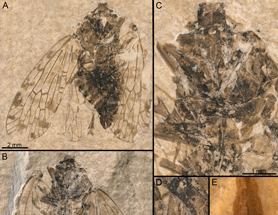
Lapicixius yixianensis sp. nov., the second species of this genus, is described and illustrated on the basis of an almost complete specimen from the Lower Cretaceous Yixian Formation of Liaoning Province, China. This new representative of the extinct hemipteran family Lalacidae increases the taxonomic diversity of the group during the Cretaceous. The affinities of the new fossil with described lalacid planthoppers and the validity of Lalacidae are discussed.
References
- Boderau M., Fu Y. Z., Jiang H., Guan S. H., Peng A. C., Nel A. & Jouault C. 2025a. Bayesian modelling of the fossil record enlightens the evolutionary history of Hemiptera. Proceedings of the Royal Society B 292: 20251133. https://doi.org/10.1098/rspb.2025.1133
- Boderau M., Nam G.-S., Jouault C. & Nel A. 2025b. The first cixiid planthopper (Fulgoromorpha: Cixiidae) from Lower Cretaceous Jinju Formation (Republic of Korea). Journal of Asia-Pacific Entomology 28: 102472. https://doi.org/10.1016/j.aspen.2025.102472
- Bourgoin T., Wang R., Asche M., Hoch H., Soulier-Perkins A., Stroinski A., Yap S. & Szwedo J. 2015. From micropterism to hyperpterism: recognition strategy and standardized homology-driven terminology of the forewing venation patterns in planthoppers (Hemiptera: Fulgoromorpha). Zoomorphology 134: 63–77. https://doi.org/10.1007/s00435-014-0243-6
- Bourgoin T. & Szwedo J. 2022. Toward a new classification of planthoppers Hemiptera Fulgoromorpha: 1. What do Fulgoridiidae really cover? Annales Zoologici 72(4): 951–962.
- Bourgoin T. & Szwedo J. 2023. Toward a new classification of planthoppers Hemiptera Fulgoromorpha: 2. Higher taxa, their names and their composition. Zootaxa 5297: 562–568. https://doi.org/10.11646/zootaxa.5297.4.5
- Bucher M., Gignoux G., Szwedo J. & Bourgoin T. 2024. Time-traveling through fossil planthopper tegmina in the Paleozoic and Mesozoic eras (Insecta. Hemiptera: Fulgoromorpha). Palaeoentomology 7: 1–67. https://doi.org/10.11646/palaeoentomology.7.1.1
- Chen J. 2022. True hopper fossils (Fulgoromorpha and Cicadomorpha) in the Jurassic to Cretaceous of eastern Asia and their evolutionary implications. Geological Society, London, Special Publications 521: 61–80. https://doi.org/10.1144/SP521-2021-18
- Deng J., Stroiński A., Szwedo J., Ghanavi H. R., Yapar E., Franco D. C. et al. 2025. Phylogenomic insights into the relationship and the evolutionary history of planthoppers (Insecta: Hemiptera: Fulgoromorpha). Systematic Entomology 50(3): 495–518. https://doi.org/10.1111/syen.12666
- Hamilton K. G. A. 1990. Insecta from the Santana Formation, Lower Cretaceous, of Brazil. Chapter 6. Homoptera. Bulletin of the American Museum of Natural History 195: 82–122.
- Martins-Neto R. G. 1989. A new fossil insect (Homoptera, Cixiidae) from the Santana Formation (LowerCretaceous) Araripe Basin. Northeast Brazil. Acta Geologica Leopoldensia 26(11): 7–14.
- Nel A., Prokop J., Nel P., Grandcolas P., Huang D. Y, Roques P., Guilbert E., Dostál O. & Szwedo J. 2012. Traits and evolution of wing venation pattern in paraneopteran insects. Journal of Morphology 273: 480–506. https://doi.org/10.1002/jmor.11036
- Ren D., Lu L., Guo Z. & Ji S. 1995. [Faunae and stratigraphy of Jurassic – Cretaceous in Beijing and the adjacent areas]. Seismic Publishing House Beijing: i-vii + 1–222. [in Chinese, with English summary]
- Ren D., Yin J. & Dou W. 1998. New planthoppers and froghoppers from the Late Jurassic of northeast China (Homoptera: Auchenorrhyncha). Acta Zootaxonomica Sinica 23(3): 281–288.
- Schubnel T., Desutter-Grandcolas L., Legendre F., Prokop J., Mazurier A., Garrouste R., Grandcolas P. & Nel A. 2019. To be or not to be: postcubital vein in insects revealed by microtomography. Systematic Entomology 45: 327–336. https://doi.org/10.1111/syen.12399
- Shcherbakov D. E. 1981. Diagnostics of the families of the Auchenorrhyncha (Homoptera) on the basis of the wings. 1. Fore wing. Entomological Review 60(4): 64–81.
- Shcherbakov D. E. 1984. [A system and the phylogeny of Permian Cicadomorpha (Cimicida, Cicadina).] Paleontologicheskii Zhurnal 1984(2): 89–101. [In Russian; English translation, 1984, in Paleontological Journal 18: 87–97].
- Szwedo J. 2018. The unity, diversity and conformity of bugs (Hemiptera) through time. Earth and Environmental Science Transactions of the Royal Society of Edinburgh 107: 109–128. https://doi.org/10.1017/S175569101700038X
- Szwedo J., Bourgoin T. & Lefebvre F. 2004. Fossil planthoppers (Hemiptera: Fulgoromorpha) of the World. An annotated catalogue with notes on Hemiptera classification. Studio 1, Warszawa, 199 pp. + 8 pls.
- Zhang H. C., Wang B. & Fang Y. 2010. Evolution of insect diversity in the Jehol Biota. Science China Earth Sciences 53(12): 1908–1917. https://doi.org/10.1007/s11430-010-4098-5
- Zhang Z. J. 2002. New early Cretaceous lalacid from Jingxi Basin of Beijing, China (Homoptera: Fulgoroidea). Acta Zootaxonomica Sinica 27(1): 20–23.