

Abstract
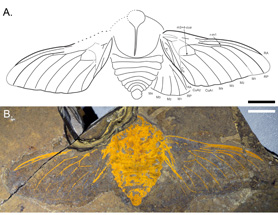
The first occurrence of the extinct cicadomorphan family Palaeontinidae from the Jiufotang Formation of China is reported based on a specimen assigned to Ilerdocossus cf. fengningensis. The genus Ilerdocossus Gomez Pallerola, 1984 is well known from the underlying Yixian Formation of northern China (Hebei, Liaoning provinces, and Inner Mongolia), as well as the Caliza con Caraceas Formation of Lerida, Spain and the Lower Weald Clay (Surrey, England), UK. The new record represents the stratigraphically youngest occurrence of the family in the Jehol Biota and extends the temporal range of Ilerdocossus into the Aptian (121–113 million years ago).
References
- Boderau M., Fu Y. Z., Jiang H., Guan S., Peng A, Nel, A. & Jousult C. 2025. Bayesian modelling of the fossil record enlightens the evolutionary history of Hemiptera. Procondings of the Royal Society B 292: 20251133. https://doi.org/10.1098/rspb.2025.1133
- Chen J., Beattie R., Wang B., Jiang H., Zheng Y. & Zhang H. C. 2019. The first palaeontinid from the Late Jurassic of Australia (Hemiptera, Cicado morpha, Palaeontinidae). Alcheringa 43: 449–454. https://doi.org/10.1080/ 03115518.2019.1587787
- Fu Y. Z., Cai C. C. & Huang D. Y. 2020. A new palaeontinid (Insecta, Hemiptera, Cicadomorpha) from the Upper Jurassic Tiaojishan Formation of northeastern China and its biogeographic significance. Journal of Paleontology 94(3): 513–520. https://doi.org/10.1017/jpa.2019.95
- Gomez Pallerola J. E. 1984. New palaeontinids from the Infra-Cretaceous site of the «Pedrera de Meiá» (Lérida). Geological and Mining Bulletin 95(4): 301–309.
- Handlirsch A. 1908. Die fossilen Insekten und die Phylogenie der rezenten Formen: ein Handbuch für Paläontologen und Zoologen. W. Engelmann: 1–1430.
- Lee S. B., Cai C. Y., Engel M. S., Nam G. S. & Park J. K. 2024. Cretaceous beetles of the Jinju Formation (Coleoptera: Hydrophiloidea). Palaeoentomology 7(3): 443–452. https://doi.org/10.11646/palaeoentomology.7.3.14
- Li Y. L., Chen J. & Wang B. 2019. New Cretaceous palaeontinids (Insecta, Hemiptera) from northeast China. Cretaceous Research 95: 130–137. https://doi.org/10.1016/j.cretres.2018.11.007
- Li Y. L., Jarzembowski E., Chen J. & Wang B. 2019. New Palaeontinidae (Insecta: Hemiptera) from the Lower Cretaceous of southern England. Cretaceous Research 95: 297–301. https://doi.org/10.1016/j.cretres.2018.11.019
- Lü Y. N., Du X. X., Ning L. D. & Zhang Q. Q. 2025. New species of Stellularis (Hemiptera: Cicadomorpha: Procercopidae) from the Lower Cretaceous Jiufotang Formation in northeastern China. Proceedings of the Geologists' Association 2025: 101138. https://doi.org/10.1016/j.pgeola.2025.101138
- Menon F., Heads S. W. & Martill D. M. 2005. New Palaeontinidae (Insecta: Cicadomorpha) from the Lower Cretaceous Crato Formation of Brazil. Cretaceous Research 26(6): 837–844. https://doi.org/10.1016/j.cretres.2005.05.005
- Nam K. S., Wang Y., Ren D., Kim J. H. & Szwedo J. 2017. An extraordinary palaeontinid from the Triassic of Korea and its significance. Scientific reports 7(1): 40691. https://doi.org/10.1038/srep40691
- Nel A., Prokop J., Nel P., Grandcolas P., Huang D. Y., Roques P., Guilbert E., Dostál O. & Szwedo J. 2012. Traits and evolution of wing venation pattern in paraneopteran insects. Journal of Morphology 273(5): 480–506. https://doi.org/10.1002/jmor.1103
- Ren D., Yin J. & Dou W. 1998. Late Jurassic palaeontinids (Homoptera: Auchenorrhyncha) from Hebei and Liaoning provinces in China. Insect Science 5(3): 222–232. https://doi.org/10.1111/j.1744-7917.1998.tb00319.x
- Riek E. F. 1976. A new collection of insects from the Upper Triassic of South Africa. Annals of the Natal Museum 22(3): 791–820.
- Rosse-Guillevic S., Kopylov D., Rasnitsyn A., Nam G. S., Kwon S. H. & Jouault C. 2023. Blurring the limits of anaxyelid subfamilies: a new genus and species (Hymenoptera: Anaxyelidae) from the Albian of the Republic of Korea. Palaeoentomology 6(4): 424–434. https://doi.org/10.11646/palaeoentomology.6.4.13
- Schubnel T., Desutter-Grandcolas L., Legendre F., Prokop J., Mazurier A., Garrouste R., Grandcolas P. & Nel A. 2019. To be or not to be: postcubital vein in insects revealed by microtomography. Systematic Entomology 45(2): 327–336. https://doi.org/10.1111/syen.12399
- Sha J. G., Pan Y. H., Wang Y. Q., Zhang X. L. & Rao X. 2012. Non-marine and marine stratigraphic correlation of Early Cretaceous deposits in NE China, SE Korea and SW Japan, non-marine molluscan biochronology, and palaeogeographic implications. Journal of Stratigraphy 36(2): 357–381. https://doi.org/10.19839/j.cnki.dcxzz.2012.02.015
- Sun M. D., Lin Q., Ramezani J., Liu J. S., Lu Z. A., Yang H. Q., Bai J. H., Cai S. X., Chen J. C., Chen X. Y. & Cui H. 2025. Terrestrial ecosystem response to Early Cretaceous global environmental change: A calibrated, high-resolution Aptian record from Northeast China. Earth and Planetary Science Letters 653: 119206. https://doi.org/10.1016/j.epsl.2025.119206
- Szwedo J. 2018. The unity, diversity and conformity of bugs (Hemiptera) through time. Earth and Environmental Science Transactions of the Royal Society of Edinburgh 107(2–3): 109–128. https://doi.org/10.1017/S175569101700038X
- Tillyard R. J. & Dunstan B. 1916. Mesozoic and Tertiary insects of Queensland and New South Wales. Queensland Geological Survey 253: 11–47. https://doi.org/10.5962/bhl.title.2497
- Tillyard R. J. 1921. Mesozoic insects of Queensland. No. 8. Hemiptera Homoptera (contd.). The genus Mesogereon; with a discussion of its relationship with the Jurassic Palaeontinidae. Proceedings of the Linnean Society of New South Wales 46: 270–284. https://doi.org/10.5962/bhl.part.14018
- Wang B., Zhang H. C., Fang Y., Wang D. & Ji S. 2008. New data on Cretaceous Palaeontinidae (Insecta: Hemiptera) from China. Cretaceous Research 29(4): 551–560. https://doi.org/10.1016/j.cretres.2008.01.007
- Xu C., Chen J., Muijres F. T., Yu Y., Jarzembowski E. A., Zhang H. C. & Wang B. 2024. Enhanced flight performance and adaptive evolution of Mesozoic giant cicadas. Science Advances 10: eadr2201. https://doi.org/10.1126/sciadv.adr2201
- Wang Y. L., Yao Y., Zhang C. B., Zhao C. Y., Lu S., Zhao B. & Wang C. J. 2013. Stratigraphic division of the Jiufotang Formation in Kazuo Basin of western Liaoning and related issues. Geology in China 40(5):1523–1530.
- Whalley E. S. & Jarzembowski E. A. 1985. Fossil insects from the Lithographic Limestone of Montsech (late Jurassic-early Cretaceous). Lerida Province, Spain. Bulletin of the British Museum (Natural History) 38(5): 381–412.
- Zhang H. C., Wang B. & Fang Y. 2010. Evolution of insect diversity in the Jehol Biota. Science China Earth Sciences 53(12): 1908–1917. https://doi.org/10.1007/s11430-010-4098-5
- Zhang Q. Q., Chen J., Wang Y., Zhang L. & Zhang H. C. 2025. A new procercopid froghopper (Hemiptera: Cicadomorpha: Procercopidae) from the Lower Cretaceous Jiufotang Formation, western Liaoning Province, NE China. Historical Biology 37(9): 2026–2031. https://doi.org/10.1080/08912963.2024.2403594