

Abstract
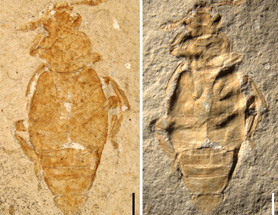
Recent phylogenetic work has placed the family Silphidae within Staphylinidae as subfamily Silphinae. Despite this taxonomic progress, the early fossil record and the evolution of Silphinae remain incompletely understood. Here I describe Paracretosaja gen. nov. (type species: Paracretosaja newtoni sp. nov.) and Cretosaja thayerae sp. nov., based on well-preserved compression fossils from the Lower Cretaceous Yixian Formation (Liaoning and Inner Mongolia, northeastern China). Both new taxa possess paired stridulatory files on abdominal tergite V and a distinct, straight frontoclypeal suture that permit confident placement in the extant tribe Nicrophorini. An examination of new specimens of Cretosaja Sohn & Nam corrects several earlier character interpretations for C. jinjuensis Sohn & Nam. The presence of derived nicrophorines in multiple Early Cretaceous localities, together with slightly younger records from the Jinju Formation of South Korea, indicates a broad geographic distribution of Nicrophorini in eastern Asia. These fossils document that traits associated with communication and parental provisioning were established by the Early Cretaceous, and they imply that carrion-feeding beetles had already assumed important roles in nutrient recycling and terrestrial ecosystem functioning during the Mesozoic.
References
- Bartlett J. & Ashworth C. M. 1988. Brood size and fitness in Nicrophorus vespilloides (Coleoptera: Silphidae). Behavioral Ecology and Sociobiology 22(6): 429–434. https://doi.org/10.1007/BF00294981
- Büchner G., Hothorn T., Feldhaar H., von Hoermann C., Lackner T., Rietz J. & Müller J. 2024. Ecological drivers of carrion beetle (Staphylinidae: Silphinae) diversity on small to large mammals. Ecology and Evolution 14(9): e70203. https://doi.org/10.1002/ece3.70203
- Cai C. Y., Tihelka E., Giacomelli M., Lawrence J. F., Ślipiński A., Kundrata R., Yamamoto S., Thayer M. K., Newton A. F., Leschen R. A. B., Gimmel M. L., Lü L., Engel M. S., Bouchard P., Huang D., Pisani D. & Donoghue P. C. J. 2022. Integrated phylogenomics and fossil data illuminate the evolution of beetles. Royal Society Open Science 9(3): 211771. https://doi.org/10.1098/rsos.211771
- Cai C. Y., Thayer M. K., Engel M. S., Newton A. F., Ortega-Blanco J., Wang B., Wang X. & Huang D. Y. 2014. Early origin of parental care in Mesozoic carrion beetles. Proceedings of the National Academy of Sciences of the United States of America 111(39): 14170–14174. https://doi.org/10.1073/pnas.1412280111
- Cai C. Y., Tihelka E., Pisani D. & Donoghue P. C. J. 2024. Resolving incongruences in insect phylogenomics: a reply to Boudinot et al. (2023). Palaeoentomology 7(2): 176–183. https://doi.org/10.11646/palaeoentomology.7.2.2
- Haitlinger R. 2025. Mites (Acari) associated with Silphinae (Coleoptera: Staphylinidae): a worldwide review. Acarological Studies 7(2): 72–100. https://doi.org/10.47121/acarolstud.1724127
- Kalinová B., Podskalská H., Růžička J. & Hoskovec M. 2009. Irresistible bouquet of death—how are burying beetles (Coleoptera: Silphidae: Nicrophorus) attracted by carcasses. Naturwissenschaften 96(8): 889–899. https://doi.org/10.1007/s00114-009-0545-6
- Lee S. B., Cai C. Y., Engel M. S., Nam G. S. & Park J. K. 2024a. Cretaceous beetles of the Jinju Formation (Coleoptera: Hydrophiloidea). Palaeoentomology 7(3): 443–452. https://doi.org/10.11646/palaeoentomology.7.3.14
- Lee S. B., Li Y. D., Cai C., Engel M. S., Nam G. S., Park J. K. & Kundrata R. 2024b. Cretaceous beetles of the Jinju Formation (Coleoptera): An overview of the Jinju Formation, its coleopteran diversity, and past and future research. Journal of Asia-Pacific Entomology 27(2): 102236. https://doi.org/10.1016/j.aspen.2024.102236
- Lee S. B., Nam G. S. & Li Y. D. 2022. A new species of Notocupes (Coleoptera: Archostemata) from the Lower Cretaceous (Albian) Jinju Formation in South Korea. Cretaceous Research 140: 105357. https://doi.org/10.1016/j.cretres.2022.105357
- Lee S. B., Nam G. S., Park J. K., Lee B. H. & Li Y. D. 2023. Cretaceous beetles of the Jinju Formation (Coleoptera): Archostemata. Palaeoentomology 6(5): 496–506. https://doi.org/10.11646/palaeoentomology.6.5.8
- Li Y. D., Jin Z. Y., Ślipiński A., Huang D. Y. & Cai C. Y. 2022. Parelateriformius from the Middle–Late Jurassic of China reinterpreted as the earliest Dascillidae (Coleoptera: Dascilloidea). Palaeoentomology 5(6): 545–568. https://doi.org/10.11646/palaeoentomology.5.6.6
- Li Y. D., Tihelka E., Newton A. F., Huang D. Y. & Cai C. Y. 2023. New species of Notocupes (Coleoptera: Archostemata) from the Middle Jurassic Daohugou beds, with discussion on the generic circumscription. Palaeoentomology 6(4): 398–415. https://doi.org/10.11646/palaeoentomology.6.4.11
- Lian X. N., Cai C. Y. & Huang D. 2021. The early assemblage of Middle–Late Jurassic Yanliao Biota: checklist, bibliography and statistical analysis of described taxa from the Daohugou beds and coeval deposits. Palaeoentomology 4(2): 95–136. https://doi.org/10.11646/palaeoentomology.4.2.1
- Newton A. F. 2025. StaphBase (version Aug 2022). In: Bánki O, Roskov Y, et al. (Eds) Catalogue of Life Checklist (Aug 2022). https://doi.org/10.48580/dfqf-3gk
- Potticary A. L., Belk M. C., Creighton J. C., Ito M., Kilner R., Komdeur J. & Moore A. J. 2024. Revisiting the ecology and evolution of burying beetle behavior (Staphylinidae: Silphinae). Ecology and Evolution 14(8): e70175. https://doi.org/10.1002/ece3.70175
- Růžička J., Jakubec P., Mahlerová K., Šípková H. & Nishikawa M. 2023. Integrative taxonomy and species distribution models of the genus Diamesus Hope, 1840 (Coleoptera: Staphylinidae: Silphinae). Scientific Reports 13(1): 3192. https://doi.org/10.1038/s41598-023-30019-x
- Scott M. P. & Traniello J. F. 1990. Behavioural and ecological correlates of male and female parental care and reproductive success in burying beetles (Nicrophorus spp.). Animal Behaviour 39(2): 274–283. https://doi.org/10.1016/S0003-3472(05)80871-1
- Sikes D. S. & Venables C. 2013. Molecular phylogeny of the burying beetles (Coleoptera: Silphidae: Nicrophorinae). Molecular Phylogenetics and Evolution 69(3): 552–565. https://doi.org/10.1016/j.ympev.2013.07.022
- Sikes D. S. 2016. Silphidae Latreille, 1807. In: Beutel R. G., Leschen R. A. B. (Eds) Coleoptera, Beetles, Volume I: Morphology and systematics (Archostemata, Adephaga, Myxophaga, Polyphaga partim) 2nd edn. Handbook of Zoology, Arthropoda: Insecta (Beutel R. G., Kristensen N. P., eds). Walter de Gruyter, Berlin, Germany, 386–394.
- Sikes D. S., Thayer M. K. & Newton A. F. 2024. Large carrion and burying beetles evolved from Staphylinidae (Coleoptera, Staphylinidae, Silphinae): a review of the evidence. ZooKeys 1200: 159. https://doi.org/10.3897/zookeys.1200.122835
- Sohn, J. C. & Nam, G. S. 2021. New fossil genus and species of carrion beetle (Coleoptera, Silphidae) from the Lower Cretaceous Jinju Formation, South Korea. Journal of Asia-Pacific Entomology 24(3): 584–587. https://doi.org/10.1016/j.aspen.2021.05.003
- Trumbo S. T. 1990. Interference competition among burying beetles (Silphidae, Nicrophorus). Ecological Entomology 15(3): 347–355. https://doi.org/10.1111/j.1365-2311.1990.tb00816.x
- Xu X., Zhou Z. H., Wang Y. & Wang M. 2020. Study on the Jehol Biota: recent advances and future prospects. Science China Earth Sciences 63(6): 757–773. https://doi.org/10.1007/s11430-019-9509-3
- Yin Y. Q., Shih C., Engel M. S. & Ren D. 2024. The first dermapterid earwigs from the Lower Cretaceous Yixian Formation of northeastern China (Dermaptera: Dermapteridae). Palaeoentomology 7(4): 513–528. https://doi.org/10.11646/palaeoentomology.7.4.11
- Zhou Z. H. 2014. The Jehol Biota, an Early Cretaceous terrestrial Lagerstätte: new discoveries and implications. National Science Review 1(4): 543–559. https://doi.org/10.1093/nsr/nwu055
- Zhou Z. H., Barrett P. M. & Hilton J. 2003. An exceptionally preserved Lower Cretaceous ecosystem. Nature 421(6925): 807–814. https://doi.org/10.1038/nature01420
- Zhou Z. H., Meng Q. R., Zhu R. X. & Wang M. 2021. Spatiotemporal evolution of the Jehol Biota: Responses to the North China craton destruction in the Early Cretaceous. Proceedings of the National Academy of Sciences 118(34): e2107859118. https://doi.org/10.1073/pnas.2107859118