

Abstract
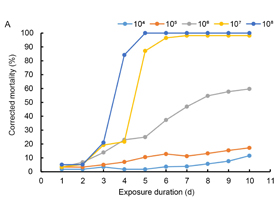
The red-necked longhorn beetle Aromia bungii is a destructive wood-borer difficult to control with insecticides. We evaluated a combined biocontrol strategy using the ectoparasitic mite Pyemotes zhonghuajia and the entomopathogenic fungus Beauveria bassiana. Fungal virulence was dose- and stage-dependent, causing up to 100% mortality at 10⁸ conidia mL⁻¹ within 5–7 days. Mites alone induced limited mortality (~44% in young larvae, ≤7% in older ones), whereas conidia-carrying mites achieved complete kill within 7–8 days, comparable to direct fungal application. The combination significantly accelerated mortality (P < 0.05), reflecting synergistic interaction between mite venom and fungal infection. These findings highlight the potential of P. zhonghuajia as both a parasitoid and a vector for B. bassiana, offering an innovative and eco-friendly approach to manage A. bungii and related xylophagous pests.
References
- Cen X., Li X., Qin H.-X., Zhang L., Yang M.-F., Wu C.-X., & Liu J.-F. 2025. Predator–parasitoid interaction between Harmonia axyridis (Coleoptera: Coccinellidae) and Pyemotes zhonghuajia (Prostigmata: Pyemotidae) in aphid control. Journal of Economic Entomology 118(2): 505–513. https://doi.org/10.1093/jee/toaf013
- Chen Y.-C., Tian T.-A., Chen Y.-H., Yu L.-C., Hu J.-F., Yu X.-F., Liu J.-F., & Yang M.-F. 2021. The biocontrol agent Pyemotes zhonghuajia has the highest lethal weight ratio compared with its prey and the most dramatic body weight change during pregnancy. Insects 12(6): 490. https://doi.org/10.3390/insects12060490
- Feng B.-X., He X.-Z., Wang L., Song Y.-F., Yang X., Yu Z., Yang M.-F., Liu J.-F., & Gao Y.-L. 2025. Non-consumptive effects of ectoparasitic mites on the moth pest Phthorimaea operculella and transgenerational impact: implications for sustainable storage pest control. Entomologia Generalis 45(4): 1125–1133. https://doi.org/10.1127/entomologia/3100
- Feng B.-X., Tian T.-A., Tian Y., Song Y.-F., Tang X.-T., Yang M.-F., & Liu J.-F. 2022. Parasitic behavior of Pyemotes zhonghuajia (Trombidiformes: Pyemotidae) on fall armyworm Spodoptera frugiperda (Lepidoptera: Noctuidae). Systematic & Applied Acarology 27(9): 1745–1754. https://doi.org/10.11158/saa.27.9.5
- Horrocks K. J., Zhang J., Haye T., Seehausen M. L., Maggini R., Xian X., Chen J., Nugnes F., Collatz J., Gruber A. & Gariepy T. D. 2024. Biology, impact, management and potential distribution of Aromia bungii, a major threat to fruit crops around the world. Journal of Pest Science 97(4): 1725–1747. https://doi.org/10.1007/s10340-024-01767-0
- Inglis G. D., Goettel M. S., Butt T. M., Strasser H., Jackson C. & Magan N. 2001. Use of hyphomycetous fungi for managing insect pests. In: Butt TM, Jackson C, Magan N (Eds). Fungi as Biocontrol Agents: Progress, Problems and Potential. Wallingford, UK, CABI Publishing, pp. 23–69.
- Koller J., Sutter L., Gonthier J., Collatz J. & Norgrove L. 2023. Entomopathogens and parasitoids allied in biocontrol: a systematic review. Pathogens 12(7): 957. https://doi.org/10.3390/pathogens12070957
- Li L., He L., Yu L., He X. Z., Xu C., Jiao R., Zhang L. & Liu J. 2019. Preliminary study on the potential of Pyemotes zhonghuajia (Acari: Pyemotidae) in biological control of Aphis citricola (Hemiptera: Aphididae). Systematic and Applied Acarology 24(6): 1116–1120. https://doi.org/10.11158/saa.24.6.12
- Li L., Jiao R., Xu C., Xu H., Zhao W. & He L. 2025. Optimizing temperature and humidity for Pyemotes zhonghuajia reproduction and survival: implications for mass-rearing and field release. Systematic and Applied Acarology 30(9): 1571–1581. https://doi.org/10.11158/saa.30.9.3
- Li J., Xiao Z., Zhang S., Cai H.,Teng K., Zeng W., Wu S., Zhou X. 2023. Synergistie interaction between the entomopathogenic fungus Beauveria bassiana SCAUjH19 and Emamectin Benzoate Against Spodoptera litura. Journal of Mountain Agriculture and Biology, 42(2):8–16. (in Chinese)
- Liu J.-F., He X.-Z., Ye S., Zhou J.-J., Han P., Gao Y.-L. & Yang M.-F. 2023. Pest management of postharvest potatoes: lethal, sublethal and transgenerational effects of the ectoparasitic mite Pyemotes zhonghuajia on the potato worm Phthorimaea operculella. Pest Management Science 79(12): 5250–5259. https://doi.org/10.1002/ps.7730
- Roy H. E. & Pell J. K. 2000. Interactions between entomopathogenic fungi and other natural enemies: implications for biological control. Biocontrol Science and Technology 10(6): 737–752.
- Shi Y. Q., Shi Y. & Lu Q. 2009. Isolation and identification of Beauveria bassiana for adult of Aromia bungii. Journal of Inner Mongolia Forestry Science and Technology 35(04): 40–41. (in Chinese)
- Song Y.-F., Tian T.-A., Chen Y.-C., Zhang K., Yang M.-F. & Liu J.-F. 2024. A mite parasitoid, Pyemotes zhonghuajia, negatively impacts the fitness traits and immune response of the fall armyworm, Spodoptera frugiperda. Journal of Integrative Agriculture 23(1): 205–216. https://doi.org/10.1016/j.jia.2023.05.022
- Song Y.-F., Du H.-L., Chen Y.-C., Ye S., Yang M.-F. & Liu, J.-F. 2022. Effect of different densities on the parasitic ability of Pyemotes zhonghuajia on Myzus persicae. Journal of Mountain Agriculture and Biology 41(5): 15–20. (in Chinese)
- Tian T.-A., Yu L.-C., Sun G.-J., Yu X.-F., Li L.-T., Wu C.-X., Chen Y.-C., Yang M.-F. & Liu J.-F. 2020. Biological control efficiency of an ectoparasitic mite Pyemotes zhonghuajia on oriental armyworm Mythimna separata. Systematic & Applied Acarology 25(9): 1683–1692. https://doi.org/10.11158/saa.25.9.13
- Wang L., Li X.-L., Fan D., Chen Y.-C., Song Y.-F., Hu J.-F., Smagghe G., Liu J.-F. & Yang M.-F. 2025. Multi-omics analyses provide molecular insights into host immune responses and metabolic disruption in Spodoptera frugiperda parasitized by Pyemotes zhonghuajia. Pest Management Science 81(10): 6303–6315. https://doi.org/10.1002/ps.8969
- Wu H., Cai S., Zeng L., Lin H., Wu S. & Xu Y. 2025. Capability of Pyemotes zhonghuajia to carry Beauveria bassiana spores and activity and virulence of carried spores. Forest Pest and Disease 44(4): 22–26. (in Chinese)
- Zimmermann G. 2007. Review on safety of the entomopathogenic fungi Beauveria bassiana and Beauveria brongniartii. Biocontrol Science and Technology 17: 553–596. https://doi.org/10.1080/09583150701309006
- Zou X. 2020. Advances in environmental adaptation of entomopathogenic fungi. Journal of Mountain Agriculture and Biology 39(6): 1–7. (in Chinese)