

Abstract
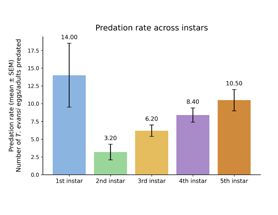
The tomato red spider mite, Tetranychus evansi Baker & Pritchard (Acari: Tetranychidae) is an invasive pest that causes severe damage to solanaceous crops and has proven difficult to control using conventional acaricides or predatory mites. The minute pirate bug, Buchananiella whitei Reuter (Hemiptera: Anthocoridae), is a common but poorly studied anthocorid predator native to Australasia. This study investigated the development, survival, and reproduction (oviposition) of B. whitei when feeding on T. evansi under laboratory conditions, with Ephestia kuehniella Zeller (Lepidoptera: Pyralidae) eggs as a control diet. Results showed that B. whitei successfully completed development and achieved high survival (83%) on T. evansi, with developmental durations not significantly different from those developed on E. kuehniella eggs. Predation capacity increased with age of instar. We also documented for the first time that B. whitei exhibits a variable number of immature instars (five or six) during development, even under controlled environmental conditions. In our oviposition experiment, adult females fed on T. evansi produced a significantly higher number of eggs (4.2 ± 1.0 per male-female pair) in 7 days. These findings provide the first evidence that B. whitei can develop and reproduce on T. evansi, suggesting its potential as a biological control agent against this invasive mite. Further work should assess its performance under greenhouse and field conditions, and its integration with other natural enemies within pest management programmes.
References
- Armer C. A., Wiedenmann R. N. & Bush D. R. 1998. Plant feeding site selection on soybean by the facultatively phytophagous predator Orius insidiosus. Entomologia experimentalis et applicata 86(2): 109–118. https://doi.org/10.1046/j.1570-7458.1998.00271.x
- Azandémè-Hounmalon G., Affognon H., Assogba-Komlan F., Tamo M., Fiaboe K. K. M., Kreiter S. & Martin T. 2016. Farmers’ perception and control practices against the invasive red spider mite (Tetranychus evansi Baker & Pritchard) in Benin. III All Africa Horticultural Congress 1225. https://doi.org/10.1016/j.cropro.2015.06.007
- Azandéme-Hounmalon G. Y., Affognon H. D., Komlan F. A., Tamo M., Fiaboe K. K. M., Kreiter S. & Martin T. 2015. Farmers’ control practices against the invasive red spider mite, Tetranychus evansi Baker & Pritchard in Benin. Crop Protection 76: 53–58. https://doi.org/10.1016/j.cropro.2015.06.007
- Azandeme-Hounmalon G. Y., Sikirou R., Onzo A., Fiaboe K. K. M., Tamo M., Kreiter S. & Martin T. 2022. Re-assessing the pest status of Tetranychus evansi (Acari: Tetranychidae) on solanaceous crops and farmers control practices in Benin. Journal of Agriculture and Food Research 10: 100401. https://doi.org/10.1016/j.jafr.2022.100401
- Ballal C. R., Yamada K. & Joshi S. 2016. Morphology and biology of litter-inhabiting Buchananiella indica Muraleedharan (Hemiptera: Anthocoridae). Entomon 41(1): 11–20. https://doi.org/10.33307/entomon.v41i1.118
- Barraclough E. I., Burgess E. P., Kean A. M. & Malone L. A. 2014. Growth and development in a lepidopteran with variable instar number, Pseudocoremia suavis (Geometridae), under standard rearing conditions and when parasitised by Meteorus pulchricornis (Hymenoptera: Braconidae). European Journal of Entomology 111(4): 501. https://doi.org/10.14411/eje.2014.062
- Bonte M. & Clercq P. D. 2010. Impact of artificial rearing systems on the developmental and reproductive fitness of the predatory bug, Orius laevigatus. Journal of Insect Science 10(1): 104. https://doi.org/10.1673/031.010.10401
- Boubou A., Migeon A., Roderick G. K. & Navajas M. 2011. Recent emergence and worldwide spread of the red tomato spider mite, Tetranychus evansi: genetic variation and multiple cryptic invasions: Recent emergence and multiple cryptic invasions of Tetranychus evansi. Biological Invasions 13(1): 81–92. https://doi.org/10.1007/s10530-010-9791-y
- De Vasconcelos G. J. N., Moraes G. J. De, Júnior Í. D. & Knapp M. 2008. “Life history of the predatory mite Phytoseiulus fragariae on Tetranychus evansi and Tetranychus urticae (Acari: Phytoseiidae, Tetranychidae) at five temperatures. Experimental and Applied Acarology 44(1): 27–36. https://doi.org/10.1007/s10493-007-9124-8
- Esperk T., Tammaru T. & Nylin S. 2007. Intraspecific variability in number of larval instars in insects. Journal of Economic Entomology 100(3): 627–645. https://doi.org/10.1093/jee/100.3.627
- Fan Q.-H., Li D., Bennett S. & Balan R. K. 2021. Diagnosis of a new to New Zealand spider mite, Tetranychus evansi Baker and Pritchard, 1960 (Acari: Tetranychidae). New Zealand Entomologist 44(1): 59–70. https://doi.org/10.1080/00779962.2021.1951932
- Gerlach S. & Şengonca Ç. 1985. Comparative studies on the effectiveness of the predatory mite, Phytoseiulus persimilis Athias-Henriot, and the predatory thrips, Scolothrips longicornis Priesner/Vergleichende Untersuchungen zur Wirksamkeit der Raubmilbe, Phytoseiulus persimilis Athias-Henriot, und des räuberischen Thrips, Scolothrips longicornis Priesner. Zeitschrift für Pflanzenkrankheiten und Pflanzenschutz/Journal of Plant Diseases and Protection: 138–146.
- Gong Y. Z., Zhang K., Xuan Q. & Zhang Z.-Q. 2026. Development and reproductive biology of Buchananiella whitei (Hemiptera: Anthocoridae) reared on different diets. Journal of Insect Biodiversity 78(1): 21–36. https://doi.org/10.12976/jib/2026.78.1.6
- Knihinicki D., Gopurenko D., Gillespie P. S., Millynn B., Dominiak B. & Rossiter L. 2025. Detection of the invasive tomato red spider mite, Tetranychus evansi Baker & Pritchard (Acari: Prostigmata: Tetranychidae) in Australia based on morphological identification and DNA sequence analysis. bioRxiv: 2025.2006. 2011.657326. https://doi.org/10.1101/2025.06.11.657326
- Koller M., Knapp M. & Schausberger P. 2007. Direct and indirect adverse effects of tomato on the predatory mite Neoseiulus californicus feeding on the spider mite Tetranychus evansi. Entomologia Experimentalis et Applicata 125(3): 297–305. https://doi.org/10.1111/j.1570-7458.2007.00625.x
- Lattin J. D. 1999. Bionomics of the Anthocoridae. Annual Review of Entomology 44(1): 207–231. https://doi.org/10.1146/annurev.ento.44.1.207
- Lattin J. D. 2000. Minute pirate bugs (Anthocoridae), pp. 607-637. In: Heteroptera of economic importance. Vol. 1 (Carl W. Schaefer, Antonio Ricardo Panizzi, editors). Washington, CRC Press, 856 pp. https://doi.org/10.1201/9781420041859.ch26
- Lemos F., Sarmento R. A., Pallini A., Dias C. R., Sabelis M. W. & Janssen A. 2010. Spider mite web mediates anti-predator behaviour. Experimental and Applied Acarology 52(1): 1–10. https://doi.org/10.1007/s10493-010-9344-1
- Li X.T. & Zhang Z.-Q. 2026. Lacewings (Mallada basalis) and minute pirate bugs (Buchananiella whitei) as potential biocontrol agents of western flower thrips in strawberries: predation on different thrips stages in no-choice and choice tests. Journal of Insect Biodiversity 78(1): 37–44. https://doi.org/10.12976/jib/2026.78.1.7
- Liebherr J. K. 2006. Harpalini (Insecta: Coleoptera: Carabidae: Harpalinae). Journal of the New York Entomological Society 114(1): 92–93. https://doi.org/10.1664/0028-7199(2006)114[17:RADOBK]2.0.CO;2
- Migeon A., Ferragut F., Escudero-Colomar L. A., Fiaboe K., Knapp M., de Moraes G. J., Ueckermann E. & Navajas M. 2009. Modelling the potential distribution of the invasive tomato red spider mite, Tetranychus evansi (Acari: Tetranychidae). Experimental and Applied Acarology 48(3): 199–212. https://doi.org/10.1007/s10493-008-9229-8
- Mo H.-h., Jang K. B., Park J.-J., Lee S.-E., Shin K.-I., Lee J.-H. & Cho K. 2013. Interactive effect of diet and temperature on instar numbers in Spodoptera litura, with reference to head capsule width and weight. Journal of Asia–Pacific Entomology 16(4): 521–525. https://doi.org/10.1016/j.aspen.2013.08.007
- Moraes G. De & McMurtry J. 1986. Suitability of the spider mite Tetranychus evansi as prey for Phytoseiulus persimilis.” Entomologia experimentalis et applicata 40(2): 109–115. https://doi.org/10.1111/j.1570-7458.1986.tb00490.x
- Navajas M., Moraes G. J. de, Auger P. & Migeon A. 2013. Review of the invasion of Tetranychus evansi: biology, colonization pathways, potential expansion and prospects for biological control. Experimental and Applied Acarology 59(1): 43–65. https://doi.org/10.1007/s10493-012-9590-5
- Sánchez-Bayo F. 2021. Indirect effect of pesticides on insects and other arthropods. Toxics 9(8): 177. https://doi.org/10.3390/toxics9080177
- Sarmento R. A., Lemos F., Dias C. R., Kikuchi W. T., Rodrigues J. C., Pallini A., Sabelis M. W. & Janssen A. 2011. A herbivorous mite down-regulates plant defence and produces web to exclude competitors. PLoS One 6(8): e23757. https://doi.org/10.1371/journal.pone.0023757
- Shirvani Z., Döker I., Karut K. & Kazak C. 2023. Foraging behavior of Amblyseius swirskii (Acari: Phytoseiidae) feed on the invasive pest Tetranychus evansi (Acari: Tetranychidae) on tomato. Systematic and Applied Acarology 28(2): 223–235. https://doi.org/10.11158/saa.28.2.6
- Wang J., Zhang K., Li L. & Zhang Z.-Q. 2024. Development and reproduction of four predatory mites (Parasitiformes: Phytoseiidae) feeding on the spider mites Tetranychus evansi and T. urticae (Trombidiformes: Tetranychidae) and the dried fruit mite Carpoglyphus lactis (Sarcoptiformes: Carpoglyphidae). Systematic and Applied Acarology 29(2): 269–284. https://doi.org/10.11158/saa.29.2.7
- Workman P. & Martin N. 2002. Towards integrated pest management of Thrips tabaci in onions. New Zealand Plant Protection 55: 188–192. https://doi.org/10.30843/nzpp.2002.55.3992
- Yeh C.-Y. 2025. Temperature-dependent life history and population parameters of Tetranychus evansi (Acari: Tetranychidae) on Solanum nigrum in Taiwan. Systematic and Applied Acarology 30(4): 714–733. https://doi.org/10.11158/saa.30.4.6
- Zhang K. & Zhang Z.-Q. 2021. The dried fruit mite Carpoglyphus lactis (Acari: Carpoglyphidae) is a suitable alternative prey for Amblyseius herbicolus (Acari: Phytoseiidae). Systematic and Applied Acarology 26(11): 2167–2176. https://doi.org/10.11158/saa.26.11.15