
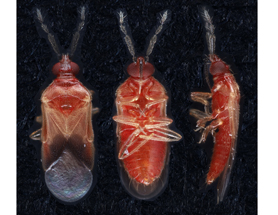

Abstract
Buchananiella whitei Reuter (Hemiptera: Anthocoridae) is a native New Zealand predator that has recently been commercialised for the biological control of various arthropod pests. However, no detailed biological information has been reported for this species. This study describes its life history, development, and some oviposition when reared on three different diets—frozen moth eggs of Ephestia kuehniella (Lepidoptera: Pyralidae); frozen mixed stages of Carpoglyphus lactis (Sarcoptiformes: Carpoglyphidae); and live mixed stages of C. lactis. All three diets supported complete development, but individuals fed live C. lactis or frozen moth eggs attained significantly larger adult body sizes than those reared on frozen C. lactis. Developmental duration, hatch rate, and survival did not differ significantly among diets. Between 15% and 23% of individuals developed through six (rather than the usual five) nymphal instars, representing the variable instar number within the Anthocoridae. Adult females were larger than males across all treatments. Oviposition occurred only when females were provided with live C. lactis, and increased markedly when relative humidity was reduced (from 80% ± 5% to 26% ± 4%), suggesting that environmental moisture strongly influences reproduction. These results support our hypotheses, demonstrating that live C. lactis is a suitable and cost-effective factitious prey for rearing B. whitei, and they provide the first detailed biological description of this species. The discovery of humidity-dependent oviposition and variable instar number highlights developmental plasticity within the Anthocoridae and offers insights for optimising mass-rearing systems and improving the use of B. whitei in New Zealand biological control programmes.
References
- Ali M. F., Mashaly A. M. A., Mohammed A. A. & El -Magd Mahmoud Mohammed A. 2011. Effect of temperature and humidity on the biology of Attagenus fasciatus (Thunberg) (Coleoptera: Dermestidae). Journal of Stored Products Research 47(1): 25–31. https://doi.org/10.1016/j.jspr.2010.07.002
- Amin M. R. & Khanjani M. 2024. Development, reproduction and survival Protogamasellopsis rhizoglyphusi and Gaeolaelaps aculeifer (Mesostigmata: Rhodacaridae, Laelapidae) feeding on two astigmatine mite prey and notes on the behavior of P. rhizoglyphusi. Systematic and Applied Acarology 29(1): 109–124.
- Archer T. L., Musick G. L. & Murray R. L. 1980. Influence of temperature and moisture on black cutworm (Lepidoptera: Noctuidae) development and reproduction. Canadian Entomologist 112(7): 665–673. https://doi.org/10.4039/Ent112665-7
- Baker B. P., Green T. A. & Loker A. J. 2020. Biological control and integrated pest management in organic and conventional systems. Biological Control 140: 104095. https://doi.org/10.1016/j.biocontrol.2019.104095
- Ballal C. R., Yamada K. & Joshi S. 2016. Morphology and biology of litter-inhabiting Buchananiella indica Muraleedharan (Hemiptera: Anthocoridae). ENTOMON 41(1): 11–20. https://doi.org/10.33307/entomon.v41i1.118
- Beretta G. M., Deere J. A., Messelink G. J., Muñoz-Cárdenas K. & Janssen A. 2022. Review: predatory soil mites as biocontrol agents of above- and below-ground plant pests. Experimental & Applied Acarology 87(2-3): 143–162. https://doi.org/10.1007/s10493-022-00723-w
- Bonte J., Van de Walle A., Conlong D. & De Clercq P. 2017. Eggs of Ephestia kuehniella and Ceratitis capitata, and motile stages of the astigmatid mites Tyrophagus putrescentiae and Carpoglyphus lactis as factitious foods for Orius spp. Insect Science 24(4): 613–622.
- Bonte M. & Clercq P. D. 2010. Impact of artificial rearing systems on the developmental and reproductive fitness of the predatory bug, Orius laevigatus. Journal of Insect Science 10(1): 104.
- Broufas G. D., Pappas M. L. & Koveos D. S. 2009. Effect of relative humidity on longevity, ovarian maturation, and egg production in the olive fruit fly (Diptera: Tephritidae). Annals of the Entomological Society of America 102(1): 70–75. https://doi.org/10.1603/008.102.0107
- Cao J., Zhang K., Li X. & Zhang Z. Q. 2025. Individual development and population growth of four phytoseiid predators feeding on Carpoglyphus lactis (Acari: Phytoseiidae, Carpoglyphidae). Systematic and Applied Acarology 30(8): 1534–1538.
- Chen X., Zhang K. & Zhang Z. 2025. Effects of variable mating opportunity, delay, and male mating experience on the lifespan, female reproductive traits, and offspring traits of Phytoseiulus persimilis (Acari: Phytoseiidae). Experimental and Applied Acarology 94(2): 33.
- Chen X. & Stansly P. A. 2014. Biology of Tamarixia radiata (Hymenoptera: Eulophidae), parasitoid of the citrus greening disease vector Diaphorina citri (Hemiptera: Psylloidea): a mini review. Florida entomologist 97(4): 1404–1413.
- Deere J. A., Beretta G. M., van Rijn P. C., Messelink G. J., Leman A. & Janssen A. 2024. Does alternative food for predatory arthropods improve biological pest control? A meta-analysis. Biological Control 198: 105605. https://doi.org/10.1016/j.biocontrol.2024.105605
- Dhileepan K. 2001. Effectiveness of introduced biocontrol insects on the weed Parthenium hysterophorus (Asteraceae) in Australia. Bulletin of Entomological Research 91(3): 167–176.
- Esperk T., Tammaru T. & Nylin S. 2007. Intraspecific variability in number of larval instars in insects. Journal of Economic Entomology 100(3): 627–645. https://doi.org/10.1603/0022-0493(2007)100[627:ivinol]2.0.co;2
- Fadamiro H. Y. & Baker T. C. 1999. Reproductive performance and longevity of female European corn borer, Ostrinia nubilalis: effects of multiple mating, delay in mating, and adult feeding. Journal of Insect Physiology 45(4): 385–392.
- Hamasaki K. & Matsui M. 2006. Development and reproduction of an aphidophagous coccinellid, Propylea japonica (Thunberg) (Coleoptera: Coccinellidae), reared on an alternative diet, Ephestia kuehniella Zeller (Lepidoptera: Pyralidae) eggs. Applied Entomology and Zoology 41(2): 233–237.
- He L., Zhao S., Ali A., Ge S. & Wu K. 2021. Ambient humidity affects development, survival, and reproduction of the invasive fall armyworm, Spodoptera frugiperda (Lepidoptera: Noctuidae), in China. Journal of Economic Entomology 114(3): 1145–1158. https://doi.org/10.1093/jee/toab056
- Herrick N. J., Cloyd R. A., Conner M. A. & Motolai G. 2021. Insidious flower bug, Orius insidiosus (Say) (Hemiptera: Anthocoridae), predation on western flower thrips, Frankliniella occidentalis (Pergande) (Thysanoptera: Thripidae), on Transvaal daisy, Gerbera jamesonii, cut flowers and chrysanthemum, Tanacetum×grandiflorum, plants under laboratory and greenhouse conditions. Biological Control 163: 104739. https://doi.org/10.1016/j.biocontrol.2021.104739
- Huynh M. P., Shelby K. S. & Coudron T. A. 2021. Recent advances in insect rearing methodology to promote scientific research and mass production. Insects 12(11): 961.
- Jaiswal D. K., Gawande S. J., Soumia P. S., Krishna R., Vaishnav A. & Ade A. B. 2022. Biocontrol strategies: an eco-smart tool for integrated pest and diseases management. BMC microbiology 22(1): 324. https://doi.org/10.1186/s12866-022-02744-2
- Jalali M. A., Tirry L. & De Clercq P. 2009. Effects of food and temperature on development, fecundity and life-table parameters of Adalia bipunctata (Coleoptera: Coccinellidae). Journal of Applied Entomology 133(8): 615–625. https://doi.org/10.1111/j.1439-0418.2009.01408.x
- Ji J., Zhang Y., Lin J., Chen X., Sun L. & Saito Y. 2015. Life histories of three predatory mites feeding upon Carpoglyphus lactis (Acari, Phytoseiidae; Carpoglyphidae). Systematic and Applied Acarology 20(5): 491–496. https://doi.org/10.11158/saa.20.5.5
- Larivière M. & Larochelle A. 2014. Checklist of the New Zealand Heteroptera (Insecta: Hemiptera): an update based on the 2004 to 2013 literature. Zootaxa 3755(4): 347–367. https://doi.org/10.11646/zootaxa.3755.4.2
- Lattin J. D. 1999. Bionomics of the Anthocoridae. Annual Review of Entomology 44(1): 207–231.
- Lenteren J. C. V. & Tommasini M. G. 2003. Mass production, storage, shipment and release of natural enemies. Quality control and production of biological control agents: theory and testing procedures (pp. 181–189). CABI Publishing. https://doi.org/10.1079/9780851996882.0181
- Levi-Mourao A., Madeira F., Meseguer R., García A. & Pons X. 2021. Effects of temperature and relative humidity on the embryonic development of Hypera postica Gyllenhal (Col.: Curculionidae). Insects 12(3): 250. https://doi.org/10.3390/insects12030250
- Li L.J. & Zhang Z.-Q. 2026. Testing biocontrol potential of an indigenous predator against an invasive pest in New Zealand: Buchananiella whitei (Hemiptera: Anthocoridae) and the tomato red spider mite Tetranychus evansi (Acari: Tetranychidae). Journal of Insect Biodiversity 78(1), 13–20. https://doi.org/10.12976/jib/2026.78.1.5
- Li X.T. & Zhang Z.-Q. 2026. Lacewings (Mallada basalis) and minute pirate bugs (Buchananiella whitei) as potential biocontrol agents of western flower thrips (Frankliniella occidentalis) in strawberries: predation on different thrips stages in no-choice and choice tests. Journal of Insect Biodiversity 78(1): 37–44. https://doi.org/10.12976/jib/2026.78.1.7
- Liu Z., Zhang K. & Zhang Z. 2024a. Enhancing the efficiency of egg collection of the astigmatid mite Carpoglyphus lactis (Acari: Carpoglyphidae) as a diet for predatory mites. Systematic and Applied Acarology 29(2): 355–358. https://doi.org/10.11158/saa.29.2.14
- Liu Z., Zhang K. & Zhang Z. 2024b. Unintended consequences: the adverse effects of royal jelly supplementation in the predatory mite Amblyseius herbicolus Chant (Acari: Phytoseiidae). Systematic and Applied Acarology 29(2): 335–345.
- Mbata G. N. 1986. Combined effect of temperature and relative humidity on mating activities and commencement of oviposition in Plodia interpunctella (Hubner) (Lepidoptera: Phycitidae). Insect Science and its Application 7(5): 623–628. https://doi.org/10.1017/S1742758400011553
- Mohaghegh J. & Amir-Maafi M. 2007. Reproduction of the predatory stinkbug Andrallus spinidens (F.) (Heteroptera: Pentatomidae) on live and frozen prey. Applied Entomology and Zoology 42(1): 15–20. https://doi.org/10.1303/aez.2007.15
- Naseer M. & Abdurahman U. C. 1990. Reproductive biology and predatory behaviour of the anthocorid bugs (Anthocoridae: Hemiptera) associated with the coconut caterpillar, Opisina arenosella (Walker). Entomon 15(3-4): 149–158.
- Navarro-Campos C., Wäckers F. L. & Pekas A. 2016. Impact of factitious foods and prey on the oviposition of the predatory mites Gaeolaelaps aculeifer and Stratiolaelaps scimitus (Acari: Laelapidae). Experimental & Applied Acarology 70(1): 69–78. https://doi.org/10.1007/s10493-016-0061-2
- Norhisham A. R., Abood F., Rita M. & Hakeem K. R. 2013. Effect of humidity on egg hatchability and reproductive biology of the bamboo borer (Dinoderus minutus Fabricius). SpringerPlus 2(1): 9. https://doi.org/10.1186/2193-1801-2-9
- Ogawa Y. & Osakabe M. 2008. Development, long-term survival, and the maintenance of fertility in Neoseiulus californicus (Acari: Phytoseiidae) reared on an artificial diet. Experimental & Applied Acarology 45(3): 123–136. https://doi.org/10.1007/s10493-008-9189-z
- Omkar S. S. & Mishra G. 2010. Multiple matings affect the reproductive performance of the aphidophagous ladybird beetle, Coelophora saucia (Coleoptera: Coccinellidae). European Journal of Entomology 107: 177–182.
- Pai A., Bennett L. & Yan G. 2005. Female multiple mating for fertility assurance in red flour beetles (Tribolium castaneum). Canadian Journal of Zoology 83(7): 913–919.
- Pakyari H., Amir-Maafi M., Moghadamfar Z. & Zalucki M. 2019. Estimating development and temperature thresholds of Ephestia kuehniella: toward improving a mass production system. Bulletin of Entomological Research 109(4): 435–442. https://doi.org/10.1017/S0007485318000718
- Parra J. R. P. & Coelho Jr A. 2022. Insect rearing techniques for biological control programs, a component of sustainable agriculture in Brazil. Insects 13(1): 105.
- Prado S., Jandricic S. & Frank S. 2015. Ecological Interactions Affecting the Efficacy of Aphidius colemani in Greenhouse Crops. Insects 6(2): 538–575. https://doi.org/10.3390/insects6020538
- R Core Team. 2024. R: A language and environment for statistical computing. [computer software]. Vienna: http://www.R-project.org/
- Rahman M. A., Sarker S., Ham E., Lee J. & Lim U. T. 2020. Development and fecundity of Orius minutus (Hemiptera: Anthocoridae) and O. laevigatus reared on Tetranychus urticae (Acari: Tetranychidae). Journal of Economic Entomology 113(4): 1735–1740.
- Riddick E. W. 2009. Benefits and limitations of factitious prey and artificial diets on life parameters of predatory beetles, bugs, and lacewings: a mini-review. BioControl 54(3): 325–339.
- Sobhy I. S., Sarhan A. A., Shoukry A. A., El-Kady G. A., Mandour, N. S. & Reitz S. R. 2010. Development, consumption rates and reproductive biology of Orius albidipennis reared on various prey. Biocontrol 55(6): 753–765.
- Song Z., Nguyen D. T., Li D. & De Clercq P. 2019. Continuous rearing of the predatory mite Neoseiulus californicus on an artificial diet. BioControl 64(2): 125–137. https://doi.org/10.1007/s10526-019-09923-7
- Tung N. D., Anh N. T. & Fang X. 2022. Effects of factitious prey on the biology and growth rate of the predatory mites Neoseiulus californicus (McGregor) (Acari: Phytoseiidae). Zoosymposia 22: 121. https://doi.org/10.11646/zoosymposia.22.1.73
- Van Lenteren J. C. 2012. The state of commercial augmentative biological control: plenty of natural enemies, but a frustrating lack of uptake. BioControl 57(1): 1–20. https://doi.org/10.1007/s10526-011-9395-1
- Wang J., Zhang K., Li L. & Zhang Z. 2024. Development and reproduction of four predatory mites (Parasitiformes: Phytoseiidae) feeding on the spider mites Tetranychus evansi and T. urticae (Trombidiformes: Tetranychidae) and the dried fruit mite Carpoglyphus lactis (Sarcoptiformes: Carpoglyphidae). Systematic and Applied Acarology 29(2): 269–284. https://doi.org/10.11158/saa.29.2.7
- Wei Y. J. 2010. Variation in the number of nymphal instars in Nysius huttoni White (Hemiptera: Lygaeidae). New Zealand Journal of Zoology 37(4): 285–296. https://doi.org/10.1080/03014223.2010.513396
- Wickham, H. 2016. ggplot2: elegant graphics for data analysis (2nd ed ed.). Springer International Publishing. 10.1007/978-3-319-24277-4
- Workman P. J. & Martin N. A. 2002. Towards integrated pest management of Thrips tabaci in onions. New Zealand Plant Protection 55: 188–192. https://doi.org/10.30843/nzpp.2002.55.3992
- Xu Y., Zhang K. & Zhang Z. 2023. Development, survival, and reproduction of Phytoseiulus persimilis Athias-Henriot (Acari: Phytoseiidae) feeding on fresh versus frozen eggs of Tetranychus urticae Koch (Acari: Tetranychidae). Acarologia 63(1): 24–30. https://doi.org/10.24349/17km-oc7u
- Yan H., Zhang B. & Li Z. P. 2022. Phenotypic plasticity of predatory mite Amblyseius orientalis in response to diet switch. Systematic and Applied Acarology 27 (6): 1098–1108.
- Yanık E. 2011. The effects of different temperatures and relative humidity on the nymphal development, mortality and prey consumption of Anthocoris nemoralis (F.) (Heteroptera: Anthocoridae). Selcuk Journal of Agriculture and Food Sciences 25(4): 21–26.
- Zhang K., Zhang Q. & Zhang Z. 2025. Fresh and frozen dried fruit mites (Carpoglyphus lactis) supported the rearing of a predatory mite Phytoseius leaki (Acari: Phytoseiidae) with specialised niche requirements. Journal of Stored Products Research 112: 102651.
- Zhang K. & Zhang Z. 2021. The dried fruit mite Carpoglyphus lactis (Acari: Carpoglyphidae) is a suitable alternative prey for Amblyseius herbicolus (Acari: Phytoseiidae). Systematic and Applied Acarology 26(11): 2167–2176. https://doi.org/10.11158/saa.26.11.15
- Zhang Q., Zhang K. & Zhang Z. 2025. Leaf trichome density influences oviposition preference in Phytoseius leaki Schicha (Acari: Phytoseiidae). Systematic and Applied Acarology 30(4): 826–830. https://doi.org/10.11158/saa.30.4.13
- Zhu R., Guo J., Yi T., Hou F. & Jin D. 2023. Potential of a winterschmidtiid prey mite for the production of the predatory mite Neoseiulus californicus (Acari: Phytoseiidae). Experimental & Applied Acarology 91(4): 571–584. https://doi.org/10.1007/s10493-023-00860-w