

Abstract
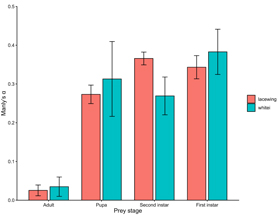
The strawberry (Fragaria × ananassa) is a significant economic crop in New Zealand, but has recently suffered substantial damage from western flower thrips (Frankliniella occidentalis), resulting in significant financial losses. This study first assessed the predation ability of two commercially available predatory insects, the green lacewing, Mallada basalis (first-instar larvae) and Buchananiella whitei (adults), on western flower thrips nymphs and adults under no-choice conditions in a laboratory setting. Next, the preferences of the two predatory insects for different life stages of the thrips were tested in the same laboratory setting under choice conditions. In no-choice test, both predator species consumed the highest number of first instar thrips nymphs, second highest the second instar thrips nymphs, and the lowest the thrips adults. In choice test, both predator species ate significantly fewer thrips adults than immature life stages; further analysis of Manly index confirmed the lowest preference for thrips adults by both predator species. This study provides the first insight into the potential of these two predatory insect species for biocontrol against western flower thrips. The potential of these two predator species in controlling western flower thrips on strawberries should be further tested in greenhouses or field plots to better understand their roles in integrated pest control systems.
References
- Ballal C. R., Gupta T. & Varshney R. 2023. The flower bugs (Anthocoridae), pp. 73–106. In: Insect Predators in Pest Management (Omkar, editor). Boca Raton, Florida, CRC Press, 332 pp.
- Chen C. C., Cheng L. L., Dong Y. J., Lu C. T., Wu W. J. & Yaninek J. S. 2014. Using the green lacewing Mallada basalis (Walker) (Neuroptera: Chrysopidae) to control Tetranychus kanzawai Kishida (Acari: Tetranychidae) on papaya in a screenhouse. Journal of Taiwan Agricultural Research 63(2): 91–104. https://doi.or/10.6156/JTAR/2014.06302.01
- Coll M. 1998. Living and feeding on plants in predatory Heteroptera, p. 89. In: Predatory Heteroptera: Their Ecology and Use in Biological Control (Moshe Coll; John R. Ruberson, editors). Lanham, Maryland, Entomological Society of America, 233 pp.
- De Clercq, P., Coudron T. A. & Riddick E. W. 2023. Production of heteropteran predators, pp. 37–69. In: Mass Production of Beneficial Organisms (Juan A. Morales-ramos, M. Guadalupe Rojas and David I. Shapiro-ilan, editors). Amsterdam, Academic Press, 742 pp.
- DeGraaf H. E. & Wood G. M. 2009. An improved method for rearing western flower thrips Frankliniella occidentalis. Florida Entomologist 92(4): 664–666. https://doi.org/10.1653/024.092.0424
- Hunter W. B. & Ullman D. E. 1989. Analysis of mouthpart movements during feeding of Frankliniella occidentalis (Pergande) and F. schultzei Trybom (Thysanoptera: Thripidae). International Journal of Insect Morphology and Embryology 18(2–3): 161–171. https://doi.org/10.1016/0020-7322(89)90024-X
- Kay M., Wobbrock J. O. & Rosenholtz R. 2021. ARTool: Aligned rank transform for nonparametric factorial ANOVAs. R Journal 13(1): 183–199. https://doi.org/10.32614/RJ-2021-047
- Lahiri S., Smith H. A., Gireesh M., Kaur G. & Montemayor J. D. 2022. Arthropod pest management in strawberry. Insects 13(5): 475. https://doi.org/10.3390/insects13050475
- Lenth R. 2023. emmeans: estimated marginal means, aka least-squares means. R package, version 1.8. 5.
- Manly B. F. J. 1974. A model for certain types of selection experiments. Biometrics 30(2): 281–294. https://doi.org/10.2307/2529649
- Mouden S., Sarmiento K. F., Klinkhamer P. G. & Leiss K. A. 2017. Integrated pest management in western flower thrips: Past, present and future. Pest Management Science 73(5): 813–822. https://doi.org/10.1002/ps.4482
- Mound L. A. & Walker A. K. 1982. Terebrantia (Insecta: Thysanoptera). Fauna of New Zealand 1: 1–113.
- Mound L.A. 2002 So many thrips - so few tospoviruses? pp 15–18. In: Thrips and Tospoviruses: Proceedings of the 7th International Symposium on Thysanoptera. (R. Marullo & L.A. Mound, editors). Canberra, Australian National Insect Collection, 386 pp.
- Mound L. A., Nielsen M. & Hastings A. 2017. Thysanoptera Aotearoa – Thrips of New Zealand. Lucidcentral.org, Identic Pty Ltd, Queensland, Australia. Available from: https://keys.lucidcentral.org/keys/v3/nz_thrips/ (accessed on 26 December 2025)
- Mouratidis A., De Lima A. P., Dicke M. & Messelink G. J. 2022. Predator-prey interactions and life history of Orius laevigatus and O. majusculus feeding on flower and leaf-inhabiting thrips. Biological Control 172: 104954. https://doi.org/10.1016/j.biocontrol.2022.104954
- Ntalia P., Broufas G. D., Wäckers F., Pekas A. & Pappas M. L. 2022. Overlooked lacewings in biological control: The brown lacewing Micromus angulatus and the green lacewing Chrysopa formosa suppress aphid populations in pepper. Journal of Applied Entomology 146(6): 796–800. https://doi.org/10.1111/jen.13019
- Panthi B. R., Renkema J. M., Lahiri S. & Liburd O. E. 2021. The short-range movement of Scirtothrips dorsalis and rate of spread of feeding injury among strawberry plants. Environmental Entomology 50(1): 12–18. https://doi.org/10.1093/ee/nvaa149
- Proteggente A. R., Pannala A. S., Paganga G., Van Buren L., Wagner E., Wiseman S., Van De Put, F., Dacombe C. & Rice-Evans C. A. 2002. The antioxidant activity of regularly consumed fruits and vegetables reflects their phenolic and vitamin C composition. Free Radical Research 36(2): 217–233. https://doi.org/10.1080/10715760290006484
- R Core Team. 2024. R: A language and environment for statistical computing. R Foundation for Statistical Computing, Vienna, Austria.
- Richardson J. 2020. Selectapref: analysis of field and laboratory foraging. R package 0.1.2. Available from: https://CRAN.R-project.org/package=selectapref (accessed on 26 December 2025)
- Salas-Aguilar J. & Ehler L. E. 1977. Feeding habits of Orius tristicolor. Annals of the Entomological Society of America 70(1): 60–62. https://doi.org/10.1093/aesa/70.1.60
- Sarkar S. C., Wang E., Zhang Z., Wu S. & Lei Z. 2019. Laboratory and glasshouse evaluation of the green lacewing, Chrysopa pallens (Neuroptera: Chrysopidae) against the western flower thrips, Frankliniella occidentalis (Thysanoptera: Thripidae). Applied Entomology and Zoology 54(1): 115–121. https://doi.org/10.1007/s13355-018-0601-9
- Shrestha G. & Enkegaard A. 2013. The green lacewing, Chrysoperla carnea: Preference between lettuce aphids, Nasonovia ribisnigri, and western flower thrips, Frankliniella occidentalis. Journal of Insect Science 13(1): 94. https://doi.org/10.1673/031.013.9401
- Strzyzewski I. L., Funderburk J. E. Renkema J. M. & Smith H. A. 2021. Characterization of Frankliniella occidentalis and Frankliniella bispinosa injury to strawberry. Journal of Economic Entomology 114(2): 794–800. https://doi.org/10.1093/jee/toaa311
- Summerfield A., Buitenhuis R., Jandricic S. & Scott-Dupree C. D. 2024. Laboratory investigations on the potential efficacy of biological control agents on two thrips species, onion thrips (Thrips tabaci Lindeman) and western flower thrips (Frankliniella occidentalis (Pergande)). Insects 15(6): 400. https://doi.org/10.3390/insects15060400
- Teulon D. A. J. & Nielsen M. C. 2005. Distribution of western (glasshouse strain) and intonsa flower thrips in New Zealand. New Zealand Plant Protection 58: 208–212. https://doi.org/10.30843/nzpp.2005.58.4274
- Timudo-Torrevilla O. E., Everett K. R., Waipara N. W., Weeds K. B. W., Langford G. I. & Walter M. 2005. Present status of strawberry fruit rot diseases in New Zealand. New Zealand Plant Protection 58: 74–79. https://doi.org/10.30843/nzpp.2005.58.4257
- Wang J., Zhang K., Li L. & Zhang Z.-Q. 2024. Development and reproduction of four predatory mites feeding on Tetranychus evansi, T. urticae, and Carpoglyphus lactis. Systematic and Applied Acarology 29(2): 269–284. https://doi.org/10.11158/saa.29.2.7
- Workman P. J. & Martin N. A. 2002. Towards integrated pest management of Thrips tabaci in onions. New Zealand Plant Protection 55: 188–192. https://doi.org/10.30843/nzpp.2002.55.3992
- Zhou J., Li Z. Y., Guan Y. X., Pan Z. P. & Chen K. W. 2021. Prey instar preference and functional responses of Mallada basalis (Walker) (Neuroptera: Chrysopidae) to different life stages of Phenacoccus solenopsis Tinsley (Hemiptera: Pseudococcidae). Journal of Asia-Pacific Entomology 24(4): 1251–1256. https://doi.org/10.1016/j.aspen.2021.08.005