

Abstract
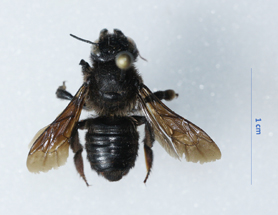
We report the rediscovery of Megachile diabolica Friese, 1898 in Italy, 76 years after its last and only known record. A single female was collected in May 2024 in the Alta Murgia National Park (Apulia, southern Italy), an area of calcareous grasslands recognized as a hotspot of Mediterranean biodiversity for insects. Morphological identification was supported by DNA barcoding, confirming the specimen’s identity with minimal divergence (0.77%) from a Turkish haplotype. The bee was observed foraging on Asyneuma limonifolium (L.) Janch, a plant species with a limited distribution in southern Italy. This finding not only confirms the occurrence of the species in Italy but also highlights the conservation value of the Alta Murgia National Park, confirming its rich pollinator community and the remarkably low extinction rates. The coexistence of open grasslands and forested patches likely provides a microhabitat mosaic that buffers pollinator populations from increasing climatic extremes.
References
Aubert M., Bonifacino M., Genoud D., Leclercq V. & Schatz B. 2024. First observations of Eucera (Cubitalia) breviceps (Friese, 1911) in Italy and France, with updated information on the distribution and ecology of the species (Hymenoptera: Anthophila: Apidae). Osmia 12: 5–18. https://doi.org/10.47446/OSMIA12.2
Ballantyne G., Baldock K.C.R., Rendellv L. & Willmer P.G. 2017. Pollinator importance networks illustrate the crucial value of bees in a highly speciose plant community. Scientific Reports 7: 8389. https://doi.org/10.1038/s41598-017-08798-x
Bonifacino M. 2021. A new species for the bee fauna of Italy: Dasypoda crassicornis (Friese, 1896) (Hymenoptera: Apoidea: Melittidae: Dasypodainae). Osmia 9: 1–6. https://doi.org/10.47446/OSMIA9.1
Bruschini C., Simbula G., Benetello F., Dell’Olmo L., Lazzaro L., Mugnai M., Paola P., Pasquali L. & Dapporto L. 2024. Micro-habitat shifts by butterflies foster conservation strategies to preserve pollinator diversity in a warming Mediterranean climate. Ecological Indicators 166: 112253. https://doi.org/10.1016/j.ecolind.2024.112253
Catania R., Nobile V. & Bella S. 2021. The species of Eucera Scopoli, subgenus Tetralonia Spinola from Sardinia (Italy) with new records and E. gennargentui sp. nov. (Hymenoptera, Apidae). Journal of Hymenoptera Research 88: 1–16. https://doi.org/10.3897/jhr.88.70819
Cole L. J., Kleijn D., Dicks L. V., Stout J. C., Potts S. G., Albrecht M., et al. 2020. A critical analysis of the potential for EU Common Agricultural Policy measures to support wild pollinators on farmland. Journal of Applied Ecology 57(4): 681–694. https://doi.org/10.1111/1365-2664.13572
Comba M. & Comba L. 2010. Gli Apoidei Apiformi del Parco Nazionale del Circeo (Hymenoptera, Apoidea). Bollettino dell’Associazione Romana di Entomologia 65: 85–434.
Conti F., Abbate G., Alessandrini A. & Blasi, C. 2005. An annotated checklist of the Italian vascular flora. Palombi Editori, Roma, 420 pp.
Cornalba M., Quaranta M., Selis M., Flaminio S., Gamba S., Mei M., Bonifacino M., et al. 2024. Exploring the hidden riches: Recent remarkable faunistic records and range extensions in the bee fauna of Italy (Hymenoptera, Apoidea, Anthophila). Biodiversity Data Journal 12: e116014. https://doi.org/10.3897/BDJ.12.e116014
Drossart M. & Gérard M. 2020. Beyond the decline of wild bees: Optimizing conservation measures and bringing together the actors. Insects 11(9): 649. https://doi.org/10.3390/insects11090649
European Commission 2013. Interpretation Manual of European Union Habitats. Nature ENV B.3, 144 p.
European Commission 2020. EU Biodiversity Strategy for 2030: Bringing nature back into our lives (COM (2020) 380 final). Available from: https://eur-lex.europa.eu/legal-content/EN/TXT/?uri=CELEX:52020DC0380 (Accessed 28 Oct. 2025)
European Parliament and the Council of the European Union 2024. Regulation (EU) 2024/1991 on the establishment of a framework for the restoration of nature. Available from: https://eur-lex.europa.eu/eli/reg/2024/1991/oj/eng (Accessed 28 Oct. 2025)
Flaminio S., Cilia G., Vella A., Quaranta M. & Lo Verde G. 2023. Melitta schmiedeknechti (Hymenoptera Apoidea, Melittidae), a new species for the fauna of Italy. Bulletin of Insectology 76(2): 315–319.
Flaminio S., Pauly A., Cilia G., Cornuel-Willermoz A., Bortolotti L. & Quaranta M. 2024. Lasioglossum inexpectatum sp. nov., a new species from Sardinia and Corsica (Hymenoptera: Apoidea: Halictidae). Osmia 12: 23–32. https://doi.org/10.47446/OSMIA12.4
Forbicioni L., Filippi L. & Strumia F. 2019. Contributo alla conoscenza degli Imenotteri Apoidei dell’Isola d’Elba. Bollettino del Museo regionale di Scienze naturali di Torino 35(1–2): 103–120.
Friese H. 1898. Species aliquot novae vel minus cognitae generis Megachile Latr. (et Chalicodoma Lep.). Természetrajzi Füzetek 21: 198–202.
Friese H. 1899. Apidae Europaeae, Band. 5: Genera Lithurgus, Megachile. Lampe, Innsbruck, 228 pp.
Gagnarli E., Simoni S., Addante R., Panzarino O., Loverre P., Mastronardi M. G., et al. 2023. The Habitat Network for Butterfly Communities of the Alta Murgia National Park (Apulia, Italy). Land 12(5): 1039. https://doi.org/10.3390/land12051039
Gamba S. & Carta E. 2021. First record of Andrena rhenana Stöckhert, 1930 in Italy (Hymenoptera: Apoidea: Andrenidae: Andreninae). Osmia 9: 51–58. https://doi.org/10.47446/OSMIA9.7
Ghisbain G., Rosa P., Bogusch P., Flaminio S., Le Divelec R., Dorchin A., et al. 2023. The new annotated checklist of the wild bees of Europe (Hymenoptera: Anthophila). Zootaxa 5327(1): 1–147. https://doi.org/10.11646/zootaxa.5327.1.1
Hartmann P. & Arens W. 1998. Beitrag zur Kenntnis der Biologie und Verbreitung der Megachile diabolica Friese1898 mit Erstbeschreibung des Männchens. Linzer biologische Beiträge 30(1): 349–364.
Hayes M. P., Ashe-Jepson E., Hitchcock G. E., Clark R., Hellon J., Knock R. I., et al. 2024. Heatwave predicts a shady future for insects: impacts of an extreme weather event on a chalk grassland in Bedfordshire, UK. Journal of Insect Conservation 28(5): 923–933. https://doi.org/10.1007/s10841-024-00556-5
Labadessa R. 2014. Updated list and community structure of Tettigonioidea and Acridoidea (Insecta: Orthoptera) of the Alta Murgia plateau (Italy). Zootaxa 3755(6): 549–560. https://doi.org/10.11646/zootaxa.3755.6.2
Labadessa R., Cagnetta G., Desaphy J. F., Bonifacino M., Dodaro G., Festa D., et al. 2021. Using occurrence data to evaluate extinction reveals a strong resilience of butterflies in a National Park of Southern Europe (Alta Murgia National Park). Journal of Insect Biodiversity 28(1): 1–12. https://doi.org/10.12976/jib/2021.28.1.1
Marselle M. R., Turbe A., Shwartz A., Bonn A. & Colléony A. 2021. Addressing behavior in pollinator conservation policies to combat the implementation gap. Conservation Biology 35(2): 610–622. https://doi.org/10.1111/cobi.13581
Moldoveanu O. C., Maggioni M. & Dani F. R. 2024. Environmental ameliorations and politics in support of pollinators. Experiences from Europe: A review. Journal of Environmental Management 362: 121219. https://doi.org/10.1016/j.jenvman.2024.121219
Nieto A., Roberts S. P. M., Kemp J., Rasmont P., Kuhlmann M., Garcia Criado M., Biesmeijer J. C., Bogusch P., Dathe H. H., et al. 2014. European red list of bees. Luxembourg Publication Office of the European Union, 98 pp.
Orr M. C., Hughes A. C., Chesters D., Pickering J., Zhu C. D. & Ascher J. S. 2021. Global patterns and drivers of bee distribution. Current Biology 31(3): 451–458. https://doi.org/10.1016/j.cub.2020.10.053
Orsenigo S., Fenu G., Gargano D., Montagnani C., Abeli T., Alessandrini A., et al. 2021. Red list of threatened vascular plants in Italy. Plant Biosystems-An International Journal Dealing with all Aspects of Plant Biology 155(2): 310–335. https://doi.org/10.1080/11263504.2020.1739165
Perrino E. V., Wagensommer R. P. & Medagli P. 2012. Schede per una Lista Rossa della Flora vascolare e crittogamica Italiana: Asyneuma limonifolium (L.) Janch. subsp. limonifolium. Informatore Botanico Italiano 44(2): 414–416.
Piatti C. & Ricciardelli D’Albore G. 2006. Gli Apoidei, (partim) (Hymenoptera, Aculeata) nel Parco Nazionale dei Monti Sibillini. Bollettino del Laboratorio di Entomologia Agraria di Portici “Filippo Silvestri” 71: 79–146.
Pittioni B. 1953. Eine Bienenausbeute aus Apulien (Hym., Apoidea). Memorie di Biogeografia Adriatica 2: 49–62.
Praz C. J. 2017. Subgeneric classification and biology of the leafcutter and dauber bees (genus Megachile Latreille) of the western Palearctic (Hymenoptera, Apoidea, Megachilidae). Journal of Hymenoptera Research 55: 1–54. https://doi.org/10.3897/jhr.55.11255
Praz C., Tourbez C., Le Maire S., Santerre R., Benrezkallah J., Radchenko V., Devalez J., Flaminio S., Paukkunen J. & Ortiz Sánchez F. J. 2025. Megachile diabolica (Europe assessment). The IUCN Red List of Threatened Species 2025: e.T19199304A222156850. (Accessed 29 Oct. 2025)
Quaranta M., Cornalba M., Biella P., Comba M., Battistoni A., Rondinini C., Teofili C. 2018. Lista Rossa IUCN delle api italiane minacciate. Comitato Italiano IUCN e Ministero dell’Ambiente e della Tutela del Territorio e del Mare, Roma, 68 pp.
Reverté S., Miličić M., Ačanski J., Andrić A., Aracil A., Aubert M., et al. 2023. National records of 3000 European bee and hoverfly species: A contribution to pollinator conservation. Insect Conservation and Diversity 16(6): 758–775. https://doi.org/10.1111/icad.12680
Rosa P. & Pagliano G. 2015. Hymenoptera (Insecta) raccolti nel Parco del Ticino e nei suoi dintorni (Piemonte, Lombardia). Bollettino del Museo Regionale di Scienze Naturali di Torino 32(1–2): 55–124.
Tarantino C., De Lucia M., Zollo L., Dell’Aglio M., Adamo M., & Labadessa R. 2025. Combination of GEOBIA and data-driven approach for grassland habitat mapping in the Alta Murgia National Park. Science of Remote Sensing 11: 100214. https://doi.org/10.1016/j.srs.2025.100214
Trunz V., Packer L., Vieu J., Arrigo N. & Praz C. J. 2016. Comprehensive phylogeny, biogeography and new classification of the diverse bee tribe Megachilini: Can we use DNA barcodes in phylogenies of large genera? Molecular Phylogenetics and Evolution 103: 245–259. https://doi.org/10.1016/j.ympev.2016.07.004
Van Swaay C., Warren M., Ellis S., Clay J., Bellotto V., Allen D.J. & Trottet A. 2025. Measuring the pulse of European biodiversity. European Red List of Butterflies. European Commission, Brussels, 93 pp. https://doi.org/10.2779/935927
Van Tongeren E., Sistri G., Bonifacino M., Menchetti M., Pasquali L., Salvati V., et al. 2023. Unstructured citizen science reduces the perception of butterfly local extinctions: the interplay between species traits and user effort. Biodiversity and Conservation 32(14): 4701–4718. https://doi.org/10.1007/s10531-023-02721-9
Willmer P.G., Cunnold H. & Ballantyne G. 2017. Insights from measuring pollen deposition: quantifying the pre-eminence of bees as flower visitors and effective pollinators. Arthropod-Plant Interactions 11(3): 411–425. https://doi.org/10.1007/s11829-017-9528-2