

Abstract
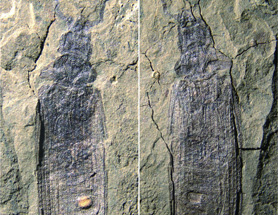
Cupedidae is the most species-rich family within the extinct beetle suborder Archostemata, noted for its abundance, diversity, and broad geographic distribution in the Mesozoic. Although archostematans are relatively common in the Jehol Biota of northeastern China, most records to date have been recovered from the Yixian Formation. In this study, we report a new cupedid beetle fossil from the Jiufotang Formation. The new species, Apriacma acoronata sp. nov., is characterized by an elongate body; long antennae with the pedicel distinctly shorter than the other antennomeres; large, flattened mandibles; a subrectangular prothorax slightly wider than the head, with gently curved lateral margins and lacking anterior corners; and distinctly stout profemora. This discovery constitutes the first record of Archostemata from the Jiufotang Formation, extending the stratigraphic and geographic distribution of cupedid beetles within the Jehol Biota, and contributes to our understanding of archostematan persistence and diversity in Early Cretaceous lacustrine ecosystems.
References
- Cai C. Y. & Huang D. Y. 2017. Omma daxishanense sp. nov., a fossil representative of an extant Australian endemic genus recorded from the Late Jurassic of China (Coleoptera: Ommatidae). Alcheringa: An Australasian Journal of Palaeontology 41: 277–283. https://doi.org/10.1080/03115518.2016.1225251
- Cai C. Y., Tihelka E., Giacomelli M., Lawrence J. F., Ślipiński A., Kundrata R., Yamamoto S., Thayer M. K., Newton A. F., Leschen R. A. B., Gimmel M. L., Lü L., Engel M. S., Bouchard P., Huang D. Y., Pisani D. & Donoghue P. C. J. 2022. Integrated phylogenomics and fossil data illuminate the evolution of beetles. Royal Society Open Science 9: 211771. https://doi.org/10.1098/rsos.211771
- Chen P. J. 1988. Distribution and migration of the Jehol Fauna with reference to non-marine Jurassic-Cretaceous boundary in China. Acta Palaeontologica Sinica 27: 659–683. [in Chinese]
- Chen Y. Y., Li X. B., Teng F. F., Chen J. & Reisz R. R. 2023. Micro-XRF mapping study on the taphonomy of a Jurassic larval salamander fossil from Inner Mongolia of China. Atomic Spectroscopy 44(1): 24–31. https://doi.org/10.46770/as.2023.016
- Chiappe L. M. & Meng Q. 2016. Birds of Stone: Chinese Avian Fossils from the Age of Dinosaurs. Johns Hopkins University Press, Baltimore, 304 pp.
- Colombo M., Lehmann T., Ensinger W. & Rossi V. 2025. Application of mobile-macroscale scanning X-ray fluorescence (mobile-MA-XRF) imaging in paleontology: analyses of vertebrate fossil specimens from Messel conserved in different solid and liquid media. Journal of Analytical Atomic Spectrometry 40(4): 989–1005. https://doi.org/10.1039/d5ja90001f
- Crowson R. A. 1962. Observations on the beetle family Cupedidae, with descriptions of two new forms and a key to the recent genera. Annals and Magazine of Natural History 13: 147–157.
- Eggleton P. 2020. The state of the world’s insects. Annual Review of Environment and Resources 45: 61–82. https://doi.org/10.1146/annurev-environ-012420-050035
- Friedrich F., Farrell B. D. & Beutel R. G. 2009. The thoracic morphology of Archostemata and the relationships of the extant suborders of Coleoptera (Hexapoda). Cladistics 25: 1–37.
- Gui S. M., Gao S., Liu Y. C., Chu D. L., Dal Corso J., Tong J. N. & Tian L. 2024. The rise of modern-type entomofauna in the Triassic. Journal of Insect Biodiversity 60(1): 64–74. https://doi.org/10.12976/jib/2024.60.1.10
- Hong Y. C. 1998. Establishment of fossil entomofaunas and their evolutionary succession in North China. Insect Science 5(4): 283–300. https://doi.org/10.1111/j.1744-7917.1998.tb00324.x
- Hörnschemeyer T. 2016. Archostemata Kolbe, 1908, pp. 41–61. In: Beutel R. G. & Leschen R. A. (Eds.), Handbook of Zoology, Arthropoda: Insecta, Coleoptera, beetles, Vol.1: morphology and systematics (Archostemata, Adephaga, Myxophaga, Polyphaga partim), Second Edition. Walter de Gruyter, Berlin. https://doi.org/10.1515/9783110373929-008
- Jarzembowski E. A., Wang B. & Zheng D. R. 2020. An archaic-beetle ‘jaws’ from mid-Cretaceous Burmese amber (Coleoptera: Archostemata). Proceedings of the Geologists' Association 131: 155–159. https://doi.org/10.1016/j.pgeola.2020.02.003
- Kirejtshuk A. G., Nel A. & Kirejtshuk P. A. 2016. Taxonomy of the reticulate beetles of the subfamily Cupedinae (Coleoptera: Archostemata), with a review of the historical development. Invertebrate Zoology 13(2): 61–190. https://doi.org/10.15298/invertzool.13.2.01
- Li S. Z. 1996. Lithostratigraphy of Hebei Province. China University of Geosciences Press, Wuhan, 146 pp.
- Li Y. D., Liu Z. H., Jarzembowski E. A., Yin Z. W., Huang D. Y. & Cai C. Y. 2019. Early evolution of Cupedidae revealed by a mid‐Cretaceous reticulated beetle from Myanmar (Coleoptera: Archostemata). Systematic Entomology 44(4): 777–786. https://doi.org/10.1111/syen.12355
- Li Y. D., Tihelka E., Yamamoto S., Newton A. F., Xia F. Y., Liu Y., Huang D. Y. & Cai C. Y. 2023. Mesozoic Notocupes revealed as the sister group of Cupedidae (Coleoptera: Archostemata). Frontiers in Ecology and Evolution 11: 1015627. https://doi.org/10.3389/fevo.2023.1015627
- Liu Y. C., Ji Q., Wang X. R., Yang J., O’Connor J. K., Guo B., Ren T. L., Yin T. T. & Wang Y. B. 2024. Micro-XRF map** elucidates the taphonomy of two early cretaceous Paravian fossils from Western Liaoning, China. Atomic Spectroscopy 45(2): 123–131. https://doi.org/10.46770/as.2024.002
- Meng J. 2014. Mesozoic mammals of China: Implications for phylogeny and early evolution of mammals. National Science Review 1: 521–542. https://doi.org/10.1093/nsr/nwu070
- Norell M. A. & Xu X. 2005. Feathered dinosaurs. Annual Review of Earth and Planetary Sciences 33: 277–299. https://doi.org/10.1146/annurev.earth.33.092203.122511
- Pan Y. H., Sha J. G., Zhou Z. H. & Fürsich F. T. 2013. The Jehol Biota: definition and distribution of exceptionally preserved relicts of a continental Early Cretaceous ecosystem. Cretaceous Research 44: 30–38. https://doi.org/10.1016/j.cretres.2013.03.007
- Qin Z. H., Xi D. P., Shi Z. Y. & Wan X. Q. 2023. Ostracod biostratigraphy of Lower Cretaceous lacustrine sequences in northern Hebei, North China: A revision. Cretaceous Research 141: 105340. https://doi.org/10.1016/j.cretres.2022.105340
- Qin Z. H., Xi D. P., Yu Z. Q., Shi Z. Y. & Wan X. Q. 2022. Biotic response to Early Cretaceous climate warming in Hebei, northern China: Implications for the phased development of the Jehol Biota. Palaeogeography, Palaeoclimatology, Palaeoecology 601: 111097. https://doi.org/10.1016/j.palaeo.2022.111097
- Regional Geological and Mineral Survey Institute of Hebei Province. 1996. 1:50,000 Regional Geological Survey Report for the Xilongtou, Guandi, and Sujiadian Sheets. [in Chinese]
- Regional Geological Survey Institute of Hebei Province. 2024. Hebei Regional Geological Outline. China University of Geosciences Press, Wuhan, 277 pp. [in Chinese]
- Ren D., Lu L. W., Ji S. A. & Guo Z. G. 1995. Faunae and Stratigraphy of Jurassic-Cretaceous in Beijing and the Adjacent Areas. Seismic Publishing House, Beijing, 222 pp.
- Ren D., Lu L. W., Ji S. A., Guo Z. G., Yin J. C. & Han Y. J. 1996. Late Mesozoic fauna assemblages of Yanliao area, North China, and its paleoecological and paleogeographical significance. Acta Geoscientia Sinica 17(z1): 148–154. [in Chinese]
- Ren D., Shi Z. G., Gao T. P. Wang Y. J. & Yao Y. Z. 2024. The Rhythm of Insect Evolution: Evidence from the Jurassic and Cretaceous of Northern China. Henan Science and Technology Press, Zhengzhou, 872pp. [in Chinese]
- Ren D., Shih C. K., Gao T. P., Yao Y. Z. & Wang Y. J. 2010. Silent stories–Insect Fossil Treasures from Dinosaur Era of the Northeastern China. Science Press, Beijing, 332 pp.
- Ren D., Shih C., Gao T., Wang Y. & Yao Y. 2019. Rhythms of Insect Evolution: Evidence from the Jurassic and Cretaceous in Northern China. John Wiley & Sons, New Jersey, 707 pp.
- Shao T., Zhang H., Wang Q., Liu Y. & Zhang Y. 2017. A Mesozoic Pompeii: History of the Jehol Biota's rise and fall. Acta Geologica Sinica-English Edition 91(5): 1893–1903. https://doi.org/10.1111/1755-6724.13418
- Soriano C. & Delclòs X. 2006. New cupedid beetles from the Lower Cretaceous of Spain and the palaeogeography of the family. Acta Palaeontologica Polonica 51: 185–200.
- Tan J. J., Ren D. & Shih C. K. 2006. First record of fossil Priacma Coleoptera: Archostemata: Cupedidae) from the Jehol biota of western Liaoning, China. Zootaxa 1326(1): 55–68. https://doi.org/10.5281/zenodo.174106
- Yu Z. Q., Wang M., Li Y. J., Deng C. L. & He H. Y. 2021. New geochronological constraints for the Lower Cretaceous Jiufotang Formation in Jianchang Basin, NE China, and their implications for the late Jehol Biota. Palaeogeography, Palaeoclimatology, Palaeoecology 583: 110657. https://doi.org/10.1016/j.palaeo.2021.110657
- Zhang H. C., Wang B. & Fang Y. 2010. Evolution of insect diversity in the Jehol Biota. Science China Earth Sciences 53(12): 1908–1917. https://doi.org/10.1007/s11430-010-4098-5
- Zhang M. M., Chen Y. Y., Zhang J. Y. & Chen P. F. 2001. Fish fossils and stupendous changes. Bulletin of Chinese Academy of Sciences 16(1): 39–43. [in Chinese]
- Zhang Q. Q., Chen J., Wang Y. L., Zhang L. J. & Zhang H. C. 2024. A new procercopid froghopper (Hemiptera: Cicadomorpha: Procercopidae) from the Lower Cretaceous Jiufotang Formation, western Liaoning Province, NE China. Historical Biology 37(9): 2026–2031. https://doi.org/10.1080/08912963.2024.2368573
- Zhou Z. H. & Wang Y. 2017. Vertebrate assemblages of the Jurassic Yanliao Biota and the Early Cretaceous Jehol Biota: Comparisons and implications. Palaeoworld 26: 241–252. https://doi.org/10.1016/j.palwor.2017.01.002
- Zhou Z. H. 2014. The Jehol Biota, an Early Cretaceous terrestrial Lagerstätte: new discoveries and implications. National Science Review 1(4): 543–559. https://doi.org/10.1093/nsr/nwu055
- Zhou Z. H., Barrett P. M. & Hilton J. 2003. An exceptionally preserved Lower Cretaceous ecosystem. Nature 421: 807–814. https://doi.org/10.1038/nature01420
- Zhou Z. H., Meng Q. R., Zhu R. X. & Wang M. 2021. Spatiotemporal evolution of the Jehol Biota: Responses to the North China craton destruction in the Early Cretaceous. Proceedings of the National Academy of Sciences 118(34): e2107859118. https://doi.org/10.1073/pnas.2107859118