

Abstract
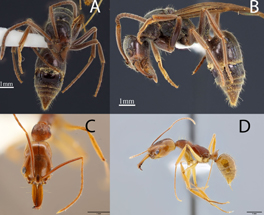
Hunter ants are among top invertebrate predators in tropical forests and play a key role in regulating invertebrate populations. This study documents new records of Ectatomminae and Ponerinae ants in the Colombian Amazon Basin. We provide the first country record of the genus and species Corrieopone nouragues, as well as new country records for ten other species: Alfaria simulans, Poneracantha mediatrix, Odontomachus allolabis, O. chicomendesi, O. davidsoni, O. ruginodis (sensu França et al. 2024), O. spissus, Pachycondyla procidua, Typhlomyrmex meire, and Simopelta anomma. Taxonomic notes are included for five species: Holcoponera auricula, H. dichotoma, Typhlomyrmex major, Odontomachus bauri, and O. ruginodis. An updated modified key is provided for species of Typhlomyrmex, along with the first photographs of the types of H. auricula and H. dichotoma, as well as the description of the queen of O. mormo.
References
Abadía J. C., Bermúdez C., Lozano-Zambrano F. & Chacón P. 2010. Hormigas cazadoras en un paisaje subandino de Colombia: riqueza, composición y especies indicadoras. Revista Colombiana de Entomología 36(1): 127–134.
Agudelo Martínez J. C. & Pérez-Buitrago N. 2017. New records of hunting ants (Poneroids and Ectatomminoids) in the northern part of the Colombian Orinoquia region. Arxius de Miscel·lània Zoològica 15: 229–248.
Andrade-Silva J., Baccaro F. B., Prado L. P., Guénard B., Warren D. L., Kass J. M., Economo E. P. & Silva R. R. 2022. A large-scale assessment of ant diversity across the Brazilian Amazon Basin: integrating geographic, ecological and morphological drivers of sampling bias. Ecography 2022(9): e06295. https://doi.org/10.1111/ecog.06295
Arredondo B. S., Carreño-Guevara Y., Gutiérrez-Villanueva Y., Duran-Bautista E. H., Gamboa-Tabares J. & Guerrero R. J. 2025. Soil and leaf litter ants from the Amazon Region offer new distribution records for Colombia. Biodiversity Data Journal 13: e142813. https://doi.org/10.3897/BDJ.13.e142813
Basset Y., L. Cizek, P. Cuenoud, R. K. Didham, F. Guilhaumon, O. Missa, V. Novotny, F. Odegaards, T. Roslin, J. Schmidl et al. 2012. Arthropod diversity in a tropical forest. Science 338(6113): 1481–1484. [Panama].
Bini L. M., Diniz-Filho J. A. F., Rangel T. F. L. V. B., Bastos R. P. & Pinto M. P. 2006. Challenging Wallacean and Linnean shortfalls: knowledge gradients and conservation planning in a biodiversity hotspot. Diversity and Distributions 12: 475–482.
Branstetter M. G. & Longino J. T. 2022. UCE phylogenomics of New World Cryptopone (Hymenoptera: Formicidae) elucidates genus boundaries, species boundaries, and the vicariant history of a temperate–tropical disjunction. Insect Systematics and Diversity 6: ixab031. https://doi.org/10.1093/isd/ixab031
Brown W. L. 1965. Contributions to a reclassification of the Formicidae. IV. Tribe Typhlomyrmecini (Hymenoptera). Psyche 72: 65–78.
Camacho G. P., Franco W., Branstetter M. G., Pie M. R., Longino J. T., Schultz T. R. & Feitosa R. M. 2022. UCE phylogenomics resolves major relationships among ectaheteromorph ants (Hymenoptera: Formicidae: Ectatomminae, Heteroponerinae): a new classification for the subfamilies and the description of a new genus. Insect Systematics and Diversity 6: 5.
Camacho G. P., Franco W. & Feitosa R. M. 2020. Additions to the taxonomy of Gnamptogenys Roger (Hymenoptera: Formicidae: Ectatomminae) with an updated key to the New World species. Zootaxa 4747(3): 450–476. https://doi.org/10.11646/zootaxa.4747.3.2
Castro D., Fernández F., Meneses A. D., Tocora M. C., Sanchez S. & Peña-Venegas C. P. 2018. A preliminary checklist of soil ants (Hymenoptera: Formicidae) of Colombian Amazon. Biodiversity Data Journal 6: e29278. https://doi.org/10.3897/BDJ.6.e29278
Ferreira T. & Rasband W. 2012. ImageJ User Guide. Available from: http://imagej.nih.gov/ij/docs/guide (accessed on 16/04/2026)
Fernandes I. O. & Delabie J. H. C. 2019. A new species of Cryptopone Emery (Hymenoptera: Formicidae: Ponerinae) from Brazil with observations of this genus and a key for New World species. Sociobiology 66: 408–413.
Fernandes I. O., Souza J. L. P., Fernández F. & Delabie J. H. C. 2015. A new species of Simopelta (Hymenoptera: Formicidae: Ponerinae) from Brazil and Costa Rica. Zootaxa 3956: 295–300.
Fernandes I. O., Larabee F. J., Oliveira M. L., Delabie J. H. C. & Schultz T. R. 2021. A global phylogenetic analysis of trap-jaw ants, Anochetus Mayr and Odontomachus Latreille (Hymenoptera: Formicidae: Ponerinae). Systematic Entomology 46(3): 685–703. https://doi.org/10.1111/syen.12483
Fernández F. 1991. Las hormigas cazadoras del género Ectatomma (Formicidae: Ponerinae) en Colombia. Caldasia 79: 551–564.
Fernández F., Fiorentino G. & Castro D. 2023. A new species of Typhlomyrmex from Colombia, re-description of the worker of T. clavicornis Emery, description of the worker of T. prolatus Brown, and key of known species (Hymenoptera: Formicidae). Journal of Hymenoptera Research 96: 579–597.
Fernández F., Guerrero Flórez R. J. & Delsinne T. 2019. Hormigas de Colombia. Universidad Nacional de Colombia, Bogotá D.C 1198 pp.
França E. C. B., Fernandes I. O. & Lattke J. E. 2024. Looking at upside-down ants: taxonomic revision of the Neotropical species of Odontomachus Latreille, 1804 (Hymenoptera: Formicidae: Ponerinae). Zootaxa 5502: 1–166.
Guénard B., Weiser M. D., Gómez K., Narula N. & Economo E. P. 2017. The Global Ant Biodiversity Informatics (GABI) database: synthesizing data on the geographic distribution of ant species (Hymenoptera: Formicidae). Myrmecological News 24: 83–89.
Herrera-Rangel E., Jiménez-Carmona I. & Armbrecht I. 2015. Monitoring the diversity of hunting ants (Hymenoptera: Formicidae) on a fragmented and restored Andean landscape. Environmental Entomology 44(5): 1287–1298. https://doi.org/10.1093/ee/nvv103
Hortal J., de Bello F., Diniz-Filho J. A. F., Lewinsohn T. M., Lobo J. M. & Ladle R. J. 2015. Seven shortfalls that beset large-scale knowledge of biodiversity. Annual Review of Ecology, Evolution, and Systematics 46: 523–549. https://doi.org/10.1146/annurev-ecolsys-112414-054400
Houadria M. & Menzel F. 2021. Digging deeper into the ecology of subterranean ants: diversity and niche partitioning across two continents. Diversity 13(2): 53. https://doi.org/10.3390/d13020053
Janicki J., Narula N., Ziegler M., Guénard B. & Economo E. P. 2016. Visualizing and interacting with large-volume biodiversity data using client–server web-mapping applications: the design and implementation of antmaps.org. Ecological Informatics 32: 185–194. https://doi.org/10.1016/j.ecoinf.2016.02.003
Jiménez E., Fernández F., Arias T. M. & Lozano-Zambrano F. H. 2008. Sistemática, biogeografía y conservación de las hormigas cazadoras de Colombia. Instituto Alexander von Humboldt, Bogotá D.C.
Lacau S., Villemant C. & Delabie J. H. C. 2004. Typhlomyrmex meire, a remarkable new species endemic to Southern Bahia, Brazil (Formicidae: Ectatomminae). Zootaxa 678: 1–23.
Lacau S., Villemant C., Jahyny B. & Delabie J. H. C. 2008. Typhlomyrmex Mayr, 1862: un genre méconnu de petites fourmis cryptiques et prédatrices (Ectatomminae: Typhlomyrmecini), pp. 241–283. In: Sistemática, biogeografía y conservación de las hormigas cazadoras de Colombia (E. Jiménez, F. Fernández, T. M. Arias-Penna & F. H. Lozano-Zambrano, editors). Instituto Alexander von Humboldt, Bogotá D.C.
Ladino N., Jiménez-C E. & Yara-O C. 2018. Hormigas poneroides y ectatomminas (Hymenoptera: Formicidae) en fragmentos boscosos del piedemonte llanero y altillanura del Meta, Colombia. Caldasia 40: 310–320.
Lattke J. E. 2008. Género Gnamptogenys Roger, pp. 66–100. In: Sistemática, biogeografía y conservación de las hormigas cazadoras de Colombia (E. Jiménez, F. Fernández, T. M. Arias-Penna & F. H. Lozano-Zambrano, editors). Instituto Alexander von Humboldt, Bogotá D.C.
Lattke J. E., Fernández F. & Palacio E. E. 2007. Identification of the species of Gnamptogenys Roger in the Americas, pp. 254–270. In: Advances in Ant Systematics (Hymenoptera: Formicidae): Homage to E. O. Wilson – 50 Years of Contributions (R. R. Snelling, B. L. Fisher & P. S. Ward, editors). Memoirs of the American Entomological Institute 80.
Leponce M., Fernández F., Neto E. A. S., Drescher J., Schmidl J., Basset Y., Neita J., Villemant C., Aristizabal-Botero Á. & Delabie J. H. C. 2025. Outstanding ant diversity in large old tropical trees along the Andean Amazon gradient: insights from the Life on Trees program. Oral presentation, XXVII Simpósio de Mirmecologia: An International Ant Meeting, Recife, Brazil.
Longino J. T. & Branstetter M. G. 2020. Phylogenomic species delimitation, taxonomy, and “bird guide” identification for the Neotropical ant genus Rasopone (Hymenoptera: Formicidae). Insect Systematics and Diversity 4: 1–33.
Mackay W. P. & Mackay E. E. 2010. The systematics and biology of the New World ants of the genus Pachycondyla (Hymenoptera: Formicidae). Edwin Mellen Press, Lewiston.
Moret P., Arenas-Clavijo A. & López-Victoria M. 2023. Description of a highly modified endemic ground beetle (Coleoptera: Carabidae) from the oceanic island of Malpelo, Colombia. Taxonomy 3(4): 496–508. https://doi.org/10.3390/taxonomy3040028
Olivero D. Y., Guerrero R. J. & Escárraga M. E. 2009. Claves taxonómicas para las hormigas cazadoras (Hymenoptera: Formicidae: Ponerinae s.str., Ectatomminae, Heteroponerinae) de la Sierra Nevada de Santa Marta, Colombia. Intropica 4(1): 17–28.
Ryder Wilkie K. T., Mertl A. L. & Traniello J. F. A. 2007. Biodiversity below ground: probing the subterranean ant fauna of Amazonia. Naturwissenschaften 94(9): 725–731. https://doi.org/10.1007/s00114-007-0250-2
Ryder Wilkie K. T., Mertl A. L. & Traniello J. F. A. 2010. Species diversity and distribution patterns of the ants of Amazonian Ecuador. PLoS ONE 5: e13146. https://doi.org/10.1371/journal.pone.0013146
Sanabria-Blandón M. C. & de Ulloa P. C. 2011. Hormigas cazadoras en sistemas productivos del piedemonte amazónico colombiano: diversidad y especies indicadoras. Acta Amazonica 41: 503–512.
Santschi F. 1923. Solenopsis et autres fourmis néotropicales. Revue Suisse de Zoologie 30: 173–245.
Whittaker R. J., Araújo M. B., Jepson P., Ladle R. J., Watson J. E. M. & Willis K. J. 2005. Conservation biogeography: assessment and prospect. Diversity and Distributions 11(1): 3–23. https://doi.org/10.1111/j.1366-9516.2005.00143.x
Wong M. K. L. & Guénard B. 2017. Subterranean ants: summary and perspectives on field sampling methods, with notes on diversity and ecology (Hymenoptera: Formicidae). Myrmecological News 25: 1–16. https://doi.org/10.25849/myrmecol.news_025:001
Yara-O C. & Reinoso F. G. 2012. Hormigas cazadoras (Ectatomminae y Ponerinae) en fragmentos de bosque seco y sus matrices (Tolima, Colombia). Revista Colombiana de Entomología 38: 329–337.