

Abstract
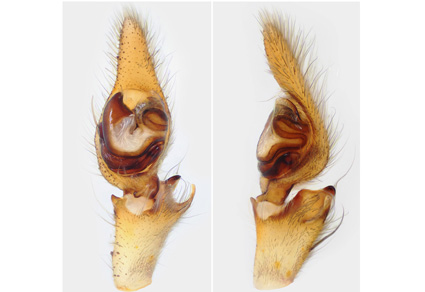
The nursery web spider Tinus ursus Carico, 1976 was originally described based on female specimens from Costa Rica. In this study, we describe for the first time the male of the species, providing the first records from Colombia, and documenting its sexual behavior, including courtship and nuptial gift production. The previously unknown male palp revealed a unique combination of characters that prompted us to reassess the phylogenetic placement of T. ursus using morphological, behavioral and molecular evidence. Our analyses demonstrate that T. ursus does not belong to Tinus F. O. Pickard-Cambridge, 1901, but instead forms a distinct lineage sister to the clade comprising Tinus and Thaumasia Perty, 1833. In light of these results, we transfer the species to a new monotypic genus, Dobarakuku gen. nov., designating Dobarakuku ursus (Carico, 1976) comb. nov. as the type species. In addition, we recognize Thaumasiinae Petrunkevitch, 1928 as comprising four genera: Architis Simon, 1898a, Dobarakuku gen. nov., Thaumasia, and Tinus. The proximal tegular projection may constitute a potential morphological synapomorphy of Thaumasiinae, secondarily lost in Architis. Dobarakuku gen. nov. differs from all other Neotropical Pisauridae genera by a unique combination of characters, including a narrow distal tegular projection, vestigial median apophysis, laminar hyaline conductor, stout embolus, and a pair of oval atria in the epigynum. The courtship behavior of D. ursus comb. nov. resembles that of other Pisauridae species, and the production of nuptial gifts makes it the sixth species in the family known to exhibit this behavior.
References
- Álvarez-Padilla, F. & Hormiga, G. (2007) A protocol for digesting internal soft tissues and mounting spiders for scanning electron microscopy. Journal of Arachnology, 35 (3), 538–542. https://doi.org/10.1636/Sh06-55.1
- Albo, M.J., Costa‐Schmidt, L.E. & Costa, F.G. (2009) To feed or to wrap? Female silk cues elicit male nuptial gift construction in a semiaquatic trechaleid spider. Journal of Zoology, 277 (4), 284–290. https://doi.org/10.1111/j.1469-7998.2008.00539.x
- Albo, M.J., Melo-González, V., Carballo, M., Baldenegro, F., Trillo, M.C. & Costa, F.G. (2014a) Evolution of worthless gifts is favoured by male condition and prey access in spiders. Animal Behaviour, 92, 25–31. https://doi.org/10.1016/j.anbehav.2014.03.018
- Albo, M.J., Toft, S. & Bilde, T. (2014b) Sexual selection, ecology, and evolution of nuptial gifts in spiders. In: Macedo, R.H. & Machado, G. (Eds.), Sexual Selection: Perspectives and Models from the Neotropics. Academic Press, London, pp. 183–200. https://doi.org/10.1016/B978-0-12-416028-6.00007-4
- Albo, M.J., Bidegaray-Batista, L., Bechsgaard, J., da Silva, E.L.C., Bilde, T. & Pérez-Miles, F. (2017) Molecular phylogenetic analyses show that Trechaleidae and Lycosidae are sister groups. Arachnology, 17 (4), 169–176. https://doi.org/10.13156/arac.2017.17.4.169
- Bishop, S.C. (1924) A revision of the Pisauridae of the United States. New York State Museum Bulletin, 252, 1–140.
- Bösenberg, W. & Strand, E. (1906) Japanische Spinnen. Abhandlungen der Senckenbergischen Naturforschenden Gesellschaft, 30, 93–422.
- Bristowe, W.S. (1958) The World of Spiders. Collins, London, xiii + 304 pp.
- Bristowe, W.S. & Locket, G.H. (1926) The courtship of British lycosid spiders, and its probable significance. Proceedings of the Zoological Society of London, 96 (1), 317–347. https://doi.org/10.1111/j.1096-3642.1926.tb01551.x
- Carico, J.E. (1976) The spider genus Tinus (Pisauridae). Psyche: A Journal of Entomology, 83 (1), 63–78. https://doi.org/10.1155/1976/79585
- Carico, J.E. (2008) A new species of Tinus (Araneae, Lycosoidea, Pisauridae) from Mexico. Journal of Arachnology, 36 (1), 173–175. https://doi.org/10.1636/h07-25sc.1
- Chamberlin, R.V. & Ivie, W. (1936) New spiders from Mexico and Panama. Bulletin of the University of Utah, 27 (5), 1–103.
- Clerck, C. (1757) Aranei Svecici. Svenska spindlar, uti sina hufvud-slågter indelte samt under några och sextio särskildte arter beskrefne och med illuminerade figurer uplyste. Laurentius Salvius, Stockholmiae, 154 pp. https://doi.org/10.5962/bhl.title.119890
- Costa-Schmidt, L.E., Carico, J.E. & de Araújo, A.M. (2008) Nuptial gifts and sexual behavior in two species of spider (Araneae, Trechaleidae, Paratrechalea). Naturwissenschaften, 95, 731–739. https://doi.org/10.1007/s00114-008-0379-7
- Ewing, B. & Green, P. (1998) Base-calling of automated sequencer traces using Phred II. Error probabilities. Genome Research, 8, 186–194. https://doi.org/10.1101/gr.8.3.186
- Goloboff, P.A. & Morales, M.E. (2023) TNT version 1.6, with a graphical interface for MacOS and Linux, including new routines in parallel. Cladistics, 39 (2), 144–153. https://doi.org/10.1111/cla.12524
- Gordon, D., Abajian, C. & Green, P. (1998) Consed: a graphical tool for sequence finishing. Genome Research, 8, 195–202. https://doi.org/10.1101/gr.8.3.195
- Gordon, D., Desmarais, C. & Green, P. (2001) Automated finishing with autofinish. Genome Research, 11, 614–625. https://doi.org/10.1101/gr.171401
- Guindon, S., Dufayard, J.F., Lefort, V., Anisimova, M., Hordijk, W. & Gascuel, O. (2010) New algorithms and methods to estimate maximum-likelihood phylogenies: assessing the performance of PhyML 3.0. Systematic biology, 59 (3), 307–321. https://doi.org/10.1093/sysbio/syq010
- Hazzi, N.A. & Hormiga, G. (2023) Molecular phylogeny of the tropical wandering spiders (Araneae, Ctenidae) and the evolution of eye conformation in the RTA clade. Cladistics, 39 (1), 18–42. https://doi.org/10.1111/cla.12518
- Hoang, D.T., Chernomor, O., Von Haeseler, A., Minh, B.Q. & Vinh, L.S. (2018) UFBoot2: improving the ultrafast bootstrap approximation. Molecular biology and evolution, 35 (2), 518–522. https://doi.org/10.1093/molbev/msx281
- Itakura, Y. (1993) The life history and nuptial feeding of a nursery web spider, Pisaura lama. Insectarium, 30, 88–93.
- Itakura, Y. (1998) Discovery of nuptial feeding in the spider, Perenethis fascigera (Araneae: Pisauridae). Acta Arachnologica, 47, 173–175. https://doi.org/10.2476/asjaa.47.173
- Jocqué, R. (1994) Halidae, a new spider family from Madagascar (Araneae). Bulletin of the British Arachnological Society, 9 (9), 281–289.
- Just, P., Opatova, V. & Dolejš, P. (2019) Does reproductive behaviour reflect phylogenetic relationships? An example from Central European Alopecosa wolf spiders (Araneae: Lycosidae). Zoological Journal of the Linnean Society, 185 (4), 1039–1056. https://doi.org/10.1093/zoolinnean/zly060
- Kalyaanamoorthy, S., Minh, B.Q., Wong, T.K., Von Haeseler, A. & Jermiin, L.S. (2017) ModelFinder: fast model selection for accurate phylogenetic estimates. Nature methods, 14 (6), 587–589. https://doi.org/10.1038/nmeth.4285
- Katoh, K. & Standley, D.M. (2013) MAFFT multiple sequence alignment software version 7: improvements in performance and usability. Molecular biology and evolution, 30 (4), 772–780. https://doi.org/10.1093/molbev/mst010
- Kulkarni, S., Wood, H.M. & Hormiga, G. (2023) Advances in the reconstruction of the Spider Tree of Life: a roadmap for spider systematics and comparative studies. Cladistics, 39 (6), 479–532. https://doi.org/10.1111/cla.12557
- Larsson, A. (2014) AliView: a fast and lightweight alignment viewer and editor for large datasets. Bioinformatics, 30 (22), 3276–3278. https://doi.org/10.1093/bioinformatics/btu531
- Maddison, W.P. & Maddison, D.R. (2023) Mesquite: a modular system for evolutionary analysis. Version 3.81. Available from: http://www.mesquiteproject.org (accessed 5 March 2025)
- Martínez Villar, M., Germil, M., Pavón-Peláez, C., Tomasco, I.H., Bilde, T., Toft, S. & Albo, M.J. (2023) Lack of female preference for nuptial gifts may have led to loss of the male sexual trait. Evolutionary Biology, 50 (3), 318–331. https://doi.org/10.1007/s11692-023-09606-3
- Mello-Leitão, C.F. de (1943) Arañas nuevas de Mendoza, La Rioja y Córdoba colectadas por el Professor Max Birabén. Revista del Museo de La Plata, Nueva Serie (Sección Zoología), 3, 101–121.
- Minh, B.Q., Schmidt, H.A., Chernomor, O., Schrempf, D., Woodhams, M.D., Von Haeseler, A. & Lanfear, R. (2020) IQ-TREE 2: new models and efficient methods for phylogenetic inference in the genomic era. Molecular Biology and Evolution, 37 (5), 1530–1534. https://doi.org/10.1093/molbev/msaa015
- Morris, S.A., Hazzi, N.A. & Hormiga, G. (2025) Molecular phylogenetics of nursery web spiders (Araneae: Pisauridae). Molecular Phylogenetics and Evolution, 203, 108247. https://doi.org/10.1016/j.ympev.2024.108247
- Nitzsche, R.O. (2011) Courtship, mating and agonistic behaviour in Pisaura mirabilis (Clerck, 1757). Arachnology, 15 (4), 93–120. https://doi.org/10.13156/arac.2011.15.4.93
- Nitzsche, R.O. (1988) ‘‘Brautgeschenk’’und umspinnen der beute bei Pisaura mirabilis, Dolomedes fimbriatus und Thaumasia uncata (Arachnida, Araneida, Pisauridae). Verhandlungen des Naturwissenschaftlichen Vereins in Hamburg, 20, 353–393.
- Olson, D.M., Dinerstein, E., Wikramanayake, E.D., Burgess, N.D., Powell, G.V.N., Underwood, E.C., D'Amico, J.A., Itoua, I., Strand, H.E., Morrison, J.C., Loucks, C.J., Allnutt, T.F., Ricketts, T.H., Kura, Y., Lamoreux, J.F., Wettengel, W.W., Hedao, P. & Kassem, K.R. (2001) Terrestrial ecoregions of the world: a new map of life on Earth. Bioscience, 51 (11), 933–938. https://doi.org/10.1641/0006-3568(2001)051[0933:TEOTWA]2.0.CO;2
- Pavón-Peláez, C., Pandulli-Alonso, I., Franco-Trecu, V., Jones, T. & Albo, M.J. (2022) Beyond the prey: male spiders highly invest in silk when producing worthless gifts. PeerJ, 10, e12757. https://doi.org/10.7717/peerj.12757
- Pickard-Cambridge, O. (1876) Catalogue of a collection of spiders made in Egypt, with descriptions of new species and characters of a new genus. Proceedings of the Zoological Society of London, 44 (3), 541–630. https://doi.org/10.1111/j.1096-3642.1876.tb02595.x
- Pickard-Cambridge, F.O. (1901) Arachnida - Araneida and Opiliones. In: Biologia Centrali-Americana, Zoology. Vol. 2. Published for the editors by R. H. Porter, London, pp. 193–312.
- Polotow, D., Carmichael, A. & Griswold, C.E. (2015) Total evidence analysis of the phylogenetic relationships of Lycosoidea spiders (Araneae, Entelegynae). Invertebrate Systematics, 29 (2), 124–163. https://doi.org/10.1071/IS14041
- Perty, M. (1833) Arachnides Brasilienses. In: de Spix, J.B. & Martius, F.P. (Eds.), Delectus animalium articulatorum quae in itinere per Braziliam ann. 1817 et 1820 colligerunt. Monachii, pp. 191–209.
- Petrunkevitch, A. (1928) Systema Aranearum. Transactions of the Connecticut Academy of Arts and Sciences, 29, 1–270.
- Rengifo, L., Albo, M.J. & Delgado-Santa, L. (2021) The unknown Enna (Araneae: Trechaleidae), new species and first record of wrapped nuptial gifts in the genus. Journal of Arachnology, 48 (3), 242–248. https://doi.org/10.1636/JoA-S-20-022
- Salgado‐Roa, F.C., Pardo‐Diaz, C., Lasso, E., Arias, C.F., Solferini, V.N. & Salazar, C. (2018) Gene flow and Andean uplift shape the diversification of Gasteracantha cancriformis (Araneae: Araneidae) in Northern South America. Ecology and Evolution, 8 (14), 7131–7142. https://doi.org/10.1002/ece3.4237
- Santos, A.J. (2007a) A phylogenetic analysis of the nursery‐web spider family Pisauridae, with emphasis on the genera Architis and Staberius (Araneae: Lycosoidea). Zoologica Scripta, 36 (5), 489–507. https://doi.org/10.1111/j.1463-6409.2007.00291.x
- Santos, A.J. (2007b) A revision of the Neotropical nursery-web spider genus Architis (Araneae: Pisauridae). Zootaxa, 1578 (1), 1–40. https://doi.org/10.11646/zootaxa.1578.1.1
- Sierwald, P. (1989) Morphology and ontogeny of female copulatory organs in American Pisauridae, with special reference to homologous features (Arachnida: Araneae). Smithsonian Contributions to Zoology, 484, 1–24.
- Sierwald, P. (1984) Madagassische Arten der Gattung Thalassius Simon, 1885 (Arachnida: Araneae: Pisauridae). Verhandlungen des Naturwissenschaftlichen Vereins in Hamburg, N.F., 27, 405–416.
- Sierwald, P. (1990) Morphology and homologous features in the male palpal organ in Pisauridae and other spider families, with notes on the taxonomy of Pisauridae (Arachnida: Araneae). Nemouria, Occasional Papers of the Delaware Museum of Natural History, 35, 1–59.
- Silva, E.L.C. da & Carico, J.E. (2012) Revision of the Neotropical nursery-web spider genus Thaumasia Perty, 1833 (Araneae: Lycosoidea: Pisauridae: Thaumasiinae). Zootaxa, 3567 (1), 1–64. https://doi.org/10.11646/zootaxa.3567.1.1
- Simon, E. (1876) Les arachnides de France. Tome troisième. Roret, Paris, 364 pp.
- Simon, E. (1890) Etudes arachnologiques. 22e Mémoire. XXXIV. Etude sur les arachnides de l'Yemen. Annales de la Société Entomologique de France, 6 (10), 77–124.
- Simon, E. (1898a) Descriptions d'arachnides nouveaux des familles des Agelenidae, Pisauridae, Lycosidae et Oxyopidae. Annales de la Société Entomologique de Belgique, 42, 5–34.
- Simon, E. (1898b) Histoire naturelle des araignées. Deuxième édition, tome second. Roret, Paris, 188 pp., [pp. 193–380]. https://doi.org/10.5962/bhl.title.51973
- Stratton, G., Hebets, E.A., Miller, P.R. & Miller, G.L. (1996) Pattern and duration of copulation in wolf spiders (Araneae, Lycosidae). Journal of Arachnology, 24, 186–200.
- Walckenaer, C.A. (1802) n.k. In: Faune parisienne. Insectes. Ou histoire abrégée des insectes de environs de Paris, classés d'après le système de Fabricius. Tome seconde. Dentu, Paris, pp. 187–250 + 428–430.
- Wheeler, W.C. (2012) Systematics: a course of lectures. Wiley-Blackwell, Chichester, 448 pp. https://doi.org/10.1002/9781118301081
- Wheeler, W.C., Coddington, J.A., Crowley, L.M., Dimitrov, D., Goloboff, P.A., Griswold, C.E., Hormiga, G., Prendini, L., Ramírez, M.J., Sierwald, P., Almeida-Silva, L.M., Álvarez-Padilla, F., Arnedo, M.A., Benavides, L.R., Benjamin, S.P., Bond, J.E., Grismado, C.J., Hasan, E., Hedin, M., Izquierdo, M.A., Labarque, F.M., Ledford, J., Lopardo, L., Maddison, W.P., Miller, J.A., Piacentini, L.N., Platnick, N.I., Polotow, D., Silva-Dávila, D., Scharff, N., Szűts, T., Ubick, D., Vink, C. & Zhang, J.X. (2017) The spider tree of life: phylogeny of Araneae based on target-gene analyses from an extensive taxon sampling. Cladistics, 33 (6), 576–616. https://doi.org/10.1111/cla.12182
- World Spider Catalog (2025) World Spider Catalog. Version 26. Natural History Museum Bern, Bern. Available from: http://wsc.nmbe.ch (accessed 5 March 2025) https://doi.org/10.24436/2
- Yu, K.P., Cheng, R.C., Haddad, C.R., Tanikawa, A., Pett, B.L., Piacentini, L.N., Yip, H.Y., Suzuki, Y., Henrard, A., Painting, C.J., Vink, C.J., Hebets, E.A., Harvey, M.S. & Kuntner, M. (2025) Systematics and evolutionary history of raft and nursery‐web spiders (Araneae: Dolomedidae and Pisauridae). Zoologica Scripta, 54 (3), 421–435. https://doi.org/10.1111/zsc.12719