
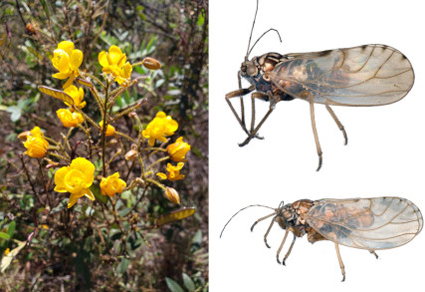

Abstract
Two new species of the Neotropical jumping plant-louse genus Mitrapsylla Crawford (Hemiptera: Psylloidea: Psyllidae: Ciriacreminae) are described from the highlands of the state of Minas Gerais in the Southeast Region of Brazil. Both species are associated with Chamaecrista (Fabaceae: Caesalpinioideae) and represent the first records of Psylloidea from this plant genus. Chamaecrista, especially its section Absus, has many species endemic to the Cerrado and Caatinga biomes in eastern Brazil. They are characterised by the presence of glandular trichomes that produce sticky secretion that hinders insect mobility and herbivory. Mitrapsylla burckhardtiella sp. nov. is unique within Mitrapsylla because of the long legs and rostrum in the adults and immatures, as well as the details of the tarsus, arolium and claws, the ventral position of the anus, the reduced sectasetae on the caudal plate and the presence of numerous long and thick capitate setae on dorsal sclerites and tubercles in the immatures. These character states are interpreted here as adaptations to living on young leaflets and stems of inflorescences of the densely hairy host plant Chamaecrista ursina, which may help to minimise contact with sticky exudates and camouflage the immatures on the surface of the host plant. In contrast, Mitrapsylla danieli sp. nov. associated with the sparsely haired Chamaecrista hedysaroides lacks these adaptations, and the morphology of adults and immatures is more similar to other Mitrapsylla spp. with non-sticky hosts. The phylogenetic relationships and systematic placement of the two new species within Mitrapsylla and other South American Ciriacreminae are also discussed on the basis of a phylogenetic analysis of the DNA sequences of the mitochondrial COI and cytb gene fragments, which we provide for the first time for four species of Mitrapsylla and two species of Queiroziella Burckhardt. As far as is known, M. burckhardtiella sp. nov. and M. danieli sp. nov. have a limited distribution in the highly diverse but threatened habitats of the Brazilian Cerrado and Campo Rupestre and may be of conservation importance, requiring further study.
References
- Alencar, A., Shimbo, J.Z., Lenti, F., Balzani Marques, C., Zimbres, B., Rosa, M., Arruda, V., Castro, I., Fernandes Márcico Ribeiro, J.P., Varela, V., Alencar, I., Piontekowski, V., Ribeiro, V., Bustamante, M.M.C., Eyji Sano, E. & Barroso, M. (2020) Mapping three decades of changes in the Brazilian savanna native vegetation using Landsat data processed in the Google Earth Engine platform. Remote Sensing, 12 (6), 924. https://doi.org/10.3390/rs12060924
- Boselli, F.B. (1929) Studii sugli Psyllidi (Homoptera: Psyllidae o Chermidae) V. Descrizione di un nuovo genere di Psyllidi di S. Domingo (Antille). Bolletino del Laboratoria di zoologia generale e agraria della Facolta agraria di Portici, 24, 70–77.
- Brown, R.G. & Hodkinson, I.D. (1988) Taxonomy and ecology of the jumping plant-lice of Panama (Homoptera: Psylloidea). E.J. Brill, Leiden, 304 pp. https://doi.org/10.1163/156853988X00241
- Burckhardt, D. (1987a) Jumping plant lice (Homoptera: Psylloidea) of the temperate neotropical region. Part 1: Psyllidae (subfamilies Aphalarinae, Rhinocolinae and Aphalaroidinae). Zoological Journal of the Linnean Society, 89 (4), 299–392. https://doi.org/10.1111/j.1096-3642.1987.tb01568.x
- Burckhardt, D. (1987b) Jumping plant lice (Homoptera: Psylloidea) of the temperate neotropical region. Part 2: Psyllidae (subfamilies Diaphorininae, Acizziinae, Ciriacreminae and Psyllinae). Zoological Journal of the Linnean Society, 90 (2), 145–205. https://doi.org/10.1111/j.1096-3642.1987.tb01353.x
- Burckhardt, D. (2021) Queiroziella gen. nov., a new genus of jumping plant-lice (Hemiptera, Psyllidae) from Southern Brazil associated with Mimosa scabrella (Leguminosae). Zootaxa, 4927 (3), 359–382. https://doi.org/10.11646/zootaxa.4927.3
- Burckhardt, D. & Brown, R.G. (1992) Larvae of Panamanian jumping plant-lice (Homoptera: Psylloidea). In: Quintero, D. & Aiello, A. (Eds.), Insects of Panama and Mesoamerica. Selected studies. Oxford University Press, Oxford/New York/Tokyo, pp. 290–301.
- Burckhardt, D., Carneiro, R.G.S., Fernandes, I.S. & Queiroz, D.L. (2022) Gall inducing jumping plant lice of the genus Nothotrioza Burckhardt (Hemiptera: Psylloidea: Triozidae) associated with Myrtaceae. Journal of Natural History, 56 (13–16), 865–884. https://doi.org/10.1080/00222933.2022.2054742
- Burckhardt, D., Dalle Cort, G. & de Queiroz, D.L. (2020) Jumping plant lice of the genus Aphalara (Hemiptera, Psylloidea, Aphalaridae) in the Neotropics. ZooKeys, 980, 119–140. https://doi.org/10.3897/zookeys.980.56807
- Burckhardt, D., Díaz, F. & Queiroz, D.L. (2017) Four new neotropical Trioza species associated with Loranthaceae (Santalales) and comments on mistletoe inhabiting psyllids (Hemiptera, Psylloidea). Alpine Entomology, 1, 91–108. https://doi.org/10.3897/alpento.1.20905
- Burckhardt, D., Ouvrard, D. & Percy, D.M. (2021) An updated classification of the jumping plant-lice (Hemiptera: Psylloidea) integrating molecular and morphological evidence. European Journal of Taxonomy, 736, 137–182. https://doi.org/10.5852/ejt.2021.736.1257
- Burckhardt, D., Ouvrard, D., Queiroz, D. & Percy, D. (2014) Psyllid host-plants (Hemiptera: Psylloidea): Resolving a semantic problem. Florida Entomologist, 97 (1), 242–246. https://doi.org/10.1653/024.097.0132
- Burckhardt, D. & Queiroz, D.L. (2012) Checklist and comments on the jumping plant-lice (Hemiptera: Psylloidea) from Brazil. Zootaxa, 3571 (1), 26–48. https://doi.org/10.11646/zootaxa.3571.1.2
- Burckhardt, D. & Queiroz, D.L. (2017) The jumping plant-lice of the Neotropical genus Tainarys (Hemiptera: Psylloidea) associated with Anacardiaceae. Zootaxa, 4232 (4), 535–567. https://doi.org/10.11646/zootaxa.4232.4.5
- Burckhardt, D. & Queiroz, D.L. (2020) Neotropical jumping plant-lice (Hemiptera, Psylloidea) associated with plants of the tribe Detarieae (Leguminosae, Detarioideae). Zootaxa, 4733 (1), 1–73. https://doi.org/10.11646/zootaxa.4733.1.1
- Burckhardt, D. & Queiroz, D.L. (2021a) Two new species of Colophorina Capener, 1973 (Hemiptera: Psylloidea: Psyllidae) from Brazil associated with Dipteryx (Fabaceae) with comments on Colophorina and Euryconus Aulmann, 1912. Entomologische Zeitschrift, 131 (2), 105–114.
- Burckhardt, D. & Queiroz, D.L. (2021b) Mitrapsylla rupestris sp. nov., a psyllid (Hemiptera, Psylloidea) associated with Poiretia bahiana (Fabaceae) endemic to the Espinhaço mountain range (Brazil, Bahía). Alpine Entomology, 5, 69–75. https://doi.org/10.3897/alpento.5.70640
- Burckhardt, D. & Queiroz, D.L. (2024) Thought to be extinct, but still alive today: the Miocene genus Primascena Klimaszewski, 1997 (Hemiptera: Psyllidae) in the light of two extant species from Brazil. Insects, 15 (6), 382, 1–18. https://doi.org/10.3390/insects15060382
- Burckhardt, D. & Queiroz, D.L. de (2025) The psyllid genus Ciriacremum (Hemiptera, Psyllidae) in Brazil. ZooKeys, 1258, 119–136. https://doi.org/10.3897/zookeys.1258.167703
- Caldwell, J.S. (1944) Notes on Mexican and Central American Psyllidae. Ohio Journal of Science, 44, 57–64.
- Caldwell, J.S. & Martorell, L.F. (1952) A brief review of the Psyllidae of Puerto Rico (Homoptera). Annals of the Entomological Society of America, 44 (4), 603–613. https://doi.org/10.1093/aesa/44.4.603
- Colli, G.R., Vieira, C.R. & Dianese, J.C. (2020) Biodiversity and conservation of the Cerrado: recent advances and old challenges. Biodiversity and Conservation, 29, 1465–1475. https://doi.org/10.1007/s10531-020-01967-x
- Crawford, D.L. (1914) A monograph of the jumping plant-lice or Psyllidae of the New World. Bulletin of the United States National Museum, 85, 1–186. https://doi.org/10.5479/si.03629236.85.1
- da Silva, G.M., Rodarte, A.T.A., Benevides, C.R. & de Lima, H.A. (2022) Florivory in two Chamaecrista species: Are secretory trichomes effective against florivores? Plant Species Biology, 37 (6), 339–348. https://doi.org/10.1111/1442-1984.12386
- Darriba, D., Taboada, G.L., Doallo, R. & Posada, D. (2012) jModelTest 2: more models, new heuristics and parallel computing. Nature Methods, 9, 772. https://doi.org/10.1038/nmeth.2109
- de Queiroz, D.L., Burckhardt, D. & Garrastazu, M.C. (2017) Protocolo de coleta e montagem de psilídeos. Comunicado Técnico, Embrapa Florestas, 393, 1–11. Available from: https://www.embrapa.br/busca-de-publicacoes/-/publicacao/1067827/protocolo-de-coleta-e-montagem-de-psilideos (accessed 9 September 2023)
- de Souza, A.O., Lewis, G.P. & da Silva, M.J. (2021) A new infrageneric classification of the pantropical genus Chamaecrista (Fabaceae: Caesalpinioideae) based on a comprehensive molecular phylogenetic analysis and morphology. Botanical Journal of the Linnean Society, 197 (3), 350–395. https://doi.org/10.1093/botlinnean/boab029
- de Souza Conceição, A., Paganucci de Queiroz, L., Lewis, G.P., Gomes de Andrade, M.J., Machado de Almeida, P.R., Schnadelbach, A.S. & Berg, C.v.d. (2009) Phylogeny of Chamaecrista Moench (LeguminosaeCaesalpinioideae) based on nuclear and chloroplast DNA regions. Taxon, 58 (4), 1168–1180. https://doi.org/10.1002/tax.584010
- Edwards, J. (1896) The Hemiptera-Homoptera (Cicadina and Psyllina) of the British Islands. L. Reeve & Co., London, 271 pp.
- Fernandes, G.W., Arantes-Garcia, L., Barbosa, M., Barbosa, N.P.U., Batista, E.K.L., Beiroz, W., Resende, F.M., et al. (2020) Biodiversity and ecosystem services in the Campo Rupestre: A road map for the sustainability of the hottest Brazilian biodiversity hotspot. Perspectives in Ecology and Conservation, 18 (4), 213–222. https://doi.org/10.1016/j.pecon.2020.10.004
- Flora e Funga do Brasil (2025) Chamaecrista in Flora e Funga do Brasil. Jardim Botânico do Rio de Janeiro. Available from: https://floradobrasil.jbrj.gov.br/FB22876 (accessed 16 September 2025)
- Gajski, D. & Pekár, S. (2021) Assessment of the biocontrol potential of natural enemies against psyllid populations in a pear tree orchard during spring. Pest Management Science, 77 (5), 2358–2366. https://doi.org/10.1002/ps.6262
- Halbert, S.E. & Burckhardt, D. (2020) The psyllids (Hemiptera: Psylloidea) of Florida: newly established and rarely collected taxa and checklist. Insecta Mundi, 0788, i–ii + 1–88.
- Harmon, J.P., Losey, J.E. & Ives, A.R. (1998) The role of vision and color in the close proximity foraging behavior of four coccinellid species. Oecologia, 115, 287–292. https://doi.org/10.1007/s004420050518
- He, Z., Burckhardt, D., Luo, X., Xu, R., Cai, W. & Song, F. (2025) A review of the psyllid genus Epipsylla (Hemiptera, Psyllidae) from the Chinese mainland with phylogenetic considerations and the description of a new species. Insects, 16, 99. https://doi.org/10.3390/insects16010099
- Hodek, I. & Honěk, A. (2009) Scale insects, mealybugs, whiteflies and psyllids (Hemiptera, Sternorrhyncha) as prey of ladybirds. Biological Control, 51 (2), 232–243. https://doi.org/10.1016/j.biocontrol.2009.05.018
- Hodkinson, I.D. (1989) The biogeography of the Neotropical jumping plant-lice (Insecta: Homoptera: Psylloidea). Journal of Biogeography, 16 (3), 203–217. https://doi.org/10.2307/2845257
- Hodkinson, I.D. (1992) Telmapsylla gen.n., an unusual psyllid from black mangrove in Florida and Costa Rica (Insecta, Homoptera, Psylloidea). Zoologica Scripta, 21 (3), 307–309. https://doi.org/10.1111/j.1463-6409.1992.tb00332.x
- Hodkinson, I.D. & White, I.M. (1981) The Neotropical Psylloidea (Homoptera: Insecta): an annotated check list. Journal of Natural History, 15 (3), 491–523. https://doi.org/10.1080/00222938100770361
- Hollis, D. & Martin, J.H. (1987) Jumping plantlice (Insecta: Hemiptera) attacking Lonchocarpus species (Leguminosae), including ʻBlack Cabbage Bark’, in Belize. Journal of Natural History, 31 (2), 237–267. https://doi.org/10.1080/00222939700770131
- Irwin, H.S. & Barneby, R.C. (1982) The American Cassiinae, a synoptical revision of Leguminosae tribe Cassieae subtribe Cassiinae in the New World. Memoirs of the New York Botanical Garden, 35, 1–918.
- Kumar, S., Stecher, G., Li, M., Knyaz, C. & Tamura, K. (2018) MEGA X: Molecular Evolutionary Genetics Analysis across computing platforms. Molecular Biology and Evolution, 35 (6), 1547–1549. https://doi.org/10.1093/molbev/msy096
- Jackson, R.R. & Pollard, S.D. (1996) Predatory behavior of jumping spiders. Annual Review of Entomology, 41, 287–308. https://doi.org/10.1146/annurev.en.41.010196.001443
- Jerinić-Prodanović, D. & Protić, L. (2013) True bugs (Hemiptera, Heteroptera) as psyllid predators (Hemiptera, Psylloidea). In: Popov, A., Grozeva, S., Simov, N. & Tasheva, E. (Eds.), Advances in Hemipterology. ZooKeys, 319, 169–189. https://doi.org/10.3897/zookeys.319.4316
- Letunic, I. & Bork, P. (2021) Interactive Tree Of Life (iTOL) v5: an online tool for phylogenetic tree display and annotation. Nucleic Acids Research, 49 (1), 293–296. https://doi.org/10.1093/nar/gkab301
- Lewis, G.P. (2005) Tribe Cassieae. In: Lewis, G., Schrire, B., Mackinder, B. & Lock, M. (Eds.), Legumes of the World. Royal Botanic Gardens, Kew, pp. 111–161.
- Lim, U.T. & Ben-Yakir, D. (2020) Visual sensory systems of predatory and parasitic arthropods. Biocontrol Science and Technology, 30 (7), 728–739. https://doi.org/10.1080/09583157.2020.1752362
- Loyn, R.H., Runnalls, R.G., Forward, G.Y. & Tyers, J. (1983) Territorial bell miners and other birds affecting populations of insect prey. Science, 221 (4618), 1411–1413. https://doi.org/10.1126/science.221.4618.1411
- Machado, R.B., Aguiar, L.M.S. & Bustamante, M.M.C. (2024) Why is it so easy to undergo devegetation in the Brazilian Cerrado? Perspectives in Ecology and Conservation, 22 (3), 209–212. https://doi.org/10.1016/j.pecon.2024.08.003
- Mauck, K.E., Gebiola, M. & Percy, D.M. (2023) The hidden secrets of Psylloidea: biology, behavior, symbionts, and ecology. Annual Review of Entomology, 69, 277–302. https://doi.org/10.1146/annurev-ento-120120-114738
- Meira, R.M.S.A., Francino, D.M.T. & Ascensão L. (2014) Oleoresin trichomes of Chamaecrista dentata (Leguminosae): structure, function, and secretory products. International Journal of Plant Sciences, 175 (3), 336–345. https://doi.org/10.1086/673538
- Miller, M.A., Pfeiffer, W. & Schwartz, T. (2010) Creating the CIPRES science gateway for inference of large phylogenetic trees. Gateway Computing Environments Workshop. IEEE, New Orleans, Louisiana, pp. 1–8. https://doi.org/10.1109/GCE.2010.5676129
- Morkel, K. (2007) On kleptoparasitic stilt bugs (Insecta, Heteroptera: Berytidae) in spider funnel-webs (Arachnida, Araneae: Agelenidae), with notes on their origin. Mainzer naturwissenschaftliches Archiv, Beiheft 31, 129–143.
- Muddiman, S.B., Hodkinson, I.D. & Hollis, D. (1992) Legume-feeding psyllids of the genus Heteropsylla (Homoptera: Psylloidea). Bulletin of Entomological Research, 82 (1), 73–117. https://doi.org/10.1017/S0007485300051518
- Ouvrard, D., Chalise, P. & Percy, D.M. (2015) Host-plant leaps versus host-plant shuffle: a global survey reveals contrasting patterns in an oligophagous insect group (Hemiptera, Psylloidea). Systematics and Biodiversity, 13 (5), 434–454. https://doi.org/10.1080/14772000.2015.1046969
- Percy, D.M., Crampton-Platt, A., Sveinsson, S., Lemmon, A.R., Lemmon, E.M., Ouvrard, D. & Burckhardt, D. (2018) Resolving the psyllid tree of life: phylogenomic analyses of the superfamily Psylloidea (Hemiptera). Systematic Entomology, 43 (4), 762–776. https://doi.org/10.1111/syen.12302
- POWO (2023) Plants of the World Online. Board of Trustees of the Royal Botanic Gardens, Kew. Available from: https://powo.science.kew.org/ (accessed 15 September 2025).
- Pramatarova, M., Burckhardt, D., Malenovský, I., Gjonov, I., Schuler, H. & Serbina, L.Š. (2024) Unravelling the molecular identity of Bulgarian jumping plant lice of the family Aphalaridae (Hemiptera: Psylloidea). Insects, 15 (9), 683. https://doi.org/10.3390/insects15090683
- Rendón-Mera, D.I., Burckhardt, D., Cavichioli, R.R. & Queiroz, D.L. (2020) Taxonomy and host-plant relationships of the psyllid genus Mitrapsylla (Hemiptera: Psylloidea: Psyllidae) in Brazil. Zootaxa, 4887 (1), 1–100. https://doi.org/10.11646/zootaxa.4887.1.1
- Ronquist, F., Teslenko, M., van der Mark, P., Ayres, D.L., Darling, A., Höhna, S., Larget, B., Liu, L., Suchard, M.A. & Huelsenbeck, J.P. (2012) MrBayes 3.2: Efficient Bayesian phylogenetic inference and model choice across a large model space. Systematic Biology, 61 (3), 539–542. https://doi.org/10.1093/sysbio/sys029
- Serbina, L. & Burckhardt, D. (2017) Systematics, biogeography and host-plant relationships of the Neotropical jumping plantlouse genus Russelliana (Hemiptera: Psylloidea). Zootaxa, 4266 (1), 1–114. https://doi.org/10.11646/zootaxa.4266.1.1
- Serbina, L.Š., Burckhardt, D., Petráková Dušátková, L., Queiroz, D.L., Goldenberg, R., Schuler, H., Percy, D.M. & Malenovský, I. (2025a) Deciphering the patterns and timing of diversification of the genus Melanastera (Hemiptera: Psylloidea: Liviidae) in the Neotropics. Molecular Phylogenetics and Evolution, 208, 108347. https://doi.org/10.1016/j.ympev.2025.108347
- Serbina, L.Š., Malenovský, I., Queiroz, D.L. & Burckhardt, D. (2025b) Jumping plant-lice of the tribe Paurocephalini (Hemiptera: Psylloidea: Liviidae) in Brazil. Zootaxa, 5585 (1), 1–164. https://doi.org/10.11646/zootaxa.5585.1.1
- Simão, R.N. (2005) Herbivoria e fogo: seus efeitos em Chamaecrista neesiana (Mart. ex. Benth.) I. & B. (Caesalpinoidea) na vegetação do cerrado (Herbivory and fire: their effects in Chamaecrista neesiana (Mart.ex. Benth.) I. & B. (Caesalpinoidea) in cerrado vegetation). M.Sc. Thesis, Universidade Federal de Uberlândia, Uberlândia, 51 pp.
- Simon, C.F., Frati, F., Beckenbach, A.T., Crespi, B., Liu, H. & Flook, P. (1994) Evolution, weighting, and phylogenetic utility of mitochondrial gene sequences and a compilation of conserved polymerase chain reaction primers. Annals of the Entomological Society of America, 87 (6), 651–701. https://doi.org/10.1093/aesa/87.6.651
- Southwood, R. (1986) Plant surfaces and insects – an overview. In: Juniper, B. & Southwood, R. (Eds.), Insects and the Plant Surface. Edward Arnold Publishers, London, pp. 1–22.
- Stubbs, M. (1980) Another look at prey detection by coccinellids. Ecological Entomology, 5 (2), 179–182. https://doi.org/10.1111/j.1365-2311.1980.tb01139.x
- Sutton, R. (1984) The effect of host plant flowering on the distribution and growth of hawthorn psyllids (Homoptera: Psylloidea). Journal of Animal Ecology, 53, 37–50. https://doi.org/10.2307/4340
- Trifinopoulos, J., Nguyen, L.T., von Haeseler, A. & Minh, B.Q. (2016) W-IQ-TREE: a fast online phylogenetic tool for maximum likelihood analysis. Nucleic Acids Research, 44, 232–235. https://doi.org/10.1093/nar/gkw256
- Voigt, D. & Gorb, S. (2010) Locomotion in a sticky terrain. Arthropod-Plant Interactions, 4, 69–79. https://doi.org/10.1007/s11829-010-9088-1
- Voigt, D., Gorb, E. & Gorb, S. (2007) Plant surface–bug interactions: Dicyphus errans stalking along trichomes. Arthropod-Plant Interactions, 1, 221–243. https://doi.org/10.1007/s11829-007-9021-4
- Wheeler, A.G., Jr. & Krimmel, B.A. (2015) Mirid (Hemiptera: Heteroptera) specialists of sticky plants: adaptations, interactions, and ecological implications. Annual Review of Entomology, 60, 393–414. https://doi.org/10.1146/annurev-ento-010814-020932
- White, I.M. & Hodkinson, I.D. (1985) Nymphal taxonomy and systematics of Psylloidea (Homoptera). Bulletin of the British Museum (Natural History), Entomology, 50 (2), 153–301. https://doi.org/10.5281/zenodo.16146999
- Wu, W., Mao, Q., Ye, Z.-X., Liao, Z., Shan, H.-W., Li, J.-M., Zhang, C.-X. & Chen, J.-P. (2025) Brochosomes as an antireflective camouflage coating for leafhoppers. eLife, 13, RP99639. https://doi.org/10.7554/eLife.99639.3
- Zeferino, L.C., de Queiroz, R.T., Rando, J.G., Cota, M.M.T., Fantini, I.F., de Souza Caetano, A.P. & Perez, A.P.F. (2019) O gênero Chamaecrista (Leguminosae: Caesalpinioideae) no Parque Estadual do Rio Preto, São Gonçalo do Rio Preto, Minas Gerais, Brasil. (The genus Chamaecrista (Leguminosae: Caesalpinioideae) in Parque Estadual do Rio Preto, São Gonçalo do Rio Preto, Minas Gerais, Brazil). Rodriguésia, 70, e02802017. https://doi.org/10.1590/2175-7860201970030
- Zhang, A., Zhou, W., Wu, D., Zhu, L., Fan, D., Han, L. & Zhao, K. (2022) Impact of olfactory and visual cues of soybean aphid on the metabolism and stress resistance of Orius sauteri (Poppius). Biological Control, 173, 105004. https://doi.org/10.1016/j.biocontrol.2022.105004