

Abstract
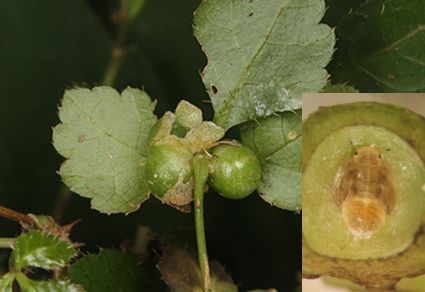
The genus Triozidus Li, 1994 stat. rev., sensu novo has a complex history. Here we redefine the genus as a natural group with two new species from Taiwan, Triozidus burckhardti Liao & Percy sp. nov. from the southernmost peninsula, and Triozidus yangorum Liao & Percy sp. nov. from the central and northern mountain region. In addition, we redescribe the type species, Triozidus stackelbergi (Loginova, 1967) comb. nov. and Triozidus ukogi (Shinji, 1940) comb. nov., and we propose new combinations for a further two species as follows: Triozidus ceratophorus (Li, 2005) comb. nov. and Triozidus eleutherococci (Konovalova, 1980) comb. nov.; all new combinations except the latter are transferred from Heterotrioza Dobreanu & Manolache, and T. eleutherococci from Trioza Foerster. All but one Triozidus species with confirmed host plants are known to produce enclosed galls on Eleutherococcus (Araliaceae): Triozidus stackelbergi produces round galls on the leaf surface of Eleutherococcus sessiliflorus or more variably on leaf petioles, flowers, fruits and twigs of E. divaricatus; T. ukogi produces spindle-shaped galls on the leaf petioles or petiolules of E. spinosus; and T. yangorum produces round galls on the petiolules of the compound leaves or leaf bases of Eleutherococcus trifoliatus; T. burckhardti appears to share the same host plant and similar galling biology as T. yangorum. The description of T. yangorum and redescriptions of T. stackelbergi and T. ukogi are based on adults and immatures, and the immatures of T. stackelbergi and T. ukogi are described for the first time. Additionally, we provide new host and distribution records for T. stackelbergi in Japan. We provide identification keys for both adults and immatures, DNA barcode data for four of the six species, and an annotated mitochondrial genome for T. yangorum.
References
- Ashmead, W.H. (1881) On the Aphididae of Florida, with descriptions of new species. Canadian Entomologist, 13, 220–225. https://doi.org/10.4039/Ent13220-11
- Bastin, S., Burckhardt, D., Reyes-Betancort, J.A., Hernández-Suárez, E. & Ouvrard, D. (2023) A review of the jumping plant-lice (Hemiptera: Psylloidea) of the Canary Islands, with descriptions of two new genera and sixteen new species. Zootaxa, 5313 (1), 1–98. https://doi.org/10.11646/zootaxa.5313.1.1
- Burckhardt, D. (2005) Biology, ecology, and evolution of gall-inducing psyllids (Hemiptera: Psylloidea). In: Raman, A., Schaefer, C. & Withers, T. (Eds.), Biology, Ecology and Evolution of Gall-inducing Arthropods. Science Publishers, Enfield, pp. 143–157.
- Burckhardt, D. & Basset, Y. (2000) The jumping plant-lice (Hemiptera, Psylloidea) associated with Schinus (Anacardiaceae): systematics, biogeography and host plant relationships. Journal of Natural History, 34, 57–155. https://doi.org/10.1080/002229300299688
- Burckhardt, D. & Ouvrard, D. (2012) A revised classification of the jumping plant-lice (Hemiptera: Psylloidea). Zootaxa, 3509 (1), 1–34. https://doi.org/10.11646/zootaxa.3509.1.1
- Burckhardt, D., Ouvrard, D. & Percy, D.M. (2021) An updated classification of the jumping plant-lice (Hemiptera: Psylloidea) integrating molecular and morphological evidence. European Journal of Taxonomy, 736, 137–182. https://doi.org/10.5852/ejt.2021.736.1257
- Burckhardt, D. & Queiroz, D.L. (2012) Checklist and comments on the jumping plant-lice (Hemiptera: Psylloidea) from Brazil. Zootaxa, 3571 (1), 26–48. https://doi.org/10.11646/zootaxa.3571.1.2
- Cho, G., Burckhardt, D. & Lee, S. (2017) On the taxonomy of Korean jumping plant-lice (Hemiptera: Psylloidea). Zootaxa, 4238, 531–561. https://doi.org/10.11646/zootaxa.4238.4.3
- Cho, G., Burckhardt, D. & Lee, S. (2022) Check list of jumping plant-lice (Hemiptera: Psylloidea) of the Korean Peninsula. Zootaxa, 5177 (1), 001–091. https://doi.org/10.11646/zootaxa.5177.1.1
- Hodkinson, I.D. (1974) The biology of the Psylloidea (Homoptera): a review. Bulletin of Entomological Research, 64, 325–338. https://doi.org/10.1017/S0007485300031217
- Hodkinson, I.D. (1984) The biology and ecology of the gall-forming Psylloidea (Homoptera). In: Ananthakrishnan, T.N. (Ed.), Biology of Gall Insects. Arnold, London, pp. 59–77.
- Hodkinson, I.D. (2009) Life cycle variation and adaptation in jumping plant lice (Insecta: Hemiptera: Psylloidea): a global synthesis. Journal of Natural History, 43, 65–179. https://doi.org/10.1080/00222930802354167
- Hollis, D. (1987) A review of the Malvales-feeding psyllid family Carsidaridae (Homoptera). Bulletin of the British Museum (Natural History) Entomology Series, 56, 87–127.
- Hollis, D. & Broomfield, P.S. (1989) Ficus-feeding psyllids (Homoptera), with special reference to the Homotomidae. Bulletin of the British Museum (Natural History) Entomology Series, 58, 131–183.
- Huang, Y.H., Li, J.T., Zan, K., Wang, J. & Fu, Q. (2022) The traditional uses, secondary metabolites, and pharmacology of Eleutherococcus species. Phytochemistry Reviews, 21, 1081–1184. https://doi.org/10.1007/s11101-021-09775-z
- Kearse, M., Moir, R., Wilson, A., Stones-Havas, S., Cheung, M., Sturrock, S., Buxton, S., Cooper, A., Markowitz, S., Duran, C., Thierer, T., Ashton, B., Meintjes, P. & Drummond, A. (2012) Geneious Basic: an integrated and extendable desktop software platform for the organization and analysis of sequence data. Bioinformatics, 28, 1647–1649. https://doi.org/10.1093/bioinformatics/bts199
- Kim, K., Nguyen, V.B., Dong, J., Wang, Y., Park, J.Y., Lee, S.C. & Yang, T.J. (2017) Evolution of the Araliaceae family inferred from complete chloroplast genomes and 45S nrDNAs of 10 Panax-related species. Scientific Reports, 7, 4917. https://doi.org/10.1038/s41598-017-05218-y
- Kim, M-K., Jang, G-H., Yang, D-C., Lee, S., Lee, H-N. & Jin, C-G. (2014) Molecular authentication of Acanthopanacis Cortex by multiplex-PCR analysis tools. Korean Journal of Plant Resources, 27, 680–686. https://doi.org/10.7732/kjpr.2014.27.6.680
- Klimaszewski, S.M. (1973) The jumping plant lice or psyllids (Homoptera, Psylloidea) of the Palaearctic: an annotated check-list. Annales Zoologici, 30, 155–286.
- Konovalova, Z.A. (1980) New species of Psylloidea (Homoptera) from Primorye region. In: Ler, P.A. (Ed.), Taksonomiya nasekomykh Dal’nego Vostoka [Taxonomy of insects of the Far East]. Biologo-pochvennyĭ institut (Akademiia nauk SSSR), Vladivostok, pp. 20–24. [in Russian]
- Konovalova, Z.A. (1988) Suborder Psyllinea – jumping plant lice. In: Ler, P.A. (Ed,), Opredelitel’ nasekomykh Dal’nego Vostoka SSSR v shesti tomakh. Vol. 2. Ravnokrylye i poluzhestkokrylye [Keys to the insects of the Far East]. Biologo-pochvennyĭ institut (Akademiia nauk SSSR), Nauka Publishing House, Leninigrad, pp. 1–46. [U.S. Department of Agriculture, 2001, English translation]
- Kuznetsova, V.G., Labina, E.S., Shapoval, N.A., Maryańska-Nadachowska, A. & Lukhtanov, V.A. (2012) Cacopsylla fraudatrix sp.n. (Hemiptera: Psylloidea) recognised from testis structure and mitochondrial gene COI. Zootaxa, 3547 (1), 55–63. https://doi.org/10.11646/zootaxa.3547.1.5
- Kwon, Y.J. (1983) Psylloidea of Korea (Homoptera: Sternorrhyncha). Insecta Koreana, Series 2, 1–181.
- Kwon, J.H. & Kwon, Y.J. (2020) Psylloidea. Insect Fauna of Korea, 9 (9), 1–403.
- Kwon, J.H., Suh, S.J. & Kwon, Y.J. (2022a) Notes on the triozid jumping plant-louse, Bactericera sarahae Kwon et Kwon, associated with Oriental medicinal plant of Acanthopanax from Korea (Hemiptera: Psylloidea: Triozidae). 2022 Spring Meeting of The Entomological Society of Korea, Conference Poster. Available from: https://www.researchgate.net/publication/372768814 (accessed 12 March 2025)
- Kwon, J.H., Suh, S.J. & Kwon, Y.J. (2022b) A new jumping plant-louse genus, Lunatrioza gen. nov., split from Heterotrioza Dobreanu et Manolache belonging to the family Triozidae from Korea (Hemiptera: Psylloidea). 2022 Spring Meeting of The Entomological Society of Korea, 2022, Conference Poster: Available from: https://www.researchgate.net/publication/372768769 (accessed 21 November 2024)
- Li, F. (1994) New genus Triozidus and five new species from China (Homoptera: Psylloidea: Triozidae). Wuyi Science Journal, 11, 84–92. [in Chinese]
- Li, F. (2005) Homoptera: Psylloidea. In: Yang, X. (Ed,), Insect Fauna of Middle-West Qinling Range and South Mountains of Gansu Province. Science Press, Beijing, pp. 142–213. [in Chinese]
- Li, F. (2011) Psyllidomorpha of China (Insecta: Hemiptera). Science Press, Beijing, 1976 pp. [in Chinese]
- Li, R. & Wen, J. (2016) Phylogeny and diversification of Chinese Araliaceae based on nuclear and plastid DNA sequence data. Journal of Systematics and Evolution, 54, 453–467. https://doi.org/10.1111/jse.12196
- Linnaeus, C. (1758) Systema naturae per regna tri naturae, secundum classes, ordines, genera, species, cum characteribus, differentiis, synonymis, locis. Tomus I. Editio decima, reformata. Impensis Direct. Laurentii Salvii, Holmiae, Stockholm, 824 pp. https://doi.org/10.5962/bhl.title.542
- Loginova, M.M. (1967) New psyllids (Homoptera, Psylloidea) from the Far East of the USSR. Entomologicheskoe Obozrenie, 46, 336–347. [in Russian]
- Malenovský, I., Burckhardt, D. & Tamesse, J.L. (2007) Jumping plant‐lice of the family Phacopteronidae (Hemiptera: Psylloidea) from Cameroon. Journal of Natural History, 41, 1875–1927. https://doi.org/10.1080/00222930701515488
- Miller, M.A., Pfeiffer, W. & Schwartz, T. (2010) Creating the CIPRES Science Gateway for inference of large phylogenetic trees. Proceedings of the Gateway Computing Environments Workshop (GCE), New Orleans, 2010, 1–8.
- Miyatake, Y. (1996) Psylloidea. In: Yukawa, J. & Masuda, H. (Eds,), Insect and mite galls of Japan. Zenkoku Nôson Kyôiku Kyôkai, Tokyo, pp. 352–358. [in Japanese]
- Ouvrard, D., Chalise, P. & Percy, D.M. (2015) Host-plant leaps versus host-plant shuffle: a global survey reveals contrasting patterns in an oligophagous insect group (Hemiptera, Psylloidea). Systematics and Biodiversity, 13 (5), 434–454. https://doi.org/10.1080/14772000.2015.1046969
- Ouvrard, D. (2024) Psyl’list – The World Psylloidea Database. Available from: https://psyllist.hemiptera.infosyslab.fr/psyllist/ (accessed 1 December 2024)
- Percy, D.M. (2003) Radiation, diversity, and host-plant interactions among island and continental legume-feeding psyllids. Evolution, 57, 2540–2556. https://doi.org/10.1554/02-558
- Percy, D.M. (2017) Making the most of your host: the Metrosideros-feeding psyllids (Hemiptera, Psylloidea) of the Hawaiian Islands. ZooKeys, 649, 1–163. https://doi.org/10.3897/zookeys.649.10213
- Percy, D.M., Crampton-Platt, A., Sveinsson, S., Lemmon, A.R., Lemmon, E.M., Ouvrard, D. & Burckhardt, D. (2018) Resolving the psyllid tree of life: phylogenomic analyses of the superfamily Psylloidea (Hemiptera). Systematic Entomology, 43, 762–776. https://doi.org/10.1111/syen.12302
- Percy, D.M. & Cronk, Q.C. (2022) Psyllid honeydew as a Bombus food source in the boreal landscape. Ecological Entomology, 47, 713–718. https://doi.org/10.1111/een.13147
- Percy, D.M., Page, R.D. & Cronk, Q.C. (2004) Plant–insect interactions: double-dating associated insect and plant lineages reveals asynchronous radiations. Systematic Biology, 53, 120–127. https://doi.org/10.1080/10635150490264996
- POWO (2024) Plants of the World Online. Facilitated by the Royal Botanic Gardens, Kew. Available from: http://www.plantsoftheworldonline.org/ (accessed 30 August 2024)
- Rübsaamen, E.H. (1908) Beiträge zur Kenntnis aussereuropäischer Zoocecidien. III. Beitrag: Gallen aus Brasilien und Peru. Marcellia, 7, 15–79.
- Shinji, O. (1940) A new species of Japanese Psyllidae (Hemip.). Insect World, 44, 66–67. [in Japanese]
- Song, J., Shi, L., Li, D-Z., Sun, Y., Niu, Y., Chen, Z., Luo, H., Pang, X., Sun, Z., Liu, C., Lv, A., Deng, Y., Larson-Rabin, Z., Wilkinson, M. & Chen, S. (2012) Extensive pyrosequencing reveals frequent intra-genomic variations of internal transcribed spacer regions of nuclear ribosomal DNA. PLoS One, 7, e43971. https://doi.org/10.1371/journal.pone.0043971
- Stamatakis, A. (2014) RAxML Version 8: A tool for phylogenetic analysis and post-analysis of large phylogenies. Bioinformatics, 30, 1312–1313. https://doi.org/10.1093/bioinformatics/btu033
- Sun, H., Feng, J., Sun, Y., Sun, S., Li, L., Zhu, J. & Zang, H. (2023) Phytochemistry and pharmacology of Eleutherococcus sessiliflorus (Rupr. & Maxim.) S.Y.Hu: a review. Molecules, 28, 6564. https://doi.org/10.3390/molecules28186564
- Swofford, D.L. (2003) PAUP*: Phylogenetic Analysis Using Parsimony (*and Other Methods). Version 4. Sinauer, Sunderland, Massachusetts. [program]
- Tuthill, L.D. (1944) Contributions to the knowledge of the Psyllidae of Mexico. Journal of the Kansas Entomological Society, 17, 143–159.
- Yang, M.M. & Raman, A. (2007) Diversity, richness, and patterns of radiation among gall-inducing psyllids (Hemiptera: Psylloidea) in the Orient and Eastern Palearctic. Oriental Insects, 41, 55–65. https://doi.org/10.1080/00305316.2007.10417499