

Abstract
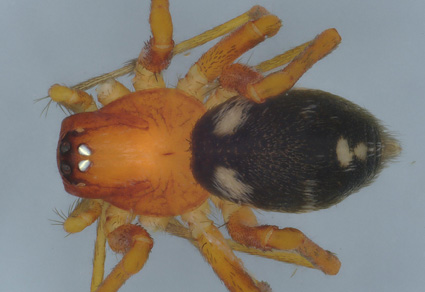
A new species in the unusual myrmecophagous family Myrmecicultoridae is described. This new species, Myrmecicultor pueblaensis sp. nov. shares several unique morphological features with the one other species in the family, M. chihuahuensis Ramírez, Grismado, and Ubick 2019. A multi-locus phylogenetic analysis of six molecular markers from the mitochondrial (12 S rDNA, 16S rDNA, cytochrome oxidase subunit I) and nuclear (18S rDNA, 28S rDNA, histone H3) genomes also places this new species as sister to M. chihuahuensis. In addition, the new species is a myrmecophage and shows similar hunting behavior to M. chihuahuensis. We hypothesize that additional species of this unusual family may be distributed throughout the desert ecosystems of southern Mexico in association with various species of ants.
References
- Abd El-Ghani, M.M., Huerta-Martínez, F.M., Hongyan, L. & Qureshi, R. (2017) The Deserts of Mexico. In: Plant Responses to Hyperarid Desert Environments. Springer, Cham, pp. 473–501. https://doi.org/10.1007/978-3-319-59135-3_9
- Carranza, S., Giribet, G., Ribera, C., Baguña, J. & Riutort, M. (1996) Evidence that two types of 18S rDNA coexist in the genome of Dugesia (Schmidtea) mediterranea (Platyhelminthes, Turbellaria, Tricladida). Molecular Biology and Evolution, 13 (6), 824–832. https://doi.org/10.1093/oxfordjournals.molbev.a025643
- Colgan, D.J., McLauchlan, A., Wilson, G.D.F., Livingston, S.P., Edgecombe, G.D., Macaranas, J., Cassis, G. & Gray, M.R. (1998) Histone H3 and U2 snRNA DNA sequences and arthropod molecular evolution. Australian Journal of Zoology, 46, 419–437. https://doi.org/10.1071/ZO98048
- Cushing, P.E., Brückner, A., Rogers, J.W. & Horner, N.V. (2022) Trophic specialization of a newly described ant symbiont, Myrmecicultor chihuahuensis (Araneae: Myrmecicultoridae). Journal of Arachnology, 50, 250–255. https://doi.org/10.1636/JoA-S-21-072
- Cushing, P.E., Graham, M.R., Prendini, L. & Brookhart, J.O. (2015) A multilocus molecular phylogeny of the endemic North American camel spider family Eremobatidae (Arachnida: Solifugae). Molecular Phylogenetics and Evolution, 92, 280–293. https://doi.org/10.1016/j.ympev.2015.07.001
- Cushing, P.E. & Santangelo, R.G. (2002) Notes on the natural history and hunting behavior of an ant eating zodariid spider (Arachnida, Araneae) in Colorado. Journal of Arachnology, 30 (3), 618–621. https://doi.org/10.1636/0161-8202(2002)030[0618:NOTNHA]2.0.CO;2
- Cushing, P.E., Wicker, R.M. & Horner, N.V. (2024) Living with the enemy: behavioral study of Myrmecicultor chihuahuensis Ramírez, Grismadeo & Ubick (Araneae: Myrmecicultoridae). Journal of Arachnology, 52, 71–74. https://doi.org/10.1636/JoA-S-22-063
- Folmer, O., Black, M.B., Hoch, W., Lutz, R.A. & Vrijehock, R.C. (1994) DNA primers for amplification of mitochondrial Cytochrome c Oxidase subunit I from diverse metazoan invertebrates. Molecular Marine Biology and Biotechnology, 3, 294–299.
- González-Santillán, E. (2025) Matrix, partition and tree for the publication "A new species in the spider family Myrmecicultoridae and evidence of myrmecophagy in the family". Versión 1. Zenodo. [published online] https://doi.org/10.5281/zenodo.15164897
- Hoang, D.T., Chernomor, O., von Haeseler, A., Minh, B.Q. & Vinh, L.S. (2018) UFBoot2: Improving the ultrafast bootstrap approximation. Molecular Biology and Evolution, 35, 518–522. https://doi.org/10.1093/molbev/msx281
- Kalyaanamoorthy, S., Minh, B.Q., Wong, T.K.F., von Haeseler, A. & Jermiin, L.S. (2017) ModelFinder: Fast model selection for accurate phylogenetic estimates. Nature Methods, 14, 587–589. https://doi.org/10.1038/nmeth.4285
- Katoh, K., Rozewicki, J. & Yamada, K.D. (2019) MAFFT online service: multiple sequence alignment, interactive sequence choice and visualization. Briefings in Bioinformatics, 4, 1160–1166. https://doi.org/10.1093/bib/bbx108
- Köcher, T.D., Thomas, W.K., Meyer, A., Edwards, S.V., Pääbo, S., Villablanca, F.X. & Wilson, A.C. (1989) Dynamics of mitochondrial DNA evolution in animals: amplification and sequencing with conserved primers. Proceedings of the National Academy of Sciences, 86 (16), 6196–6200. https://doi.org/10.1073/pnas.86.16.6196
- Maddison, W.P. & Maddison, D.R. (2023) Mesquite: a modular system for evolutionary analysis. Version 3.81. Available from: https://www.mesquiteproject.org (accessed 4 November 2025)
- Nunn, G.B., Theisen, B.F., Christensen, B. & Arctander, P. (1996) Simplicity-correlated size growth of the nuclear 28S ribosomal RNA D3 expansion segment in the crustacean order Isopoda. Journal of Molecular Evolution, 42, 211–223. https://doi.org/10.1007/BF02198847
- Pekár, S. (2002) Revision of the genus Zodarion (Araneae: Zodariidae) in the Czech and Slovak Republics. Acta Societatis Zoologicae Bohemicae, 66, 51–66.
- Prendini, L., Weygoldt, P. & Wheeler, W.C. (2005) Systematics of the Damon variegatus group of African whip spiders (Chelicerata: Amblypygi): evidence from behaviour, morphology and DNA. Organisms, Diversity and Evolution, 5, 203–236. https://doi.org/10.1016/j.ode.2004.12.004
- Ramírez, M.J. (2014) The morphology and phylogeny of Dionychan spiders (Araneae: Araneomorphae). Bulletin of the American Museum of Natural History, 390, 1–374. https://doi.org/10.1206/821.1
- Ramírez, M.J., Grismado, C.J., Ubick, D., Ovtsharenko, V., Cushing, P.E., Platnick, N.I., Wheeler, W.C., Prendini, L., Crowley, L.M. & Horner, N.V. (2019) Myrmecicultoridae, a new family of myrmecophilc spiders from the Chihuahuan Desert (Araneae: Entelegynae). American Museum Novitates, 3930, 1–24. https://doi.org/10.1206/3930.1
- Simon, C., Frati, F., Beckenback, A., Crespi, B., Liu, H. & Flook, P. (1994) Evolution, weighting, and phylogenetic utility of mitochondrial gene sequences and a compilation of conserved polymerase chain reaction primers. Annals of the Entomological Society of America, 89, 641–701. https://doi.org/10.1093/aesa/87.6.651
- Wheeler, W.C., Coddington, J.A., Crowley, L.M., Dimitrov, D., Goloboff, P.A., Griswold, C.E., Hormiga, G., Prendini, L., Ramírez, M.J., Sierwald, P., Almeida-Silva, L., Alvarez-Padilla, F., Arnedo, M.A., Benavides Silva, L.R., Benjamin, S.P., Bond, J.E., Grismado, C.J., Hasan, E., Hedin, M., Izquierdo, M.A., Labarque, F.M., Ledford, J., Lopardo, L., Maddison, W.P., Miller, J.A., Piacentini, L.N., Platnick, N.I., Polotow, D., Silva-Dávila, D., Scharff, N., Szűts, T., Ubick, D., Vink, C.J., Wood, H.M. & Zhang, J. (2017) The spider tree of life: phylogeny of Araneae based on target-gene analyses from an extensive taxon sampling. Cladistics, 33, 574–616. https://doi.org/10.1111/cla.12182