

Abstract
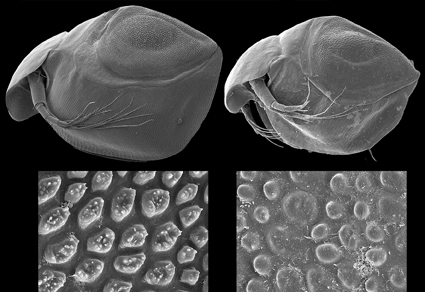
Despite the important advances made in the taxonomy of water fleas (Crustacea: Cladocera), many taxa have not yet been revised. The genus Simocephalus Schoedler, 1858 (Anomopoda: Daphniidae) belongs to understudied groups. During the last forty years, several attempts have been made to use genetic approaches to estimate species diversity within Simocephalus. At the same time, investigations on morphology almost stopped after the last revision of Orlova-Bienkowskaja (2001). The lack of morphological data, even on the most widespread taxa, makes it difficult to apply the remains of this group to paleoecological reconstructions, although Simocephalus ephippia are common in subfossil sediments and fossils of different geological ages. We investigated more than 80 ephippia of recent representatives of the genus from Eurasia and North America, and 45 ephippia from Pleistocene sites of different ages on these two continents. For the first time, we have distinguished three main morphotypes based on the sculpture of the ephippia among the recent representatives. Ephippia of the vetulus-type are covered by polygonal hillocks of moderate height and with prominent processes. This morphotype is the most common in Eurasia, but it could be found on other continents, considering the distribution patterns of the S. vetulus species complex. Ephippia of the vetuloides-mixtus-type are covered by hillocks with processes strongly protruding above the ephippium surface. This morphotype is found only in the Asian part of Russia; it has more localized distribution than the vetulus-type. Ephippia of the serrulatus-type are covered by almost flat hillocks, or with hillocks of moderate height. This morphotype is found in both Eurasia and North America, which may confirm previous genetic data on a close relationship between serrulatus populations from the Eastern Palearctic and North America. Ephippia of the vetulus- and serrulatus-types are found in several Pleistocene localities. Due to lack of information about ornamentation patterns of Simocephalus ephippia of pre-Cenozoic age, we could not estimate the precise time of the morphotype separation. However we may conclude that in the Late Pleistocene the vetulus- and serrulatus-types were broadly distributed in Northern Eurasia and North America. Simocephalus ephippia demonstrate a morphological stasis at least since the Late Pleistocene, or even during longer time. In Maly Chukochiy Cape deposits (Republic Yakutia) we found a sole ephippium presumably belonging to an extinct taxon of Simocephalus. Eastern parts of Northern Eurasia had diverse communities of Simocephalus at the Pleistocene-Holocene boundary, and these then changed analogously to the transformation of Daphnia communities. In the course of our work, we obtained a large set of illustrations of Simocephalus ephippium morphology in different populations. We hope that our study will attract more attention to the taxonomy of modern Simocephalus and its Pleistocene-earlier Holocene subfossil ephippia.
References
- Abramova, E., Vishnyakova, I., Boike, J., Abramova, A., Solovyev, G. & Martynov, F. (2017) Structure of freshwater zooplankton communities from tundra waterbodies in the Lena River Delta, Russian Arctic, with a discussion on new records of glacial relict copepods. Polar Biology, 40 (8), 1629–1643. https://doi.org/10.1007/s00300-017-2087-2
- Alonso, M. (1996) Crustacea, Branchiopoda. Fauna Iberica. Vol. 7. Museo Nacional de Ciencias Naturales, Madrid, 486 pp.
- Amsinck, S.L., Jeppesen, E. & Verschuren, D. (2007) Use of cladoceran resting eggs to trace climate-driven and anthropogenic changes in aquatic ecosystems. In: Alekseev, V.R., De Stasio, B. & Gilbert, J.J. (Eds.), Diapause in Aquatic Invertebrates Theory and Human Use. Springer Netherlands, Dordrecht, pp. 135–157. https://doi.org/10.1007/978-1-4020-5680-2_8
- Bekker, E.I., Karabanov, D.P., Galimov, Y.R. & Kotov, A.A. (2016) DNA barcoding reveals high cryptic diversity in the North Eurasian Moina species (Crustacea: Cladocera). PLoS One, 11 (8), e0161737. https://doi.org/10.1371/journal.pone.0161737
- Bennion, H., Sayer, C.D., Clarke, S.J., Davidson, T.A., Rose, N.L., Goldsmith, B., Rawcliffe, R., Burgess, A., Clarke, G., Turner, S. & Wiik, E. (2018) Sedimentary macrofossil records reveal ecological change in English lakes: implications for conservation. Journal of Paleolimnology, 60, 329–348. https://doi.org/10.1007/s10933-017-9941-7
- Benzie, J.A.H. (2005) The genus Daphnia (including Daphniopsis) (Anomopoda: Daphniidae). Guides to the identification of the microinvertebrates of the continental waters of the world, 21. Kenobi Productions, Ghent & Backhuys Publishers, Leiden, 376 pp.
- Bi, R., Wei, J., Deng, Z., Blair, D., Hu, W. & Yin, M. (2025) Moina heilongjiangensis sp. nov. (Crustacea, Cladocera) from the northeast of China. Zoosystematics and Evolution, 101 (3), 1325–1337. https://doi.org/10.3897/zse.101.150242
- Błędzki, L.A. & Rybak, J.I. (2016) Freshwater Crustacean Zooplankton of Europe. Cladocera & Copepoda (Calanoida, Cyclopoida). Key to species identification, with notes on ecology, distribution, methods and introduction to data analysis. Springer, Cham, 918 pp.
- Elías-Gutiérrez, M., Jerónimo, F.M., Ivanova, N.V., Valdez-Moreno, M. & Hebert, P.D. (2008) DNA barcodes for Cladocera and Copepoda from Mexico and Guatemala, highlights and new discoveries. Zootaxa, 1839 (1), 1–42. https://doi.org/10.11646/zootaxa.1839.1.1
- Fefilova, E., Dubovskaya, O., Frolova, L., Abramova, E., Kononova, O., Nigamatzyanova, G., Zuev, I. & Kochanova, E. (2022) Biogeographic patterns of planktonic and meiobenthic fauna diversity in inland waters of the Russian Arctic. Freshwater Biology, 67 (1), 78–94. https://doi.org/10.1111/fwb.13624
- Flössner, D. (2000) Die Haplopoda und Cladocera (ohne Bosminidae) Mitteleuropas. Backhuys, Leiden, 428 pp.
- Fryer, G. (1991) A daphniid ephippium (Branchiopoda: Anomopoda) of Cretaceous age. Zoological Journal of the Linnean Society, 102 (2), 163–167. https://doi.org/10.1111/j.1096-3642.1991.tb00287.x
- García-Girón, J., Fernández-Aláez, C., Fernández-Aláez, M. & Luis, B. (2018) Subfossil Cladocera from surface sediment reflect contemporary assemblages and their environmental controls in Iberian flatland ponds. Ecological Indicators, 87, 33–42. https://doi.org/10.1016/j.ecolind.2017.12.007
- Gerhard, M., Iglesias, C., Clemente, J.M., Goyenola, G., Meerhoff, M., Pacheco, J.P., Teixeira-de Mello, F. & Mazzeo, N. (2017) What can resting egg banks tell about cladoceran diversity in a shallow subtropical lake? Hydrobiologia, 798, 75–86. https://doi.org/10.1007/s10750-016-2654-5
- Gu, Y.L., Liu, P. & Han, B.P. (2021) Complete mitochondrial genome of freshwater flea Simocephalus sibiricus Sars, 1899 (Crustacea: Cladocera: Anomopoda). Mitochondrial DNA, Part B, 6 (11), 3100–3102. https://doi.org/10.1080/23802359.2021.1981787
- Guerrero-Jiménez, G., Álvarez-Solis, F.S., Aguilar-Nazare, E., Adabache-Ortiz, A., Baquero-Mariaca, A., Wallace, R.L. & Silva-Briano, M. (2024) To what extent are ephippia of Mexican Anomopoda (Crustacea, Cladocera) identifiable? ZooKeys, 1205, 169. https://doi.org/10.3897/zookeys.1205.115506
- Hann, B.J. (1995) Genetic variation in Simocephalus (Anomopoda: Daphniidae) in North America: patterns and consequences. Hydrobiologia, 307 (1), 9–14. https://doi.org/10.1007/BF00031992
- Hann, B.J. & Hebert, P.D.N. (1982) Re-interpretation of genetic variation in Simocephalus (Cladocera, Daphniidae). Genetics, 102 (1), 101–107. https://doi.org/10.1093/genetics/102.1.101
- Hegna, T.A. & Kotov, A.A. (2016) Ephippia belonging to Ceriodaphnia Dana, 1853 (Cladocera: Anomopoda: Daphniidae) from the Lower Cretaceous of Australia. Palaeontologia Electronica, 19.3.40A, 1–9. https://doi.org/10.26879/667
- Huang, X., Shi, X., Kotov, A.A. & Gu, F. (2014) Confirmation through genetic analysis of the existence of many local phyloclades of the genus Simocephalus (Crustacea, Cladocera) in China. PLoS One, 9 (11), e112808. https://doi.org/10.1371/journal.pone.0112808
- Hudec, I. (2010) Anomopoda, Ctenopoda, Haplopoda, Onychopoda (Crustacea: Branchiopoda). Fauna Slovenska III. VEDA, Bratislava, 496 pp.
- Jeffery, N.W., Elías-Gutiérrez, M. & Adamowicz, S.J. (2011) Species diversity and phylogeographical affinities of the Branchiopoda (Crustacea) of Churchill, Manitoba, Canada. PLoS One, 5, e18364. https://doi.org/10.1371/journal.pone.0018364
- Kim, W. & Yoon, S.M. (2000) Taxonomic review of the сladoceran genus Simocephalus (Branchiopoda, Anompoda, Daphnidae) in Korea, with redescription of Simocephalus mixtus. Korean Journal of Ecology and Environment, 33 (2), 152–161.
- Kirillova, I.V., van der Plicht, J., Gubin, S.V., Zanina, O.G., Chernova, O.F., Lapteva, E.G., Trofimova, S.S., Zinovyev, E.V., Zharov, A.A., Fadeeva, E.O., Van Kolfschoten, T., Shidlovskiy, F.K. & Kotov, A.A. (2016) Taphonomic phenomenon of ancient hair from Glacial Beringia: perspectives for palaeoecological reconstructions. Boreas, 45 (3), 455–469. https://doi.org/10.1111/bor.12162
- Kohout, J., Illyová, M., Čiampor, F. & Čiamporová-Zaťovičová, Z. (2014) Discrimination between four Simocephalus species from Slovakia using a PCR-RFLP technique. Biologia, 69 (1), 76–79. https://doi.org/10.2478/s11756-013-0285-0
- Korovchinsky, N.M., Kotov, A.A., Sinev, A.Y., Neretina, A.N. & Garibian, P.G. (2021) Water fleas (Crustacea: Cladocera) of North Eurasia. Vol. 2. KMK, Moscow, 544 pp. [in Russian with English abstract]
- Kotov, A.A. (2009) New finding of Mesozoic ephippia of the Anomopoda (Crustacea: Cladocera). Journal of Natural History, 43 (9–10), 523–528. https://doi.org/10.1080/00222930802003020
- Kotov, A.A. (2013) Morphology and phylogeny of Anomopoda (Crustacea: Cladocera). KMK, Moscow, 638 pp. [in Russian with English abstract]
- Kotov, A.A. (2016) Faunistic complexes of the Cladocera (Crustacea, Branchiopoda) of Eastern Siberia and the Far East of Russia. Zoologicheskiy Zhurnal, 95, 748–768. https://doi.org/10.7868/S0044513416070059
- Kotov, A.A. & Taylor, D.J. (2011) Mesozoic fossils (> 145 Mya) suggest the antiquity of the subgenera of Daphnia and their coevolution with chaoborid predators. BMC Evolutionary Biology, 11 (1), 129. https://doi.org/10.1186/1471-2148-11-129
- Kotov, A.A., Forró, L., Korovchinsky, N.M. & Petrusek, A. (2013) World checklist of freshwater Cladocera species. World Wide Web electronic publication. Available from: http://fada.biodiversity.be/group/show/17 (accessed 18 August 2024)
- Kotov, A.A., Ibragimova, A.G. & Neretina, A.N. (2018) Identification of Ceriodaphnia Dana, 1853 (Crustacea: Cladocera) taxa from European Russia based on ephippial morphology. Zootaxa, 4527 (1), 105–123. https://doi.org/10.11646/zootaxa.4527.1.9
- Kotov, A.A., Kuzmina, S.A., Frolova, L.A., Zharov, A.A., Neretina, A.N. & Smirnov, N.N. (2019) Ephippia of the Daphniidae (Branchiopoda: Cladocera) in Late Caenozoic deposits: untapped source of information for palaeoenvironmental reconstructions in the Northern Holarctic. Invertebrate Zoology, 16 (2), 183–199. https://doi.org/10.15298/invertzool.16.2.06
- Kotov, A.A., Neretina, A.N., Zharov, A.A., Izymova, E.I., Boeskorov, G.G., Kosintsev, P.A. & Shidlovskiy, F.K. (2020) A new glance at old samples: Remains of freshwater invertebrates associated with mummified carcasses of large quaternary mammals. Biology Bulletin, 47, 753–761. https://doi.org/10.1134/S1062359020070080
- Kotov, A.A., Garibian, P.G., Bekker, E I., Taylor, D.J. & Karabanov, D.P. (2021) A new species group from the Daphnia curvirostris species complex (Cladocera: Anomopoda) from the eastern Palaearctic: taxonomy, phylogeny and phylogeography. Zoological Journal of the Linnean Society, 191 (3), 772–822. https://doi.org/10.1093/zoolinnean/zlaa046
- Kuzmina, S.A., Elias, S.A. & Kotov, A.A. (2019) Late Quaternary insects and freshwater invertebrates of the Alaskan North Slope and paleoenvironmental reconstructions in Arctic Alaska. Invertebrate Zoology, 16 (2), 89–125. https://doi.org/10.15298/invertzool.16.2.02
- Kuzmina, S.A., Savelieva, L.A., Popova, S.S., Maksimov, F.E., Kuznetsov, V.Y., Laukhin, S.A., Larin, S.I., & Kotov, A.A. (2021) Last interglacial environment of the Baikal Region (Southern Siberia, Russia) based on analysis of fossil invertebrates and plants. Palaeoentomology, 4 (6), 559–583. https://doi.org/10.11646/palaeoentomology.4.6.6
- Laforsch, C. & Tollrian, R. (2000) A new preparation technique of daphnids for Scanning Electron Microscopy using hexamethyldisilazane. Archiv für Hydrobiologie, 149, 587–596. https://doi.org/10.1127/archiv-hydrobiol/149/2000/587
- Liao, H.Y., Cai, C.Y., Shen, Y.B., Sun, X.Y. & Huang, D.Y. (2020) An early Cretaceous branchiopod community in northeastern China: discovery of daphniid (Cladocera: Anomopoda) ephippia in the early assemblage of the Jehol Biota. Cretaceous Research, 113, 104491. https://doi.org/10.1016/j.cretres.2020.104491
- Maksimov, F.E., Savelyeva, L.A., Laukhin, S.A., Petrov, A.Y., Popova, S.S., Larin, S.I., Kobylkin, D.V., Kuznetsova, V.Y., Grigoryev, V.A., Levchenko, S.B. & Yakimova, K.S. (2020) New Evidence on the Age and Formation Conditions of Pleistocene Deposits in the Eastern Part of the Tunka Depression. Geography and Natural Resources, 41 (3), 266–277. https://doi.org/10.1134/S1875372841030087
- Neretina, A.N., Gololobova, M.A., Neplyukhina, A.A., Zharov, A.A., Rogers, C.D., Horne, D.J., Protopopov, A.V., & Kotov, A.A. (2020) Crustacean remains from the Yuka mammoth raise questions about non-analogue freshwater communities in the Beringian region during the Pleistocene. Scientific Reports, 10 (1), 859. https://doi.org/10.1038/s41598-020-57604-8
- Ni, Y., Ma, X., Hu, W., Blair, D. & Yin, M. (2019) New lineages and old species: lineage diversity and regional distribution of Moina (Crustacea: Cladocera) in China. Molecular Phylogenetics and Evolution, 134, 87–98. https://doi.org/10.1016/j.ympev.2019.02.007
- Novichkova, A.A. & Chertoprud, E.S. (2016) The freshwater crustaceans (Cladocera: Copepoda) of Bering Island (Commander Islands, Russian Far East): species richness and taxocene structure. Journal of Natural History, 50 (21–22), 1357–1368. https://doi.org/10.1080/00222933.2015.1113319
- Novichkova, A.A. & Azovsky, A.I. (2017) Factors affecting regional diversity and distribution of freshwater microcrustaceans (Cladocera, Copepoda) at high latitudes. Polar Biology, 40 (1), 185–198. https://doi.org/10.1007/s00300-016-1943-9
- Novichkova, A.A. & Chertoprud, E.S. (2022) The species structure, biogeographical status, and the relation to the Beringian fauna of microcrustaceans (Cladocera, Copepoda) of the Magadan Area (Far East, Russia). Arthropoda Selecta, 31 (3), 283–292. https://doi.org/10.15298/arthsel.31.3.03
- Orlova-Bienkowskaja, M.J. (1995) A revision of the Simocephalus (latirostris) species group (Crustacea: Anomopoda: Daphniidae). Hydrobiologia, 316, 43–58. https://doi.org/10.1007/BF00019374
- Orlova-Bienkowskaja, M.Y. (2001) Daphniidae: genus Simocephalus. Guides to the identification of the microinvertebrates of the continental waters of the World. Vol. 17. Backhuys, Leyden, 130 pp.
- Rakhmatullaeva, G. & Mirabdullayev, I. (1998) Record of the tropical Simocephalus mesorostris Orlova-Bienkowskaja, 1995 (Crustacea, Cladocera) in Central Asia and first description of its male. International Review of Hydrobiology, 83 (5), 435–438. https://doi.org/10.1002/iroh.19980830511
- Rawcliffe, R., Bennion, H. & Davidson, T.A. (2009) Macrofossil analyses of White Loch. Final Report to SEPA and SNH. Environmental Change Research Centre, Research Report, 134, 1–14.
- Reyes, A.V., Jensen, B.J., Zazula, G.D., Ager, T.A., Kuzmina, S., La Farge, C. & Froese, D.G. (2010) A late-Middle Pleistocene (Marine Isotope Stage 6) vegetated surface buried by Old Crow tephra at the Palisades, interior Alaska. Quaternary Science Reviews, 29 (5–6), 801–811. https://doi.org/10.1016/j.quascirev.2009.12.003
- Sadler, T.D. & Spitze, K. (1995) Genetic variation in subtropical populations of Simocephalus (Crustacea: Cladocera). Hereditas, 123 (1), 1–7. https://doi.org/10.1111/j.1601-5223.1995.t01-1-00001.x
- Shi, X., Xu, S., Xue, C., Huang, X., Liu, G. & Zhao, Y. (2011) Discovery of males of Simocephalus himalayensis (Cladocera, Simocephalus), with the re-description of females. Chinese Journal of Oceanology and Limnology, 29 (1), 206–212. https://doi.org/10.1007/s00343-011-0010-1
- Vandekerkhove, J., Declerck, S., Vanhove, M., Brendonck, L., Jeppesen, E., Conde Porcuna, J.M. & De Meester, L. (2004) Use of ephippial morphology to assess richness of anomopods: potentials and pitfalls. Journal of Limnology, 63 (Supplement 1), 75–84. https://doi.org/10.4081/jlimnol.2004.s1.75
- Vandekerkhove, J., Louette, G., Brendonck, L. & De Meester, L. (2005) Development of cladoceran egg banks in new and isolated pools. Archiv für Hydrobiologie, 162 (3), 339–347. https://doi.org/10.1127/0003-9136/2005/0162-0339
- Venkataraman, K. (1990) Scanning electron microscopic observations on the ephippial eggs of Cladocera. Journal of the Andaman Science Association, 6 (1), 35–38.
- Young, S.S., Ni, M.H. & Liu, M.Y. (2012) Systematic study of the Simocephalus sensu stricto species group (Cladocera: Daphniidae) from Taiwan by morphometric and molecular analyses. Zoological Studies, 51 (2), 222–231.
- Zuykova, E.I., Bochkarev, N.A., Taylor, D.J. & Kotov, A.A. (2019) Unexpected endemism in the Daphnia longispina complex (Crustacea: Cladocera) in Southern Siberia. PLoS One, 14 (9), e0221527. https://doi.org/10.1371/journal.pone.0221527