

Abstract
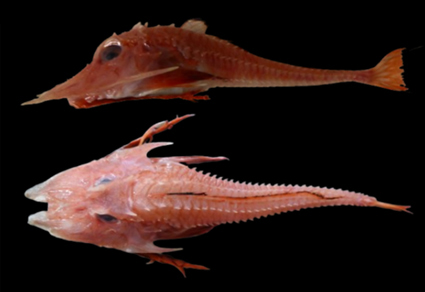
The oriental armored gurnard, Scalicus orientalis (Fowler), a benthic species in the family Peristediidae, is redescribed based on a specimen collected in 2023 from off the coast of Mozambique during an ecosystem survey by the R/V Dr. Fridtjof Nansen, alongside four comparative specimens housed in the NRF-SAIAB National Fish Collection. This study is part of a post-survey taxonomic initiative under the EAF-Nansen Programme, aimed at strengthening taxonomic capacity in the East African region and advancing knowledge of its marine fish biodiversity. Detailed morphological analyses, including updated meristic and morphometric data, are presented with illustrations of both fresh and preserved coloration. DNA barcoding of the mitochondrial COI gene was used to support morphological identification, and species boundaries within the genus Scalicus were further evaluated using three molecular species delimitation methods: assemble species by automatic partitioning (ASAP), automatic barcode gap discovery (ABGD), and Bayesian implementation of the Poisson tree process (PTP). The results confirm the identification of the Mozambican specimen as S. orientalis, representing the first report of this species from the East African coast and the second record from the southwestern Indian Ocean. A revised key to the species of Scalicus is also provided.
References
- Alcock, A.W. (1898) A note on the deep-sea fishes, with descriptions of some new genera and species, including another probably viviparous ophidioid. The Annals and Magazine of Natural History, Series 7, 2 (8), 136–156. https://doi.org/10.1080/00222939808678029
- De Abreu, D., Sitoe, J., Pinto, A. & Psomadakis, P. (2023) Survey records, possible new species and new geographical records for Mozambique. Regional News. WIOMSA Newsbrief, 2023, 22–23.
- de Beaufort, L.F. & Briggs, J.C. (1962) Scleroparei, Hypostomides, Pediculati, Plectognathi, Opisthomi, Discocephali, Xenopterygii. In: Weber, M. & de Beaufort, L.F. (Eds.), The Fishes of the Indo-Australian Archipelago. E.J. Brill, Leiden, pp. i–xi + 1–481.
- https://doi.org/10.1163/9789004590953
- del Cerro, L. & Lloris, D. (1997) Gurnard fishes (Scorpaeniformes, Triglidae) from off New Caledonia, with description of five new species. In: Séret, B. (Ed.), Résultats des Campagnes Musorstom. Vol. 17. Mémoires du Muséum national d’Histoire naturelle, 174, pp. 91–124.
- Durville, P., Mulochau, T., Barrère, A., Quod, J.-P., Spitz, J., Quéro, J.-C. & Ribes, S. (2009) Inventaire des poissons récoltés lors l’éruption volcanique d’avril 2007 du Piton de la Fournaise (île de La Réunion). Annales de la Société des Sciences Naturelles Charente-Maritime, 9 (9), 948–956.
- Fowler, H.W. (1938) Descriptions of new fishes obtained by the United States Bureau of Fisheries steamer “Albatross”, chiefly in Philippine seas and adjacent waters. Proceedings of the United States National Museum, 85, 31–135.
- https://doi.org/10.5479/si.00963801.85-3032.31
- Fricke, R. (2020) New record of the Oriental armoured gurnard Scalicus orientalis (Fowler 1938) from La Réunion, southwestern Indian Ocean (Teleostei: Peristediidae). FishTaxa, 16, 1–7.
- Fricke, R., Kulbicki, M. & Wantiez, L. (2011) Checklist of fishes of New Caledonia, and their distribution in the Southwest Pacific Ocean. Stuttgarter Beiträge zur Naturkunde A, Neue Serie, 4, 341–463.
- Fricke, R., Mulochau, T, Durville, P., Chabanet, P., Tessier, E., Letourneur, Y. (2009) Annotate checklist of the fish species (Pisces) of La Réunion, including a Red List of threatened and declining species. Stuttgarter Beiträge zur Naturkunde A, Neue Serie, 2, 1–168.
- Ivanova, N.V., Zemlak, T.S., Hanner, R.H. & Hebert, P.D.N. (2007) Universal primer cocktails for fish DNA barcoding. Molecular Ecology Notes, 7 (4), 544–548. https://doi.org/10.1111/j.1471-8286.2007.01748.x
- Kalyaanamoorthy, S., Minh, B.Q., Wong, T.K.F., Haeseler, A.V. & Jermiin, L.S. (2017) ModelFinder: Fast model selection for accurate phylogenetic estimates. Nature Methods, 14 (6), 587–589.
- https://doi.org/10.1038/nmeth.4285
- Kamohara, T. (1952) Studies on the family Peristediidae found in Japan. Japanese Journal of Ichthyology, 2 (1), 1–13.
- https://doi.org/10.11369/jji1950.2.1
- Katoh, K., Misawa, K., Kuma, K. & Miyata, T. (2002) MAFFT: A novel method for rapid multiple sequence alignment based on fast Fourier transform. Nucleic Acids Research, 30 (14), 3059–3066. https://doi.org/10.1093/nar/gkf436
- Katoh, K. & Toh, H. (2008) Recent developments in the MAFFT multiple sequence alignment program. Briefings in Bioinformatics, 9 (4), 286–298. https://doi.org/10.1093/bib/bbn013
- Kawai, T. (2008) Phylogenetic systematics of the family Peristediidae (Teleostei: Actinopterygii). Species Diversity, 13 (1), 1–34. https://doi.org/10.12782/specdiv.13.1
- Kawai, T. (2013) Revision of the peristediid genus Satyrichthys (Actinopterygii: Teleostei) with the description of a new species, S. milleri sp. nov. Zootaxa, 3635 (4), 419–438.
- https://doi.org/10.11646/zootaxa.3635.4.5
- Kawai, T. (2016) Peristedion richardsi sp. nov. (Actinopterygii: Teleostei: Peristediidae) from Indonesian waters, with synonymy between Peristedion riversandersoni Alcock, 1894 and Peristedion nierstraszi Weber, 1913. Zootaxa, 4171 (2), 335–346.
- https://doi.org/10.11646/zootaxa.4171.2.6
- Kawai, T. (2019) Revision of an armored searobin genus Scalicus Jordan 1923 (Actinopterygii: Teleostei: Peristediidae) with a single new species. Ichthyological Research, 66 (4), 437–459.
- https://doi.org/10.1007/s10228-019-00691-z
- Kawai, T., Imamura, H. & Nakaya, K. (2004) Paraheminodus kochiensis Kamohara, 1957 (Teleostei: Peristediidae), a junior synonym of Paraheminodus murrayi (Günther, 1880), with a comparison of Paraheminodus murrayi and Paraheminodus laticephalus (Kamohara, 1952). Ichthyological Research, 51 (1), 73–76.
- https://doi.org/10.1007/s10228-003-0188-0
- Kawai, T., Nakaya, K & Séret, B. (2008) A new armored searobin genus Paraheminodus longirostralis (Teleostei: Peristediidae) from New Caledonia. Ichthyological Research, 55 (4), 374–378. https://doi.org/10.1007/s10228-008-0061-2
- Kawai, T. & Richards, W.J. (2022) Family Peristediidae. In: Heemstra, P.C., Heemstra, E., Ebert, D.A., Holleman, W. & Randall, J.E. (Eds.), Coastal Fishes of the Western Indian Ocean. Vol. 2. South African Institute for Aquatic Biodiversity, a National Research Facility of the National Research Foundation (NRF/SAIAB), Makhanda, pp. 611–613.
- Kawai, T. & Yato, T. (2008) A species name for a peristediid fish having a Japanese name, “Nanyou-kihoubou.” Japanese Journal of Ichthyology, 55, 61–62.
- Kimura, M. (1980) A simple method for estimating evolutionary rates of base substitutions through comparative studies of nucleotide sequences. Journal of Molecular Evolution, 16 (2), 111–120.
- https://doi.org/10.1007/BF01731581
- Larsson, A. (2014) AliView: A fast and lightweight alignment viewer and editor for large datasets. Bioinformatics, 30 (22), 3276–3278. https://doi.org/10.1093/bioinformatics/btu531
- Miller, G.C. (1974) Fische des Indischen Ozeans. Ergebnisse der ichthyologischen Untersuchungen während der Expedition des Forschungsschiffes “Meteor” in den Indischen Ozean, Oktober 1964 bis Mai 1965. A. Systematischer teil, XIV, Scorpaeniformes (2) Family Peristediidae. Meteor Forschungsergebnisse, Reihe D, 18, 61–72.
- Miller, G.C. & Richards, W.J. (2002) Peristediidae. In: Carpenter K.E. (Ed.), The Living Marine Resources of the Western Central Atlantic. Vol. 2. Bony Fishes Part 1. Acipenseridae to Grammatidae. FAO Species Identification Guide for Fishery Purposes. Food and Agricultural Organization of the United Nations, Rome, pp. 1278–1285.
- Minh, B.Q, Schmidt, H.A, Chernomor, O., Schrempf, D., Woodhams, M.D, von Haeseler, A. & Lanfear, R. (2020) IQ-TREE 2: New models and efficient methods for phylogenetic inference in the genomic era. Molecular Biology and Evolution, 37 (5), 1530–1534. https://doi.org/10.1093/molbev/msaa015
- Nakamura, J., Fujii T., Funakawa, K., Hirose, J., Ikehata, H. & Motomura, H. (2021) First Kagoshima record of Scalicus orientalis (Peristediidae) from off the Satsuma Peninsula, southwestern Kyushu, Japan. Ichthy, Natural History of Fishes of Japan, 14, 39–42.
- https://doi.org/10.34583/ichthy.14.0_39
- Nihal, D., Rajeeshkumar, M.P., Kumar, K.V.A. & Manjebrayakath, H. (2024) Range extension of two deep-sea peristediid fishes (Scorpaenoidei: Peristediidae) to the Arabian Sea, Northern Indian Ocean. Indian Journal of Geo-Marine Sciences (IJMS), 53 (03), 142–148. https://doi.org/10.56042/ijms.v53i03.7383
- Ochiai, A & Yatou, T. (1984) Peristediidae. In: Masuda, H., Amaoka, K., Araga, C., Uyeno, T. & Yoshino, T. (Eds.), The Fishes of the Japanese Archipelago. Tokai University Press, Tokyo, pp. 301–302, pls 334–336, 364.
- Ono, M. & Kawai, T. (2014) Review of armored searobins of the genus Peristedion (Teleostei: Peristediidae) in Japanese waters. Species Diversity, 19 (2), 117–131. https://doi.org/10.12782/sd.19.2.117
- Psomadakis, P.N., Thein, H., Russell, B.C. & Tun, M.T. (2019) Field Identification Guide to the Living Marine Resources of Myanmar. FAO Species Identification Guide for Fishery Purposes. Food and Agricultural Organization of the United Nations and Department of Fisheries, Ministry of Agriculture, Livestock and Irrigation Republic of the Union of Myanmar, Rome, xvii + 694 pp.
- Puillandre, N., Brouillet, S. & Achaz, G. (2021) ASAP: Assemble species by automatic partitioning. Molecular Ecology Resources, 21 (2), 609–620. https://doi.org/10.1111/1755-0998.13281
- Puillandre, N., Lambert, A., Brouillet, S. & Achaz, G. (2012) ABGD, Automatic Barcode Gap Discovery for primary species delimitation. Molecular Ecology, 21 (8), 1864–1877. https://doi.org/10.1111/j.1365-294X.2011.05239.x
- QGIS Development Team. (2023) QGIS Geographic Information System. Version 3.32.3. Open Source Geospatial Foundation. Available from: https://qgis.org (accessed 18 June 2025)
- Ratnasingham, S., Wei, C., Chan, D., Agda, J., Agda, J., Ballesteros-Mejia, L., Boutou, H.A., El Bastami, Z.M., Ma, E., Manjunath, R., Rea, D., Ho, C., Telfer, A., McKeowan, J., Rahulan, M., Steinke, C., Dorsheimer, J., Milton, M. & Hebert, P.D.N. (2024) BOLD v4: A centralized bioinformatics platform for DNA-based biodiversity data. In: DeSalle, R. (Ed.), DNA Barcoding: Methods and Protocols. Humana Press, New York, New York, pp. 403–441.
- https://doi.org/10.1007/978-1-0716-3581-0_26
- Richards, W.J. (1999) Triglidae. In: Carpenter, K.E. & Niem, V.H. (Eds.), The Living Marine Resources of the Western Central Pacific. Vol. 4. Bony Fishes Part 2. Mugilidae to Carangidae. FAO Species Identification Guide for Fishery Purposes. Food and Agricultural Organization of the United Nations, Rome, pp. 2359–2382.
- Richards, W.J. (2000) Family Peristediidae (armoured gurnards). In: Randall, J.E., Lim, K.K.P. (Eds.), A checklist of the fishes of the South China Sea. Raffles Bulletin of Zoology, Supplement 8, pp. 569–667.
- Richards, W.J. & Miller, G.C. (2016) Peristediidae. In: Carpenter, K.E. & De Angelis, N. (Eds.), The Living Marine Resources of the Eastern Central Atlantic. Vol. 3. Bony Fishes Part 1 (Elopiformes to Scorpaeniformes). FAO Species Identification Guide for Fishery Purposes. Food and Agricultural Organization of the United Nations, Rome, pp. 2297–2298.
- Sambrook, J. & Russell, D.W. (2001) Molecular Cloning: A Laboratory Manual. 3rd Edition. Vol. 1. Cold Spring Harbor Laboratory Press, Cold Spring Harbor, New York, 2234 pp.
- Steinke, D., Connell, A.D., Hebert, P.D.N. (2016) Linking adults and immatures of South African marine fishes. Genome, 59 (11), 959–967. https://doi.org/10.1139/gen-2015-0212
- Sunnucks, P. & Hales, D.F. (1996) Numerous transposed sequences of mitochondrial cytochrome oxidase I–II in aphids of the genus Sitobion (Hemiptera: Aphididae). Molecular Biology and Evolution, 13 (3), 510–524.
- https://doi.org/10.1093/oxfordjournals.molbev.a025612
- Tamura, K., Stecher, G. & Kumar, S. (2021) MEGA11: Molecular Evolutionary Genetics Analysis version 11. Molecular Biology and Evolution, 38 (7), 3022–3027.
- https://doi.org/10.1093/molbev/msab120
- Trifinopoulos, J., Nguyen, L.-T., von Haeseler, A. & Minh, B.Q. (2016) W-IQ-TREE: A fast online phylogenetic tool for maximum likelihood analysis. Nucleic Acids Research, 44 (W1), W232–W235. https://doi.org/10.1093/nar/gkw256
- Vences, M., Miralles, A., Brouillet, S., Ducasse, J., Fedosov, A., Kharchev, V., Kostadinov, I., Kumari, S., Patmanidis, S., Scherz, M.D., Puillandre, N. & Renner, S.S. (2021) iTaxoTools 0.1: Kickstarting a specimen-based software toolkit for taxonomists. Megataxa, 6 (2), 77–92. https://doi.org/10.11646/megataxa.6.2.1
- Ward, R.D., Zemlak, T.S., Innes, B.H., Last, P.R. & Hebert, P.D.N. (2005) DNA barcoding Australia’s fish species. Philosophical Transactions of the Royal Society B: Biological Sciences, 360 (1462), 1847–1857. https://doi.org/10.1098/rstb.2005.1716
- Werle, E., Schneider, C., Renner, M., Völker, M. & Fiehn, W. (1994) Convenient single-step, one tube purification of PCR products for direct sequencing. Nucleic Acids Research, 22 (20), 4354–4355. https://doi.org/10.1093/nar/22.20.4354
- Yamada, U. (2002) Peristediidae. In: Nakabo, T. (Ed.), Fishes of Japan with Pictorial Keys to the Species. 2nd Edition. Tokai University Press, Hadano, pp. 610–613.
- Yamada, U. & Yagishita, N. (2013) Peristediidae. In: Nakabo, T. (Ed.), Fishes of Japan with Pictorial Keys to the Species. 3rd Edition. Tokai University Press, Hadano, pp. 727–731 + 1951–1952.
- Yatou, T. (1985) Nemaperistedion orientale Fowler. In: Okamura, O. (Ed.), Fishes of the Okinawa Trough and the Adjacent Waters II. Japan Fisheries Resource Conservation Association, Tokyo, pp. 594–595 + 727.
- Yatou, T. (1997) Peristediidae. In: Okamura, O. & Amaoka, K. (Eds.), Sea Fishes of Japan. Yama-kei Publishers, Tokyo, pp. 217.
- Zhang, J., Kapli, P., Pavlidis, P. & Stamatakis, A. (2013) A general species delimitation method with applications to phylogenetic placements. Bioinformatics, 29 (22), 2869–2876. https://doi.org/10.1093/bioinformatics/btt499
- Zhang, J.-B. & Hanner, R. (2011) DNA barcoding is a useful tool for the identification of marine fishes from Japan. Biochemical Systematics and Ecology, 39 (1), 31–42. https://doi.org/10.1016/j.bse.2010.12.017