

Abstract
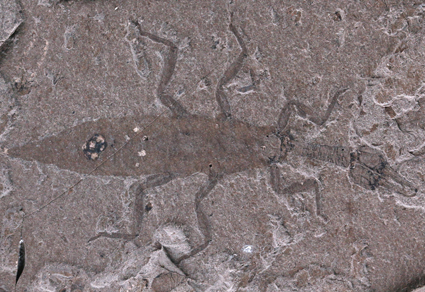
Neuroptera, a small relict Order of Insecta that experienced rapid species diversification during the Mesozoic Era, is known by diverse extinct lineages preserved in compression fossils or amber. Current knowledge of Mesozoic neuropteran diversity primarily relies on adults, while the contemporaneous larvae, particularly those of Jurassic lacewings, are relatively rare. Herein, a third Jurassic neuropteran larva from the Daohugou Beds of China, namely Quadraticaput scleroticum gen. et sp. nov., is described. The previously published genus, Natator Kong, Shih, Ren & Wang, 2024, is found to be a junior homonym and revised to Yongling Kong, Shih, Ren & Wang nom. nov.. Additionally, based on the new material, the description of Girafficervix baii Du, Niu & Bao, 2023 is updated, and a detailed morphological comparison is conducted among all three Jurassic neuropteran larvae.
References
- Badano, D., Aspöck, U., Aspoeck, H. & Cerretti, P. (2017) Phylogeny of Myrmeleontiformia based on larval morphology (Neuropterida: Neuroptera). Systematic Entomology, 42, 94–117. https://doi.org/10.1111/syen.12200
- Badano, D., Fratini, M., Maugeri, L., Palermo, F., Pieroni, N., Cedola, A., Haug, J.T., Weiterschan, T., Velten, J., Mei, M., Di, Giulio, A. & Cerretti, P. (2021) X‐ray microtomography and phylogenomics provide insights into the morphology and evolution of an enigmatic Mesozoic insect larva. Systematic Entomology, 46, 672–684. https://doi.org/10.1111/syen.12482
- Beutel, R.G., Friedrich, F. & Aspöeck, U. (2010) The larval head of Nevrorthidae and the phylogeny of Neuroptera (Insecta). Zoological Journal of the Linnean Society, 158, 533–562. https://doi.org/10.1111/j.1096-3642.2009.00560.x
- Chen, L., Xiao, L., Guo, S., Yang, N., Labandeira, C.C., Shih, C.K., Shi, C. & Ren, D. (2025) Reconstructing fossil insect communities and palaeoclimates for the Middle Jurassic Yanliao Biota in the Daohugou area of China. Science Bulletin, 70, 176–179. https://doi.org/10.1016/j.scib.2024.11.010
- Du, X., Niu, K. & Bao, T. (2023a) Giant jurassic dragon lacewing larvae with lacustrine palaeoecology represent the oldest fossil record of larval neuropterans. Proceedings of the Royal Society B, 290, 20222500. https://doi.org/10.1098/rspb.2022.2500
- Du, X., Niu, K. & Bao, T. (2023b) Correction to: ‘Giant jurassic dragon lacewing larvae with lacustrine palaeoecology represent the oldest fossil record of larval neuropterans’ (2023) by du et al. Proceedings of the Royal Society B, 290, 20230411. https://doi.org/10.1098/rspb.2023.0411
- Gao, T., Shih, C.K. & Ren, D. (2021) Behaviors and interactions of insects in mid-Mesozoic ecosystems of Northeastern China. Annual Review Of Entomology, 66, 337–354. https://doi.org/10.1146/annurev-ento-072720-095043
- Gu, J., Montealegre, Z.F., Robert, D., Engel, M.S., Qiao, G. & Ren, D. (2012) Wing stridulation in a Jurassic katydid (Insecta, Orthoptera) produced low-pitched musical calls to attract females. Proceedings of the National Academy of Sciences of USA, 109, 3868–3873. https://doi.org/10.1073/pnas.1118372109
- Haug, C., Herrera-Flórez, A.F., Müller, P. & Haug, J.T. (2019a) Cretaceous chimera—an unusual 100-million-year old neuropteran larva from the “experimental phase” of insect evolution. Palaeodiversity, 12, 1–11. https://doi.org/10.18476/pale.v12.a1
- Haug, C., Posada Zuluaga, V., Zippel, A., Braig, F., Müller, P., Gröhn, C., Weiterschan, T., Wunderlich, J., Haug, G.T. & Haug, J.T. (2022a) The morphological diversity of antlion larvae and their closest relatives over 100 Million Years. Insects, 13, 587. https://doi.org/10.3390/insects13070587
- Haug, G., Haug, C., Pazinato, P., Braig, F., Perrichot, V., Gröhn, C., Müller, P. & Haug, J. (2020a) The decline of silky lacewings and morphological diversity of long-nosed antlion larvae through time. Palaeontologia Electronica, 23, a39. https://doi.org/10.26879/1029
- Haug, G.T., Baranov, V., Wizen, G., Pazinato, P.G., Müller, P., Haug, C. & Haug, J.T. (2021a) The morphological diversity of long-necked lacewing larvae (Neuroptera: Myrmeleontiformia). Bulletin of Geosciences, 96.4, 431–457. https://doi.org/10.3140/bull.geosci.1807
- Haug, J.T., Baranov, V., Schädel, M., Müller, P., Gröhn, C. & Haug, C. (2020b) Challenges for understanding lacewings: how to deal with the incomplete data from extant and fossil larvae of Nevrorthidae? (Neuroptera). Fragmenta entomologica, 52, 137–168. https://doi.org/10.4081/fe.2020.472
- Haug, J.T., Haug, G.T., Zippel, A., van der Wal, S., Müller, P., Gröhn, C., Wunderlich, J., Hoffeins, C., Hoffeins, H.W. & Haug, C. (2021b) Changes in the morphological diversity of larvae of lance lacewings, mantis lacewings and their closer relatives over 100 Million years. Insects, 12, 860. https://doi.org/10.3390/insects12100860
- Haug, J.T., Linhart, S., Haug, G.T., Gröhn, C., Hoffeins, C., Hoffeins, H.W., Müller, P., Weiterschan, T., Wunderlich, J. & Haug, C. (2022b) The diversity of aphidlion-like larvae over the Last 130 Million Years. Insects, 13, 336. https://doi.org/10.3390/insects13040336
- Haug, J.T., Müller, P. & Haug, C. (2018) The ride of the parasite: a 100-million-year old mantis lacewing larva captured while mounting its spider host. Zoological Letter, 4, 31. https://doi.org/10.1186/s40851-018-0116-9
- Haug, J.T., Müller, P. & Haug, C. (2019b) A 100-million-year old predator: a fossil neuropteran larva with unusually elongated mouthparts. Zoological Letter, 5, 29. https://doi.org/10.1186/s40851-019-0144-0
- Kong, B., Shih, C.K., Ren, D. & Wang, Y. (2024) A new giant Jurassic lacewing larva reveals a particular aquatic habit and its significance to the palaeoecology. Journal of Systematics and Evolution, 62, 1193–1200. https://doi.org/10.1111/jse.13071
- Liu, X., Ren, D., Shih, C.K. & Wang, Y. (2023) New osmylopsychopid taxa from the Middle Jurassic of Northeastern China (Neuroptera: Osmylopsychopidae). Insects, 14, 484. https://doi.org/10.3390/insects14050484
- Liu, X., Zhang, W., Winterton, S.L., Breitkreuz, L.C.V. & Engel, M.S. (2016) Early morphological specialization for insect-spider associations in mesozoic lacewings. Current Biology, 26, 1590–1594. https://doi.org/10.1016/j.cub.2016.04.039
- Liu, X., Shi, G., Xia, F., Lu, X., Wang, B. & Engel, M.S. (2018) Liverwort mimesis in a Cretaceous lacewing larva. Current Biology, 28, 1475–1481. https://doi.org/10.1016/j.cub.2018.03.060
- Lu, X. & Liu, X. (2021) The Neuropterida from the mid-Cretaceous of Myanmar: a spectacular palaeodiversity bridging the Mesozoic and present faunas. Cretaceous Research, 121, 104727. https://doi.org/10.1016/j.cretres.2020.104727
- McCulloch, A.R. (1908) A new genus and species of turtle from North Australia. Records of the Australian Museum, 7, 126–128. https://doi.org/10.3853/j.0067-1975.7.1908.956
- Oswald, J.D. (2017) Neuropterida species of the World. Lacewing digital library, research publication No. 1. Available from: http://lacewing.tamu.edu/SpeciesCatalog/Main (accessed 10 April 2025)
- Pérez-de la Fuente, R., Engel, M.S., Delclòs, X. & Peñalver, E. (2020) Straight-jawed lacewing larvae (Neuroptera) from Lower Cretaceous Spanish amber, with an account on the known amber diversity of neuropterid immatures. Cretaceous Research, 106, 104200. https://doi.org/10.1016/j.cretres.2019.104200
- Ren, D. (1998) Flower-associated brachycera flies as fossil evidence for Jurassic angiosperm origins. Science, 280, 85–88. https://doi.org/10.1126/science.280.5360.85
- Ren, D. (2002) A new lacewing family (Neuroptera) from the Middle Jurassic of Inner Mongolia, China. Insect Science, 9, 53–67. https://doi.org/10.1111/j.1744-7917.2002.tb00172.x
- Ren, D. & Yin, J. (2003) New ‘osmylid-like’ fossil Neuroptera from the Middle Jurassic of Inner Mongolia, China. Journal of the New York Entomological Society, 111, 1–11. https://doi.org/10.1664/0028-7199(2003)111[0001:NOFNFT]2.0.CO;2
- Wang, B., Xia, F., Engel, M.S., Perrichot, V., Shi, G., Zhang, H., Chen, J., Jarzembowski, E.A., Wappler, T. & Rust, J.J.S.A. (2016) Debris-carrying camouflage among diverse lineages of Cretaceous insects. Science Advance, 2, e1501918. https://doi.org/10.1126/sciadv.1501918
- Wang, Y., Liu, Z., Wang, X., Shih, C.K., Zhao, Y., Zhao, Y., Engel, M.S. & Ren, D. (2010) Ancient pinnate leaf mimesis among lacewings. Proceedings of the National Academy of Sciences of USA, 107, 16212–16215. https://doi.org/10.1073/pnas.1006460107
- Yang, Q., Wang, Y., Labandeira, C.C., Shih, C.K. & Ren, D. (2014) Mesozoic lacewings from China provide phylogenetic insight into evolution of the Kalligrammatidae (Neuroptera). BMC Evolutionary Biology, 14, 126. https://doi.org/10.1186/1471-2148-14-126
- Yao, Y., Cai, W., Xu, X., Shih, C.K., Engel, M.S., Zheng, X., Zhao, Y. & Ren, D. (2014) Blood-feeding true bugs in the Early Cretaceous. Current Biology, 24, 1786–1792. https://doi.org/10.1016/j.cub.2014.06.045
- Zippel, A.N.A., Kiesmller, C., Haug, G.T., Müller, P., Weiterschan, T., Haug, C., Hörnig, M.K. & Haug, J.T. (2021) Long-headed predators in Cretaceous amber—fossil findings of an unusual type of lacewing larva. Palaeoentomology, 4 (5), 475–498. https://doi.org/10.11646/palaeoentomology.4.5.14