

Abstract
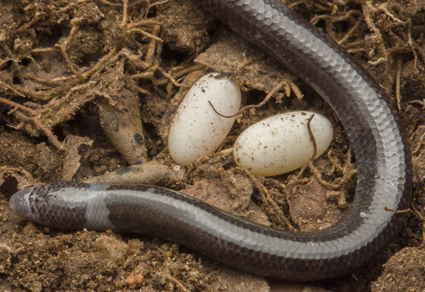
A new species of dibamid lizard, Dibamus irregularis sp. nov. is described based on molecular (three mitochondrial genes) and morphological (external and skeletal) characters of twelve specimens collected from the Chu Yang Sin National Park, Dak Lak Province, southern Vietnam. The new species can be distinguished from other congeners by the following combination of characters: medial rostral suture absent or incomplete, nasal sutures incomplete, labial sutures complete or incomplete; two to three postoculars; three to four scales on the posterior edge of infralabial; 22–24 midbody scale rows; 180–211 ventral scales; 39–46 subcaudal scales; and maximum snout-vent length 147 mm. Moreover, two eggs of a new species were collected in the same locality. The only known clutch of Dibamus was described more than 120 years ago based on a single egg of D. alfredi collected from Bukit Besar, Thailand. Herein, we provide the first description of a complete clutch of the genus Dibamus based on two eggs of Dibamus irregularis sp. nov. Our study brings the total number of species in the genus Dibamus to 30; Dibamus irregularis sp. nov. is the 10th species of Dibamus recorded from Vietnam, highlighting the importance of the country as a hot spot of reptilian diversity in Southeast Asia.
References
- Angel, F. (1935) Un lézard nouveau de la famille des dibamidés. Bulletin Museum National d’Histoire Naturelle, Series 2, 7 (6), 354–356.
- Bobrov, V.V. (2008) Dibamids (Reptilia, Sauria, Dibamidae) of Vietnam: systematics, distribution, and ecology [in Russian]. Modern Herpetology, 8 (2), 91–100.
- Bouckaert, R., Vaughan, T.G., Barido-Sottani, J., Duchêne, S., Fourment, M., Gavryushkina, A., Heled, J., Jones, G., Kühnert, D., De Maio, N. & Matschiner, M. (2019) BEAST 2.5: An advanced software platform for Bayesian evolutionary analysis. PLoS Computational Biology, 15 (4), e1006650. https://doi.org/10.1371/journal.pcbi.1006650
- Boulenger, G.A. (1912) A Vertebrate Fauna of the Malay Peninsula from the Isthmus of Kra to Singapore Including the Adjacent Islands. Reptilia and Batrachia. Taylor and Francis, London, 294 pp. https://doi.org/10.5962/bhl.title.10813
- Bragin, A.M., Geissler, P., Trofimets, A.V., Neang Thy, Le, S.X., Nguyen, T.V. & Poyarkov, N.A. (2025) A new species of skink from mountains of southern Vietnam (Reptilia, Squamata, Scincidae). Current Studies in Herpetology, 25 (1–2), 3–21. https://doi.org/10.18500/1814-6090-2025-25-1-2-3-21
- Chan-ard, T., Nabhitabhata, J. & Parr, J.W. (2015) A Field Guide to the Reptiles of Thailand. Oxford University Press, New York, 352 pp.
- Cope, E.D. (1885) A contribution to the herpetology of Mexico. I. The collection of the Comision Cientifica. Proceedings of the American Philosophical Society, 22, 379–382.
- Darevsky, I.S. (1992) Two new species of the worm-like lizard Dibamus (Sauria, Dibamidae), with remarks on the distribution and ecology of Dibamus in Vietnam. Asiatic Herpetological Research, 4 (1), 1–12. https://doi.org/10.5962/bhl.part.6175
- Das, I. & Lim, K.K. (2003) Two new species of Dibamus (Squmata: Dibamidae) from Borneo. Raffles Bulletin of Zoology, 51 (1), 137–142.
- Das, I. & Lim, K.K. (2005) New species of Dibamus (Squamata: Dibamidae) from Pulau Nias, Indonesia. Journal of Herpetology, 39 (1), 113–117. https://doi.org/10.1670/0022-1511(2005)039[0113:NSODSD]2.0.CO;2
- Das, I. & Lim, K.K. (2009) A new species of Dibamus (Squamata: Dibamidae) from Pulau Simeuleu, Mentawai Archipelago, Indonesia. Zootaxa, 2088 (1), 15–23. https://doi.org/10.11646/zootaxa.2088.1.2
- Das, I. & Yaakob, N. (2003) A new species of Dibamus (Squamata: Dibamidae) from Peninsular Malaysia. Raffles Bulletin of Zoology, 51 (1), 143–148.
- Das, I. (1996) The validity of Dibamus nicobaricum (Fitzinger in Steindachner, 1867) (Squamata: Sauria: Dibamidae). Russian Journal of Herpetology, 3 (2), 157–162.
- Diaz, R.E., Leong, T.M., Grismer, L.L. & Yaakob, N.S. (2004) A new species of Dibamus (Squamata: Dibamidae) from West Malaysia. Asiatic Herpetological Research, 10, 1–7.
- Duméril, A.M.C. & Bibron, G. (1839) Erpétologie Générale ou Histoire Naturelle Compléte des Reptiles. Tome Cinquième. Contenant l’Histoire de Quatre-vingt-trois Genres et Deux Cent Sept Espèces des Trois Dernieres Familles de l’Ordre des Sauriens, savoir: Les Lacertiens, les Chalcidiens et les Sincoïdiens. Libraire Encyclopédique de Roret, Paris, viii + 854 + [1] pp., 4 folding tables, pls. 37 + 39 + 39bis + 41bis + 49 + 51–54 + 56–58.
- Greer, A.E. (1985) The relationships of the lizard genera Anelytropsis and Dibamus. Journal of Herpetology, 19, 116–156. https://doi.org/10.2307/1564427
- Hall, T.A. (1999) BioEdit: a user-friendly biological sequence alignment editor and analysis program for Windows 95/98/NT. Nucleic Acids Symposium Series, 41, 95–98.
- Hedges, S.B. (1994) Molecular evidence for the origin of birds. Proceedings of the National Academy of Sciences of the United States of America, 91 (7), 2621–2624. https://doi.org/10.1073/pnas.91.7.2621
- Hoang, D.T., Chernomor, O., von Haeseler, A., Minh, B.Q. & Vinh, L.S. (2018) UFBoot2: Improving the ultrafast bootstrap approximation. Molecular Biology and Evolution, 35, 518–522. https://doi.org/10.1093/molbev/msx281
- Honda, M., Nabhitabhata, J., Ota, H. & Hikida, T. (1997) A new species of Dibamus (Squamata: Dibamidae) from Thailand. Raffles Bulletin of Zoology, 45, 275–280.
- Honda, M., Ota, H., Hikida, T. & Darevsky, I.S. (2001) A new species of the worm-like lizard, Dibamus Dumeril & Bibron 1839 (Squamata Dibamidae), from Vietnam. Tropical Zoology, 14 (1), 119–125. https://doi.org/10.1080/03946975.2002.10531146
- Ineich, I. (1999) Une nouvelle espèce de Dibamus (Reptilia, Squamata, Dibamidae) du Vietnam. Bulletin de la Société zoologique de France, 124 (3), 279–286.
- IUCN Standards and Petitions Subcommittee (2019) Guidelines for Using the IUCN Red List Categories and Criteria. Version 12. Available from: http://www.iucnredlist.orgdocumentsRedListGuidelines.pdf (accessed 31 January, 2025)
- Jonniaux, P. & Kumazawa, Y. (2008) Molecular phylogenetic and dating analyses using mitochondrial DNA sequences of eyelid geckos (Squamata: Eublepharidae). Gene, 407, 105–115. https://doi.org/10.1016/j.gene.2007.10.016
- Katoh, K., Rozewicki, J. & Yamada, K.D. (2019) MAFFT online service: multiple sequence alignment, interactive sequence choice and visualization. Briefings in Bioinformatics, 20, 1160–1166. https://doi.org/10.1093/bib/bbx108
- Kliukin, N.S., Nguyen, T.V., Le, S.X., Bragin, A.M., Tran, T.T.V., Gorin, V.A. & Poyarkov, N.A. (2023) A new species of the genus Dibamus Duméril & Bibron, 1839 (Squamata: Dibamidae) from the driest and hottest place of Vietnam. Zootaxa, 5380 (4), 301–320. https://doi.org/10.11646/zootaxa.5380.4.1
- Kliukin, N.S., Bragin, A.M., Nguyen, T.V., Le, S.X., Tran, T.T.V., Gorin, V.A. & Poyarkov, N.A. (2024a) Another new species of Dibamus Duméril & Bibron, 1839 (Squamata: Dibamidae) from Nui Chua National Park, Ninh Thuan Province, Vietnam. Zootaxa, 5406 (1), 87–104. https://doi.org/10.11646/zootaxa.5406.1.4
- Kliukin, N.S., Bragin, A.M., Neang, T., Gorin, V.A., Lisenkova, A.A., Bogatyreva, V.Y. & Poyarkov, N.A. (2024b) A new species of blind skink of the genus Dibamus Duméril et Bibron, 1839 (Squamata, Dibamidae) from Сambodia [in Russian]. Zoologicheskiy Zhurnal, 103, 97–120. https://doi.org/10.31857/S0044513424110077
- Kliukin, N.S., Nguyen, T.V., Pawangkhanant, P., Pham, H.M., Le, S.X., Gorin, V.A., Bos, C., Krone, I. & Poyarkov, N.A. (2025) A new species of Dibamus from the Central Highlands of Vietnam with redescription of Dibamus montanus Smith, 1921 (Squamata: Dibamidae). Zootaxa, 5693 (1), 1–31. https://doi.org/10.11646/zootaxa.5693.1.1
- Koppetsch, T., Böhme, W. & Koch, A. (2019) A new species of Dibamus Duméril & Bibron, 1839 (Squamata: Dibamidae) from Pulau Manado Tua, northern Sulawesi, Indonesia. Zootaxa, 4555 (3), 331–345. https://doi.org/10.11646/zootaxa.4555.3.3
- Kumar, S., Stecher, G., Li, M., Knyaz, C. & Tamura, K. (2018) MEGA X: molecular evolutionary genetics analysis across computing platforms. Molecular Biology and Evolution, 35 (6), 1547–1549. https://doi.org/10.1093/molbev/msy096
- Lanfear, R., Calcott, B., Ho, S.Y.W. & Guindon, S. (2012) PartitionFinder: Combined selection of partitioning schemes and substitution models for phylogenetic analyses. Molecular Biology and Evolution, 29, 1695–1701. https://doi.org/10.1093/molbev/mss020
- Le, T.T., Richardson, W.J., Bui, D.T., Le, V.C., Nguyen, H.D., Ha, H.V., Monastyrskii, A.L. & Eames, J.C. (1999) An Investment Plan for Ngoc Linh Nature Reserve, Kon Tum Province, Vietnam: A Contribution to the Management Plan. BirdLife International Vietnam Programme, Conservation Report, Hanoi, 93 pp.
- Lee, M.S. (1998) Convergent evolution and character correlation in burrowing reptiles: towards a resolution of squamate relationships. Biological Journal of the Linnean Society, 65 (4), 369–453. https://doi.org/10.1111/j.1095-8312.1998.tb01148.x
- Luong, A.M., Hoang, C.V., Pham, C.T., Nguyen, T.T., Orlov, N.L., Ziegler, T. & Nguyen, T.Q. (2022) A new species of Xenophrys (Amphibia: Anura: Megophryidae) from Truong Son Range, Vietnam. Zootaxa, 5150 (3), 333–356. https://doi.org/10.11646/zootaxa.5150.3.2
- Macey, J.R., Larson, A., Ananjeva, N.B., Fang, Z. & Papenfuss, T.J. (1997) Two novel gene orders and the role of light-strand replication in rearrangement of the vertebrate mitochondrial genome. Molecular Biology and Evolution, 14 (1), 91–104. https://doi.org/10.1093/oxfordjournals.molbev.a025706
- Minh, Q., Nguyen, M.A.T. & von Haeseler, A. (2013) Ultrafast approximation for phylogenetic bootstrap. Molecular Biology and Evolution, 30, 1188–1195. https://doi.org/10.1093/molbev/mst024
- Nagy, Z.T., Sonet, G., Glaw, F. & Vences, M. (2012) First large-scale DNA barcoding assessment of reptiles in the biodiversity hotspot of Madagascar, based on newly designed COI primers. PLoS One, 7 (3), e34506. https://doi.org/10.1371/journal.pone.0034506
- Nazarov, R.A., Orlov, N.L., Nguyen, N.S. & Ho, T.C. (2008) Taxonomy of naked-toes geckos Cyrtodactylus irregularis complex of South Vietnam and description of a new species from Chu Yang Sin Natural Park (Krong Bong district Dac Lac province, Vietnam). Russian Journal of Herpetology, 15 (2), 141–156.
- Neang, T., Holden, J., Eastoe, T., Seng, R., Ith, S. & Grismer, L.L. (2011) A new species of Dibamus (Squamata: Dibamidae) from Phnom Samkos Wildlife Sanctuary, southwestern Cardamom Mountains, Cambodia. Zootaxa, 2828 (1), 58–68. https://doi.org/10.11646/zootaxa.2828.1.5
- Nguyen, S.V., Ho, C.T. & Nguyen, T.Q. (2009) Herpetofauna of Vietnam. Edition Chimaira, Frankfurt am Main, 768 pp.
- Nguyen, S.N., Le, M.V. & Murphy, R.W. (2021) On the second specimen of Dibamus deharvengi Ineich, 1999 (Squamata: Dibamidae). Proceeding of the 3rd National Scientific Workshop on Amphibians and Reptiles in Vietnam, 287–289.
- Nguyen, L.T., Schmidt, H.A., Von Haeseler, A. & Minh, B.Q. (2015) IQ-TREE: A fast and effective stochastic algorithm for estimating maximum-likelihood phylogenies. Molecular Biology and Evolution, 32, 268–274. https://doi.org/10.1093/molbev/msu300
- Nguyen, T.H., Ha, H.B., Murdoch, M.L., Grismer, J.L., Grismer, L.L. & Luu, V.Q. (2025) Integrative taxonomic approaches revealed a new species of the Cyrtodactylus irregularis complex (Squamata: Gekkonidae) from Gia Lai Province, Central Highlands of Vietnam. Zootaxa, 5679 (1), 45–73. https://doi.org/10.11646/zootaxa.5679.1.2
- Phan, T.H., Dinh, A.T.P., Nguyen, S.L.H. & Le, D.T. (2021) Amphibians and reptiles in Son Tra Nature Reserve [in Vietnamese]. Publishing House for Natural Science and Technology, Hanoi, 137 pp.
- Pinto, B., Gamble, T., Smith, C., Keating, S., Havird, J. & Chiari, Y. (2023) The revised leopard gecko (Eublepharis macularius) reference genome provides insight into the considerations of genome phasing and assembly. Journal of Heredity, 114 (5), 513–520. https://doi.org/10.1093/jhered/esad016
- Poyarkov, N.A., Vassilieva, A.B., Orlov, N.L., Galoyan, E.A., Tran, T.A.D., Le, D.T.T., Kretova, V.D. & Geissler, P. (2014) Taxonomy and distribution of narrow-mouth frogs of the genus Microhyla Tschudi, 1838 (Anura: Microhylidae) from Vietnam with descriptions of five new species. Russian Journal of Herpetology, 21 (2), 89–148.
- Poyarkov, N.A., Duong, T.V., Orlov, N.L., Gogoleva, S.S., Vassilieva, A.B., Nguyen, L.T., Nguyen, V.H.D., Nguyen, S.N., Che, J. & Mahony, S. (2017) Molecular, morphological and acoustic assessment of the genus Ophryophryne (Anura, Megophryidae) from Langbian Plateau, southern Vietnam, with description of a new species. ZooKeys, 672, 49–120. https://doi.org/10.3897/zookeys.672.10624
- Poyarkov, N.A., Geissler, P., Gorin, V.A., Dunayev, E.A., Hartmann, T. & Suwannapoom, C. Counting stripes: revision of the Lipinia vittigera complex (Reptilia, Squamata, Scincidae) with description of two new species from Indochina. Zoological Research, 40 (5), 358–393. https://doi.org/10.24272/j.issn.2095-8137.2019.052
- Poyarkov, N.A., Nguyen, T.V., Trofimets, A.V. & Gorin, V.A. (2020) A new cryptic species of the genus Microhyla (Amphibia: Microhylidae) from Langbian Plateau, Vietnam. Taprobanica, 9 (2), 136–163. https://doi.org/10.47605/tapro.v9i2.228
- Poyarkov, N.A., Nguyen, T.V., Popov, E.S., Geissler, P., Pawangkhanant, P., Neang, T. & Suwannapoom, C. & Orlov, N.L. (2021a) Recent progress in taxonomic studies, biogeographic analysis and revised checklist of Amphibians in Indochina. Russian Journal of Herpetology, 28 (3A), 1–110. https://doi.org/10.30906/1026-2296-2021-28-3A-1-110
- Poyarkov, N.A., Nguyen, T.V., Yang, J.H. & Gorin, V.A. (2021b) A new species of Micryletta (Amphibia: Anura: Microhylidae) from Langbian Plateau in southern Vietnam. Zoological Research, 42 (6), 726–733. https://doi.org/10.24272/j.issn.2095-8137.2021.228
- Poyarkov, N.A., Nguyen, T.V., Popov, E.S., Geissler, P., Pawangkhanant, P., Neang, T., Suwannapoom, C., Ananjeva, N.B. & Orlov, N.L. (2023) Recent progress in taxonomic studies, biogeographic analysis and revised checklist of reptilians in Indochina. Russian Journal of Herpetology, 30 (5), 255–476. https://doi.org/10.30906/1026-2296-2023-30-5-255-476
- Poyarkov, N.A., Bragin, A.M., Idiiatullina, S.S., Tran, T.A., Le, D.X., David, P. & Nguyen, T.V. (2025) A new species of the Gonyosoma prasinum species complex (Squamata: Serpentes: Colubridae) from Indochina. Zootaxa, 5673 (3), 355–384. https://doi.org/10.11646/zootaxa.5673.3.2
- Prasetyo, M.D., Yudha, D.S., Amarasinghe, T.A.A., Ineich, I., Gillespie, G.R. & Riyanto, A. (2025) A new blind skink (Reptilia: Dibamidae: Dibamus) from Buton Island, Indonesia. Taprobanica, 14 (1), 25–38. https://doi.org/10.47605/tapro.v14i1.349
- Quah, E.S., Anuar, S., Grismer, L.L. & Grassby-Lewis, R. (2017) A new species of Dibamus Duméril & Bibron, 1839 (Squamata: Dibamidae) from a hill station in Peninsular Malaysia. Raffles Bulletin of Zoology, 65, 681–690.
- Rambaut, A., Suchard, M., Xie, W. & Drummond, A.J. (2014) Tracer. Version 1.6. Institute of Evolutionary Biology, University of Edinburgh, Edinburgh. Available from: http://tree.bio.ed.ac.uk/software/tracer/ (accessed 1 September 2025)
- Rieppel, O. (1984) The cranial morphology of the fossorial lizard genus Dibamus with a consideration of its phylogenetic relationships. Journal of Zoology, 204 (3), 289–327.
- Sambrook, J., Fritsch, E.F. & Maniatis, T. (1989) Molecular cloning: a laboratory manual. Cold Spring Harbor Laboratory Press, Cold Spring Harbor, New York, 473 pp.
- Shen, X.X., Liang, D., Wen, J.Z. & Zhang, P. (2011) Multiple genome alignments facilitate development of NPCL markers: a case study of tetrapod phylogeny focusing on the position of Turtles. Molecular Biology and Evolution, 28 (12), 3237–3252. https://doi.org/10.1111/j.1469-7998.1984.tb02376.x
- Singhal, S., Colston, T.J., Grundler, M.R., Smith, S.A., Costa, G.C., Colli, G.R., Moritz, C., Pyron, R.A. & Rabosky, D.L. (2021) Congruence and conflict in the higher-level phylogenetics of squamate reptiles: an expanded phylogenomic perspective. Systematic Biology, 70 (3), 542–557. https://doi.org/10.1093/sysbio/syaa054
- Smith, M.A. (1921) New or little-known reptiles and batrachians from Southern Annam (Indochina). Proceedings of the Zoological Society of London, 1921, 423–440. https://doi.org/10.1111/j.1096-3642.1921.tb03271.x
- Stuart, B.L., Seateun, S., Sivongxay, N., Sitthivong, S. & Phimmachak, S. (2024) Lizards (Order Squamata, Group Sauria) In: WCS 2024. Wildlife in Lao PDR. 2024 Status Report. Wildlife Conservation Society Lao PDR Program, Vientiane, pp. 234–251.
- Taylor, E.H. (1962) New oriental reptiles. University of Kansas Science Bulletin, 43, 209–263. https://doi.org/10.5962/bhl.part.13346
- Townsend, T.M., Leavitt, D.H. & Reeder, T.W. (2011) Intercontinental dispersal by a microendemic burrowing reptile (Dibamidae). Proceedings of the Royal Society B: Biological Sciences, 278 (1718), 2568–2574. https://doi.org/10.1098/rspb.2010.2598
- Uetz, P., Freed, P. & Hošek, J. (2025) The Reptile Database. Available from: http://reptiledatabase.reptarium.cz (accessed 31 October 2025)
- Underwood, G. & Lee, M.S.Y. (2000) The egg tooth of Dibamus and their bearing on possible relationships with gekkotan lizards. Amphibia-Reptilia, 21 (4), 507–511.
- Wang, Z., Wu, W., Ren, J., Peng, C., Jiang, D. & Li, J. (2021) Evolution of phenotype and mitochondrial genome reveals limbless and body-elongated squamates may change their energy basis for locomotion. Asian Herpetological Research, 12 (2), 213–220. https://doi.org/10.16373/j.cnki.ahr.200130