

Abstract
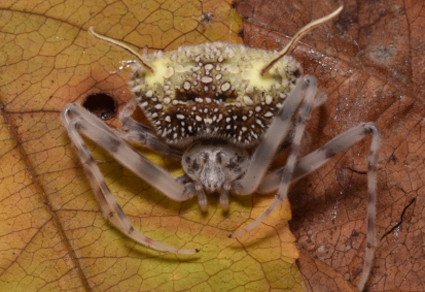
Herein, we describe a new species of the rare spider genus Taczanowskia Keyserling, 1879 (Araneae: Araneidae), Taczanowskia waska sp. nov. (♀) from the Ecuadorian Amazon. Additionally, we discuss its unique fungal mimicry, comment on Taczanowskia ecology, and provide an updated taxonomic key for females of the genus. The importance of this discovery extends well beyond the description of a novel taxon, representing the first reported case of Arachnid mimicry of an araneopathogenic fungus. Finally, we discuss the application of citizen science to collecting ecological and biogeographical data on arachnids and its potential use for describing new taxa.
References
- Álvarez-Padilla, F. & Hormiga, G. (2007) A protocol for digesting internal soft tissues and mounting spiders for scanning electron microscopy. Journal of Arachnology, 35, 538–542. https://doi.org/10.1636/Sh06-55.1
- Aristeidou, M., Herodotou, C., Ballard, H.L., Young, A.N., Miller, A.E., Higgins, L. & Johnson, R.F. (2021) Exploring the participation of young citizen scientists in scientific research: The case of iNaturalist. PLoS One, 16 (1), e0245682. https://doi.org/10.1371/journal.pone.0245682
- Bentley, A.G., Reyes-Puig, J.P., Hidalgo, A.B., Altamirano, J.A.H., Barragan-Paladines, M.E., Yanez-Munoz, M.H., Almeida-Reinoso, D., Guerra, M.A., Arboleda, J., Culebras, J., Fiallos Moreno, D.A., Saenz, J., Yoder, P.M., Best, D., Vizcarra Vasconez, R.S., Penafiel Flores, M.G., Franchini, A., Carlson, E., Segovia Larrea, J.I., Smitherman, I. & Gren, E.C.K. (2025) Snake (Serpentes, Reptilia) diversity in Mera, Ecuador: a citizen‑science approach to surveying a biodiversity hotspot of the western Amazon. Check List, 21 (5), 1–25. https://doi.org/10.15560/21.5.945
- Bertner, P. (2013) Observación en Wordpress. Available from: https://pbertner.wordpress.com/tips-for-arachnids-and-chilopoda-centipedes/?utm_source=chatgpt.com (accessed 14 August 2025)
- Coronado Antunes, T.G. (2021) Observación en iNaturalist. Available from: https://www.inaturalist.org/observations/71212725 (accessed 14 August 2025)
- Chandler, M., See, L., Copas, K., Bonde, A.M.Z., López, B.C., Danielsen, F., Legind, J.K., Masinde, S., Miller-Rushing, A.J., Newman, G., Rosemartin, A. & Turak, E. (2017) Contribution of citizen science towards international biodiversity monitoring. Biological Conservation, 213, 280–294. https://doi.org/10.1016/j.biocon.2016.09.004
- Damián-Parizaca, A., Karremans, A.P., Barona-Colmenares, A.A., Iturralde, G., Pérez, Á.J., De la Cruz, W., Jost, L., Garzón, H.X., Villalba-Vargas, D., Zenteno-Ruiz, F.S., Moya-Huanca, A.L., Castro, C., Pizango, J., Vilcatoma, E., Bentley, A.G., Jiménez, M.M., Baquero, L. & Mitidieri-Rivera, N. & Cameron, K.M. (2025) The Genus Vanilla (Orchidaceae) in South America—Bolivia, Colombia, Ecuador, and Peru: An Annotated Checklist with a New Species1. Annals of the Missouri Botanical Garden, 110 (1), 335–362. https://doi.org/10.3417/2025992
- Deschandol, F. (2023) Observación en iNaturalist. iNaturalist.org, Napo. Available from: https://www.inaturalist.org/observations/189425755 (accessed 14 August 2025)
- Dimitrov, D., Benavides, L.R., Arnedo, M.A., Giribet, G., Griswold, C.E., Scharff, N. & Hormiga, G. (2017) Rounding up the usual suspects: A standard target‑gene approach for resolving the interfamilial phylogenetic relationships of ecribellate orb‑weaving spiders with a new family‑rank classification (Araneae, Araneoidea). Cladistics, 33 (3), 221–250. https://doi.org/10.1111/cla.12165
- Díaz-Guevara, D.R., Macías-Tulcán, M. & Galvis, W. (2024) Taczanowskia yasuni new species: a new enigmatic species of spider (Araneidae) from the Ecuadorian Amazon canopy. Zootaxa, 5397 (2), 295–300. https://doi.org/10.11646/zootaxa.5397.2.11
- Eberhard, W.G. (1977) Aggressive chemical mimicry by a bolas spider. Science, 198, 1173–1175. https://doi.org/10.1126/science.198.4322.1173
- Eberhard, W.G. (1981) The natural history and behavior of the bolas spider Mastophora dizzydeani sp. n. (Araneidae). Psyche, 87, 143–169. https://doi.org/10.1155/1980/81062
- Eberhard, W.G. (1981) Notes on the natural history of Taczanowskia sp. (Araneae: Araneidae). Bulletin of the British Arachnological Society, 5 (4), 175–176.
- Fundación Natura. (2002) Proyecto Sangay: Identificación de áreas especiales para la conservación en el Parque Nacional Sangay y su área de influencia. Fundación Natura, Quito, 79 pp.
- Gemeno, C., Yeargan, K.V. & Haynes, K.F. (2000) Aggressive chemical mimicry by the bolas spider Mastophora hutchinsoni. Journal of Chemical Ecology, 26, 1235–1243. https://doi.org/10.1023/A:1005488128468
- Geurts, E.M., Reynolds, J.D. & Starzomski, B.M. (2023) Turning observations into biodiversity data: Broadscale spatial biases in community science. Ecosphere, 14 (6), e4582. https://doi.org/10.1002/ecs2.4582
- Hidalgo, A.B., Bentley, A.G., Mesonero, N., Miller, C., Benalcázar, O.T. & Culebras, J.C. (2025) First Dietary Records for Erythrolamprus guentheri (COLUBRIDAE): Ophiophagy of Tantilla melanocephala (COLUBRIDAE). Revista Latinoamericana de Herpetología, 8 (1), e1101-132. https://doi.org/10.22201/fc.25942158e.2025.1.1101
- Huber, B.A., Meng, G., Dupérré, N., Herrera, M., Inclán, D.J. & Wipfler, B. (2023) Humpback spiders from Ecuador: relationships, prosoma ‘inflation’ and genital asymmetry (Araneae: Pholcidae: Mecolaesthus). Invertebrate Systematics, 37 (2), 117–151. https://doi.org/10.1071/IS22052
- Jackson, R.R. & Whitehouse, M.E. (1986) The biology of New Zealand and Queensland pirate spiders (Araneae, Mimetidae): aggressive mimicry, araneophagy and prey specialization. Journal of Zoology, 210 (2), 279–303. https://doi.org/10.1111/j.1469-7998.1986.tb03635.x
- Jordán, J.P., Domínguez-Trujillo, M. & Cisneros-Heredia, D.F. (2021) Phylogenetic placement of the spider genus Taczanowskia (Araneae: Araneidae) and description of a new species from Ecuador. Invertebrate Systematics, 35 (7), 742–753. https://doi.org/10.1071/IS20084
- Kallal, R.J., Dimitrov, D., Arnedo, M.A., Giribet, G. & Hormiga, G. (2020) Monophyly, Taxon Sampling, and the Nature of Ranks in the Classification of Orb‑Weaving Spiders (Araneae: Araneoidea). Systematic Biology, 69 (3), 401–424. https://doi.org/10.1093/sysbio/syz043
- Kuntner, M., Gregoric, M., Cheng, R.-C. & Li, D. (2016) Leaf masquerade in an orb web spider. Journal of Arachnology, 44 (3), 397–400. https://doi.org/10.1636/JoA-S-16-027.1
- Levi, H.W. (2003) The bolas spiders of the genus Mastophora (Araneae: Araneidae). Bulletin of the Museum of Comparative Zoology, 157 (5), 309–382.
- Mesaglio, T., Soh, A., Kurniawidjaja, S. & Sexton, C. (2021) ‘First Known Photographs of Living Specimens’: the power of iNaturalist for recording rare tropical butterflies. Journal of Insect Conservation, 25 (5), 905–911. https://doi.org/10.1007/s10841-021-00350-7
- Nelson, X.J. & Jackson, R.R. (2009) Aggressive use of Batesian mimicry by an ant-like jumping spider. Biology letters, 5 (6), 755–757. https://doi.org/10.1098/rsbl.2009.0355
- Nelson, X.J. & Jackson, R.R. (2012) How spiders practice aggressive and Batesian mimicry. Current Zoology, 58 (4), 620–629. https://doi.org/10.1093/czoolo/58.4.620
- Omelko, M.M. (2025) New species and new records of Phrynarachne crab spiders (Araneae, Thomisidae) from Southeast Asia. ZooKeys, 1257, 55–70. https://doi.org/10.3897/zookeys.1257.165973
- Ortega, J.A., Brito, J. & Ron, S.R. (2022) Six new species of Pristimantis (Anura: Strabomantidae) from Llanganates National Park and Sangay National Park in Amazonian cloud forests of Ecuador. PeerJ, 10, e13761. https://doi.org/10.7717/peerj.13761
- Ortega-Andrade, H.M., Bentley, A., Koch, C., Yánez-Muñoz, M.H. & Entiauspe-Neto, O.M. (2022) A time relic: a new species of dwarf boa, Tropidophis Bibron, 1840 (Serpentes: Amerophidia), from the Upper Amazon Basin. European Journal of Taxonomy, 854 (1), 1–107. https://doi.org/10.5852/ejt.2022.854.2021
- Rettenmeyer, C.W. (1970) Insect mimicry. Annual review of entomology, 15 (1), 43–74. https://doi.org/10.1146/annurev.en.15.010170.000355
- Reyes-Puig, J.P., Ríos-Alvear, G. & Bentley, A.G. (2024a) Mamíferos Grandes y Medianos del Corredor de Conectividad Llanganates-Sangay. Serie de Publicaciones Instituto Nacional de Biodiversidad. Publicación Miscelánea N° 20. Instituto Nacional de Biodiversidad, Fundación Ecominga, Fundación Oscar Efrén Reyes, Waska Amazonía and World Wildlife Fund, Quito, Ecuador, 114 pp. [ISBN: 978-9942-620-12-5]
- Reyes-Puig, J.P., Yánez-Muñoz, M.H., Libke, Z., Vinueza, P. & Carrión-Olmedo, J.C. (2024b) Phylogenetic diversity of the Pristimantis anaiae species group, with a description of a new species of Pristimantis (Anura, Strabomantidae) from Cerro Candelaria, Tungurahua, Ecuador. Evolutionary Systematics, 8, 101–118. https://doi.org/10.3897/evolsyst.8.118855
- Ríos-Alvear, G., Meneses, P., Ortega-Andrade, H.M., Santos, C., Muzo, A., López, K.G. & Ron, S. (2024) Key connectivity areas in the Llanganates-Sangay Ecological Corridor in Ecuador: A participative multicriteria analysis based on a landscape species. Landscape and Urban Planning, 246, 105039. https://doi.org/10.1016/j.landurbplan.2024.105039
- Scharff, N. & Coddington, J.A. (2020) A phylogenetic analysis of the orb‑weaving spider family Araneidae (Arachnida, Araneae). Zoological Journal of the Linnean Society, 120 (4), 355–434. https://doi.org/10.1111/j.1096-3642.1997.tb01281.x
- Scharff, N., Coddington, J. A., Blackledge, T. A., Agnarsson, I., Framenau, V.W., Szűts, T., Hayashi, C.Y. & Dimitrov, D. (2020) Phylogeny of the orb‑weaving spider family Araneidae (Araneae: Araneoidea). Cladistics, 36 (1), 1–21. https://doi.org/10.1111/cla.12382
- Sherwood, D., Gabriel, R., Peñaherrera-R., P., León-E., R.J., Cisneros-Heredia, D.F., Brescovit, A.D. & Lucas, S.M. (2023f) Pamphobeteus Pocock, 1901: redescriptions, new species and records, description of a missing sex, with taxonomic notes and changes in Megaphobema Pocock, 1901 (Araneae: Theraphosidae). Arachnology, 19 (6), 894–930. https://doi.org/10.13156/arac.2023.19.6.894
- Tapuy-Avilés, Y., Díaz-Guevara, D.R. & Caterino, M.S. (2025) First record of Bibrax Fletcher, 1927 (Coleoptera, Staphylinidae, Pselaphinae) from Ecuador, with descriptions of twelve new species. ZooKeys, 1250, 105–133. https://doi.org/10.3897/zookeys.1250.156763
- Tomaszek, A. (2024) Observación en iNaturalist. Available from: https://www.inaturalist.org/observations/236712025 (accessed 14 August 2025)
- Tweed, J.M.H., Ashman, L.G. & Ślipiński, A. (2024) Excastra albopilosa, a remarkable new genus and species of Lamiinae (Insecta: Coleoptera: Cerambycidae) from southeastern Queensland, Australia. Australian Journal of Taxonomy, 54, 1–8. https://doi.org/10.54102/ajt.iv1x5
- Vargas, D., Pucha-Cofrep, D., Serrano-Vincenti, S., Burneo, A., Carlosama, L., Herrera, M., Oñate-Valdivieso, F. & Ballantyne, A. (2022) ITCZ precipitation and cloud cover excursions control Cedrela nebulosa tree‑ring oxygen and carbon isotopes in the northwestern Amazon. Global and Planetary Change, 211, 103791. https://doi.org/10.1016/j.gloplacha.2022.103791
- Wang, B., Xia, F., Engel, M.S., Perrichot, V., Shi, G., Zhang, H., Chen, J., Jarzembowski, E.A., Wappler, T. & Rust, J. (2016) Debris‑carrying camouflage among diverse lineages of Cretaceous insects. Science Advances, 2 (6), e1501918. https://doi.org/10.1126/sciadv.1501918
- Xu, C., Wang, B., Fan, L., Jarzembowski, E.A., Fang, Y., Wang, H., Kondorosy, E., Szwedo, J., Zhang, H. & Engel, M.S. (2022) Widespread mimicry and camouflage among mid‑Cretaceous insects. Gondwana Research, 101, 94–102. https://doi.org/10.1016/j.gr.2021.07.025
- Bentley, A.G., Reyes-Puig J.P., Carrión-Olmedo, J.C., Libke, Z., Culebras, J. & Yánez-Muñón, M,H. (2023) Anfibios y Reptiles del Corredor Ecológico Llanganates-Sangay. Serie de Publicaciones Instituto Nacional de Biodiversidad. Publicación Miscelánea N° 17. World Wildlife Fund, Quito, 114 pp. [ISBN: 978-9942-620-06-04]
- Zhang, Y.M., Sasan, K., O’Kennon, R.J. & Kranz, A.J. (2022) Discovery through iNaturalist: new species and new records of oak gall wasps (Hymenoptera: Cynipidae: Cynipini) from Texas, USA. Zootaxa, 5168 (1), 63–74. https://doi.org/10.11646/zootaxa.5168.1.5