

Abstract
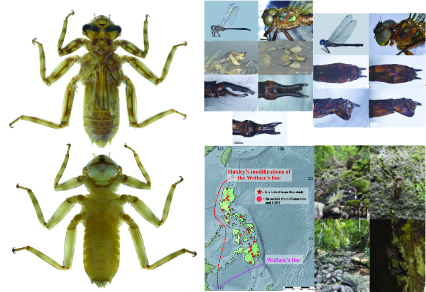
Heteronaias Needham & Gyger, 1937 is a monotypic genus represented solely by Heteronaias heterodoxa (Selys, 1878), a poorly documented corduliid. Based on reared specimens from Luzon, Philippines, we provide a detailed larval description, notes on adult morphology, and distributional data. Adult characters, particularly the vesica spermalis of male and female terminalia, are redescribed and illustrated. The larva is distinguished by a flattened body, 9–13 premental setae, 8–11 palpal setae, a poorly developed ligula, middorsal protuberances on abdominal segments 6–10, and a distinct episternal apophysis. Comparative analysis with Asian corduliid genera highlights diagnostic larval features valuable for taxonomy and phylogenetic studies. Larvae inhabit shaded forest streams and emerge on rock surfaces, showing rheophilic adaptations comparable to those of Zygonyx Selys in Hagen, 1867 (Libellulidae). Distributional records confirm that H. heterodoxa is endemic to the Philippines.
References
- Asahina, S. (1959) Diagnosis of the ultimate instar larvae of the four species of the Viridiaenea-group of Japanese Somatochlora (Corduliidae). Tombo, 2 (1/2), 7–10.
- Asahina, S. (1980) Notes on the Philippine Odonata in the Collection of the National Science Museum, Tokyo. Part I. Bulletin of the National Science Museum, Series A (Zoology), 6 (2), 77–100.
- Barve, V. & Hart, E. (2025) rinat: Access 'iNaturalist' data through APIs. R package version 0.1.9. Available from: https://docs.ropensci.org/rinat/ (accessed 4 June 2025)
- Bybee, S.M., Kalkman, V.J., Erickson, R.J., Frandsen, P.B., Breinholt, J.W., Suvorov, A., Dijkstra, K.-D.B., Cordero-Rivera, A., Skevington, J.H., Abbott, J.C., Sanchez Herrera, M., Lemmon, A.R., Lemmon, E.M. & Ware, J.L. (2021) Phylogeny and classification of Odonata using targeted genomics. Molecular Phylogenetics and Evolution, 160, 107115. https://doi.org/10.1016/j.ympev.2021.107115
- Campion, H. (1921) Odonata collected in New Caledonia by the late Mr Paul Montague. The Annals and Magazine of Natural History, Series 9, 8 (43), 33–67. https://doi.org/10.1080/00222932108632558
- Campion, H. & Laidlaw, F.F. (1928) Notes on oriental dragonflies (Odonata) with descriptions of new species. Proceedings of the Zoological Society of London, 1928 (1), 129–138. https://doi.org/10.1111/j.1469-7998.1928.tb07144.x
- Carle, F.L., Kjer, K.M. & May, M.L. (2015) A molecular phylogeny and classification of Anisoptera (Odonata). Arthropod Systematics & Phylogeny, 73 (2), 281–301. https://doi.org/10.3897/asp.73.e31805
- Chamberlain, S., Barve, V., Mcglinn, D., Oldoni, D., Desmet, P., Geffert, L. & Ram, K. (2024) rgbif: Interface to the Global Biodiversity Information Facility API. R Package Version 3.8.1. Available from: https://CRAN.R-project.org/package=rgbif (accessed 4 June 2025)
- Charpentier, T. (1840) Libellulinae Europae descriptae et depictae. Lisiae, Paris, 179 pp. https://doi.org/10.5962/t.173037
- Cho, S. (2021) Korean Odonata adult and larva. Gwangil Publishing Co., Gyeonggi, 404 pp.
- Dijkstra, K.-D.B., Bechly, G., Bybee, S.M., Dow, R.A., Dumont, H.J., Fleck, G., Garrison, R.W., Hämäläinen, M., Kalkman, V.J., Karube, H., May, M.L., Orr, A.G., Paulson, D.R., Rehn, A.C., Theischinger, G., Trueman, J.W.H., van Tol, J. & von Ellenrieder, N. & Ware, J. (2013) The classification and diversity of dragonflies and damselflies (Odonata). In: Zhang, Z.-Q. (Ed.,) Animal Biodiversity: An Outline of Higher-level Classification and Survey of Taxonomic Richness (Addenda 2013). Zootaxa, 3703 (1), 36–45. https://doi.org/10.11646/zootaxa.3703.1.9
- Dijkstra, K.D.B., Suhling, F. & Müller, O. (2006) Review of the genus Zygonoides, with description of the larvae and notes on 'zygonychine' Libellulidae (Odonata). Tijdschrift voor Entomologie, 149 (2), 275–292. https://doi.org/10.1163/22119434-900000204
- Dumont, H.J., Vierstraete, A. & Vanfleteren, J.R. (2010) A molecular phylogeny of the Odonata (Insecta). Systematic Entomology, 35, 6–18. https://doi.org/10.1111/j.1365-3113.2009.00489.x
- Fleck, G. (2007) Contribution à la connaissance des Odonates de Nouvelle-Calédonie: une larve du genre Metaphya Laidlaw, 1912 (Anisoptera, Corduliidae). Bulletin de la Société entomologique de France, 112 (2), 183–186. https://doi.org/10.3406/bsef.2007.16419
- Fleck, G., Brenk, M. & Misof, B. (2008) Larval and molecular characters help to solve phylogenetic puzzles in the highly diverse family Libellulidae (Insecta: Odonata: Anisoptera): The Tetrathemistinae are a polyphyletic group. Organisms Diversity and Evolution, 8 (1), 1–16. https://doi.org/10.1016/j.ode.2006.08.003
- GBIF.org (2025) Derived dataset: Filtered export of GBIF occurrence data. Available from: https://www.gbif.org/derivedDataset/10.15468/dd.34w2za (accessed 7 November 2025) https://doi.org/10.15468/dd.34w2za
- Goodman, A., Abbott, J.C., Bybee, S., Ehlert, J., Frandsen, P.B., Guralnick, R., Kalkman, V.J., Newton, L., Pinto, A.P. & Ware, J.L. (2025) Systematic and taxonomic revision of emerald and tigertail dragonflies (Anisoptera: Synthemistidae and Corduliidae). Systematic Entomology, 49 (2), e70000, 221–242. https://doi.org/10.1111/syen.70000
- Hagen, H.A. (1867) Notizen beim Studium von Brauer’s Novara–Neuropteren. Verhandlungen der Zoologisch–Botanischen Gesellschaft in Wien, 17, 31–62.
- Hämäläinen, M. & Müller, R.A. (1997) Synopsis of the Philippine Odonata, with lists of species recorded from forty islands. Odonatologica, 26 (3), 249–315.
- Ishida, K. (1996) Monograph of Odonata larvae in Japan. Hokkaido University Press, Sapporo, 446 pp.
- Keetapithchayakul, T.S., Kim, J., Lam, N.B.V. & Phan, Q.T. (2025) Description of the larva of Anotogaster klossi Fraser, 1919 (Odonata, Cordulegastroidea, Cordulegastridae), with a note on the known larvae of the genus Anotogaster Selys, 1854. Zootaxa, 5632 (2), 349–363. https://doi.org/10.11646/zootaxa.5632.2.8
- Laidlaw, F.F. (1912) On a new genus and species of Odonata from Sarawak. Sarawak Museum Journal, 1 (2), 65–67, 1 pl.
- Lee, J.-E. & Jung, K.-S. (2012) Insect fauna of Korea. Vol. 4. No. 2. Arthropoda: Insecta: Odonata: Corduliidae, Macromiidae, Libellulidae – Dragonflies. National Institute of Biological Resources, Incheon, 82 pp.
- Lieftinck, M.A. (1933) The life-history of Procordulia artemis Lieft. (Odon., Cordul.), with comparative notes on the biology of P. sumbawana (Förster). Internationale Revue der gesamten Hydrobiologie und Hydrographie, 28, 399–440. https://doi.org/10.1002/iroh.19330280503
- Martin, R. (1907) Cordulines. In: Collections zoologiques du Baron Edm. de Selys Longchamps. Catalogue systématique et descriptif. Vol. 17. Hayez, Bruxelles, pp. 1–94. [1906]
- Matsuki, K., Obana, S. & Miki, Y. (1985) The larvae of the genus Hemicordulia of Japan (Odonata: Corduliidae). Gekkan-Mushi, 177, 13–15.
- Morse, J.C., Yang, L. & Tian, L. (1994) Aquatic insects of China useful for monitoring water quality. Hohai University Press, Nanjing, 570 pp.
- Needham, J.G. & Gyger, M.K. (1937) The Odonata of the Philippines. Philippine Journal of Science, 63 (1), 21–482.
- Novelo-Gutierrez, R. & Sites, R.W. (2024) The Dragonfly Nymphs of Thailand (Odonata: Anisoptera): An identification Guide to Families and Genera. Springer Nature Switzerland AG, Cham, [xxi] + 501 pp. https://doi.org/10.1007/978-3-031-33712-3
- Nguyen, M.T., Ignatius, K.J., Sunprasit, S., Phan, Q.T. & Keetapithchayakul, T.S. (2024) Description of final stadium larva of Dysphaea gloriosa Fraser, 1938, (Odonata: Euphaeidae) with notes on its habitat and biology. Zootaxa, 5447 (3), 385–396. https://doi.org/10.11646/zootaxa.5447.3.4
- Orr, A.G. (2024) A review of present knowledge of larvae of the Calopterygoidea (Zygoptera) of the Oriental realm, including keys to families and known genera. Zootaxa, 5497 (2), 209–243. https://doi.org/10.11646/zootaxa.5497.2.3
- Paulson, D., Schorr, M., Abbott, J., Bota-Sierra, C., Deliry, C., Dijkstra, K.-D. & Lozano, F. (Coords.) (2025) World Odonata List. OdonataCentral, University of Alabama, Tuscaloosa, Alabama. Available from: https://www.odonatacentral.org/app/#/wol/ (accessed 7 July 2025).
- Phan, Q.T. & Keetapithchayakul, T.S. (2023) First descriptions of the final stadium larva of Heliogomphus chaoi Karube, 2004 and the adult female of Microgomphus jurzitzai Karube, 2000 from Vietnam (Odonata: Gomphidae). Zootaxa, 5318 (1), 38–96. https://doi.org/10.11646/zootaxa.5318.1.4
- Phan, Q.T. & Keetapithchayakul, T.S. (2024) Description of the final stadium larva of Cryptophaea vietnamensis (van Tol & Rozendaal, 1995) (Odonata: Euphaeidae) from Vietnam. Zootaxa, 5512 (1), 93–102. https://doi.org/10.11646/zootaxa.5512.1.7
- Selys-Longchamps, E. de (1869) Odonates des Iles Seychelles. Annales de la Société Entomologique de Belgique, 12, 95–99.
- Selys-Longchamps, E. de (1870) Sous-famille des Cordulines, Selys (1). In: Comptes-rendus des seances de la societe entomologique de Belgique: Assemblee mensuelle du 5 novembre 1870. Annales de la Societe entomologique de Belgique, 14, pp. 4–7. https://doi.org/10.5962/bhl.part.13349
- Selys-Longchamps, E. de (1871) Synopsis des Cordulines. Bulletin de l’Académie Royale de Belgique, 31, 239–316, 519–565.
- Selys-Longchamps, E. de (1878) Secondes additions au synopsis des Cordulines. Bulletins de l’Académie Royale des Sciences, des Lettres et des Beaux-Arts de Belgique, 45, 183–222.
- Shorthouse, D.P. (2010) SimpleMappr, an online tool to produce publication-quality point maps. Available from: http://www.simplemappr.net (accessed 4 June 2025)
- Steinmann, H. (1997) World catalogue of Odonata. Volume II Anisoptera. De Gruyter, Berlin, New York, 636 pp. https://doi.org/10.1515/9783110824438
- Theischinger, G. & Fleck, G. (2003) A new character useful for taxonomy and phylogeny of Anisoptera (Odonata). Bulletin de la Société Entomologique de France, 108 (4), 409–412. https://doi.org/10.3406/bsef.2003.16992
- Villanueva, R.J.T., Cahilog, H., Jose, E. & van Beijnen, J. (2018) A brief odonatological survey in Palawan and in Cuyo Island, the Philippines. International Dragonfly Fund – Report, 119, 1–12.
- Walker, E.M. (1925) The North American dragonflies of the genus Somatochlora. University of Toronto Studies, Biological Series, 26, 1–202, pls. 1–35 (excl.).
- Ware, J., May, M. & Kjer, K. (2007) Phylogeny of the higher Libelluloidea (Anisoptera: Odonata): An exploration of the most speciose superfamily of dragonflies. Molecular Phylogenetics and Evolution, 45 (1), 289–310. https://doi.org/10.1016/j.ympev.2007.05.027
- Ware, J., Abbott, J., Abbott, K., Beatty, C.D., Bota-Sierra, C.A., Büsse, S., Cano-Cobos, Y., Combey, R., Ehlert, J., Fomekong-Lontchi, J., Frandsen, P., Goodman, A., Guralnick, R., Juen, L., Kalkman, V.J., Kemabonta, K., Kohli, M., Lupiyaningdyah, P., Newton, L., Onsongo, V., Pessacq, P., Pinto, Â.P., Ferreira, R.G., Salas, R., Sanchez Herrera, M., Sutherland, L., Tennessen, K., Tolman, E., Uche Dike, R., Wellenreuther, M. & Bybee, S. (2025) Odonata systematics: past, present, and future: a review of the phylogenetic works in Anisoptera (dragonflies). Insect Systematics and Diversity, 9 (4), ixaf030. https://doi.org/10.1093/isd/ixaf030
- Watson, M.C. (1956) The utilization of mandibular armature in taxonomic studies of anisopterous nymphs. Transactions of the American Entomological Society, 81, 155–202.
- Wickham, H., Averick, M., Bryan, J., Chang, W., McGowan, L.D., François, R., Grolemund, G., Hayes, A., Henry, L., Hester, J., Kuhn, M., Pedersen, T.L., Miller, E., Bache, S.M., Müller, K., Ooms, J., Robinson, D., Seidel, D.P., Spinu, V., Takahashi, K., Vaughan, D., Wilke, C., Woo, K. & Yutani, H. (2019) Welcome to the tidyverse. Journal of Open Source Software, 4 (43), 1686. https://doi.org/10.21105/joss.01686
- Yu, X. (2026) Description of the final stadium larva of Priscagrion kiautai Zhou & Wilson (Zygoptera: Priscagrionidae). Zootaxa, 5741 (1), 192–196. https://doi.org/10.11646/zootaxa.5741.1.9
- Xu, Q.-H. (2016) Description of the final stadium larva of Philoganga vetusta Ris, with discussion of the taxonomic characters of the larvae of the genus Philoganga Kirby (Odonata: Philogangidae). International Journal of Odonatology, 19 (1–2), 69–74. https://doi.org/10.1080/13887890.2016.1181009