

Abstract
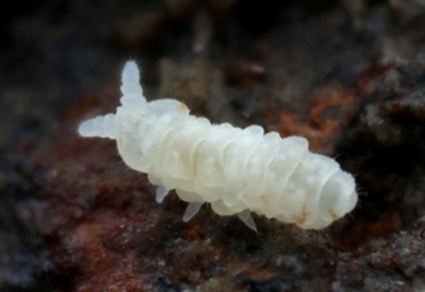
A new species, Anurida huangxiei sp. nov., discovered from the bank of the Huangpu River in Shanghai, East China, is described and illustrated. It is characterized by the special reticulations on the body, the absence of ocelli, 18–22 elliptical vesicles on PAO, six blunt sensilla with distinct heel and trilobed apical vesicle on Ant. IV, seta p3 in front of p2–p4 line on thoracic segments II and III, seta p2 present on Abd. I–IV, and slender sensilla on dorsal side. In addition, the complete mitochondrial genome of the new species was sequenced and analyzed. Its COI barcode was also compared with other 19 species of the subfamily Pseudachorutinae and the genetic distances between them were calculated.
References
- Anslan, S. & Tedersoo, L. (2015) Performance of cytochrome c oxidase subunit I (COI), ribosomal DNA Large Subunit (LSU) and Internal Transcribed Spacer 2 (ITS2) in DNA barcoding of Collembola. European Journal of Soil Biology, 69, 1–7. https://doi.org/10.1016/j.ejsobi.2015.04.001
- Babenko, A.B. & Nakamori, T. (2021) A new Anurida species of the hammerae‐group from the Russian Far East (Collembola, Neanuridae). Zootaxa, 4995 (2), 367–374. https://doi.org/10.11646/zootaxa.4995.2.9
- Babenko, A.B. & Potapov, M.B. (2025) New or little‐known species of springtails (Collembola: Hypogastruridae, Isotomidae) with uncommon chaetotaxy from India and Nepal. Russian Entomological Journal, 34 (2), 155–166. https://doi.org/10.15298/rusentj.34.2.01
- Babenko, A.B., Nakamori, T., Ohira, A. & Potapov, M.B. (2021) The genus Ceratrimeria Börner, 1906 (Collembola, Neanuridae, Pseudachorutinae) in the fauna of Japan. Far East Entomologist, 442, 18–32. https://doi.org/10.25221/fee.442.4
- Babenko, A.B., Shveenkova, Yu.B. & Kuznetsova, N.A. (2019) New species of the genus Anurida (Collembola, Neanuridae) from the Far East of Russia. Zoologicheskii Zhurnal, 98 (2), 130–148. https://doi.org/10.1134/S004451341902003X
- Bellinger, P.F., Christiansen, K.A. & Janssens, F. (1996–2024) Checklist of the Collembola of the World. Available from: https://www.collembola.org (accessed 15 June 2025)
- Birney, E., Clamp, M. & Durbin, R. (2004) GeneWise and genomewise. Genome Research, 14, 988–995. https://doi.org/10.1101/gr.1865504
- Börner, C. (1906) Das System der Collembolen nebst Beschreibung neuer Collembolen des Hamburger Naturhistorischen Museums. Mitteilungen aus den Naturhistorischen Museum in Hamburg, Bd., 23, 147–188.
- Börner, C. (1901) Neue Collembolen formen und zur Nomenclatur der Collembola Lubb. Zoologischer Anzeiger, 24 (657/658), 696–712.
- Börner, C. (1901) Zur Kenntnis der Apterygoten‐Fauna von Bremen und der Nachbardistrikte. Beitrag zu einer Apterygoten‐Fauna Mitteleuropas. Abhandlungen des Naturwissenschaftlichen Vereins zu Bremen, 17 (1), 1–140. https://doi.org/10.5962/bhl.part.18332
- Cucini, C., Fanciulli, P.P., Frati, F., Convey, P., Nardi, F. & Carapelli, A. (2021) Re‐evaluating the internal phylogenetic relationships of Collembola by means of mitogenome data. Genes, 12, 1–20. https://doi.org/10.3390/genes12010044
- Deharveng, L. (1983) Morphologie évolutive des Collemboles Neanurinae en particulier de la lignée Néanurienne. Travaux du Laboratoire d’Ecobiologie des Arthropodes Edaphiques, Toulouse, 4 (2), 1–63.
- deWaard, J.R., Ratnasingham, S., Zakharov, E.V., Borisenko, A.V., Steinke, D., Telfer, A.C., Perez, K.H.J., Sones, J.E., Young, M.R., Levesque-Beaudin, V., Sobel, C.N., Abrahamyan, A., Bessonov, K., Blagoev, G., deWaard, S.L., Ho, C., Ivanova, N.V., Layton, K.K.S., Lu, L., Manjunath, R., McKeown, J.T.A., Milton, M.A., Miskie, R., Monkhouse, N., Naik, S., Nikolova, N., Pentinsaari, M., Prosser, S.W.J., Radulovici, A.E., Steinke, C. & Warne, C.P. (2019) A reference library for Canadian invertebrates with 1.5 million barcodes, voucher specimens, and DNA samples. Scientific Data, 6 (1), 308. https://doi.org/10.1038/s41597-019-0320-2
- Dong, J., Zhang F. & Wang, X. (2020) Complete mitochondrial genome of Pseudachorutes palmiensis (Collembola: Neanuridae). Mitochondrial DNA Part B, 5 (1), 394–395. https://doi.org/10.1080/23802359.2019.1704187.
- Gama, M.M. (1971) Nouvelle contribution à la connaissance du genre Xenylla (Insecta: Collembola). Khumbu Himal: Ergebnisse des Forschungsunternehmens Nepal Himalaya, 4 (1), 152–155.
- Gao, Y. & Bu, Y. (2025) Three new species of Philotella (Collembola, Neanuridae, Pseudachorutinae) from China with the DNA barcoding analysis. Zootaxa, 5701 (2), 179–190. https://doi.org/10.11646/zootaxa.5701.2.6
- Gertz, E.M., Yu, Y.K., Agarwala, R., Schäffer, A.A. & Altschul, S.F. (2006) Composition‐based statistics and translated nucleotide searches: improving the TBLASTN module of BLAST. BMC Biology, 4, 41–54. https://doi.org/10.1186/1741-7007-4-41
- Jühling, F., Putz, J., Bernt, M., Donath, A., Middendorf, M., Florentz, C. & Stadler, P.F. (2012) Improved systematic tRNA gene annotation allows new insights into the evolution of mitochon‐drial tRNA structures and into the mechanisms of mitochondrial genome rearrange‐ments. Nucleic Acids Research, 40, 2833–2845. https://doi.org/10.1093/nar/gkr1131
- Karlicki, M., Antonowicz, S. & Karnkowska, A. (2022) Tiara: deep learning‐based classification system for eukaryotic sequences. Bioinformatics, 38 (2), 344–350. https://doi.org/10.1093/bioinformatics/btab672
- Kimura, M. (1980) A simple method for estimating evolutionary rate of base substitutions through comparative studies of nucleotide sequences. Journal of Molecular Evolution, 16 (2), 111–120. https://doi.org/10.1007/BF01731581
- Krzywinski, M., Schein, J., Birol, I., Connors, J., Gascoyne, R., Horsman, D., Jones, S.J. & Marra, M.A. (2009) Genome Research, 19, 1639–1645. https://doi.org/10.1101/gr.092759.109
- Kumar, S., Stecher, G., Li, M., Knyaz, C. & Tamura, K. (2018) MEGA X: Molecular Evolutionary Genetics Analysis across computing platforms. Molecular Biology and Evolution, 35 (6), 1547–1549. https://doi.org/10.1093/molbev/msy096
- Laboulbène, A. (1865) Recherches sur l’Anurida maritima, Insecte Thysanoure de la famille des Podurides. Annales de la Société entomologique de France, 4 (4), 705–720.
- Lee, B.H. (1983) A new subfamily Caputanurinae with two species of neanurid Collembola from Korea and the evolutionary consideration. The Korean Journal of Entomology, 13 (1), 27–36.
- Li, D., Liu, C.M., Luo, R., Sadakane, K. & Lam, T.W. (2015) MEGAHIT: An ultra‐fast single‐node solution for large and complex metagenomics assembly via succinct de Bruijn graph. Bioinformatics, 31 (10), 1674–1676. https://doi.org/10.1093/bioinformatics/btv033
- Li, H. & Durbin, R. (2009) Fast and accurate short read alignment with Burrows-Wheeler transform. Bioinformatics, 25, 1754–60. https://doi.org/10.1093/bioinformatics/btp324
- Meng, G., Li, Y., Yang, C. & Liu, S. (2019) MitoZ: a toolkit for animal mitochondrial genome assembly, annotation and visualization. Nucleic Acids Research, 47, e63. https://doi.org/10.1093/nar/gkz173
- Nawrocki, E.P. & Eddy, S.R. (2013) Infernal 1.1:100‐fold faster RNA homology searches. Bioinformatics, 29, 2933–2935. https://doi.org/10.1093/bioinformatics/btt509
- Nicolet, H. (1847) Essai sur une Classification des Insectes aptères, de l'ordre des Thysanoures. Annales de la Société Entomologique de France, Deuxième Série, Tome Cinquième, 335–395.
- Ohira, A., Nakamori, T., Matsumoto, S., Bessho-Uehara, M., Kato, T. & Oba, Y. (2023) Contribution to the taxonomy of Lobellini (Collembola: Neanurinae) and investigations on luminous Collembola from Japan. Zootaxa, 5325 (1), 63–89. https://doi.org/10.11646/zootaxa.5325.1.4
- Oliveira, F.G.L., Arbea, J.I., Wirkner, C.S. & Godeiro, N.N. (2025) An integrated taxonomic and phylogenetic study of Neanuroidea (Poduromorpha). Zoological Journal of the Linnean Society, 204, zlaf028. https://doi.org/10.1093/zoolinnean/zlaf028
- Shaw, P. & Benefer, C.M. (2015) Development of a barcoding database for the UK Collembola: early Results. Soil Organisms, 87 (3), 197–202.
- Stevens, M.I., Greenslade, P. & D'Haese, C.A. (2021) Species diversity of Friesea (Neanuridae) reveals similar biogeographic patterns among Antarctic Collembola. Zoologica Scripta, 50 (5), 647–657. https://doi.org/10.1111/zsc.12490
- Tamura, H. & Zhao, L. (1997) Two new species of the family Pseudachorutidae from Mt. Jizu, western Yunnan, southwest China (Insecta: Collembola). Natural History Bulletin of Ibaraki University, 1, 45–50.
- Timmermans, M.J.T.N., Arbea, J.I., Campbell, G., King, M.C., Prins, A. & Kett, S. (2021) Mitochondrial genome divergence supports an ancient origin of circatidal behaviour in the Anurida maritima (Collembola: Neanuridae) species group. Organisms Diversity & Evolution, 22 (1), 131–140. https://doi.org/10.1007/s13127-021-00503-1
- Wheeler, T.J. & Eddy, S.R. (2013) nhmmer: DNA homology search with profile HMMs. Bioinformatics, 29, 2487–2489. https://doi.org/10.1093/bioinformatics/btt403
- Yosii, R. (1971) Collembola of Khumbu Himal. Khumbu Himal, 4 (1), 80–130.
- Yue, Q. & Yin, W. (1999) Two new species of Collembola (Arthropleona: Neanuridae, Pseudachorutidae) from Shanghai, China. Entomologica Sinica, 6 (3), 222–226. https://doi.org/10.1111/j.1744-7917.1999.tb00115.x