

Abstract
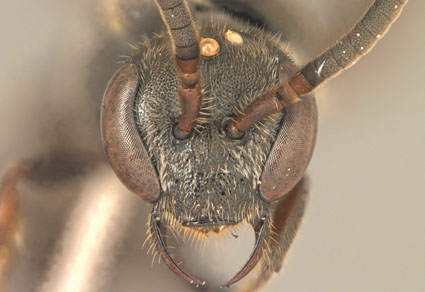
Sphecodini is a tribe with worldwide distribution, exhibiting a distinctive western hemispherical fauna composed of six genera and approximately 138 species. Among these genera, Ptilocleptis is unique due to its distinctive synapomorphies and its rarity in entomological collections. In this study, Ptilocleptis mictlan Quintos-Andrade sp. nov. is described from Mexico, new distributional records of P. tomentosa Michener within Mexico are presented, and an identification key to the species of Ptilocleptis is provided. The diversity of Ptilocleptis, its potential hosts, and most important diagnostic characters to delimit species are discussed.
References
- Ascher, J.S. & Pickering, J. (2020) Discover life bee species guide and world checklist (Hymenoptera: Apoidea: Anthophila). Available from: http://www.discoverlife.org/mp/20q?guide=Apoidea_species&flags=HAS (accessed 30 June 2025)
- Engel, M.S. (2024) On the classification of sphecodine bees (Hymenoptera: Halictidae). Entomologist's Monthly Magazine, 160 (1), 1–52. https://doi.org/10.31184/M00138908.1601.4204
- García, E. (1973) Modificaciones al Sistema de Clasificación Climática de Köppen. Instituto de Geografía UNAM, Mexico City, 41 pp.
- Gibbs, J., Albert, J. & Packer, L. (2012) Dual origins of social parasitism in North American Dialictus (Hymenoptera: Halictidae) confirmed using a phylogenetic approach. Cladistics, 28 (2), 195–207. https://doi.org/10.1111/j.1096-0031.2011.00373.x
- Gonçalves, R.B. (2021) A revised genus-level classification for the Neotropical groups of the cleptoparasitic bee tribe Sphecodini Schenck (Hymenoptera, Apidae, Halictinae). Revista Brasileira de Entomologia, 65 (1), ee20200094. https://doi.org/10.1590/1806-9665-RBENT-2020-0094
- Gonçalves, R.B., De Meira, O.M. & Rosa, B.B. (2022) Total-evidence dating and morphological partitioning: a novel approach to understand the phylogeny and biogeography of augochlorine bees (Hymenoptera: Apoidea). Zoological Journal of the Linnean Society, 195 (4), 1390–1406. https://doi.org/10.1093/zoolinnean/zlab098
- Graham, L. & Packer, L. (2024) Three New Species of Microsphecodes s. str. (Hymenoptera: Halictidae) with an updated key to species of the subgenus. Zootaxa, 5404 (1), 189–205. https://doi.org/10.11646/zootaxa.5404.1.12
- Harvard University, Museum of Comparative Zoology (2018) MCZbase, Museum of Comparative Zoology, Harvard University. Museum of Comparative Zoology, Harvard University, Cambridge, Massachusetts, Occurrence Dataset. Available from: http://digir.mcz.harvard.edu/ipt/resource?r=mczbase (accessed 31 May 2024) https://doi.org/10.15468/p5rupv
- Lim, K., Lee, S., Orr, M. & Lee, S. (2022) Harrison’s rule corroborated for the body size of cleptoparasitic cuckoo bees (Hymenoptera: Apidae: Nomadinae) and their hosts. Scientific reports, 12 (1), 10984. https://doi.org/10.1038/s41598-022-14938-9
- Michener, C.D. (1978) The parasitic groups of halictidae (Hymenoptera, Apoidea). The University of Kansas Science Bulletin, 51 (10), 291. https://doi.org/10.5962/bhl.part.24961
- Michener, C.D. (2007) The Bees of the World, 2nd Edition. John Hopkins University Press, Baltimore, Maryland, xiv + [i] + 953 pp., 20 pls.
- Morrone, J.J., Escalante, T., Rodríguez-Tapia, G., Carmona, A., Arana, M. & Mercado-Gómez, J.D. (2022) Biogeographic regionalization of the Neotropical region: New map and shapefile. Anais da Academia Brasileira de Ciências, 94, e20211167. https://doi.org/10.1590/0001-3765202220211167
- Moure, J.S. & Melo, G.A.R. (2022) Halictini Thomson, 1869. In: Moure, J.S., Urban, D. & Melo, G.A.R. (Eds.), Catalogue of Bees (Hymenoptera, Apoidea) in the Neotropical Region - online version. Sociedade Brasileira de Entomologia, Curitiba. Available from: https://www.moure.cria.org.br/catalogue (accessed 30 June 2025)
- Shorthouse, D.P. (2010) SimpleMappr, an online tool to produce publication-quality point maps. Available from: https://www.simplemappr.net (accessed 30 June 2025)