

Abstract
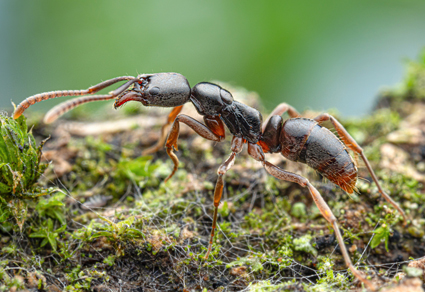
We report the first confirmed occurrence in Germany of the Asian needle ant, Brachyponera chinensis (Emery, 1895), from a complete outdoor colony collected in the Rosensteinpark of Stuttgart during a BioBlitz on 2 June 2025. Based on additional records from Rosensteinpark, it appears that this may be an established local population, capable of surviving over winter, in contrast to other, incidental occurrences in the country. Brachyponera chinensis is native to East Asia and is known as both an ecologically disruptive invasive in parts of the southeastern United States and as a species of medical concern due to allergic reactions from their stings. To aid in morphology-based identification, we refine the diagnosis of this species relative to close congeners. Our record, verified by voucher specimens and morphological comparison, represents a potential early-stage introduction of B. chinensis into Central Europe. The species was likely introduced to the Rosensteinpark through horticultural specimen transfer, as the park includes the zoological-botanical garden Wilhelma. The finding raises questions about possible urban establishment and future spread and emphasizes the need for ongoing monitoring of the ant fauna in Germany.
References
- Báthori, F., Herczeg, G., Vilizzi, L., Jégh, T., Kakas, C., Petrovics, M. & Csősz, S. (2024) A survey and risk screening of non-native ant species colonising greenhouses in Hungary. Biological Invasions, 26 (4), 1033–1044. https://doi.org/10.1007/s10530-023-03227-9
- Bertelsmeier, C., Guénard, B. & Courchamp, F. (2013) Climate change may boost the invasion of the Asian needle ant. PLoS One, 8 (10), e75438. https://doi.org/10.1371/journal.pone.0075438
- Chen, C., Yu, Y. & Yi, C. (2025) Revision of the Chinese species of the genus Brachyponera Emery, 1900 (Hymenoptera, Formicidae), with a key to the world species of the genus. ZooKeys, 1230, 247. https://doi.org/10.3897/zookeys.1230.140159
- Doré, M., Borowiec, M.L., Branstetter, M.G., Camacho, G.P., Fisher, B.L., Longino, J.T. & Blaimer, B.B. (2025) Evolutionary history of ponerine ants highlights how the timing of dispersal events shapes modern biodiversity. Nature Communications, 16 (1), 8297. https://doi.org/10.1038/s41467-025-63709-3
- Espadaler, X., Pradera, C. & Santana, J.A. (2018) The first outdoor-nesting population of Wasmannia auropunctata in continental Europe (Hymenoptera, Formicidae). Iberomyrmex, 10, 1–8.
- EU IAS (2025) European Union Invasive Alien Species. Available from: https://environment.ec.europa.eu/topics/nature-and-biodiversity/invasive-alien-species_en (accessed 14 December 2025)
- Eyer, P.-A., Matsuura, K., Vargo, E.L., Kobayashi, K., Yashiro, T., Suehiro, W., Himuro, C., Yokoi, T., Guénard, B., Dunn, R.R. & Tsuji, K. (2018) Inbreeding tolerance as a pre‐adapted trait for invasion success in the invasive ant Brachyponera chinensis. Molecular Ecology, 27 (23), 4711–4724. https://doi.org/10.1111/mec.14910
- Fisher, B.L., Branstetter, M.G., Blaimer, B.B., Borowiec, M.L., Camacho, G.P., Doré, M., Ward, P.S. & Longino, J.T. (2025) A genus-level classification of the ant subfamily Ponerinae (Hymenoptera, Formicidae). ZooKeys, 1264, 281–349. https://doi.org/10.3897/zookeys.1264.173399
- Freyhof, E. & Janke, E. (2024) Introduced greenhouse-invertebrates in Potsdam and Berlin with a focus on ants (Hymenoptera, Formicidae) with eight new records for Europe, Germany or the Berlin-Brandenburg region. Contributions to Entomology, 74 (2), 235–248. https://doi.org/10.3897/contrib.entomol.74.e136784
- Global Invasive Species Database (2025) Global Invasive Species Database. Available from: http://www.iucngisd.org/gisd/100_worst.php (accessed 13 December 2025)
- Guénard, B. & Dunn, R.R. (2010) A new (old), invasive ant in the hardwood forests of eastern North America and its potentially widespread impacts. PLoS One, 5 (7), e11614. https://doi.org/10.1371/journal.pone.0011614
- Guénard, B., Wetterer, J.K. & MacGown, J.A. (2018) Global and temporal spread of a taxonomically challenging invasive ant, Brachyponera chinensis (Hymenoptera: Formicidae). Florida Entomologist, 101, 649–656. https://doi.org/10.1653/024.101.0402
- Holway, D.A., Lach, L., Suarez, A.V., Tsutsui, N.D. & Case, T.J. (2002) The causes and consequences of ant invasions. Annual Review of Ecology and Systematics, 33 (1), 181–233. https://doi.org/10.1146/annurev.ecolsys.33.010802.150444
- Matsuura, K. (2002) Colony-level stabilization of soldier head width for head-plug defense in the termite Reticulitermes speratus (Isoptera: Rhinotermitidae). Behavioral Ecology and Sociobiology, 51, 172–179. https://doi.org/10.1007/s00265-001-0426-2
- Menchetti, M., Schifani, E., Gentile, V. & Vila, R. (2022) The worrying arrival of the invasive Asian needle ant Brachyponera chinensis in Europe (Hymenoptera: Formicidae). Zootaxa, 5115 (1), 146–150. https://doi.org/10.11646/zootaxa.5115.1.10
- Menchetti, M., Schifani, E., Alicata, A., Cardador, L., Sbrega, E., Toro-Delgado, E. & Vila, R. (2023) The invasive ant Solenopsis invicta is established in Europe. Current Biology, 33 (17), R896–R897. https://doi.org/10.1016/j.cub.2023.07.036
- Menchetti, M., Schifani, E., Alicata, A., Cardador, L., Sbrega, E., Toro-Delgado, E. & Vila, R. (2024) Response to Genovesi et al.: Ant biosurveillance should come before invasion. Current Biology, 34 (2), R51–R52. https://doi.org/10.1016/j.cub.2023.11.055
- Nelder, M.P., Paysen, E.S., Zungoli, P.A. & Benson, E.P. (2006) Emergence of the introduced ant Pachycondyla chinensis (Formicidae: Ponerinae) as a public health threat in the southeastern United States. Journal of Medical Entomology, 43 (5), 1094–1098. https://doi.org/10.1093/jmedent/43.5.1094
- OJEU [Official Journal of the European Union] (2025) Commission Implementing Regulation (EU), 2025/1422. Available from: https://eur-lex.europa.eu/eli/reg_impl/2025/1422/oj/eng (accessed 24 February 2026)
- Schifani, E. (2019) Exotic ants (Hymenoptera, Formicidae) invading mediterranean Europe: a brief summary over about 200 years of documented introductions. Sociobiology, 66 (2), 198–208. https://doi.org/10.13102/sociobiology.v66i2.4331
- Schifani, E., Grunicke, D., Montechiarini, A., Pradera, C., Vila, R. & Menchetti, M. (2024) Alien ants spreading through Europe: Brachyponera chinensis and Nylanderia vividula in Italy. Biodiversity Data Journal, 12, e123502. https://doi.org/10.3897/BDJ.12.e123502
- Schmidt, C.A. & Shattuck, S.O. (2014) The higher classification of the ant subfamily Ponerinae (Hymenoptera: Formicidae), with a review of ponerine ecology and behavior. Zootaxa, 3817 (1), 1–242. https://doi.org/10.11646/zootaxa.3817.1.1
- Suehiro, W., Hyodo, F., Tanaka, H.O., Himuro, C., Yokoi, T., Dobata, S., Guénard, B., Dunn, R.R., Vargo, E.L., Tsuji, K. & Matsuura, K. (2017) Radiocarbon analysis reveals expanded diet breadth associates with the invasion of a predatory ant. Scientific Reports, 7 (1), 15016. https://doi.org/10.1038/s41598-017-15105-1
- Tschinkel, W.R. (2013) The Fire Ants. Belknap Press, Cambridge, Massachusetts, 752 pp. https://doi.org/10.2307/j.ctv1dp0txz
- Wetterer, J.K. (2011) Worldwide spread of the tropical fire ant, Solenopsis geminata (Hymenoptera: Formicidae). Myrmecological News, 14 (1), 21–35.
- Wetterer, J.K. (2012) Worldwide spread of the African big-headed ant, Pheidole megacephala (Hymenoptera: Formicidae). Myrmecological News, 17, 51–62.
- Wetterer, J.K. (2013) Worldwide spread of the little fire ant, Wasmannia auropunctata (Hymenoptera: Formicidae). Terrestrial Arthropod Reviews, 6 (3), 173–184. https://doi.org/10.1163/18749836-06001068
- Yamane, S. (2007) Pachycondyla nigrita and related species in Southeast Asia. In: Snelling, R.R., Fisher, B.L. & Ward, P.S. (Eds.), Advances in ant systematics (Hymenoptera: Formicidae): homage to E.O. Wilson—50 years of contributions. Memoirs of the American Entomological Institute, 80, pp. 650–663.
- Yashiro, T., Matsuura, K., Guénard, B., Terayama, M & Dunn, R.R. (2010) On the evolution of the species complex Pachycondyla chinensis (Hymenoptera: Formicidae: Ponerinae), including the origin of its invasive form and description of a new species. Zootaxa, 2685 (1), 39–50. https://doi.org/10.11646/zootaxa.2685.1.3