

Abstract
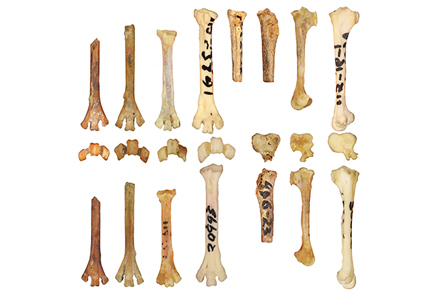
Nightjars (Aves: Caprimulgidae) are predominately nocturnal birds that are rare in the fossil record. Based on materials from the Upper Pleistocene and Holocene deposits of El Abrón Cave (Western Cuba), two species of nightjars have been identified: the likely extinct Siphonorhis daiquiri and the modern Chordeiles gundlachii. Materials on Siphonorhis daiquiri contribute notably to our knowledge of the very poorly studied clade of Siphonorhis poorwills, while the latter species is recorded at this locality for the first time. Representatives of the genus Siphonorhis are specialized for terrestrial locomotion; therefore, the presence of S. daiquiri in layers of different ages (Holocene layers II, III and Pleistocene layers IV, V, VII, and VIII) indicates the presence of open landscapes in the vicinity of the locality throughout various epochs of the taphocoenosis formation. In contrast, only remains of Ch. gundlachii have been found in Late Pleistocene layers VI and IX, which may be associated with changes in environmental conditions during these intervals. The presence of S. daiquiri in the Holocene levels of the cave corroborates the hypothesis that this species survived in Cuba into post-Pleistocene time.
References
- Arredondo, O. (1984) Sinopsis de las aves halladas en depositos fosiliferos pleisto-holocenicos de Cuba. Reporte de Investigación del Instituto de Zoología, 17, 1–35.
- Baumel, J.J., King, A.S., Breazile, J.E., Evans, H.E. & Vanden Berge, J.C. (1993) Handbook of Avian Anatomy: Nomina Anatomica Avium. 2nd Edition. Nuttall Ornithological Club, Cambridge, Massachusetts, 779 pp.
- Brigham, R.M., Ng, J., Poulin, R.G. & Grindal, S.D. (2020) Common Nighthawk (Chordeiles minor). Version 1.0. In: Poole, A.F. (Ed.), Birds of the World. Cornell Lab of Ornithology, Ithaca, New York. [online database] https://doi.org/10.2173/bow.coming.01
- Chen, A., White, N.D., Benson, R.B.J., Braun, M.J. & Field, D.J. (2020) Total-evidence framework reveals complex morphological evolution in nightbirds (Strisores). Diversity, 11 (9), 143. https://doi.org/10.3390/d11090143
- Cleere, N. (1999) Family Caprimulgidae (Nightjars). In: del Hoyo, J., Elliott, A. & Sargatal, J. (Eds.), Handbook of the birds of the world. Vol. 5. Barn owls to hummingbirds. Lynx Edicions, Barcelona, pp. 302–388.
- Cleere, N. & Sharpe, C.J. (2020) Least Pauraque (Siphonorhis brewsteri). Version 1.0. In: del Hoyo, J., Elliot, A., Sargatal, J., Christie, D.A. & de Juana, E. (Eds.), Birds of the World. Cornell Lab of Ornithology, Ithaca, New York. https://doi.org/10.2173/bow.leapau1.01
- Dreelin, A. (2020) Jamaican Pauraque (Siphonorhis americana). Version 1.0. In: Schulenberg, T.S. (Ed.), Birds of the World. Cornell Lab of Ornithology, Ithaca, New York. [online resource] https://doi.org/10.2173/bow.jampau.01
- del Hoyo, J. & Collar, N.J. (2014) HBW and BirdLife International illustrated checklist of the birds of the World. Vol. 1. Non-passerines. Lynx Edicions, Barcelona, 903 pp.
- Dickinson, E.C. & Remsen Jr, J.V. (2013) The Howard and Moore Complete Checklist of the Birds of the World, Vol. 1. Non-passerines. Aves Press, Eastbourne, 461 pp.
- Gala, M., Laroulandie, V. & Lenoble, A. (2023) Bird communities from the Guadeloupe islands over the last 30,000 yrs. Quaternaire, 34 (3), 161–203. https://doi.org/10.4000/quaternaire.18254
- Han, K.L., Robbins, M.B. & Braun, M.J. (2010) A multi-gene estimate of phylogeny in the nightjars and nighthawks (Caprimulgidae). Molecular Phylogenetics and Evolution, 55 (2), 443–453. https://doi.org/10.1016/j.ympev.2010.01.023
- Holdaway, R.N., Jones, M.D. & Beavan Athfield, N.R. (2002) Late Holocene extinction of the New Zealand owlet-nightjar Aegotheles novaezealandiae. Journal of the Royal Society of New Zealand, 32 (4), 653–667. https://doi.org/10.1080/03014223.2002.9517714
- Keith, A.R., Wiley, J.W., Latta, S.C. & Ottenwalder, J.A. (2003) Birds of Hispaniola. British Ornithologists’ Union Checklist No. 21. British Ornithologists' Union, Tring, Hertfordshire, 309 pp.
- Kuhl, H., Frankl-Vilches, C., Bakker, A., Mayr, G., Nikolaus, G., Boerno, S.T., Klages, S., Timmermann, B. & Gahr, M. (2021) An unbiased molecular approach using 3′-UTRs resolves the avian family-level tree of life. Molecular Biology and Evolution, 38, 108–127. https://doi.org/10.1093/molbev/msaa191
- Latta, S.C. & Howell, C.A. (2020) Common Pauraque (Nyctidromus albicollis). Version 1.0. In: Poole, A.F. (Ed.), Birds of the World. Cornell Lab of Ornithology, Ithaca, New York. [online database] https://doi.org/10.2173/bow.compau.01
- Manegold, A. (2010) First evidence for a nightjar (Caprimulgidae, Aves) in the early Pliocene of Langebaanweg, South Africa. Palaeobiodiversity and Palaeoenvironments, 90, 163–168. https://doi.org/10.1007/s12549-010-0023-3
- Mayr, G. (2016) Variations in the hypotarsus morphology of birds and their evolutionary significance. Acta Zoologica, 97, 196–210. https://doi.org/10.1111/azo.12117
- Mayr, G. (2017) Avian Evolution: the Fossil Record of Birds and its Paleobiological Significance. Wiley, Chichester, West Sussex, x + 302 pp. https://doi.org/10.1002/9781119020677
- Mlodinow, S.G., Pyle, P. & Guzy, M.J. (2024) Antillean Nighthawk (Chordeiles gundlachii). Version 2.0. In: Keeney, B.K. (Ed.), Birds of the World. Cornell Lab of Ornithology, Ithaca, New York. [online resource] https://doi.org/10.2173/bow.antnig.02
- Olson, S.L. (1985) A new species of Siphonorhis from Quaternary cave deposits in Cuba (Aves: Caprimulgidae). Proceedings of the Biological Society of Washington, 98, 526–532.
- Orihuela, J., Viñola, L.W., Jiménez Vázquez, O.J., Mychajliw, A.M., Hernández de Lara, O., Lorenzo, L. & Soto-Centeno, J.A. (2020) Assessing the role of humans in Greater Antillean land vertebrate extinctions: New insights from Cuba. Quaternary Science Reviews, 249, 106597. https://doi.org/10.1016/j.quascirev.2020.106597
- Rich, P.V. & Scarlett, R.J. (1977) Another look at Megaegotheles, a large owlet-nightjar from New Zealand. Emu - Austral Ornithology, 77 (1), 1–8. https://doi.org/10.1071/MU9770001
- Rojas Consuegra, R., Pajon Morejon, J.M., Aranda Pedroso, E., Barzaga Rodriguez, L.A., Freol Gonzalez, S. & Perez Lorenzo, E. (2022) Estratigrafia del Yacimiento Cuaternario de Microvertebrados Fosiles El Abron, en el Karst de Sierra La Guira, Provincia Pinar del Rio, Cuba. Geociencias UO, 5 (2), 102–113.
- Scarlett, R.J. (1968) An owlet-nightjar from New Zealand. Notornis, 15 (4), 254–266. https://doi.org/10.63172/071031bqkuqb
- Stiller, J., Feng, S., Chowdhury, A.-A., Rivas-González, I., Duchêne, D.A., Fang, Q., Deng, Y., Kozlov, A., Stamatakis, A., Claramunt, S., Nguyen, J.M.T., Ho, S.Y.W., Faircloth, B.C., Haag, J., Houde, P., Cracraft, J., Balaban, M., Mai, U., Chen, G., Gao, R., Zhou, C., Xie, Y., Huang, Z., Cao, Z., Yan, Z., Ogilvie, H.A., Nakhleh, L., Lindow, B., Morel, B., Fjeldså, J., Hosner, P.A., da Fonseca, R.R., Petersen, B., Tobias, J.A., Székely, T., Kennedy, J.D., Reeve, A.H., Liker, A., Stervander, M., Antunes, A., Tietze, D.T., Bertelsen, M.F., Lei, F., Rahbek, C., Graves, G.R., Schierup, M.H., Warnow, T., Braun, E.L., Gilbert, M.T.P., Jarvis, E.D., Mirarab, S. & Zhang, G. (2024) Complexity of avian evolution revealed by family-level genomes. Nature, 629 (8013), 851–860. https://doi.org/10.1038/s41586-024-07323-1
- Suárez, W. (2000) Fossil evidence for the occurrence of Cuban Poorwill Siphonorhis daiquiri in western Cuba. Cotinga, 14, 66–68.
- Suárez, W. (2004) The enigmatic snipe Capella sp. (Aves: Scolopacidae) in the fossil record of Cuba. Caribbean Journal of Science, 40, 155–157.
- Suárez, W. (2022) Catalogue of Cuban fossil and subfossil birds. Bulletin of the British Ornithologists’ Club, 142, 10–74. https://doi.org/10.25226/bboc.v142i1.2022.a3
- Suárez, W. & Díaz-Franco, S. (2003) A new fossil bat (Chiroptera: Phyllostomidae) from a Quaternary cave in Cuba. Caribbean Journal of Science, 39 (3), 371–377.
- Suárez, W. & Díaz-Franco, S. (2011) Estudio paleontologico del deposito fosilifero El Abron, Pinar del Rio (Sinopsis de las aves fosiles de Cueva El Abron, Pinar del Rio, Cuba). In: Suárez-Duque, W., Rojas-Consuegra, R., Silva-Taboada, G. & Menéndez-Peñate, L. (Eds.), Biodiversidad Paleontológica del Archipiélago Cubano: Bases Cartográficas y Conservacionistas. Informe final del Proyecto 022 AMA-CITMA; 074 MNHN. Museo National de Historia Natural de Cuba, Havana, pp. 1–13.
- Steadman, D.W. & Takano, O.M. (2013) A late-Holocene bird community from Hispaniola: refining the chronology of vertebrate extinction in the West Indies. The Holocene, 23 (7), 936–944. https://doi.org/10.1177/0959683613479683
- Sigurdsson, S. & Cracraft, J. (2014) Deciphering the diversity and history of New World nightjars (Aves: Caprimulgidae) using molecular phylogenetics. Zoological Journal of the Linnean Society, 170, 506–545. https://doi.org/10.1111/zoj.12109
- Syromyatnikova, E.V., Aranda, E. & González, S.F. (2021) First insight into the diversity of snakes in the Pleistocene of Cuba. Acta Palaeontologica Polonica, 66 (2), 395–407. https://doi.org/10.4202/app.00766.2020
- Vázquez, J.O., Condis, M.M. & García Cancio, E. (2005) Vertebrados post-glaciales en un residario fósil de Tyto alba Scopoli (Aves: Tytonidae) en el occidente de Cuba. Revista Mexicana de Mastozoologia, 9, 85–112. https://doi.org/10.22201/ie.20074484e.2005.9.1.168
- White, N.D., Barrowclough, G.F., Groth, J.G. & Braun, M.J. (2016) A multi-gene estimate of higher-level phylogenetic relationships among nightjars (Aves: Caprimulgidae). Ornithologia Neotropical, 27, 223–236. https://doi.org/10.58843/ornneo.v27i0.88
- Winkler, D.W., Billerman, S.M. & Lovette, I.J. (2024) Nightjars and Allies (Caprimulgidae). Version 2.0. In: Billerman, M., Keeney, B.K., Rodewald, P.G. & Schulenberg, T.S. (Eds.), Birds of the World. Cornell Lab of Ornithology, Ithaca, New York. [online database] https://doi.org/10.2173/bow.caprim2.02
- Worthy, T.H. & Holdaway, R.N. (2002) The lost world of Moa: prehistoric life of New Zealand. Indiana University Press, Bloomington, Indiana, 718 pp.
- Zelenkov, N.V. (2024) Cuban Macaw Ara tricolor in the Upper Pleistocene of Western Cuba. Doklady Biological Sciences, 516, 32–35. https://doi.org/10.1134/S0012496624700947
- Zelenkov, N.V. (2025) A new duck (Aves: Anatidae) from the Upper Pleistocene of Cuba. Zootaxa, 5633 (1), 139–150. https://doi.org/10.11646/zootaxa.5633.1.7
- Zelenkov, N.V. & Belichenko, E.S. (2022) Dynamics of the late Quaternary avifauna of Western Cuba (based on material from El Abrón cave). Doklady Biological Sciences, 503 (1), 54–57. https://doi.org/10.1134/S0012496622020053
- Zelenkov, N.V. & González, S.F. (2020) The first fossil tody (Aves: Todidae) from Cuba. Paleontological Journal, 54 (4), 414–419. https://doi.org/10.1134/S0031030120040164
- Zelenkov, N.V. & González, S.F. (2021) A new extinct species of Margarobyas (Strigiformes) and the evolutionary history of the endemic Cuban bare-legged owl (M. lawrencii). Journal of Vertebrate Paleontology, 41 (4), e1995869. https://doi.org/10.1080/02724634.2021.1995869
- Zelenkov, N.V., Lopatin, A.V., Pérez Lorenzo, E., Pajón Morejón, J.M. & Rojas-Consuegra, R. (2021) First results of the joint Russian-Cuban paleontological expedition. Russian Foundation for Basic Research Journal, 3 (111), 19–24. https://doi.org/10.22204/2410-4639-2021-111-03-19-24