
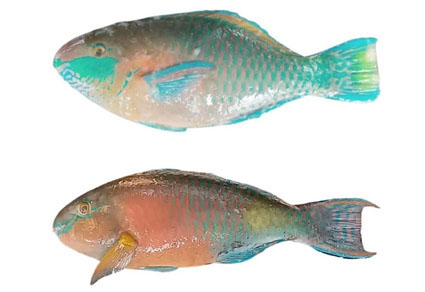

Abstract
Parrotfishes (Family Scaridae) are keystone herbivores in coral reef ecosystems, regulating algal growth and facilitating coral recruitment through bioerosive feeding. We report the first confirmed records of Scarus quoyi (Valenciennes, 1840) and Scarus zufar (Randall & Hoover, 1995) from the Gulf of Mannar, southeastern India. Specimens (24.0 cm and 24.9 cm TL, respectively) were collected in April 2025 from artisanal fish traps operating at 10–15 m depth near Therespuram. Morphometric and meristic analyses confirmed species identity based on diagnostic features, including the characteristic dark green cheek blotch in S. quoyi and the yellow caudal base patch with irregular vertical bands in S. zufar. These records represent significant eastward range extensions: S. quoyi from the western Pacific into the Bay of Bengal, and S. zufar from its type locality in Oman through the Arabian Sea to India’s southeastern coast. The occurrence of S. zufar in mixed rocky-coral substrates may explain its previous absence from coral-focused surveys. These findings underscore the importance of continued systematic surveys and morphological documentation in biodiversity hotspots, particularly for taxonomically challenging groups exhibiting ontogenetic color variation.
References
- Arai, T., Amalina, R. & Bachok, Z. (2015) Similarity in the feeding ecology of parrotfish (Scaridae) in coral reef habitats of the Malaysian South China Sea, as revealed by fatty acid signatures. Biochemical Systematics and Ecology, 58, 158–164. https://doi.org/10.1016/j.bse.2015.01.011
- Bellwood, D.R., Hughes, T.P., Folke, C. & Nyström, M. (2004) Confronting the coral reef crisis. Nature, 429, 827–833. https://doi.org/10.1038/nature02691
- Burke, L., Selig, L. & Spalding, M. (2002) Reefs at Risk in Southeast Asia. World Resources Institute, Washington, D.C., 72 pp.
- Choat, J.H., Clements, K.D. & Robbins, W.D. (2002) The trophic status of herbivorous fishes on coral reefs. I: dietary analyses. Marine Biology, 140, 613–623. https://doi.org/10.1007/s00227-001-0715-3
- Choat, J.H., Klanten, O.S., van Herwerden, L., Robertson, D.R. & Clements, K.D. (2012) Patterns and processes in the evolutionary history of parrotfishes (Family Scaridae). Biological Journal of the Linnean Society, 107 (3), 529–557. https://doi.org/10.1111/j.1095-8312.2012.01959.x
- Clements, K.D., German, D.P., Piché, J., Tribollet, A. & Choat, J.H. (2017) Integrating ecological roles and trophic diversification on coral reefs: multiple lines of evidence identify parrotfishes as microphages. Biological Journal of the Linnean Society, 120 (4), 729–751. https://doi.org/10.1111/bij.12914
- Hasan, M.E. & Parvej, M.R. (2020) Range extension of parrotfishes Scarus zufar and Chlorurus rhakoura (Teleostei: Scarinae) to Bay of Bengal, Bangladesh. Journal of the Ocean Science Foundation, 36, 84–90.
- Kuiter, R.H. & Tonozuka, T. (2001) Pictorial guide to Indonesian reef fishes. Part 2: Fusiliers – Dragonets, Caesionidae – Callionymidae. Zoonetics, Melbourne, Victoria, 319 pp. [pp. 304–622]
- Muallil, R.N., Geronimo, R.C., Cleland, D. & Alino, P.M. (2020) Coral reef fisheries in the Philippines: From common resource to local stewardship. Environmental Development, 33, 100491.
- Myers, R., Choat, J.H., Russell, B., Clements, K.D., Rocha, L.A., Lazuardi, M.E., Muljadi, A., Pardede, S. & Rahardjo, P. (2012) Scarus quoyi. IUCN Red List of Threatened Species, 2012, e.T190708A17797524.
- Patel, F., Jamalabad, A., Charloo, V. & Josh, J. (2024) Potential first record of parrotfish Scarus zufar (Randall & Hoover, 1995) from Indian waters, at Netrani Island, Karnataka. Journal of Threatened Taxa, 16 (4), 25101–25102. https://doi.org/10.11609/jott.8769.16.4.25101-25102
- Psomadakis, P.N., Osmany, H.B. & Moazzam, M. (2015) Field identification guide to the living marine resources of Pakistan. FAO Species Identification Guide for Fishery Purposes. FAO, Rome, 484 pp.
- Quan, Q., Liu, Y., Wang, T. & Li, C. (2022) Geographic variation in the species composition of parrotfish (Labridae: Scarini) in the South China Sea. Sustainability, 14 (18), 11524. https://doi.org/10.3390/su141811524
- Ramesh, R., Rajkumar, M. & Kumaraguru, A.K. (2020) A checklist of reef fishes from the Gulf of Mannar, southeastern India. Marine Biodiversity Records, 13 (1), 1–12.
- Randall, J.E. & Hoover, J.P. (1995) Scaridae. In: FAO Species Identification Guide for Fishery Purposes. The Living Marine Resources of Kuwait, Eastern Saudi Arabia, Bahrain, Qatar, and the United Arab Emirates. FAO, Rome, pp. 1212–1227.
- Sadovy de Mitcheson, Y. & Liu, M. (2008) Functional hermaphroditism in teleosts. Fish and Fisheries, 9 (1), 1–43. https://doi.org/10.1111/j.1467-2979.2007.00266.x
- Xiao, Y., Li, C., Wang, T., Lin, L., Guo, J., Quan, Q. & Liu, Y. (2022) DNA barcoding revealing the parrotfish (Perciformes: Scaridae) diversity of the coral reef ecosystem of the South China Sea. Sustainability, 14 (22), 15386. https://doi.org/10.3390/su142215386